This book reveals Marx's moral philosophy and analyzes its nature. The author shows that there is an underlying system of ethics which runs the length and breadth of Marx's thought. The book begins by discussing the methodological side of Marx's ethics showing how Marx's criticism of conventional morality and his views on historical materialism, determinism and ideology are compatible with having an ideological system of his own. In the light of contemporary social, moral and political philosophy the insights and defects of Marx's major ethical themes are discussed.
eBook - ePub
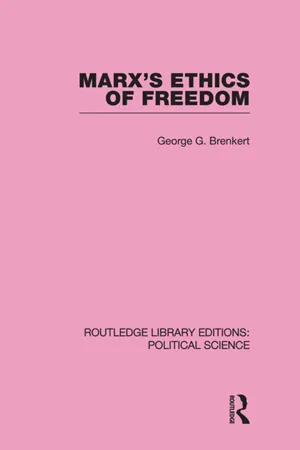
Marx's Ethics of Freedom (Routledge Library Editions: Political Science Volume 49)
- 284 pages
- English
- ePUB (mobile friendly)
- Available on iOS & Android
eBook - ePub
Marx's Ethics of Freedom (Routledge Library Editions: Political Science Volume 49)
About this book
Information
The ethical foundations
1
Marxism, moralism, and ethics
Our insipid, moralising Sancho believes … that it is merely a matter of a different morality, of what appears to have a new outlook on life, of ‘getting out of one’s head’ a few ‘fixed ideas’, to make everyone happy and able to enjoy life. (The German Ideology, MECW, 5:419)
I
The nature of Marx’s views on morality and ethics has long been a matter of considerable dispute. One widespread view is that Marx had no ethics, he rejected morality, and envisioned a communism beyond both.1 Marx is supposed to have founded a science which sought in an objective, morally neutral manner to understand the origin, growth, and collapse of capitalism as well as the ultimate succession of communism. One only has to read in the history of Marxism to appreciate how generally this view has been defended. Comments such as the following are wholly common:
Marxism is distinguished from all other socialist systems by its anti-ethical tendency. In all of Marxism from beginning to end, there is not a grain of ethics, and consequently no more of an ethical judgment than an ethical postulate.2
The obsolescence of ethical ideology is a corollary of historical materialism as applied to the superstructure of a socialist society. Ethical laws come into being as attempts to solve social antagonisms, not by removing their basic causes, but through moral coercion. An appeal to ethical doctrine is a confession that the given standpoint does not enable social antagonisms found to be resolved.3
Marx’s revolution in philosophy explicitly renounced the normative tradition of philosophical ethics while affirming the heritage of positive science.4
Accordingly, it can be said without exaggeration that it has seemed to many that it is misleading at best, wrongheaded at worst, to speak of Marx having an ethics. He simply does not fit into the categories into which we expect those having an ethics and reflecting on morality to fit.
There are, however, relatively straightforward problems with this view. For example, many of those who hold this view attribute a rather empiricist notion of science to Marx. But it is doubtful that Marx used such a notion of science. Indeed, Marx’s claims about science must be understood in light of Hegel’s claims about science. Marx’s views were significantly influenced by Hegel – and surely Hegelian science was not empiricist. Secondly, it is often noted that Marx was not, as one would expect a scientist to be, a neutral, dispassionate observer in his writings. This is as evident in his writings on political economy as it is in his newspaper articles. In Capital, for example, he condemns the egoism, exploitation, estrangement, degradation, etc. which capitalism brings in its train. Marx’s writings are pervaded by a normative and partisan atmosphere. His commitment to the particular kind of social order which he sees his work as advancing is always obvious and constantly present. Further, this commitment is not simply a personal commitment, but one which he clearly believes that others should share. Finally, if Marx were a scientist without an ethics, it is unclear how we are to understand his many comments that communism will constitute a ‘higher’ plane of existence for humanity, that there is a ‘progressive’ nature to history, and that communism will institute a ‘true realm’ of freedom.
Problems of these kinds have led some to modify the above view of Marx. They claim, instead, that Marx did have some kind of ethical or evaluative view but that this was simply added on to his scientific views. The two together explain the above kinds of problems. His science remains non-normative, neutral, objective and descriptive. It was his own personal commitments which explain his partisanship, his condemnation of various aspects of capitalist society, and his talk of communism as a ‘higher’ stage of society. Thus we may read amongst those who interpret Marx in this manner:
As theoretical abstractions employed for specific methodological reasons, the models of both the abstract labour process and the capitalist labour process are neutral. No moral recommendations are implied. On the one hand, we have the claim that if one examines all past societies, then certain general features of the labour process common to them all will be found; while on the other hand, we have the claim that if one examines the capitalist labour process, then certain specific features of that process will be found. However, moral implications can be drawn from a comparison between these models, if, like Marx, we are committed to a position which stresses the desirability and, in a kind of society not yet known in history the possibility of the free, purposive activity of human beings.5
Marx undertakes to predict on the basis of what he sees happening … and he proposes to make his prediction come true by arousing the minds of other men – the proletariat – to a sense of their future role. … We cross the inner threshold of the Marxian temple and pass from the strictly materialistic and evolutionary purlieus of history to the inner sanctum where the revelation of class consciousness and class struggle makes right belief essential, intense propaganda imperative, and ruthless political action a moral duty. … But in this [latter] part of his system Marx is really not thinking of his economic and material laws. He has become an ordinary political writer with a strong moral bias.6
There are, however, also difficulties with this interpretation. It does not modify the notion of science underlying the previous view. It simply adds an ethics to that science. The two remain wholly external to each other. This is not what we should expect, given Marx’s demands for a unity of theory and practice, or given his claim that he seeks to form a single, all-embracing science. Even more disturbingly, this interpretation suggests no basis for Marx’s advocacy of communism other than that (a) it was his own personal view – i.e. an arbitrary ultimate commitment – or that (b) he simply opted to defend morally that which he saw as inevitable – i.e. a kind of moral futurism or fatalism. Both suggestions leave much to be desired. The former contends that Marx’s ethics are ultimately personal and arbitrary, even though, throughout his life, Marx emphasized the social dimensions of life, and argued that communism would be founded upon a rational, non-arbitrary, basis. The latter leaves us wondering why, if it was bound to come, Marx worked for that moral future. Indeed, how could he – as he did – condemn some of those things which came to pass within his own lifetime?
I believe that both this and the preceding view of Marx are fundamentally mistaken. I shall argue instead that Marx has a moral theory and that this moral theory was integrally part of his ‘scientific’ views. This position (at least as so far minimally described) has had other defenders. Most notable are the accounts of Howard Selsam (Socialism and Ethics) and Eugene Kamenka (The Ethical Foundations of Marxism). Selsam’s account was written forty years ago. It was a broadly aimed, but not a terribly rigorous, attempt to formulate a Marxist ethics. Selsam lacked a number of crucial manuscripts of Marx (The Economic and Philosophic Manuscripts, and Grundrisse); he underestimated how radically different Marx’s views on ethics were; and indeed, he was not particularly concerned with explicating Marx’s ethics so much as using the writings of Marx and his followers down to Stalin to develop a new ethics. Kamenka’s work was written twenty years ago. But whereas Selsam did not have Marx’s early writings, Kamenka’s work oftentimes gives the impression of being overwhelmed by them. This is understandable in that ready access to those manuscripts occurred shortly before Kamenka began his book. Nevertheless, a more balanced account is needed. The purpose of the present book, however, is not to criticize such predecessors as Selsam and Kamenka, but to continue the work of explicating and evaluating Marx’s ethics. This is especially important in light of the considerable discussion of Marx’s ethics which has occurred in the last twenty years.7
II
At the outset it should be clear that I do not maintain that Marx formulated a moral theory in a manner comparable to the moral theories which past or present moral philosophers have formulated. Marx did not write a treatise, any pamphlets, or even any essays on ethics and morality. At the most we have various sections in larger works, paragraphs, and scattered comments on ethics and morality which are interwoven with his reflections on history, economics, and politics. Further, on those occasions on which he does speak of ethics he does not engage in moral reflection as traditional and contemporary moral philosophers have. He does not pose for himself the question, ‘What ought I to do?’ as a way of entering into moral reflection. He does not set out, as Kant and others have, to search for and establish the supreme principle of morality by argument and consideration of the reasons and views of others. Thus, he does not, in any obvious way, urge the universalization of the maxims of our actions (as Kant did) or the calculation of the greatest good our actions might promote (as J.S. Mill did). Such individual questions are quite secondary to Marx’s concern for the social system within which people raise such questions. Nor does Marx attempt to develop a theory of the meaning and purpose of moral statements as individuals make them. As such, Marx was not a moral philosopher. There are few, I think, who would deny this.
However, it does not follow that Marx did not have a moral theory. A person may be said to have a moral theory, even though he may never have explicitly formulated it. Whether one has a moral theory and whether one has formulated a moral theory are two different questions. The answer to the one question is not necessarily the answer to the other question. The latter question refers to a certain process that a person engages in, while the former question refers to a set of reasonably coherent and interrelated views which generally are but need not be the product of that process. For example, it has been maintained that to engage in the process of formulating a moral theory one must suspend one’s commitments; one must make certain conscious decisions or choices to act on the basis of moral principles; and one must have been able to have chosen otherwise.8 Whether or not these conditions for ethical inquiry are plausible, they are not plausible for determining whether or not one has an ethics or a moral theory. Suppose, for instance, I have been inclined to promote the pleasurable aspects of any situation and that I have not generally been inclined to do this simply for myself. I have tried to promote the pleasures of others as well. Still I have not myself given any thought to such matters, and do not always act or judge in the above manner. However, someone gives me Bentham’s work, I read it and am convinced.9 Now I did not suspend my judgment. I have always been inclined along Bentham’s lines. I do make, I suppose, a conscious decision to act in these ways in the future, but it is unclear whether I could have chosen to do otherwise. In this case, I think we might well say that though I did not at first have a moral theory, I now do have a moral theory which underlies my actions and desires. Thus, those features which characterize the formulation of a moral theory, the engaging in ethical inquiry, need not characterize the having of a moral theory or an ethics. Because these two different questions are confused, it is concluded that since the answer to the first question is negative, the answer to the second question must also be negative. But this does not follow.10
What is it then to have a moral theory? Surely it is not sufficient that one simply speak in favor of various notions which one might identify as moral notions. Politicians, farmers, and the common man speak, on occasion, in favor of various moral notions, but we are not immediately inclined to ascribe moral theories to them.11 As such they are, in one sense of the word, simply moralists.12 If they are to be said to have a moral theory, their ideas about ethics must possess a certain unity, even if their statements of these ideas be scattered. Their ideas cannot simply be unconnected references to various moral notions. Consider, for example, a person who (almost) always acts consistently on his moral choices (we must allow for weakness of the will and other human failings). He praises certain ends and various ways of acting. He defends his choices and views by giving certain reasons which are connected both with the choices and views he advocates and other systematic views he holds and expounds on. He attacks opposing views and tries to show their weaknesses in ways which are both consistent with and a consequence of his views. Certainly, such a person is more than the moralist. He may also be less than a moral philosopher in that he has never brought all these ideas together, he has never shown their interrelations and connections. Nevertheless, though he may not have formulated the moral theory implicit in his views it is not strange to say that he operates on the basis of an implicit moral theory. Accordingly, I suggest that to have a moral theory it is sufficient that one expresses an (essentially) consistent body of ethical judgments, that one be aware of some sort of systematic connection between these judgments, and that one derive them in a more or less conscious way from some common foundation. It is in this sense that Marx can be said to have a moral theory.13 The proof of this must wait upon the discussions in the remainder of this book.
My proof will take various forms. Firstly, it will consist in the formulation of that theory itself, together with supporting textual evidence. This part of my proof will have two parts. On the one hand, I will discuss the logical and methodological aspects of Marx’s ethics. That is, I will consider what might be called Marx’s meta-ethics. This I shall do in Chapters 2 and 3. On the other hand, the moral values and standards Marx defends and by which he criticizes capitalism must also be developed. This normative side of his ethics is developed in Chapters 4 to 6. If a consistent moral theory can be extracted from, and shown to be supported by, Marx’s writings, my thesis will be substantially proven. Secondly, I shall consider, while discussing Marx’s meta-ethics, a number of traditional objections to the view that Marx can have an ethics. By answering these objections my thesis will be further supported. Thirdly, if my thesis helps to integrate and explain other views of Marx, e.g. his views on punishment and violence, as well as indicating difficulties and problems which those who subscribe to Marx’s views encounter, then my thesis will be yet further confirmed. Finally, I would point out that Marx did, throughout his life, engage in discussions which have the appearance of ethical inquiry and discussion. For example, he discussed the relation of morality and moral principles to their historical and material settings; he analyzed and criticized egoism, utilitarianism, bourgeois rights and liberty, as well as other notions such as charity. In addition, he seems to defend values such as freedom, brotherhood, solidarity, and community. Now these various discussions may not constitute the formulation of an ethical theory. However, if he does have the moral theory which is developed below, then it would not be surprising to find such discussions in Marx and they would be an additional confirmation of the underlying moral theory that is here identified.
III
At the outset, we must begin by reflecting on the fact that not only did Marx not formulate a moral theory but he also seemed to have opposed any attempt to do so. For example, his works reveal precious little use, in any traditional manner, of moral language. Certain concepts central to modern moral philosophy are rarely, if ever, used.14 In addition, there is a significant body of textual evidence that Marx simply rejected ethics and morality and wanted to have nothing to do with them. Statements such as the following are exemplary of Marx’s apparently anti-moral and anti-ethical views:
It may be remarked in passing that German philosophy, because it took consciousness alone as its point of departure, was bound to end in moral philosophy, where the various heroes squabble about true morals. (MECW, 5:36)
In a party one must support everything which helps towards progress, and have no truck with any tedious moral scruples. (MECW, 6:56)
My standpoint, from which the evolution of the economic formation of society is viewed as a process of natural history, can less than any other make the individual responsible for relations whose creature he socially remains, however much he may subjectively raise himself above them. (Capital, 1:10)
I wrote An Address to the Working Class. … My proposals [in this Address] were all accepted by the subcommittee [of the Workingmen’s International Association]. Only I was obliged to insert two phrases about ‘duty’ and ‘right’ into the Preamble to the Statutes, ditto ‘truth, morality, and justice,’ but these are placed in such a way that they can do no harm.15
[I]t was, of course, only possible to discover … [the connection between the kinds of enjoyment open to individual...
Table of contents
- Cover
- Title
- Copyright
- Original Title
- Original Copyright
- Dedication
- Contents
- Preface
- Part one The ethical foundations
- Part two Marx’s ethics
- Part three An evaluation of Marx’s ethics
- Notes
- Bibliography
- Index
Trusted by 375,005 students
Access to over 1.5 million titles for a fair monthly price.
Study more efficiently using our study tools.
Frequently asked questions
Yes, you can cancel anytime from the Subscription tab in your account settings on the Perlego website. Your subscription will stay active until the end of your current billing period. Learn how to cancel your subscription
No, books cannot be downloaded as external files, such as PDFs, for use outside of Perlego. However, you can download books within the Perlego app for offline reading on mobile or tablet. Learn how to download books offline
Perlego offers two plans: Essential and Complete
- Essential is ideal for learners and professionals who enjoy exploring a wide range of subjects. Access the Essential Library with 800,000+ trusted titles and best-sellers across business, personal growth, and the humanities. Includes unlimited reading time and Standard Read Aloud voice.
- Complete: Perfect for advanced learners and researchers needing full, unrestricted access. Unlock 1.5M+ books across hundreds of subjects, including academic and specialized titles. The Complete Plan also includes advanced features like Premium Read Aloud and Research Assistant.
We are an online textbook subscription service, where you can get access to an entire online library for less than the price of a single book per month. With over 1.5 million books across 990+ topics, we’ve got you covered! Learn about our mission
Look out for the read-aloud symbol on your next book to see if you can listen to it. The read-aloud tool reads text aloud for you, highlighting the text as it is being read. You can pause it, speed it up and slow it down. Learn more about Read Aloud
Yes! You can use the Perlego app on both iOS and Android devices to read anytime, anywhere — even offline. Perfect for commutes or when you’re on the go.
Please note we cannot support devices running on iOS 13 and Android 7 or earlier. Learn more about using the app
Please note we cannot support devices running on iOS 13 and Android 7 or earlier. Learn more about using the app
Yes, you can access Marx's Ethics of Freedom (Routledge Library Editions: Political Science Volume 49) by George G Brenkert in PDF and/or ePUB format, as well as other popular books in Politics & International Relations & Politics. We have over 1.5 million books available in our catalogue for you to explore.