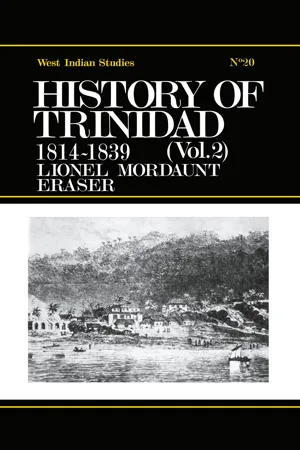
This work covers the period of rapid expansion after the British conquest in 1797 until the colony was faced with dislocations coinciding with the emancipation of the slaves.
- 408 pages
- English
- ePUB (mobile friendly)
- Available on iOS & Android
eBook - ePub
History of Trinidad from 1781-1839 and 1891-1896
About this book

Chapter I.

Towards the end of the 17th century, Matthew Woodford of New Sarum died, leaving a son, named Matthew after himself, who subsequently became Prebendary and Sub-Dean of Chichester Cathedral.
He married Ann, daughter of John Sherer, Esq., of Chichester, by whom he had a son who also bore the name of Matthew, and who married Mary, daughter of John Brideoke, Esq., by whom he had issue:
1. Ralph—First Baronet.
2. Matthew, D.D. and Prebendary of Chester.
3. John, a Colonel in the Army, who married Susan, daughter of Cosmo George, 3rd Duke of Gordon and widow of John Fane, 9th Earl of Westmoreland, by whom he had two sons, Alexander and John George.
Mr. Matthew Woodford had also three daughters, one of whom in January, 1760, married Peter Thellusson of Plaistow, Kent, and Broads worth, Yorkshire, and had issue:
Peter Isaac, the first Lord Rendlesham.
Ralph, the first Baronet, was at one time Resident Minister at the Hanse Towns, and subsequently Minister Extraordinary at the Court of Denmark, and for his services was created a Baronet in June, 1791.
He married Gertrude, daughter of — Reesen, Esq., by whom he had issue:
Ralph James, second Baronet, born in 1784, the future Governor of Trinidad.
Elizabeth, married in 1801 to John Hammet, Esq.
The first cousin of Sir Ralph, Sir Alexander Woodford, commanded a battalion of the Guards at Waterloo, took an active part in the defence of Hougoumont, and died at an advanced age a Field Marshal and Governor of Chelsea Hospital. He married Charlotte, daughter of Charles Henry Fraser, son of William Fraser who was Secretary of State for Foreign Affairs in Pitt’s Ministry in 1783.
Sir Ralph Woodford, the first baronet, was a man of letters and a wit, and had formed one of the brilliant circle of which the celebrated Mrs. Montague was the centre. On his mother’s side he was descended from a family noted for genius and loyalty, the Brideokes, one of whom, Dr. Brideoke, was Chaplain to James, 4th Earl of Derby, and distinguished himself at the historical siege of Latham House. He was afterwards made Dean of Salisbury.
When Sir Ralph James Woodford assumed the Government of Trinidad he was in his 29th year, and the mere fact of his having at such a comparatively early age been selected for so important a post is a proof of the high esteem in which he was held by the Ministry of the day. The experience gained from the disastrous results of the Commission Government, and the recent disputes between the Cabildo, the Governor, and the Chief Judge, determined the Home Government to define clearly the powers which were to be exercised by the new Governor, and these were expressed at great length in his Commission.
After declaring that, “so far as circumstances would permit” Spanish law should continue to be the law of the Colony, it was ordered, that all the powers of the Executive Government were to be vested solely in the Governor; that he should have the same powers and privileges as had been exercised by the Governors under the Crown of Spain; that the same Courts of Judicature, both civil and criminal, should continue as had existed prior to the capitulation; that the judicial powers conferred upon the Spanish Governors by virtue of their office should be enjoyed by their English successor with the same authority and jurisdiction, whether appellate or original, which had been exercised by the Court of Royal Audiencia in Caracas. Appeals in civil causes when the sum or value at issue exceeded £200 were to be made to him, and from his decision appeals were allowed to the Privy Council when the amount at issue exceeded £500,—or for any lesser amount where the matter in question related to the King’s prerogative, or to the taking or demanding any duty payable to him, or to any fee of office or annual rent, &c., &c.
There can be no doubt that these extensive powers were conferred upon Sir Ralph Woodford in order to enable him to put an end to the confusion originally created by Fullarton, and which recent events had considerably increased. The task imposed upon him was no easy one for the very first step involved the putting an end to abuses which had almost obtained a prescriptive right to exist, and this was certain to raise up a host of enemies against the reformer.
By far the most important part of his Commission was that which gave to Sir Ralph Woodford all the powers of a Court of Royal Audience, and to understand how much this implied it is necessary to explain the composition of that Court.
According to Spanish Law a Royal Audiencia was a College of Advocates composed and governed according to fixed rules. As an instance: the Audiencia of Caracas which was created in 1787, consisted of a Dean (Decano Regente), three Oidors (Judges), two Fiscals, an Escribano, or Registrar, a Relator, or Remembrancer, whose duty it was to keep the Court fully informed of everything connected with the causes before it, and an Escribano de Camera, or Judge’s Clerk.
In Trinidad the jurisdiction of this Court was now to be centred in one man, who, as Governor, Commander-in-Chief and Vice-Admiral already possessed very extensive powers. Under its original jurisdiction he had power to deal with all suits in which widows or infants were concerned (technically termed “Causas de Corte”). In all criminal cases he was the Judge of Appeal, and as President of the Royal Audiencia he had a criminal jurisdiction over all offences and crimes, from petty larceny to murder. In the same capacity he had power over the Judges of the inferior Courts who, save when holding direct appointments from the Crown, were removable from office at his option. In the latter case he could suspend them until the matter was referred to and decided by the Sovereign. He was also Intendant of the Royal Domain, and Judge in all matters connected with the Crown Lands, and, as such, dealt with escheats and other causes to which the Crown was a party. These already enormous powers were enlarged and increased by subsequent Orders in Council, and when at a later period Judge Johnson dedicated to Sir Ralph Woodford his translation of the Spanish Law, he did not at all exaggerate in stating that “He,” (the Governor) “had, in addition to his judicial functions, the direction of the whole financial, legislative, and executive machinery of the Colony.”
Doubtless, such a system of Government is opposed to the theories of the present day, but Trinidad certainly did not suffer from Sir Ralph Woodford’s administration; and it is a fact, as worthy of note as it is incontrovertible, that even in more recent times those periods during which the Colony has been blessed with Governors of ability and possessing energy enough to govern and to refuse to be governed, have been periods marked by progress and prosperity.
From the day of his arrival it was clear that Sir Ralph intended to hold the reins of Government in his own hands, to see with his own eyes, to hear with his own ears. He carried on a constant correspondence with the Heads of Departments, and that, not through a Secretary, but with his own hand, so that the whole machinery of the Government was under his immediate control.
The following letter which he addressed to the Surveyor-General a few days after his arrival will serve to show how speedily he had assumed the position he ever afterwards maintained:—
PORT-OF-SPAIN,
22nd June, 1813.
SIR,
As Surveyor-General of the Colony, I am to call your attention to your duty in that particular, and which requires your utmost exertions before the season advances too far. The Commandants of Quarters have received my orders to repair the roads in their respective districts, and whenever a defaulter is found it will be your duty to report him; at the same time you will supply the defect and charge him with the expense, and this in the most summary manner. You will render to me a report of the state of the roads on the 30th instant, and on the 15th of next month, and will prepare for my consideration and approval a draft of such regulations as you shall deem proper for the enforcement of a strict obedience to my orders.
RALPH WOODFORD.
E. Maingot, Esq.,
Surveyor-General.
On the 21st June, the Governor took his seat for the first time as Corregidor, or President of the Cabildo. In his opening address he declared that he would always support that Body in the exercise of its functions so long as there was no attempt to interfere with the Executive, or to “reproduce those regrettable discussions which had already done so much mischief.” There could be no misunderstanding either the allusion contained in these last words, or the warning they were intended to convey. It was quite clear that the new Governor would not tolerate any interference with him as Chief of the Executive, and that he intended to intimate in civil but unmistakable terms, that so far as it claimed any power of control over him as Governor the Illustrious Board was defunct.
A still greater surprise was in reserve for the public. On the 16th of August, the Governor and Council assembled for the transaction of business when Sir Ralph informed the Board that he had examined the accounts of the Committee appointed to control the expenditure of the £50,000 voted by Parliament after the fire of 1808. From those accounts it appeared that the Gaol, still uncompleted, had already cost close upon £30,000, and that £24,000 would be required for the completion of the Protestant Church. Under these circumstances the Governor said, that pending further instructions from the Home Government, he had stopped the further progress of these works.
After the Order of the Day had been disposed of, the Governor stated that he had received despatches from the Secretary of State with regard to the differences which had occurred between General Hislop and Judge Smith, the tenour of which he had been instructed to communicate to the Board. From these despatches it appeared that the whole question had been in the first instance referred to the Privy Council. As, however, General Hislop had brought no charges against the Judge, and the latter had declared that he had no desire to make a formal complaint against either the Governor, the Council, or the Cabildo, provided he were at once re-instated in the full enjoyment and exercise of all the powers of his threefold Commission, the Lords of the Council had stated that, “they felt themselves relieved of any other consideration than that of the prayer thus made by him.” On a careful revision of all the circumstances connected with the case, their Lordships came to the conclusion that Mr. Smith had shewn, “a great want of the temper, discretion and tact, so peculiarly required in the position he held, and therefore they could not recommend to His Royal Highness the Prince Regent that he should be re-instated.”
In order to fully appreciate this episode it is necessary to remember that the Council now addressed by Sir Ralph was composed of the same men who two years previously had supported the action of the Cabildo in suspending Judge Smith, and that some of its members had held seats at the Board since the day it was first summoned by Picton in 1801. The senior member, Nihell, had filled offices of trust under the Spanish Crown and after the capture of the Island had been appointed Chief Judge, an office which he had retained until 1809, when removed to make way for Mr. Smith. Next in seniority came Bégorrat, the personal friend of Picton, who had upheld the privileges of the Cabildo against the attacks of Fullarton and his party, and Black, who had so boldly resisted the First Commissioner in the case of the Escribano De Castro. The other members of the Board were men of standing in the Colony who had played no inconsiderable part in its history, and who, in common with the older members, looked upon themselves as identified with the Executive machinery of its Government. These men naturally heard with unmixed satisfaction that Mr. Smith was not to return to his post, and they had already begun to congratulate each other upon their success when the Governor called upon them to listen to another despatch from the Secretary of State, thus worded:—
“The view taken by the Privy Council has been adopted by the Prince Regent, who, however, on a review of all that has occurred, has come to the conclusion that the same want of temper, tact and discretion, which has been shewn by Judge Smith has been equally apparent in the Members of His Majesty’s Council whom he therefore directs shall be removed irom their seats, His Majesty having no further need of their services.”
The official minutes of the Council only furnish a dry recital of what took place on this occasion, but it is easy to imagine the scene which followed this most unexpected denôuement. The unseated members left the Council Room with mingled feelings of surprise and indignation, and being men of position and influence found no lack of sympathy in the hour of their humiliation.
At first sight the course taken by the Prince Regent may appear harsh, but on the other hand it must be remembered that the Members of the Council had pursued a line of conduct towards the late Chief Judge which could not but give umbrage to the Government by which Mr. Smith had been appointed. It was asserted at the time, and has been very generally believed, that it was Sir Ralph Woodford who first suggested the dissolution of the old Council in order to replace the outgoing members by men more likely to prove subservient to him. Of this there is no evidence, but it is likely enough that he was not sorry to be relieved of advisers who on more than one occasion had shewn that they could be very firm in opposition, and to most of whom it was more than probable his almost absolute powers would be highly distasteful.*
The Government was carried on for several months without the assistance of a Council, but towards the end of the year the following gentlemen were appointed in the place of the members who had been removed:—Lawrence Nihell, Esq.; Don Manuel Sorzano; General Count Loppinot; Wm. Hardin Burnley, Esq.
At this Board the principal elements of which the Colony consisted were fairly represented. Don Manuel Sorzano was a Spaniard, Nihell an Irish settler under the Cédula of 1783. General Loppinot was a French Royalist, and Burnley an English-American, and it would have been well for the Colony if Sir Ralph Woodford’s successors had always been as impartial in the selection of their advisers.
During the interval which had elapsed between the dissolution of the old Council and the formation of a new Board, the Governor had not not been idle, and among other matters had paid particular attention to the complaints of the mercantile members of the community, to whom annoyance as well as pecuniary loss was caused by the disordered state of affairs on the Mainland. In order as much as possible to remedy this...
Table of contents
- Cover
- Half Title
- Title Page
- Copyright
- Contents
- Chapter I
- Chapter II
- Chapter III
- Chapter IV
- Chapter V
- Chapter VI
- Chapter VII
- Chapter VIII
- Chapter IX
- Chapter X
- Chapter XI
- Chapter XII
- Chapter XIII
- Chapter XIV
- Chapter XV
- Chapter XVI
- Chapter XVII
- Chapter XVIII
- Chapter XIX
- Chapter XX
- Chapter XXI
- Chapter XXII
Trusted by 375,005 students
Access to over 1.5 million titles for a fair monthly price.
Study more efficiently using our study tools.
Frequently asked questions
Yes, you can cancel anytime from the Subscription tab in your account settings on the Perlego website. Your subscription will stay active until the end of your current billing period. Learn how to cancel your subscription
No, books cannot be downloaded as external files, such as PDFs, for use outside of Perlego. However, you can download books within the Perlego app for offline reading on mobile or tablet. Learn how to download books offline
Perlego offers two plans: Essential and Complete
- Essential is ideal for learners and professionals who enjoy exploring a wide range of subjects. Access the Essential Library with 800,000+ trusted titles and best-sellers across business, personal growth, and the humanities. Includes unlimited reading time and Standard Read Aloud voice.
- Complete: Perfect for advanced learners and researchers needing full, unrestricted access. Unlock 1.5M+ books across hundreds of subjects, including academic and specialized titles. The Complete Plan also includes advanced features like Premium Read Aloud and Research Assistant.
We are an online textbook subscription service, where you can get access to an entire online library for less than the price of a single book per month. With over 1.5 million books across 990+ topics, we’ve got you covered! Learn about our mission
Look out for the read-aloud symbol on your next book to see if you can listen to it. The read-aloud tool reads text aloud for you, highlighting the text as it is being read. You can pause it, speed it up and slow it down. Learn more about Read Aloud
Yes! You can use the Perlego app on both iOS and Android devices to read anytime, anywhere — even offline. Perfect for commutes or when you’re on the go.
Please note we cannot support devices running on iOS 13 and Android 7 or earlier. Learn more about using the app
Please note we cannot support devices running on iOS 13 and Android 7 or earlier. Learn more about using the app
Yes, you can access History of Trinidad from 1781-1839 and 1891-1896 by Lionel Mordant Fraser in PDF and/or ePUB format, as well as other popular books in History & World History. We have over 1.5 million books available in our catalogue for you to explore.