- 254 pages
- English
- ePUB (mobile friendly)
- Available on iOS & Android
eBook - ePub
About this book
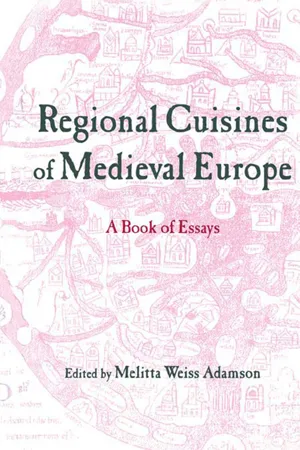
Expert food historians provide detailed histories of the creation and development of particular delicacies in six regions of medieval Europe-Britain, France, Italy, Sicily, Spain, and the Low Countries.
1
The Greco-Roman World
If the Roman writers Caesar and Tacitus are to be believed, the Germanic tribes that were one day to overrun the Roman Empire, were carnivo-rous to the bone, living mainly on meat and dairy products.1 This is in stark contrast to the Mediterranean world whose staples were primarily vegetarian: wheat, grapes, and olives. Untamed nature and the pig play a central role in Germanic and Celtic mythology, whereas in Greco-Roman culture “the ideal productive space consisted of rural areas carefully organized around cities,” as Massimo Montanari recently observed.2 With our knowledge of “barbarian” food habits still anecdotal at best, we shall turn our attention to the cookery of the Greco-Roman World whose recorded history goes back as far as 650 B.C.
While Roman cookery as evidenced in the fourth-century recipe collection De re coquinaria attributed to Apicius, a gourmet of the first century A.D., has been the subject of a number of studies by classicists, food historians, and hobby cooks over the centuries, comparatively little has until recently been known of food production and consumption in Greece in the classical and post-classical period. This changed in the last two decades with a number of important books by Peter Garnsey, Thomas W. Gallant, Monika Lavrencic, John Wilkins and others, Veronika E. Grimm, and James N. Davidson, just to name a few;3 and in 1996 culminated in Andrew Dalby's comprehensive study Siren Feasts: A History of Food and Gastronomy in Greece, in which the author uses archeological, paleobotanical, and iconographic information as well as references to food in Greek literature to write the first extensive culinary history of the Aegean.4 Among the major written sources that contain information on food and cookery in ancient Greece are Athenaeus's The Deipnosophists, Archestratos of Gela's Hedupatheia, and Galen's medical treatise, On the Properties of Foods.5
Judging from the foods mentioned in Homer's Iliad and Odyssey, meals in the eighth century B.C. were still fairly simple, consisting of bread with relish, spit-roasted meat, and red wine, complemented with fish, cheese, honey, and fruit such as apples, pears, figs, and pomegranates.6 In contrast to this rather limited menu, Dalby's list of the foods enjoyed by the Athenians in the four hundred years between 650 and 250 B.C. is much more extensive and includes everything from domestic and wild animals to seafood, fruits, nuts, and vegetables, as well as fermented foods such as fish sauce and wine. It may be that meat was not nearly as central to the Mediterranean diet as it was to that of the barbarians further north, but the selection of meats available to Athenian cooks was nevertheless impressive. According to Dalby, the emphasis in Greece was on domesticated animals, in particular sheep, pigs, and goats.7 A recipe for lamb and kid, which were both regarded as delicacies, runs as follows:
But when you prepare fresh-killed kid or lamb or even chicken as food, put some fresh wheat grains, crushed, in a deep pan, and stir up together with fragrant oil. When the stew is boiling, pour it over [the crushed meat] and cover it with the lid, for when so treated the heavy meal swells up. Serve, just warm, with bread-spoons.8
Pork, fresh or salted, was the most popular meat in Athens, beef, by contrast, was quite rare.9 Other domestic animals that were sometimes eaten but whose meat was not held in high esteem, were dogs, domestic asses, and horses. In classical Greece, as in medieval Europe, nearly all parts of animals were eaten, including the “vital parts”—heart, liver, and kidneys, as well as marrow, tongue, and other kinds of offal. In fact, sow's womb was regarded as a delicacy.
The main wild animal was the hare, which was roasted on a spit and at times accompanied with highly flavored sauces. Offal and blood were turned into stews. Wild boar, goat, ass, fox, red deer, roe deer, bear, and lion are also mentioned and so are cicadas and snails, the latter believed to be an aphrodisiac. The list of little birds sold at the Athens bird market as pets and for food included thrushes, blackbirds, and chaffinches. Sprinkled with cheese, oil, and silphium and then roasted and served in sauce, these birds formed a tasty dish. Other popular birds were lark, starling, jay, jackdaw, sparrow, siskin, blackcap, great tit, greenfinch, and the larger varieties quail, moorhen, goose, capon, pigeon, pheasant, mallard, grebe, plover, coot, wagtail, rock partridge, and francolin. Quails were raised for their meat and their eggs, and geese were already force-fed for the desired foie gras. The domestic hen, whose meat and eggs were staples in the Middle Ages, was a relatively recent introduction to Greece. Domesticated in India, it may have reached the Aegean via Persia, since the bird is called “the Persian awakener,” or the “Persian bird” in the early sources.
The main sweetener and confectionery base of the Greeks was honey, but dried dates, dried figs, and concentrated must were also used.10 Milk and butter, two of the basic foodstuffs in large parts of medieval Europe, play a minor role in Greek sources. Cheese made from sheep's and goat's milk was eaten with bread, or with honey, figs, olives, and green vegetables.
Not surprisingly, seafood was of central importance in the Aegean.11 Aside from shellfish, tuna, pike, and carp, which had already been consumed in the area in prehistoric times, the list of fish caught and traded in classical Greece also included anglerfish, grey mullet, sturgeon, swordfish, dolphinfish, mackerel, bream, gilthead, and wrasse. Tuna, fresh or salted, was the main commercial fish, harvested and eaten from Spain to the Golden Horn. Great eels and morays were gourmet food for the Greeks and Romans and continued to play a role in medieval European cookery. Also prepared in the Greek kitchen were such small fish as red mullet, goby, picarel, anchovy, shad, sandsmelt, pilchard, sardine, and sprat. Cuttlefish, octopus, and squid were eaten, and so were oysters, lobsters, langoustines, cigales, prawns, seasquirts, and sea urchins.
If there is one ingredient that defines Greco-Roman cookery, it is the sauce made from fermented fish, known in Greek under the name gáros, and in Latin under the names garum or liquamen. This salty sauce, similar to the oriental sauce ñuoc mam still used today in southeast Asia, was according to Dalby first produced by the Greeks of the Black Sea, from where it spread throughout Greece, Rome, and Byzantium. Various types of fish or pieces of fish mixed with large quantities of salt—at times also with herbs—were left to ferment in the sun for several weeks. The resulting sauce was used as a seasoning instead of salt in a growing number of recipes and, in Imperial Rome, had almost completely replaced salt (see below).
Fruits and nuts were eaten at the beginning or end of a Greek meal, and as snacks together with wine.12 They were consumed by travelers, workers in the field, and the poor. Acidic fruits such as apples, quinces, plums, sloes, sour cherries, olives, watermelons, musk melons, and cucumbers were served as appetizers, and sweet fruits such as figs, often in dried form, pears, pomegranates, grapes, raisins, and a variety of berries as dessert. The most popular nut in classical Greece—as in medieval Europe—was the almond, followed by the walnut, sweet chestnut, hazelnut, filbert, lentisk, terebinth, and pine nut. An important imported fruit was the date, which was eaten dried for dessert or was turned into date wine and vinegar.
The vegetables served as appetizers, side dishes and potherbs, according to Dalby, were dill, celery, cress, asparagus, beet, blite, cabbage, rape, capers, cardoon (an ancestor of the modern artichoke), carrot, chicory, endive, fennel, grape hyacinth, leek, lettuce, mallow, mint, mushrooms and truffles, mustard greens, nettle, onion, chives, orach, purslane, radish, rocket, samphire, sorrel and dock, turnip, and water parsnip. In addition to the already mentioned almonds, sesame seeds, raisins, fennel, dill, capers, onion, leek, honey, must, vinegar, olive oil, salt, egg, and cheese, Greek cooks flavored dishes with herbs and spices such as wormweed, anise, basil, coriander, coriander seed, cumin, flax seed, garlic, hyssop, mustard, oregano, pennyroyal, poppy, rue, Roman hyssop, safflower, Greek sage, salep, and thyme. Then as now, sesame and poppy seed were used as garnishes for bread. The sesame-cheese that occurs in one source as a filling of cake may have been similar to tahini or halva found in Arab cuisine. The two luxury flavorings not produced locally in the Aegean were sumach imported from Syria and silphium imported from Cyrene in Libya. Silphium, used to flavor birds and fish as well as marinades and sauces, became such a popular aromatic in Greece and later Rome—where it was called laserpiciurn or laser—that by the time of Nero the plant was extinct. Cooks then turned to asafoetida as a substitute, which is still found in some Middle Eastern dishes.
Wine, usually mixed with water, was the drink of choice in classical Greece, but grapes were also the basis for flavorings such as grape juice, must, and wine vinegar.13 Olives were as important to the Greek diet as grapes. Olive oil was the main source of fat for cooking in the Aegean, comparable to butter and lard in medieval Germany; olives were also eaten as snacks.
The pulses popular in classical times were primarily broad beans, lentils, and chickpeas, which were the basis for soups eaten by the workers. The cereals that figured prominently in the Greek diet were barley and emmer.14 Cultivated as well were einkorn, club wheat, and durum wheat. As cakes soaked in honey, they were often served together with fruits, nuts, and wine for dessert. Milk cakes and frumenty were delicacies, wheat loaves and barley mashes the more traditional ways of eating cereal. Most of the white and brown bread was unleavened, baked in the oven, in crocks, or under ashes, or made into drop-scones and pancakes. Porridges of barley and emmer were popular, and so was ptisáne or barley gruel, regarded as health food by Greek physicians like Galen.
During the classical period important impulses in Greek cookery came from Lydia and Sicily.15 Myttotós was a Lydian sauce eaten with tuna. Popular in fifth-century Athens, it was made from garlic, leeks, cheese, honey, olive oil, and later also eggs. Another recipe possibly of Lydian origin was called kándaulos in Greek. Its ingredients were fried or boiled meat, grated bread, Phrygian cheese, dill, and rich broth. Sicily was famous for its pork and cheese, its culinary excesses and its cooks. In fact, the earliest Greek cookbook was on Sicilian cookery, written by a certain Mithaecus. Of the collection, only one recipe has survived, which describes the preparation of fillets of fish with cheese and oil.
From Philoxenus of Leucas's work entitled Dinner we learn details about Greek banquets, such as the types of courses served:
fish predominated at the beginning, meat in the middle. Barley cakes as well as wheat accompanied the main course. Wine was served, without any accompanying food, after the main course and before the dessert, which consisted (besides eggs, almonds and walnuts) of sweet confections in which safflower, honey and sesame had a prominent role.16
However, th...
Table of contents
- Cover
- Half Title
- Routledge Medieval Casebooks
- Title Page
- Copyright Page
- Table of Contents
- Acknowledgments
- Introduction
- Chapter 1 The Greco-Roman World
- Chapter 2 Medieval Britain
- Chapter 3 Medieval France
- Chapter 4 Medieval and Renaissance Italy
- Chapter 5 Medieval Spain
- Chapter 6 Medieval Germany
- Chapter 7 The Low Countries in the Fifteenth and Sixteenth Centuries
- Bibliography
- Contributors
- Index
Trusted by 375,005 students
Access to over 1.5 million titles for a fair monthly price.
Study more efficiently using our study tools.
Frequently asked questions
Yes, you can cancel anytime from the Subscription tab in your account settings on the Perlego website. Your subscription will stay active until the end of your current billing period. Learn how to cancel your subscription
No, books cannot be downloaded as external files, such as PDFs, for use outside of Perlego. However, you can download books within the Perlego app for offline reading on mobile or tablet. Learn how to download books offline
Perlego offers two plans: Essential and Complete
- Essential is ideal for learners and professionals who enjoy exploring a wide range of subjects. Access the Essential Library with 800,000+ trusted titles and best-sellers across business, personal growth, and the humanities. Includes unlimited reading time and Standard Read Aloud voice.
- Complete: Perfect for advanced learners and researchers needing full, unrestricted access. Unlock 1.5M+ books across hundreds of subjects, including academic and specialized titles. The Complete Plan also includes advanced features like Premium Read Aloud and Research Assistant.
We are an online textbook subscription service, where you can get access to an entire online library for less than the price of a single book per month. With over 1.5 million books across 990+ topics, we’ve got you covered! Learn about our mission
Look out for the read-aloud symbol on your next book to see if you can listen to it. The read-aloud tool reads text aloud for you, highlighting the text as it is being read. You can pause it, speed it up and slow it down. Learn more about Read Aloud
Yes! You can use the Perlego app on both iOS and Android devices to read anytime, anywhere — even offline. Perfect for commutes or when you’re on the go.
Please note we cannot support devices running on iOS 13 and Android 7 or earlier. Learn more about using the app
Please note we cannot support devices running on iOS 13 and Android 7 or earlier. Learn more about using the app
Yes, you can access Regional Cuisines of Medieval Europe by Melitta Weiss Adamson in PDF and/or ePUB format, as well as other popular books in History & World History. We have over 1.5 million books available in our catalogue for you to explore.