eBook - ePub
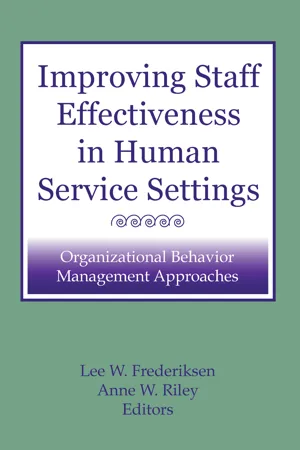
Improving Staff Effectiveness in Human Service Settings
Organizational Behavior Management Approaches
- 212 pages
- English
- ePUB (mobile friendly)
- Available on iOS & Android
eBook - ePub
Improving Staff Effectiveness in Human Service Settings
Organizational Behavior Management Approaches
About this book
An insightful volume that demonstrates how human service managers and administrators can innovatively and successfully make their agencies more effective using the principles of organizational behavior management. Improving Staff Effectiveness in Human Service Settings demonstrates the potential of OBM for identifying, tracking, targeting, and evaluating problems. Researchers, academicians, and practitioners examine interventions with OBM that took place in actual human service settings in response to severe organizational and staff problems. This important volume is an excellent resource brimming with well-evaluated, cost-effective staff management strategies..
APPLICATIONS
Description and Evaluation of an Approach to Implementing Programs in Organizational Settings
Charles A. Maher
ABSTRACT . A broad-based approach to implementing programs is described and evaluation information is reported from two investigations of its use by program managers in educational organizations. The approach consists of a framework of program implementation factors from which implementation procedures are derived. The procedures then are used by a manager to help facilitate implementation of a program according to plan. In the first investigation, three program managers were trained in the approach to assist them in implementing a behavioral group counseling program in three public high schools. In the second investigation, a program manager was trained to help implement a case management system in an elementary school. Results of both investigations suggest that managers were able to utilize the program implementation procedures, with their respective programs being more completely implemented when the procedures were applied. Reactions about the approach obtained from human service program managers, following both investigations, suggest that it may be a worthwhile managerial strategy. Advantages and limitations of the approach are considered and its relationship to organizational behavior management is discussed.
Implementing programs in organizational settings is a complex and challenging task for most managers (Prue & Frederiksen, 1982). Increased recognition exists among program managers that they must become more adept at assuring that programs for which they have responsibility are implemented as designed (Hauser, 1982; Leithwood & Montgomery, 1980). Managerial concern about implementation is apparent with respect to a range of programs in diverse organizational settings, including academic and vocational programs in public schools and colleges, counseling and psychotherapy in community mental health centers, training efforts in business, and administrative procedures such as client case management systems in rehabilitation facilities.
Implementing programs in organizational settings has become a priority area of managerial concern for several reasons. First, there is growing awareness that implementation is not a straightforward, linear task, attended to by a manager only when a program begins. Increasingly, managers have begun to appreciate that, in order to increase the likelihood that a program will occur as planned, attention to implementation is necessary at the time of program design (Gibson, Ivancevich, & Donnelly, 1979). A second reason for concern about implementation reflects the need for managers to document delivery of their programs as a means of being accountable to executive boards for use of program funds (Wholey, 1980). A third reason has to do with recent guidelines for program planning and evaluation which suggests that, in order to develop and improve public programs, attention needs to focus on facilitating and evaluating program implementation (Cronbach, 1982; Joint Committee, 1981).
Recent theory, research, and opinion in areas of organizational change and management also support the need for an increased focus on program implementation as well as the development of program implementation strategies. Contemporary thought in these areas further suggests that a broad-based view—an organizational systems perspective—can be a useful one for managers to take in implementing programs. From such a vantage point, a range of factors and forces operating on and within an organization must be identified and taken into account when attempting program implementation. For example, Weiss and Bucuvalas (1977), based upon investigations in social service organizations, have concluded that staff awareness of and commitment toward program purpose and goals are important determinants of program operation. Berman and McLaughlin (1978) and Glasser and Backer (1980), drawing upon data obtained from implementation of educational and mental health programs, assert that staff involvement in the implementation process is critical to a program's remaining in operation after implementation. Davis and Salasin (1975) and literature synthesized by the Human Interaction Research Institute (1976) have emphasized the importance of gathering information about the readiness of an organization to implement a new program as a basis for deciding how to proceed with implementation efforts. Miller (1978) and Maher (1981) have demonstrated how systematic reinforcement of staff for performing assigned program roles and functions can enhance efficiency of program functioning. Janis and Mann (1977) and Katz and Kahn (1978) have discussed the need for explicit program policies and procedures to assure that staff can successfully implement a program. Prue and Frederiksen (1982) and Bonoma (1977) have considered the issue of resistance to program change and have highlighted the need for managers to systematically incorporate a range of implementation strategies to overcome staff resistance to new approaches. Fullan and Pomfret (1977), in an extensive review of implementation of curricular and instructional programs in public schools, concluded that strategies for program implementation must intergrate a range of organizational domains, and that managers must be trained in systematic approaches to implementation. Cronbach (1982), Kratochwill and Bergan (1978), Leithwood and Montgomery (1980), Patton (1978), Hauser (1982), and Maher and Bennett (in press) have illustrated the importance of evaluating program implementation as a basis for improving program operation.
To date, theory, research, and opinion about program implementation in organizational settings has been valuable in several ways: (1) awareness of the need to take a broad-based view of the task has been increased, (2) factors that influence implementation have been identified, (3) guidelines for implementing programs have been defined. However, descriptions of practical approaches for implementing programs in organizational settings have been virtually non-existent, and data supporting potentially effective approaches have not been reported. A practical approach to program implementation is one that provides a framework and set of procedures for effectively guiding managers to implement the program as designed.
In this paper, a particular approach to program implementation is described and results of an evaluation of its use by program managers in various educational organizations are reported. The approach was derived from the theory, research, and opinion discussed above as well as from the author's fifteen years of employment as an administrator in school and university settings and his experience as a managerial consultant to public agencies. The approach can be considered to be a broad-based, organizational behavior management strategy, one that has been applied by the author and colleagues with numerous kinds of programs. In the first part of the paper, the factors that provide a framework for the approach and the program implementation procedures derived from these factors are described. Evaluation results then are reported of two formative investigations in which this approach was used by managers to facilitate implementation of two kinds of programs: (a) a group counseling program for conduct problem adolescents in public high schools; and (b) a system for managing individualized educational programs (IEPs) of handicapped students in an elementary school. Results of reactions of human service managers to the approach also are reported, and advantages and limitations of the strategy are discussed.
DESCRIPTION OF THE APPROACH
In this section, factors that provide a framework for the approach are delineated. Then, a description of the program implementation procedures derived from the factors is provided.
Program Implementation Factors
The framework reflects seven factors that are seen as being important for a manager to consider when attempting to facilitate program implementation. These seven factors can be remembered by the acronym, DURABLE: Discussing, Understanding, Reinforcing, Acquiring, Building, Learning, and Evaluating. These factors reveal a range of planning and evaluation activities that suggest how a manager may proceed with implementation. Consideration of the seven factors highlights the importance of active staff involvement in program implementation. Such involvement is seen as helping to create a sense of staff ownership of the program being implemented.
Discussing. This factor focuses on the time prior to program implementation. It suggests that a manager meet with relevant individuals or groups to discuss important aspects of the program. At those meetings, information discussed with staff includes: (a) purpose, goals, and objectives of the program to be implemented; (b) nature and scope of the activities that are to be employed by staff; (c) implementation timelines, dates, and responsibilities; and (d) procedures for staff supervision. At the meetings, the manager encourages staff to identify aspects of the program that are not clear to them and to discuss issues of concern (e.g., contractual issues, work load).
Understanding. This factor also involves the time period prior to implementation. It reflects managerial activities designed to clarify the extent to which the organization is ready to implement the program. Information about organizational readiness can be helpful in design and in suggesting areas where additional staff discussion, program development, etc., may be indicated. The AVICTORY strategy (Davis & Salasin, 1975) is a way of obtaining readiness information. Using this strategy, information can be obtained by a manager on 8 dimensions: Ability, Values, Idea, Circumstances, Timing, Obligation, Resistance, Field. Information about these dimensions can be gathered by means of structured interviews or questionnaires conducted with staff and other audiences, such as executive board members, affected by implementation (Maher & Bennett, in press). Examples of questions that can be used by a manager in gathering organizational readiness information about a program to be implemented are:
Ability
- Do staff possess skills and knowledge prerequisite to successful program implementation?
- Are necessary resources (e.g., budget, facilities) available to implement the program?
Values
- Is the program consonant with the prevailing philosophy and goals of the organization?
- Is the program consonant with the professional values of staff and others (e.g., board members)?
Idea
- Is it clear to staff and others as to the nature and scope of the program?
- Is the idea behind the program “tryable” and of potential usefulness?
Circumstances
- Does the present leadership and administrative situation in the organization appear to be conducive to implementation of the program?
Timing
- Is this the appropriate time to implement the program or expand it to other sites?
Obligation
- Is the need for the program apparent to staff, administrators, and community?
Resistance
- To what extent will individuals or groups resist implementation?
Yield
- Are the expected positive consequences of the program apparent to staff?
Information gathered in response to these kind of questions allows judgments to be made about how to further develop a program (e.g., additional staff training, further discussion with key people), as well as when to implement it (e.g., delay implementation to next calendar year).
Reinforcing. This factor reflects efforts of a manager to reinforce staff for carrying out their program implementation roles and responsibilities. Toward this end, a range of reinforcers may be used by the manager, particularly those involving (a) on-site verbal praise of staff; (b) written memos or notes to staff or supervisors expressing appreciation of and recognition for engaging in prescribed activities; (c) public posting of relevant implementation data (e.g., percent of sessions held, participant attendance rates); and (d) social reinforcement and encouragement for active participation of staff in evaluating program implementation and outcome.
Acquiring. In order for a program to operate relative to how it was designed, certain preconditions may need to exist in the organization. This factor suggests that a manager must make certain that important program pre-conditions are “acquired” such as (a) ensuring that program purpose, goals, and objectives have been clearly written and communicated to others; (b) providing necessary preprogram training to implementers; (c) seeing to it that materials and equipment have been ordered, and facilities renovated; and (d) obtaining sanctions of policieş procedures, or budget essential for program operation.
Building. This factor serves to emphasize that a manager build (develop) cooperative working relationships with planners and implementers. Toward that end, positive expectations about the program are displayed by the manager, administrative assistants, and supervisors during all meetings with staff. Active involvement of the manager with staff in matters of program design and implementation can be a way of (a) fostering positive expectations about the program or system; and (b) clarifying positive manager-staff implementation relationships.
Learning. This factor reflects managerial activities designed to help implementers improve their ability to carry out their implementation roles and responsibilities. Learning of this nature occurs within a supervisory context where a manager, ...
Table of contents
- Front Cover
- Half Title
- Title Page
- Copyright
- CONTENTS
- Introduction
- Section I: A PERSPECTIVE
- Section II: DEVELOPING APPROACHES TO EFFECTIVENESS
- Section III: APPLICATIONS
- GUEST REVIEWERS-VOLUME 5
- AUTHOR INDEX TO VOLUME 5
Trusted by 375,005 students
Access to over 1.5 million titles for a fair monthly price.
Study more efficiently using our study tools.
Frequently asked questions
Yes, you can cancel anytime from the Subscription tab in your account settings on the Perlego website. Your subscription will stay active until the end of your current billing period. Learn how to cancel your subscription
No, books cannot be downloaded as external files, such as PDFs, for use outside of Perlego. However, you can download books within the Perlego app for offline reading on mobile or tablet. Learn how to download books offline
Perlego offers two plans: Essential and Complete
- Essential is ideal for learners and professionals who enjoy exploring a wide range of subjects. Access the Essential Library with 800,000+ trusted titles and best-sellers across business, personal growth, and the humanities. Includes unlimited reading time and Standard Read Aloud voice.
- Complete: Perfect for advanced learners and researchers needing full, unrestricted access. Unlock 1.5M+ books across hundreds of subjects, including academic and specialized titles. The Complete Plan also includes advanced features like Premium Read Aloud and Research Assistant.
We are an online textbook subscription service, where you can get access to an entire online library for less than the price of a single book per month. With over 1.5 million books across 990+ topics, we’ve got you covered! Learn about our mission
Look out for the read-aloud symbol on your next book to see if you can listen to it. The read-aloud tool reads text aloud for you, highlighting the text as it is being read. You can pause it, speed it up and slow it down. Learn more about Read Aloud
Yes! You can use the Perlego app on both iOS and Android devices to read anytime, anywhere — even offline. Perfect for commutes or when you’re on the go.
Please note we cannot support devices running on iOS 13 and Android 7 or earlier. Learn more about using the app
Please note we cannot support devices running on iOS 13 and Android 7 or earlier. Learn more about using the app
Yes, you can access Improving Staff Effectiveness in Human Service Settings by Lee W Frederiksen,Anne W Riley in PDF and/or ePUB format, as well as other popular books in Business & Business General. We have over 1.5 million books available in our catalogue for you to explore.