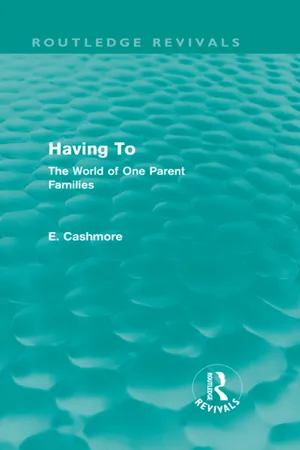
First published in 1985, Having To summarises the situation of more than a million parents in the UK alone that survive as single parents. This thought-provoking book is based on interviews with more than 200 women and men of all ages and backgrounds. The accounts of what life can be like in the world of one parent families are revealing, sometimes disturbing, and above all, moving. In this book, parents talk in depth about their experiences when confronted by violence, infidelity, lesbianism, child abuse and paranoia. They portray stories that will provoke many questions about the state of the nuclear family.
- 288 pages
- English
- ePUB (mobile friendly)
- Available on iOS & Android
eBook - ePub
About this book
Information
1
Introduction: Cages
The unnatural family?
Imagine for a moment: the family institution does not exist. People can live in virtually unlimited ways: they can have sexual relations without any other attachments, they can join together in multiples of three or more, they can have children but allow them to be raised by other people or they could decide that just one of the natural parents will raise the child, or children, and the other will disappear. The institution of the family shuts off these options. At least, it deters people from exploring them – except the last one. Society’s institutional arrangements supply a set of scripts for all of us to use and only rarely are we permitted to try out new scripts for ourselves; even then, there is a good chance that we’ll be labelled as ‘abnormal’ or ‘deviant’.
Yet a new script is being written: more and more people are writing an alternative to the nuclear family of man, woman and children; they are developing the oneparent family. The new script is not an invention, nor is it the creation of any one set of individuals. Rather, it is the creation of human purposes and the product of changing social conditions. Broadly speaking, these changes began in the 1970s. The average family size in the UK and USA dropped from about 3.3 to 2.78 persons: a combination of improvement in family planning methods and a deterioration in economic conditions fuelled an awareness of the advantages of having smaller families. Divorce rates shot up, so that first marriages had only about a 60 per cent chance of survival: this reflected changes in divorce laws and a general recognition by people that they should strive for personal satisfaction in marriage and not be content to struggle vainly in empty relationships.
Underlying these was a sweep of new feminist consciousness: women began to realize that they could seize control of their lives and abandon their conventional roles as carers rather than breadwinners. Women stridently proclaimed that biology was not destiny. They rejected dependence on men and began to campaign for new rights and freedoms. In England, the 1970 Equal Pay Act and the 1975 Sex Discrimination Act were legal acknowledgements of changes in women’s social roles and personal freedoms.
Out of this women’s movement came fresh views on the family unit. Was it so natural and wholesome? Was it the only way satisfactorily to rear children? There was a sudden ambivalence. Perhaps the gratifications of having and raising children could be achieved without consigning oneself to a legally recognized institution such as marriage. Oneparent-hood was an alternative.
The results of these changes could be seen in the growing number of parents choosing to rear their children singlehanded. In the UK, from the mid-1970s, the oneparent population grew at the rate of approximately 6 per cent per year, so that there are now over 1 million lone parents with dependent children under the age of sixteen (who total 1.6 million), that is, approximately 1 in 8 families with children at home is now headed by a lone, or single, parent. In the States, the ratio is estimated to be 1 in 5.2, or a total of 15 million parents and children. Women outnumber men in heading oneparent families by 9 to 1 in the UK and about 8.5 to 1 in the USA. (US Bureau of the Census, 1980; Popay et al., 1983, p. 9; Golanty and Harris, 1982, p. 453). According to a National Council for Voluntary Organisations report, only 16 per cent of lone parents are single, with 34 per cent divorced, 22 per cent separated and 17 per cent widowed (NCVO, 1984).
The signs are that oneparenthood is going to become even more prevalent. A mixture of choice and circumstances will guarantee that. The choices are those of those women and men whose deliberate intention it is to steer clear of the cultural scripts and write their own. The circumstances are those surrounding marriage: greater accessibility to divorce, easier arrangements over the custody of children and, generally, a slight erosion of the values people place in marriage and a tendency towards the establishment of common law, or de facto, partnerships.
The increase in the number of oneparent families has thrown up many questions, beginning with the general one: is the unit a viable and legitimate family form in modern western society? More specific questions centre on the child: how adequate is it for just one parent to handle the childrearing roles conventionally distributed amongst two? Will the children of oneparent families suffer? If so, in what ways? Further questions concern the parents themselves and the extent to which they actually benefit from the ostensibly freer and more independent lifestyle deriving from one-parenthood. In the pages that follow, I shall attempt to answer all these and more questions about oneparenthood and, in the process, settle some of the present uncertainties about oneparent families, their abilities, functions and adequacies.
One of the central issues that concerns me is the potential of oneparenthood. Many authors write enthusiastically about the oneparent family as a great force in changing people’s attitudes; the personal experiences of being a lone parent are seen as positive, liberating and packed with the kind of variety never possible in twoparent setups. Epitomizing this view is Catherine Itzin, who believes that the oneparent family ‘challenges fundamentally many of society’s fervently held beliefs and values; sexual role conditioning … basically the whole role of women and men in society’ (1980, p. 9). She argues that, out of the trauma of splitting up, comes a sort of emancipation, which she calls ‘single-parent liberation’.
It is a view that’s increasing in currency and one that really motivated me to write this book. The idea came to me whilst I was leading a project based on housing estates in the English Midlands. Residents were asked to list their perceptions of the major social problems in their area. Time and again, ‘oneparent families’ would head the list. ‘Something’s got to be done about all these oneparent families who are moving in,’ was a typical reaction. I was struck by the intensity of the anger about lone parents and the concern voiced about their alleged immorality. It was as if a moral panic was being generated. Yet the same group that was being popularly branded as outcasts had supposedly transcended the traditional barriers of marriage and the nuclear family and reached a new plateau of freedom and enlightenment.
I remember a passage written by Brigitte and Peter Berger who contrasted two visions of the conventional nuclear setup. In the first, the ‘family is a natural unit of parents and children, united by love, mutual respect, trust and fidelity, based on religiously inspired values and giving a distinct moral quality to this basic unit of social life. In the other vision, the bourgeois family is a narrowly constraining cage, turning its members into mere instruments of production, profoundly destructive of women and children (and, perhaps to a lesser degree, men), and generally cutting off its members from participation in the larger concerns of society’ (1983, p. 107).
I wondered if all the followers of the second vision, who were so vigorously applauding oneparenthood, were fully aware that, for all its liberating potential, the oneparent unit can also be ‘a narrowly constraining cage’. Not always, of course, and not necessarily. None the less, talking to several lone parents made me realize that, while Itzin and others were championing them as the vanguard of social change, they themselves were experiencing quite serious social deprivation. I checked the statistics: a oneparent family – which I defined (following Townsend, 1979, p. 756) as ‘an income unit in which there was only one natural or adoptive parent together with her or his dependent children at school or at pre-school age’ – belongs to a group that is amongst the poorest in society.
To make an accurate assessment of whether oneparenthood is a freedom or an imprisonment, I followed the advice of the Bergers, who wrote, ‘Any social situation is the “coming together” of many individual meanings and motives, and the situation cannot be understood except “from within” – that is by understanding what the situation means to those who are in it’ (1983, p. 144). In order to capture the experience of being caught in the world of oneparent families, I interviewed 255 lone parents, most of them introduced to me by various organizations (the Gingerbread organization, the Health Authorities of Solihull and East Birmingham and the Social Services Departments of Solihull and Birmingham – to which I express my gratitude). The interviews ranged between 1 and 2 hours and were conducted by myself and Carl Bagley over a period of nine months with the financial assistance of the Economic and Social Research Council.
I have approached the issue of ‘freedom or imprisonment?’ by dividing the book into two main parts, each designed to convey as faithfully as possible the subjective experience of oneparenthood. The first part is devoted to influences on the growth of oneparent families. I break down the precise reasons why oneparent families exist. It may be because a partnership has been brutalized by violence, or a partner has fled or the couple has been split by a change in sexual preference or a religious conversion. My argument is that what look at first glance to be extremely personal issues are, on closer inspection, related to broader social changes. The combination of the two produces the upsurge of oneparent families.
The second part assesses the consequences of oneparenthood, I look at the actual conditions in which lone parents live – their housing, their work; their positive appraisals, their negative evaluations. Contrasts surface repeatedly: forceful arguments in favour of oneparenthood by confident, liberated types are tempered by tales of abject poverty and depression. I also try to give a balanced account of the influence of lone parents on children: do children really need two parents to develop adequately?
I begin, however, by highlighting the sheer diversity of oneparent families. Although it’s possible to identify common features – I believe very crucial features – it’s important to recognize the differences in backgrounds of lone parents. They live in diverse social conditions: some are relatively well off, while others live on the margins of poverty. So it’s a mistake to assume that oneparent families constitute a coherent, recognizable group.
None the less, a common denominator in the lives of lone parents is that they exist in setups where the usual material, psychological and emotional inputs in the family unit are halved. As a result, lone parents are compelled to double their efforts to give to the family enough sustenance. It doesn’t always work; many families collapse. On the other hand, many succeed admirably and the families cultivate a sense of unity and solidarity; children can prosper in such an atmosphere.
‘Oneparent family’ is, to many, an inappropriate and absurdly inaccurate term, anyway. Even an academic writer like C. C. Harris, in his book The Family and Industrial Society (1983, p. 210), states that ‘“One-parent family” is however a misnomer … Strictly speaking, a “one-parent family” is a lone parent household with dependent children (LPH)’. At other levels of society, the same view can be found: people simply do not think that the LPH constitutes a family at all. That is something for the reader to decide after absorbing some of the stories that follow.
However you define them, oneparent families, or LPHs, present a direct challenge to traditional conceptions surrounding the family and childrearing. To many, they are an affront to decency and a threat to the psychological and physical health of children who are brought up in such circumstances. ‘They think we’re all slags,’ opined Kathy Morgan on how others saw her and her fellow lone parents. ‘They think our kids are neglected and their lives are in mortal danger,’ she went on.
Oneparent families are looked upon as the ‘lowest of the low’ by many and as the forces of social change by others. But how do they see themselves? As a start to answering this, I present three lone parents: a twice-divorced mother in her mid-thirties, a West Indian immigrant father nearing middle age, and a young unmarried mother. Their experiences and perspectives will introduce us to the world into which I shall delve in the more substantial sections to follow.
It doesn’t matter what you do, it’s wrong
Kay Leighton was just coming up to 20 when she met Mike. It was in the April of 1966. They married in the December. Mike was twelve months younger than Kay. He was a painter and decorator; she was a shop assistant at Woolworths. They’d got very little money, so they couldn’t afford a decent standard of living. In fact, they couldn’t even secure proper accommodation: as a makeshift solution, they lived in a caravan near Stourbridge, a place where the buses stop only every 2 hours. Fortunately, Mike had a car and, as they both worked in Birmingham, he used to take Kay to work in the morning and pick her up at the end of the day before driving back to Stourbridge. The arrangement worked well, but only for a short while. Quite soon, Mike became demanding about his domestic comforts. ‘He wanted his dinner cooked and on the table for when he walked in,’ explained Kay. ‘And I mean, I was working, so it was just impossible.’
Mike’s insistence on having his food prepared and ready probably betokened his general frustration at living in cramped, inconvenient conditions. If Kay tried to reason, she got a smack in the face; if she tried to argue back, she got worse. Soon, it grew intolerable and she determined to leave, especially after Mike accused her of conducting a series of affairs. ‘Totally unjustified,’ Kay insisted. ‘I’d never heard of half of the people that I was supposed to be going to bed with.’
But that wasn’t all. Mike became obsessed with a fear of being a father. He didn’t want children until he’d got a mortgage on a house, a reliable car and at least minimal financial security. Not that Kay was particularly interested in children either: a baby was something they could well do without at that point, but Mike’s solution, rational as it was, didn’t please Kay.
‘The way to having babies is through having sex. So the way to stop them is to stop having sex. It’s logical really, but no fun. He was utterly and totally mad, but you don’t know anybody until you’ve actually lived with them. You’ve go to live with them 24 hours a day, 7 days a week.’
Kay found it all too claustrophobic, a situation compounded by Mike’s belief that ‘A woman’s place was in the home; a woman’s job is to do the washing and ironing and the cooking and cleaning and all the rest of it.’
Depressed and frustrated, Kay upped and went. She fled back to Birmingham, where she stayed with friends. Mike reported her to the police as a ‘missing person’. Within the week, Kay returned, principally at the behest of her friends, who convinced her – mistakenly, as it turned out – that Kay’s place was with her husband. Mike thought so too. And as a way of insuring against Kay’s fleeing again, he devised a strategy. ‘He started taking all my money so I couldn’t go anywhere.’ After three weeks, Kay borrowed some money from a neighbour and went to her mother’s in Birmingham. Almost immediately, she began divorce proceedings. Her attempts at getting a divorce were repeatedly resisted by Mike. For almost five years, she tried to push the divorce through.
The Matrimonial Causes Act, 1973, introduced two new factors into divorce proceedings: divorces became obtainable after two years’ separation with both partners’ consent and after five years’ separation if one party withheld consent. The latter factor meant that Kay’s divorce was almost possible as she had been separated for just under five years. Then, quite unexpectedly, Mike cross-petitioned under section 1 (2) (c) of the Act, which relates to desertion. She didn’t contest it.
It’s a costly mistake to think that life consists of a series of checks and balances; that our bad experiences are made up for by our good ones. Life has no such symmetry. Kay wasn’t to know that, however, when she met the man who would be her second husband. He was to steer her into what she calls ‘a nightmare’. Like her first husband, Richard was younger than Kay, but only by a couple of months. They were both 24 when they met. Quite soon, they became intensely involved in each other’s lives and began living together. Kay learned from his mother that he’d been a ‘tearaway’ in his youth, but had apparently ‘calmed down’ after moving into the flat in Birmingham where they lived. He held down jobs for four or five months whereas it used to be two or three weeks; and his scrapes with the police grew infrequent. Kay seemed to have what some call a stabilizing influence. That influence strengthened after Kay gave birth to Stephan. She was 26 and her divorce wasn’t quite through. There was no doubt in her mind that she wanted the child; perhaps the situation wasn’t ideal, but, at her age, she felt that she wanted a child. Richard agreed. In fact, Stephan’s birth spurred him to ask Kay to be his wife. ‘Well, we live together, we’ve got a baby; so what can go wrong?’ he asked.
‘Up until we got married, I was the treasurer and he [Richard] used to bring his money home on a Friday and we’d pool it. We’d put it on the table and we’d say, “Right, that’s to pay the rent, that’s to pay the gas, that’s for the electric, that’s for this, that’s for that and that’s what’s left.” Half and half. And that worked out OK. But once we were married, that made him boss.’
Richard didn’t drink excessively, nor did he smoke any more than Kay and, to her knowledge, he didn’t gamble. But, he was ‘record mad’. ‘He’d think nothing of spending £400 on record equipment and records and stuff like that and then wonder why we hadn’t got any money,’ reflects Kay. ‘I couldn’t even go out and buy a pair of drawers without asking his permission!’
‘Strange what marriage can do to people: tear them apart as well as unite ...
Table of contents
- Cover
- Half Title
- Title Page
- Copyright Page
- Original Title Page
- Original Copyright Page
- Table of Contents
- 1. Introduction: Cages
- Part One: Influences
- Part Two: Consequences
- 11. Conclusion: Captive Freedom
- Bibliography
- Index
Trusted by 375,005 students
Access to over 1.5 million titles for a fair monthly price.
Study more efficiently using our study tools.
Frequently asked questions
Yes, you can cancel anytime from the Subscription tab in your account settings on the Perlego website. Your subscription will stay active until the end of your current billing period. Learn how to cancel your subscription
No, books cannot be downloaded as external files, such as PDFs, for use outside of Perlego. However, you can download books within the Perlego app for offline reading on mobile or tablet. Learn how to download books offline
Perlego offers two plans: Essential and Complete
- Essential is ideal for learners and professionals who enjoy exploring a wide range of subjects. Access the Essential Library with 800,000+ trusted titles and best-sellers across business, personal growth, and the humanities. Includes unlimited reading time and Standard Read Aloud voice.
- Complete: Perfect for advanced learners and researchers needing full, unrestricted access. Unlock 1.5M+ books across hundreds of subjects, including academic and specialized titles. The Complete Plan also includes advanced features like Premium Read Aloud and Research Assistant.
We are an online textbook subscription service, where you can get access to an entire online library for less than the price of a single book per month. With over 1.5 million books across 990+ topics, we’ve got you covered! Learn about our mission
Look out for the read-aloud symbol on your next book to see if you can listen to it. The read-aloud tool reads text aloud for you, highlighting the text as it is being read. You can pause it, speed it up and slow it down. Learn more about Read Aloud
Yes! You can use the Perlego app on both iOS and Android devices to read anytime, anywhere — even offline. Perfect for commutes or when you’re on the go.
Please note we cannot support devices running on iOS 13 and Android 7 or earlier. Learn more about using the app
Please note we cannot support devices running on iOS 13 and Android 7 or earlier. Learn more about using the app
Yes, you can access Having To (Routledge Revivals) by E. Cashmore in PDF and/or ePUB format, as well as other popular books in Social Sciences & Marriage & Family Sociology. We have over 1.5 million books available in our catalogue for you to explore.