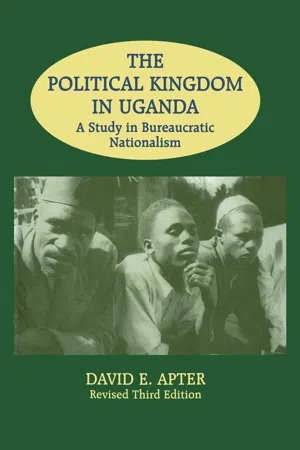
- 592 pages
- English
- ePUB (mobile friendly)
- Available on iOS & Android
eBook - ePub
About this book
It is rare for a scholar to revisit the scene of earlier research with a view to evaluating how that research has stood up over time. Here David E Apter does that and more. In a lengthy new introductory chapter to this classic study of bureaucratic nationalism, he reviews the efficacy of the concepts in his original study of Uganda of almost a century ago, including some, such as consociationalism', which have entered into the mainstream of comparative politics.
Chapter 1
The Political Kingdom and the Politics of Provincialism
TODAY in Ghana, Nigeria, Sierra Leone, Guinea, Mali, Senegal, and elsewhere, European administrators are packing their bags. They are having a last look around the compounds with the whitewashed stones and the tropical flowers, the orderly district offices, the cool and old-fashioned bungalows. The magazines left in the rest houses of country stations are increasingly out-of-date and the service and crockery become a bit more chipped and rundown. Africans, dressed not in khaki drill shorts but in trousers and jackets, begin to move in. Their servants grow beans where the district officer's wife had her English garden. Chickens and children obliterate the careful paths and remove the atmosphere of casual exclusiveness. History, having irrevocably left its mark on a changing African scene, has now taken a new turn—Perhaps to leave as indelible a stamp upon the West.
Profound though contact with the West has been, Africa can no longer be viewed as a consequence of European institutions planted in exotic soil. In the history of Africa the colonial period is but a short moment in time. The changes presently under way represent a process which has a much longer history than European intervention and which, indeed, was interrupted by the colonial experience. African institutional life has a vitality which transcends the specific structural innovations of European origin.
If this perspective is accepted, the colonial experience should no longer be viewed as the institutional watershed for contemporary events. We need a different point of vantage from which to contemplate processes of change in Africa. However, if we are not to follow after events with post hoc explanations which change with every variation in political arrangements, we need a set of abstractions which will help us find our way through the exciting multiplicity and complexity of change. In our first study, The Gold Coast in Transition,1 we tried to examine the role of a particular kind of authority system, based on charisma, yet expressed through roles and institutions embodied in British practice. We examined the prospects of parliamentary democracy as a unifying medium in Ghana. We turn now to a very different set of authority relationships in Uganda. Our central concern is with a type of authority called a modernizing autocracy.
We shall first indicate briefly how the modernizing autocracy differs from other types of authority systems. Second, we shall explore the general social and economic complex within which it operates. Our third task will be to show in some detail the characteristics of Buganda as a modernizing autocracy—indicating some of the cleavages and ambiguities of the system—and the dualism running through that society. Fourth, we shall try to show how the traditional characteristics of Buganda helped to shape the direction of more contemporary problems in which the autocracy itself fought to maintain its autonomy while demanding drastic innovation and change. Finally, we shall describe characteristic patterns of conflict which, culminating in the deportation of the King of Buganda, have now reached the point where Uganda as a nation must make the following choice: either the modernizing autocracy will accede to the needs of a modern state with an all-embracing representative government, or else the prognosis for the future will be one of increasing ethnic and parochial strife, impeding progress toward independence itself.
This analysis will conclude with a discussion of the efforts to create a modern representative government in Uganda.
A Perspective of African Political Development
The changeover from European colonial officialdom to African administration is taking place against a much wider backdrop of political change in Africa. African political leaders rather than administrators are representatives of the new Africa. They must do their best to transform the societies which they have now inherited. They need to find the most useful political machinery which will enable them to achieve their objectives. Some, as in the case of Guinea and Ghana, have sought to mobilize the total energies, resources, and skills of the country for a grand assault on the problems of poverty, ignorance, and backwardness. Others, such as Nigeria or, for a time, Mali Federation, have tended toward some union of important constituent parts—a kind of consociation which seeks in political unity a common denominator to unite all of the groups within the country for purposes of common action.
The third type, exemplified in Buganda, is more rare. In this situation, change is filtered through the medium of traditional institutions; examples of this may be found in Morocco and Ethiopia. But in such cases, modernization and change have become traditionalized, and innovation is regarded as a characteristic of the traditional system. Each of these three types—the mobilization system, the consociational system, and the modernizing autorcracy—represents a dynamic political arrangement which approaches change in a different way.
Such types are interesting to examine in a theoretical sense. The analysis of change is always precarious and, for that reason, one of the most taxing of man's urgent tasks. To dissect living history challenges man's capacity to absent himself from the immediacy of his own world in order to compare it with others. Such an effort is never entirely successful. We are a product of lives lived before us and part of a chain of cultural and social continuity which carries the past into the future. Yet is precisely because the present is always the transmitting medium, transmitting, moreover, through ourselves, that we try to seize upon those changes which we hope will provide a perspective of the future.
If each of these three types of political tendencies is a consequence of political arrangements which sort themselves out in the politics of contemporary Africa, they leave unanswered a larger and prime question. Will they have the capacity not only to absorb change but also to generate a new civilization?
Each of the three types has developed as a result of the great challenge which has emerged with lightning speed: the extension of political democracy and freedom to Asia and Africa. This has ended the Western world's political hegemony and affirmed instead the road to both spiritual and material achievement in Asia and Africa. However, what remains to be accomplished in Africa is the creation of new civilizations. The question is whether those different changes which are occurring will simply raise the level of material life in Africa or whether they will lead to fundamentally new systems of belief and culture which will have as profound an impact on the world as have the great civilizations and religions of Islam, Christianity, Buddhism, and Marxism. In their separate ways, these systems have defined the purposes and achievements of the material cultures which represent them. For in the largest sense, a civilization requires a religion or cosmology as well as a defined system of political and social organization. It is the latter which is now emerging in Africa on African terms. The former is still to be created.
Each of the three types of systems represents a type of political and social organization rather than a civilization. Each has certain affinities with ideologies and religions, but it remains impossible to predict what combinations will occur. Certainly, contemporary nationalism which is characteristic of all three is political in its materialism and its concern for rapid development. In the case of the mobilization system, Marxism as a secular religion gives a spiritual dimension to this materiality. The modernizing autocracy, on the other hand, characteristically retains more traditional religious ties, absorbing and filtering modifications in social structure and life through the screen of Islam or Christianity. But so far there have been only tentative tendencies toward the combinations of religious and social organization which could impel the new African states toward a fundamentally new civilization. Some of the factors inhibiting this process have been the result of the rapidity and success of anticolonialism and nationalism. There has been no time to develop an ideology much less a religion, since so far both have been unnecessary. Another reason may be that, born in the West, nationalism is still essentially a product of Western secularism. Having subordinated the political arm of the West, the nationalists can take a tolerant view of its religions. Indeed, perhaps the saving grace of the West is that its religious arm, born in political subordination, can gracefully reassume that position by individualizing its faith and removing it from political prominence.
The latest form of nationalism, namely pan-Africanism, is, as yet, neither religion nor a fully developed ideology. It does not represent a transcendental system of belief compelling man's allegiance to a system of moral imperatives, nor does it advance a particular code of ethics. Conforming to its political function, it argues for political independence and it relies on the similarities of the tasks of political leaders in developing their countries; it relies, too, on similar sympathies born of a common colonial heritage. All these, united by a bond of color, produce new unities in a free Africa. But pan-Africanism is not a new civilization; it is therefore at the mercy of traditional factors in African society and is vulnerable to the immediate politics of parochial nationalism. For example, pan-Africanism has been virtually without success in Uganda where traditionalism of the Buganda kind has held at bay not only pan-Africanism but also efforts to build a larger national unity. Pan-Africanism asks only that people of color be free to make their own choices, to be psychologically free through the achievement of independence and socially free by using political means to material development.
It is the heavy reliance on the political form which is the vulnerability of pan-Africanism. It is bred out of the needs of nationalism and it can also be victimized by those needs. Where traditional religion, belief, and practice are thoroughly intertwined in contemporary social institutions, pan-Africanism feels itself gravely threatened, for it cannot substitute one belief for another; rather, it offers emancipation from belief itself. Hence there is an increasing reliance on the state as more than just a political form. The state acquires a special meaning and a mystical relevance when pan-Africanism is the ideology of nationalism.
To varying degrees the mobilization systems have the greatest affinity with the new pan-African state. The consociational systems cut across pan-Africanism by substituting for its ideology some loose political framework or alliance which allows for cooperation between African states and territories. But what of traditional systems? Essentially theocratic, they result in powerful sentiments for local and parochial institutions. The nationalism of a theocratic state is no less compelling than that of a pan-African African state. Occasionally we can find strange combinations within the same territorial setting. For example, in Nigeria in the north a theocratic state collaborates with a mobilization system in the Eastern Region and all are within a consociational framework.
An interesting variant of the modernizing autocracy will be our primary concern in this study. Such a system is a secular but traditional political and social organization. It is not a theocracy but rather a political kingdom. The theocratic elements have been stripped away and do not serve as obstacles to internal change and development. Such occurrences are rare and this is one of the reasons for studying them. For they raise a form of secular traditionalism which, while maintaining its separatist character, can keep pace with the new emphasis on development. Such a system includes the pan-Africanist emphasis on modernization while offering to maintain the stability of cherished institutions. The essence of secular traditionalism is that it demonstrates a resoluteness of culture and continuity which does not falter in the face of change. Its special characteristics are not unlike those of the early European monarchies which, emerging with the separation between church and state, were the forerunners of modern nationalism. It is for this reason that we will call Buganda a modernizing autocracy, to emphasize both its secular traditionalism and its easy response to innovation.
The modernizing autocracies of the Western world gave way to representative government. If one threat to pan-Africanism, albeit a local one, is to be found in a modernizing autocracy, so representative government is a threat to the modernizing autocracy. For its most distinguishing characteristic is a hierarchical principle of authority which admits a two-way chain of communications but bases its legitimacy upon the right of a monarch to rule. In this respect, the civilization normally expressed in religious or cosmological principles in a theocratic state is expressed directly in the principle of authority in the secular traditional system. The effect is to personalize the solidarity of the members of the state by unilateral agreement on allegiance to the king. To preserve this allegiance is a first priority. The success of such a system cannot fail to exact curiosity from Western observers. If one considers that almost all elaborate political systems are by their very nature frangible, at least Buganda arouses our curiosity by its amazing durability. History is strewn with political societies and the pace of discard has if anything quickened in the political tempo of today's world. This is particularly so with tribal systems in Africa. Culture does not die easily. It shows amazing persistence and stubbornness. To a smaller extent, social institutions can show great resilience, but political institutions, dependent for support and legitimacy on the entire network of social and cultural institutions, are notoriously fragile.
One answer to the puzzle of Buganda is that its political forms and social institutions are virtually identical. Politics is the arrangement not only of the state but of the society. That is why we can call it a political kingdom. Yet, as we have observed above, it depends upon the legitimized notion of pure power. In this it differs from theocracies. Even the seventeenth-century monarchies could not claim autonomous power without employing a religious support—witness the need to proclaim the "divine right of kings." But the king of Buganda is not a divine king, nor does he make any claim to be. Equally, when Christianity swept over Buganda it did not weaken the system. On the contrary, it strengthened it. Hence we find in Buganda a secular monarchy geared for adaptation and innovation and built around a central hierarchical system of authority. It is this pattern of authority and its survival that we shall examine, for it now faces its greatest challenge: the twin pressures of pan-Africanism and representative democracy.
Uganda and Buganda2
In its formal institutions of government, legislature, ministerial system, conciliar pattern of local government, and the like, the Uganda Protectorate shows a devolution of authority somewhat similar to that which occurred in British West Africa. There is an African majority in the Legislative Council. Direct elections have been held in several parts of the country. Constitutional reform continues rapidly. All signs point to the development of self-government leading to independence. There have been repeated assurances that independence within the British Commonwealth is the goal of the political administration and the British government.
The advent of self-government in Tanganyika and the independence of the Belgian Congo make it clear, moreover, that there is no possibility that independence for Uganda will be compromised. Indeed, it is possible to say at present that progress is being impeded less by the reluctance of the Protectorate government than by the ethnic fastidiousness of some of its people. The most important political unit in Uganda is more concerned with safeguarding ethnic autonomy than securing self-government for Uganda in the shortest possible time. Indeed, the quixotic situation has occurred where the Uganda Protectorate represents a system which remains alien to its members, so long as Africans refuse to participate in it.
Inside the Protectorate of Uganda is Buganda, the Kingdom of His Highness the Kabaka. The Protectorate government seeks to build a national secular state. The Kabaka's government is a modernizing autocracy. It rightly foresees that in such a secular national state its own institutions can only be diminished and eroded.
Some Patterns of Political Behavior in Buganda
Before launching into the main body of our analysis we can sketch in some of the more general behavioral characteristics which have long prevailed in Buganda. Buganda is central to our analysis. A semiautonomous province, ...
Table of contents
- Cover
- Title
- Copyright
- Dedication
- Contents
- List of Illustrations
- Preface to the First Edition
- Preface to the Second Edition
- 1997 Introduction
- Chapter 1 The Political Kingdom and the Politics of Provincialism
- Chapter 2 The Social and Economic Environment
- Chapter 3 Missionary and Mercantile in East Africa: The Discovery And Engagement of Institutions
- Chapter 4 The Traditional Setting: Concepts and Hypotheses
- Chapter 5 Fissures Without Fracture: The First Political Groups in Buganda
- Chapter 6 The Anatomy of Internal Conflict in Buganda
- Chapter 7 The Development of a National Government
- Chapter 8 The Defense of Buganda Interests: The Campaign Against Trusteeship and Closer Union
- Chapter 9 The Growth of Economic Nationalism
- Chapter 10 Neo-Traditionalism and the Beginnings of Modern Nationalism
- Chapter 11 Crisis and the Emerging State, I
- Chapter 12 Crisis and the Emerging State, II
- Chapter 13 Authority and Men: A Battle of Roles and Personalities
- Chapter 14 Political Parties in Uganda: The Search for Leadership and Solidarity
- Chapter 15 The Buganda Government and the Development of Constitutional Government
- Chapter 16 The Constitutional Approach to Nation Building: Ideas Without Ideals
- Chapter 17 Toward Democracy and Independence
- Appendix
- Index
Trusted by 375,005 students
Access to over 1.5 million titles for a fair monthly price.
Study more efficiently using our study tools.
Frequently asked questions
Yes, you can cancel anytime from the Subscription tab in your account settings on the Perlego website. Your subscription will stay active until the end of your current billing period. Learn how to cancel your subscription
No, books cannot be downloaded as external files, such as PDFs, for use outside of Perlego. However, you can download books within the Perlego app for offline reading on mobile or tablet. Learn how to download books offline
Perlego offers two plans: Essential and Complete
- Essential is ideal for learners and professionals who enjoy exploring a wide range of subjects. Access the Essential Library with 800,000+ trusted titles and best-sellers across business, personal growth, and the humanities. Includes unlimited reading time and Standard Read Aloud voice.
- Complete: Perfect for advanced learners and researchers needing full, unrestricted access. Unlock 1.5M+ books across hundreds of subjects, including academic and specialized titles. The Complete Plan also includes advanced features like Premium Read Aloud and Research Assistant.
We are an online textbook subscription service, where you can get access to an entire online library for less than the price of a single book per month. With over 1.5 million books across 990+ topics, we’ve got you covered! Learn about our mission
Look out for the read-aloud symbol on your next book to see if you can listen to it. The read-aloud tool reads text aloud for you, highlighting the text as it is being read. You can pause it, speed it up and slow it down. Learn more about Read Aloud
Yes! You can use the Perlego app on both iOS and Android devices to read anytime, anywhere — even offline. Perfect for commutes or when you’re on the go.
Please note we cannot support devices running on iOS 13 and Android 7 or earlier. Learn more about using the app
Please note we cannot support devices running on iOS 13 and Android 7 or earlier. Learn more about using the app
Yes, you can access The Political Kingdom in Uganda by David E. Apter in PDF and/or ePUB format, as well as other popular books in History & World History. We have over 1.5 million books available in our catalogue for you to explore.