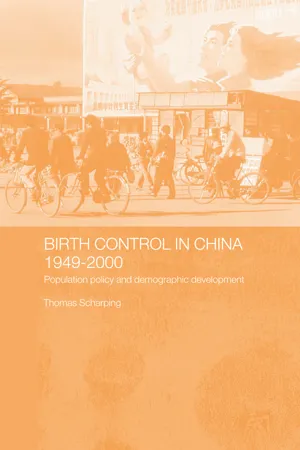
This comprehensive volume analyzes Chinese birth policies and population developments from the founding of the People's Republic to the 2000 census. The main emphasis is on China's 'Hardship Number One Under Heaven': the highly controversial one-child campaign, and the violent clash between family strategies and government policies it entails.
Birth Control in China 1949-2000 documents an agonizing search for a way out of predicament and a protracted inner Party struggle, a massive effort for social engineering and grinding problems of implementation. It reveals how birth control in China is shaped by political, economic and social interests, bureaucratic structures and financial concerns. Based on own interviews and a wealth of new statistics, surveys and documents, Thomas Scharping also analyzes how the demographics of China have changed due to birth control policies, and what the future is likely to hold.
This book will be of interest to students and scholars of modern China, Asian studies and the social sciences.
eBook - ePub
Birth Control in China 1949-2000
Population Policy and Demographic Development
- 424 pages
- English
- ePUB (mobile friendly)
- Available on iOS & Android
eBook - ePub
About this book
Information
Part I
Introduction
1 Levels of understanding
On his tour through Liaoning province in 1987, a Chinese magazine reporter met a vice-mayor. The following conversation ensued:
‘Which work is giving you most headaches?’
‘Birth planning.’
‘How big are your headaches?’
‘I never suffered from insomnia. But each time I hear birth-planning reports from below I cannot close my eyes at night any more.’
‘Birth planning.’
‘How big are your headaches?’
‘I never suffered from insomnia. But each time I hear birth-planning reports from below I cannot close my eyes at night any more.’
The cadre continues to describe a mass meeting, with pointed criticism of a peasant couple who refused sterilization even after their sixth child. Incensed at the criticism, the peasant left ‘an eternal memory’ on the face of the cadre. When the reporter toured another province and posed the same question as to what was the most awkward type of work, he received the following response:
You do not need to guess for long, the whole world knows about it. Birth planning is the Hardship Number One Under Heaven! One month ago I did inspection work in the countryside. We had not even entered the village, when a voice started yelling: ‘The devils are coming!’ When the women with unauthorized pregnancies heard this, they immediately made for the hills and woods. We searched the whole day long, but we did not even discover a shadow of the ‘village guerrilla troops’.1
Such unabashed reports about implementation problems of China’s one-child policy are rare. There are good reasons for the dearth of reports, since birth planning is one of the most sensitive issues of Chinese policy both at international and national level. It has evoked highly diverse reactions, ranging from a medal for meritorious work granted by the UN to the Chinese Birth-Planning Commission in 1983 to repeated accusations against violations of human rights. These have served as an argument for the refusal of the USA to pay arrears in UN dues, and led to the highly publicized US withdrawal of financial support for UN population programmes under the Reagan and Bush administrations.2 Even today, the world continues to be deeply divided in regard to Chinese birth-control policies, and a revival of fundamentalist policies in the USA is in the cards. The polemic has a long line of antecedents, as the pros and cons of birth planning in China have been debated since the 1920s, both inside and outside the country. The discourse on Chinese population problems in a wider sense has an even longer history and stretches back to the eighteenth century. While in Europe it came to serve as a topic in the polemics of enlightenment, political economy and revolutionary thinking, in China it is closely intertwined with the nation’s quest for modernization and the re-attainment of wealth and power.
Population policy in the People’s Republic thus has a long and tortuous history. Its most extreme expression, the one-child policy pursued since 1979, has evolved through decades of searching and feuding that first saw violent rejection of birth planning, then cautious experimentation with voluntary contraception, and finally ever wider inroads of state intervention into fertility matters. Despite arduous propaganda, it continues to be a sensitive subject within China. This is not only because the one-child policy squarely contradicts the traditional pro-natalist ideals of the country, but it also mercilessly lays bare other problems, foremost among which is the basic conflict of the reform period between liberalizing the economy and maintaining tight control of the political and social sphere. In spite of the repeated veerings of high politics to the left and right, Chinese society continues its march to emancipation from direct state control. At the same time, however, the state effects one of the strongest interventions in family life ever proposed by a government. In consequence, even Peng Peiyun, the former minister for birth control, has deemed it necessary to comment a prevalent question within China: ‘Why is everything liberalized except birth planning?’3
The conflict between liberalization and control approaches has been repeatedly waged within the leading bodies of the country. In contrast to the facade of unity and the urge to present birth control as an unflinching long-term concern, many years of controversy within the Party leadership can be documented. In this controversy pragmatists pleading for a flexible accommodation of social concerns have been poised against hard-line proponents of the one-child policy who dismiss conditional permissions for second children by invoking the risks for the country’s future. On a more general level, such controversies mirror the different approaches of politicians who continue to believe in their ability to steer social and economic policy according to professed laws of development, and power holders who, just like many people in authority in other parts of the world, restrict themselves to mediating the present while refraining from moulding the future.
This can be precarious in China’s case, since, in view of the high base numbers, minimal discrepancies of growth rates can entail maximum long-term consequences. In this way, differences in total population numbers that seem to be negligible in the mid-term can expand to differences in the range of hundreds of millions of people decades later. The high degree of inertia in demographic processes also produces age structures, which generations later result in population dynamics not prone to outside intervention. If these structures are radically breached, inertia occurs again. Population ageing offers a good example: only decades later a dramatic decline in birth numbers may lead to an equally dramatic problem of old-age support – which thereby can be put aside for some time. Under these circumstances, the controversy over liberalizing or controlling China’s present has always been waged by invoking different perspectives of the country’s future. There are those who fear gambling away this future here and now, and there are others who reply:
China’s population cannot be but controlled. But if one generation must swallow everything that has been heaped up by decades and centuries of mistakes, then the following generation will only suffer from new misery.4
Such problems of perspective may also be discerned at academic level. Here the controversy recurs in different analyses of causal relations in population matters, in a conflict about culpabilities for the manifest failure of some one-child policies, and in debates about advice for future action. In these debates China’s demographers display the age-old ambiguity of the Chinese intelligentsia: Should it articulate social concerns, in particular peasant interests, against government policy? Or should it make its know-how available for use by the government in order to effect better policy implementation? In this classical conflict of roles, large parts of the intellectual elite identify themselves as spokesmen for government interests. At the same time, they evince a deep-felt inner detachment from the peasant majority of the population.
However, the advocates of tight population control have also come to recognise the limits of government intervention. The compromises they have been forced to accept are telling for the political culture of China: the gap between hard-line declarations and lagging implementation; the facade of outside unanimity concealing a highly diverse range of opinions; the mental and verbal sophistication in reinterpreting policy guidelines; the ramification of bureaucratic hierarchies compensating for their control deficits by a continuous delegation of tasks to lower levels; the brutality born of helplessness and the passiveness of calculation prevalent at the grass roots; the cycle of directives from above, evasion from below, new measures and new countermeasures, which continues until new rules of the game are devised.
China is not a straight society. Centuries of bureaucratic experience have bred a rich tradition of administrative refinement struggling with popular evasion, and this tradition is resurfacing with the progressive collapse of both socialist systems and socialist morals. It is a long, drawn-out collapse as the leadership tries to stem the tide and prevent the danger of total disintegration. In its wake a classical structural problem of the Chinese polity re-emerges: extreme normative centralization coexisting with extreme factual decentralization. At times, it entails evolution in the forms of government coupled with involution of their substance.5 But in spite of much red tape and blockages from within, the system has demonstrated remarkable capacities for learning and innovation. On the other hand, it can also practise self-deception on a grand scale, as is documented by Chinese birth-control reports. One of the findings of this study is a continuous backsliding of quality standards in current population statistics. This has reached such high proportions that it is beginning to affect economic planning, and to render dubious many per-capita indicators from running statistics.
In this way, a study of Chinese birth planning tells many stories at the same time: the story of China’s demographic problems and their reflection in political thought, as well as the country’s agonizing search for a way out of its predicament. It can also be read as a paradigm for the hardships of policy implementation in China and the failure of planning systems, which are eroded from within once they transgress popular interests too severely. Other questions of general importance are also involved. There are few policy arenas that provide as many vivid examples of China’s internal information problems as population policy. The multiple and elaborate channels for retrieving demographic information are testimony to the internal checks and balances of the system; at the same time, they clearly demonstrate the problems of staying within its confines. Chinese approaches to law, administration and central–regional relations are further leitmotivs contained in the account of birth planning. Finally, there is the story of the one-child policy as a mobilization issue. Later historians may evaluate it as the last mass campaign and the last large-scale attempt at social engineering in China.
It is not only China’s political system and culture which are mirrored in the implementation problems of birth control. The successes and failures of the government’s population policy also reflect the profound transformations of Chinese society in recent times. Following the violent upheavals and mass campaigns of the Mao era, economic reforms have left Chinese society breathless. There are few nations which have undergone as rapid a change as China in the 1980s and 1990s. In only a few years the country has been catapulted into modern times and into the world market from the partly self-imposed and partly enforced isolation of the former period. Old fissures of Chinese society have been deepening ever since. Whereas industrialization and urbanization, the rising level of education, new consumer habits and ideals of life leave their marks in the reproductive behaviour of China’s urban population, the fertility record of large parts of the rural population continues to be highly traditional. Apart from the glaring urban–rural gap, the increasing diversification within China and the growing tendencies for decentralization are also mirrored in the different regional fertility records. The consequences of birth planning transcend the political realm as they sever a core element of Chinese culture: the traditional family with its religious, social and economic foundations. Within this context, the issues involved are inseparable from the subject of gender roles and women’s emancipation in China.
All these processes may be clearly discerned in the various aspects of birth planning. On another level, social, economic and political developments are always closely linked to changing values and ideals. But values also guide any empirical analysis of China’s one-child policy and should therefore be discussed explicitly.
2 Moral and cultural dimensions
The introduction of birth planning in China and its successive tightening until the start of the one-child policy has evoked heated debates. In most of its statements on population policy directed at foreign audiences, the Chinese leadership has tried hard to gloss over the toughness of its measures. A typical example are remarks by former Party leader Zhao Ziyang, who in July 1987, in a television spot sponsored by the UN to commemorate the ‘Day of 5 Billion People’, declared categorically: ‘Birth planning in China is practiced on a voluntary basis.’1
On the eve of the 1994 World Population Conference in Cairo, China again summed up her point of view for the foreign community. She stressed the economic and ecological motivations of birth control, and supported the UN principles of voluntariness, education and gradual change, the emancipation of women and the fight against poverty. An outline on population policy published at the same time stated that in China, medical personnel and family planning propagandists ‘offer’ services for abortion, sterilization and contraceptive advice to couples of reproductive age. According to the outline, personnel also ‘provide’ medical devices and ‘help families that practice family planning’, respecting the principle that ‘whether or not a pregnant woman has a sterilization or abortion depends totally on her own wish’. The statement continued:
The Chinese government promotes voluntary adoption of birth control on the basis of extensive education, and opposes forced imposition of it. However, we don’t deny that shortcomings and mistakes occur. China is very vast, with over 3,000 counties, and the standards of officials vary. In some areas, coercion may happen in the initial phases of family planning activity. On finding such actions, we resolve them resolutely.2
Such formulations and similar statements ever since are an indirect reply to the criticism of Chinese birth planning, which has become vociferous in the USA and other Western countries. One of the most influential critics has been former China population specialist John S. Aird from the US Bureau of the Census, who had been warning for years against unabated population growth in China. In 1990, however, he registered a strong protest against China’s birth-control programme, which according to him has been ‘the most draconian since King Herod’s slaughter of the innocents’. Aird argued: ‘The Chinese program remains highly coercive not because of local deviations from central policies but as a direct, inevitable, and intentional consequence of those policies.’3
Aird’s conclusions have been taken up by numerous politicians, journalists and human rights groups. They cannot be simply dismissed – the evidence collected by him for coercive abortion and sterilization in China is too overwhelming. This study will also confirm it. Apart from violating general human rights, Chinese birth planning is also provoking public ire because many critics discern violations of women’s special rights. Among them are the right of inviolability of the body, the right to self-determine fertility, and the option to choose from a range of different contraceptives. All these rights have been successfully claimed by feminist groups at the most recent World Population Conference.
These are justified objections against Chinese practices and should be taken seriously. To them could be added the well-known and principally correct argument that development is the best pill, because raising economic and cultural standards of life entails a spontaneous reduction of fertility. Nevertheless, the objections refer only to one side of the coin. They are one-sided because other important aspects of the problem are neglected and because different forms of coercion are not clearly differentiated.
Chinese practices of birth planning mostly do not imply the use of direct physical force. It has been proven that such force has been applied during early phases of the one-child policy in different regions of the country, when it was tacitly condoned by the Chinese leadership. Even today it is not far-fetched to assume that it has not vanished completely. However, since the mid-1980s we are mainly facing an increasingly sophisticated system of normative, remunerative and administrative coercion. Within this system, China’s leadership utilizes its legislative monopoly to decree highly restrictive birth-control regulations. In cases of non-compliance these spell out tough sanctions, ranging up to well-nigh obliteration of a family’s economic existence. Second, the leadership has designed increasingly tight procedures for population planning and birth rationing. Third, it has further enhanced this system of structural coercion by calling lower cadres to account once demographic targets are not met.
In this way, the spontaneous fertility behaviour of the population has increasingly come under state control. This has grave consequences for the individual which should not be extenuated. For even if procedures become more calculable and civilized in time, the final effect for the victims can remain the same. In former times it may have been zealots demolishing the houses of pregnant women and their families – today it may be the marshal who, if everything works out according to the will of the state, will knock politely yet commandingly at the door to present a writ of execution and to confiscate personal belongings of families violating birth-control norms.
Such ideas are shocking. Nevertheless, we accept fines and sentences if, for instance, they serve to punish non-compliance with state schooling or quarantine regulations. This is because of our understanding that self-determination in the private family sphere ends where the needs of a new generation and responsibilities towards society at large are not respected. It is an understanding which, because of its general validity, has been invoked in UN population documents. The Teheran Declaration on Human Rights of 1968 therefore has good reason to urge couples to use their right to decide the number of children they want freely but responsibly. Responsibility primarily means that the number of children born should not exceed the number who can be supported. While it would be fairly easy to reach agreement on this principle, the judgement becomes more complicated if economically viable family-size preferences on the private level conflict with the concerns of society at large. This happens in a situation of paradox, where a large population excess on the macro level is coexisting with simultaneous manpower demand on the micro level.
It is exactly this collision of private and collective interests that is shaping the population problems of China. A taboo of state intervention in reproductive behaviour seems to be out of place if the outlook of future generations is severely constrained by dramatically rising population numbers over the past 200 years. In recent years, the most populous nation of the world has been growing annually by net nearly 15 million people. Without birth planning it would be nearly 30 million. Quite rightly, Chinese statements in defence of birth control have repeatedly pointed out that this increase in population is equal to the annual creation of a new medium-sized country. On a corresponding scale are the labour, nutrition and housing problems, as well as the difficulties in the health and education sectors induced by China’s population growth. The world must also face the ecological problems of China’s natural environment, which permits the cultivation of only 14 per cent of the nation’s territory. There is a need for action, even if it has to be admitted that technological change and constant remodelling of economic organization do not permit a final judgement as to the question of maximum carrying capacities. The fact that population developments cannot be isolated from other agents of change and that multiple interdependencies prevail translates into sharply differing outlooks for China and into controversies that are as old as the debate on population issues between Robert Malthus, William Godwin and Karl Marx in the late eighteenth and early nineteenth centuries.4
Whoever has personally experienced the hard struggle for space, jobs and life chances waged in China knows that such points are anything but theoretical. The permanent need to take into consideration large masses of people constitutes one of the basic facts of life in China. It effectively limits the options for state and society in economics and in many other...
Table of contents
- Cover
- Halftitle
- Title
- Copyright
- Contents
- List of tables
- List of charts
- Preface
- Part I Introduction
- Part II Policy formulation
- Part III Bureaucratic implementation
- Part IV Popular response
- Part V Demographic results
- Part VI Conclusions and future perspectives
- Epilogue: The population census of November 2000
- Notes
- Bibliography
- Index
Trusted by 375,005 students
Access to over 1.5 million titles for a fair monthly price.
Study more efficiently using our study tools.
Frequently asked questions
Yes, you can cancel anytime from the Subscription tab in your account settings on the Perlego website. Your subscription will stay active until the end of your current billing period. Learn how to cancel your subscription
No, books cannot be downloaded as external files, such as PDFs, for use outside of Perlego. However, you can download books within the Perlego app for offline reading on mobile or tablet. Learn how to download books offline
Perlego offers two plans: Essential and Complete
- Essential is ideal for learners and professionals who enjoy exploring a wide range of subjects. Access the Essential Library with 800,000+ trusted titles and best-sellers across business, personal growth, and the humanities. Includes unlimited reading time and Standard Read Aloud voice.
- Complete: Perfect for advanced learners and researchers needing full, unrestricted access. Unlock 1.5M+ books across hundreds of subjects, including academic and specialized titles. The Complete Plan also includes advanced features like Premium Read Aloud and Research Assistant.
We are an online textbook subscription service, where you can get access to an entire online library for less than the price of a single book per month. With over 1.5 million books across 990+ topics, we’ve got you covered! Learn about our mission
Look out for the read-aloud symbol on your next book to see if you can listen to it. The read-aloud tool reads text aloud for you, highlighting the text as it is being read. You can pause it, speed it up and slow it down. Learn more about Read Aloud
Yes! You can use the Perlego app on both iOS and Android devices to read anytime, anywhere — even offline. Perfect for commutes or when you’re on the go.
Please note we cannot support devices running on iOS 13 and Android 7 or earlier. Learn more about using the app
Please note we cannot support devices running on iOS 13 and Android 7 or earlier. Learn more about using the app
Yes, you can access Birth Control in China 1949-2000 by Thomas Scharping in PDF and/or ePUB format, as well as other popular books in Social Sciences & Ethnic Studies. We have over 1.5 million books available in our catalogue for you to explore.