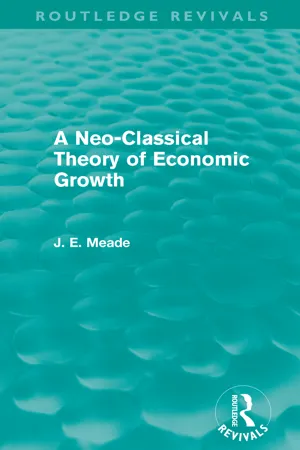
First published in 1960, this seminal work illuminates the interrelations of the various approaches to the theory of economic growth. Professor Meade seeks to understand the factors which determine the speed of economic growth and outlines the ways in which classical economic analysis may be developed for application to the problem of economic growth.
- 146 pages
- English
- ePUB (mobile friendly)
- Available on iOS & Android
eBook - ePub
A Neo-Classical Theory of Economic Growth (Routledge Revivals)
CHAPTER 1
Introduction
The purpose of this book is limited. It is designed to show the way in which the simplest form of classical economic system would behave during a process of equilibrium growth. Until recently most classical systems have been designed to answer problems in comparative statics—that is to say, in order to compare two economies in static equilibrium which are identical except in one respect, so that the ultimate effect of this specified change in the basic conditions of the economy on the static equilibrium values of the other relevant variables can be examined. In this book an extremely simple classical model of an economic system will be examined in such a way as to observe the process of change in the variables over time instead of for the purposes of comparing two static positions.
No elaborate attempt will be made in this book to persuade the reader of the realism or utility of the very simplified classical economy here examined. But the author would in fact claim that this analysis has a real usefulness. There is presumably in any case some limited usefulness in bringing out the implications for economic growth of the type of classical analysis with which economists are all so familiar. It may, in the author's opinion, be argued further that in the social studies there is a special merit in continuity of tradition and method—that there is positive virtue in putting new wine in old bottles if the bottles are strong enough. And in this case, in the author's opinion, the bottles will stand the strain. An economy can grow for three reasons : first, because net savings are being made out of current income so that the stock of capital instruments of production is growing; second, because the working population is growing; and, third, because technical progress allows more and more output to be produced by a given amount of resources as time passes. There is nothing in the nature of things which prevents one from examining the way in which a classical model of an economic system (e.g. with perfect atomistic competition) would behave over time if real capital were being accumulated, the working population were growing, and technical progress were taking place. One can then subsequently attempt to bring the results nearer to reality by modifying the classical assumptions of this growing classical economy (e.g. by allowing for the effects of certain forms of imperfect competition). There is no reason in the author's opinion why this should prove to be an unprofitable procedure; but the purpose of this book is limited to the production of the model and does not attempt to demonstrate its utility.
What then are the basic assumptions upon which the model in this book is constructed? It will be assumed throughout that we are dealing with a closed economy without any economic or financial relationships with other economies; that there are no State or governmental economic activities involving taxation or State expenditure; and, unless it is stated to the contrary, that all economic activity is carried out in conditions of perfect competition (with its corollaries of prices equal to marginal costs and net factor rewards equal to the value of their marginal net products), and that there are constant returns to scale in the sense that if, in any given state of technical knowledge, all the factors of production in any one industry were increased by x per cent then the output would also be increased by x per cent.
We shall assume further that there are only two commodities produced in our economy, namely a consumption good and a capital good. The consumption good satisfies all ultimate human needs for food, clothing, shelter, etc., while the capital good is used as an intsrument of production to assist the production of a further output of consumption goods or capital goods. The capital good is, therefore, both the output of one of our two industries and also an instrument of production used in both of our two industries. To ease the exposition, when we are thinking of the current output of the capital-good industry we shall talk of ‘capital goods’; but when we are considering the stock of capital goods available at any moment of time to aid in the production of further output we shall talk of ‘machines’. Machines constitute the only form of capital. Working capital in the form of goods in process of production is neglected. Besides machines there are two other factors of production in our economy, namely land and labour. We have then a certain amount of land, labour, and machines being used at any one time to produce a certain output of consumption goods; and we have at the same time the remaining available amount of land, labour, and machines being used to produce a certain output of capital goods, which will themselves be being used to replenish the existing stock of machines.
We desire to watch this system grow through time as the existing stock of machines grows, as the size of the working population increases, and as technical progress raises productivity. But in this book we shall confine ourselves to watching this process of growth on the assumption that the growing system remains in equilibrium. We must explain at some length what is meant by this; and this explanation can perhaps best be made in terms of the monetary system which we shall be assuming.
Although we are assuming that there is no governmental budget —no taxation and no State expenditure—we are not assuming that there is no central monetary authority. On the contrary, we shall assume that there is a banking system with a central bank and that the rate of interest is thereby always set at such a level as to preserve a constant cost-of-living index, i.e. a constant money price of our single consumption good. The mechanism must be of the following type. If the price of the consumption good tends to fall, the rate of interest is lowered (or more generally the terms on which monetary funds can be acquired by our private entrepreneurs for expenditure on investment in new machines are eased) so as to increase the incomes of those producing capital goods and, through the multiplier, the incomes of those producing consumption goods to the degree necessary to increase monetary expenditure on consumption goods to the extent necessary to prevent any fall in their money price. This easing (or tightening) of monetary conditions must be imagined to be carried out with such foresight and precision that there is never in effect any appreciable fall (or rise) in the money price offered for a consumption good.
Against this background of a constant money selling price for the consumption good we assume that full employment of labour and land available at any one moment of time is achieved by the adjustment of the money wage per worker and the money rent per acre of land. The wage per worker is always low enough to give entrepreneurs (who are faced with a constant price at which they can sell the final product of labour) an incentive to employ the whole available labour force, and the wage per worker is never so low as to cause the demand for labour by entrepreneurs to exceed the available supply. And similarly with the money rent per acre. Once more we must assume that these adjustments of factor prices are carried out with perfect foresight and precision so that there is never any excess supply of, or excess demand for, labour or land1.
We thus have in our model of equilibrium growth a constant money price of consumption goods and full employment of labour and land. Presumably we also need some similar assumption to ensure the continuous full employment of the available stock of our third factor, machines. But this is in fact already implied in our monetary assumptions. An entrepreneur will wish to employ another machine if the interest which he will have to pay on the employment of an additional machine is sufficiently below the profit which he can hope to earn on an additional machine. If in any given circumstances the rate of interest is set too high by the monetary authorities, entrepreneurs will have little or no incentive to invest in more machinery; and expenditure on investment in new machines will be zero or very low so that a deflation of money incomes and of the money price of consumption goods will not be avoided. On the other hand if the rate of interest is set too low by the monetary authorities, entrepreneurs will have an incentive not only to employ all the existing stock of machnies, but also to add to their stock of machines at a very high rate; but this will involve an excessive level of expenditure on investment in new machines so that an inflation of the price of the consumption good would not be avoided. In other words if we assume that the money wage per worker and the money rent per acre are always at the level required to ensure full employment of labour and land and if we further assume that the rate of interest is set at a level which ensures that the flow of money expenditure on investment in new machines is sufficient to prevent any rise or fall in the money price of consumption goods, we are in effect also assuming that the existing stock of machines is fully employed.
If we are assuming that, no matter what the amount of land may be or how quickly the population is growing or the stock of machines is accumulated, there is always full employment of all available land, labour, and machinery, we are, of course, assuming that the production functions are such that one can in fact substitute one factor for another. It is possible in any given state of technical knowledge to produce our consumption good or our capital good by a more labour-intensive method (if labour is cheap and plentiful), by a more land-intensive method (if land is cheap and plentiful), or by a more machinery-intensive method (if machines are plentiful and cheap to hire)1.
This is in fact a very realistic assumption. Different techniques are in fact used according to the price of the factors of production. But in the case of the substitutability between machines on the one hand and land and labour on the other hand we shall start by making an additional and very unrealistic assumption. In fact a machine is designed and built for a certain technique of production —a simple hand-loom if the hire of labour is very cheap and that of machinery is very expensive, but an elaborate automatic loom if the hire of labour is very expensive and that of machinery is very cheap. But once a particular machine is designed and built there are in fact often very narrow limits to the degree to which the amount of labour can be varied with that particular machine. In other words, in reality, machinery of a given cost can in the long run be designed in a form to be used with a large, or in a form to be used with a small, amount of labour; but in the short run it is not possible greatly to alter the amount of labour which can profitably be employed to operate a given machine.
We shall, however, start with the unreal but simple assumption that all machines are alike (they are simply a ton of steel) and that the ratio of labour to machinery (i.e. of workers to tons of steel in stock) can be varied with equal ease in the short run as in the long run. We may call this the assumption of perfect malleability of machinery; for it is exactly as if a certain tonnage of steel which had been constructed into a machine of a given sort (i.e. suitable to produce one of our two products with the techniques expected to be the most appropriate for the state of technical knowledge and for the relative cost of the different factors of production) could at a moment's notice and without cost be remoulded into another form of machine suitable to produce whatever had turned out to be the most profitable product by whatever had turned out to be the most profitable technique. In fact, much the same sort of result would follow from the assumption of perfect foresight, even if we did not assume that the capital good, once it had been installed in a particular form, could be readily remoulded into another form. In fact, what we are concerned with in this book is primarily to see how the economy would grow in equilibrium, i.e. in conditions in which inter alia the capital good has in all cases been wisely installed in its most appropriate forms for all the purposes for which it is being used.
Another assumption which we shall make at first is that the production function for a unit of the consumption good is at every moment of time the same as the production function for a unit of the capital good. This we may call the assumption of perfect substitutability in production between
capital goods and consumption goods. The effect of this assumption is that, whatever may happen to technical knowledge, the cost-price of a machine is the same as the cost-price of a consumption good. In effect, this is equivalent to the assumption that in our economy only one commodity is produced which may be used either for final consumption or for additions to the stock of instruments of production. The economy produces cows which may be eaten as meat or used as instruments of production to produce more cows1.
We shall not assume that machines last for ever; but we shall assume at first a rather unrealistic form of depreciation of machinery, namely that of any given stock of machines, no matter how old or how new they are, a certain percentage collapses or disappears each year. Thus each year ten per cent, for example, of the existing stock of machines (measured in tons of steel) would need to be replaced, regardless of the time for which the existing machines had already been used. This we shall call the assumption of depreciation by evaporation. It has two simplifying effects in our model: in the first place, the value of the capital stock of machinery in our system is always equal to the amount of machinery in existence (e.g. the tonnage of steel in stock) multiplied by the cost price of a new machine (e.g. a newly produced ton of steel), an old ton of steel being just as valuable as a new ton of steel since of each the same proportion (e.g. ten per cent) will evaporate in any year; and, second, expenditure needed for the replacement of machinery will always be equal to the depreciation allowance which must be made in respect of the existing machinery —in the above example both being equal to ten per cent of the value of the capital stock of machinery.
At a later stage we shall discuss the effects on our system of modifying these three last assumptions (namely those of the perfect malleability of machinery, of perfect substitutability in production between capital goods and consumption goods, and of depreciation by evaporation); but we will start by setting our model to work on all these extreme simplifying assumptions.
1 These assumptions in fact mean that we are ignoring all the dynamic problems involved in ensuring that our economy does not leave the path of equilibrium growth.
1 In much of what follows we shall speak of the wage per worker, the rent per acre, and the profit per machine as measuring the cost to the entrepreneur of hiring an additional worker, acre of land, or machine. In the case of machinery this use of words needs some explanation. We are dealing only with competitive equilibrium situations. In such conditions the profit per machine must be the same in all uses. If one entrepreneur uses an extra machine for one purpose, then the opportunity cost is the profit which is lost through not being able to use that machine for some other purpose; and in a fully competitive market by one means or another (either through the interest which must be paid on a loan to purchase the machine or the terms of hire or of hire-purchase of the machine or simply the alternative opportunity of profit foregone by the owner of the machine) this profit foregone from other uses of the machine will measure the cost to the entrepreneur of using the machine for this particular purpose. Thus if the profit per machine is low throughout the economy, the cost of using a machine for any particular purpose will be low.
1 The two-commodity economy to which we shall in due course revert is one in which cows are used as machines in rather different ways to produce meat to be eaten (consumption goods) and to produce more cows (capital goods) to be used as machines to produce meat or cows. If wages or rents changed and if farming to produce meat required a different amount of labour and land per cow than did farming to breed further cows, or if technical progress in producing meat was at a different rate than in breeding further cows, the cost-price of cows might vary in terms of meat.
CHAPTER 2
Three Determinants of the Rate of Economic Growth
So long as we maintain the assumption of perfect substitutability in production between capital goods and consumption goods (which we shall do until we reach Chapter 7 below), we are in fact dealing with a single-product economy, this product being useful for the two purposes of being consumed by consumers and being used by entrepreneurs as a man-made instrument of production or machine. In this case we can say that the net output produced by the economy (which will be available for consumption or for addition to the stock of machines) depends upon four things; first, the amount of the existing stock of machines (which will help to produce the gross output of the community but will also determine how much must be deducted from this gross output to maintain the stock of machines as they evaporate); second, the amount of labour available for productive employment; third, the amount of of land or natural resources available for productive use in the economy; and, fourth, the state of technical knowledge which we assume to be improving through time. We can write this simple relationship in the form of the following production function,
Y = F(K, L, N, t)
where Y = net output or net real national income, K = the existing stock of ...
Table of contents
- Front Cover
- Half Title
- Title Page
- Copyright
- Title Page
- Copyright
- PREFACE
- CONTENTS
- 1. Introduction
- 2. Three Determinants of the Rate of Economic Growth
- 3. Changes in the Rate of Economic Growth
- 4. The State of Steady Economic Growth
- 5. An Alternative Treatment of Technical Progress
- 6. The Rigidity of Machinery
- 7. The Price of Capital Goods
- 8. Depreciation and Replacement
- APPENDIX I. The Elasticities of Substitution between Three Factors
- APPENDIX II. A Two-Product Economy
- APPENDIX III. Depreciation by Sudden Death
- SUMMARY OF NOTATION USED
Trusted by 375,005 students
Access to over 1.5 million titles for a fair monthly price.
Study more efficiently using our study tools.
Frequently asked questions
Yes, you can cancel anytime from the Subscription tab in your account settings on the Perlego website. Your subscription will stay active until the end of your current billing period. Learn how to cancel your subscription
No, books cannot be downloaded as external files, such as PDFs, for use outside of Perlego. However, you can download books within the Perlego app for offline reading on mobile or tablet. Learn how to download books offline
Perlego offers two plans: Essential and Complete
- Essential is ideal for learners and professionals who enjoy exploring a wide range of subjects. Access the Essential Library with 800,000+ trusted titles and best-sellers across business, personal growth, and the humanities. Includes unlimited reading time and Standard Read Aloud voice.
- Complete: Perfect for advanced learners and researchers needing full, unrestricted access. Unlock 1.5M+ books across hundreds of subjects, including academic and specialized titles. The Complete Plan also includes advanced features like Premium Read Aloud and Research Assistant.
We are an online textbook subscription service, where you can get access to an entire online library for less than the price of a single book per month. With over 1.5 million books across 990+ topics, we’ve got you covered! Learn about our mission
Look out for the read-aloud symbol on your next book to see if you can listen to it. The read-aloud tool reads text aloud for you, highlighting the text as it is being read. You can pause it, speed it up and slow it down. Learn more about Read Aloud
Yes! You can use the Perlego app on both iOS and Android devices to read anytime, anywhere — even offline. Perfect for commutes or when you’re on the go.
Please note we cannot support devices running on iOS 13 and Android 7 or earlier. Learn more about using the app
Please note we cannot support devices running on iOS 13 and Android 7 or earlier. Learn more about using the app
Yes, you can access A Neo-Classical Theory of Economic Growth (Routledge Revivals) by James E. Meade in PDF and/or ePUB format, as well as other popular books in Economics & Business General. We have over 1.5 million books available in our catalogue for you to explore.