- 460 pages
- English
- ePUB (mobile friendly)
- Available on iOS & Android
eBook - ePub
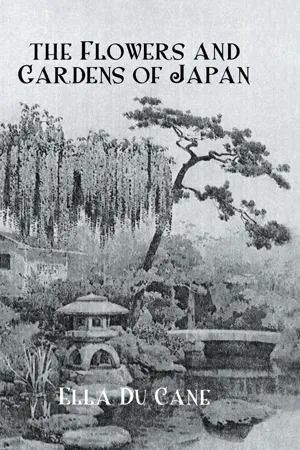
The Flowers and Gardens Of Japan
About this book
First Published in 2005. Japan is often called the land of flowers. This book gives an account of those flowers that occur in the country that are most remarkable for their beauty and profusion and that are most typically Japanese. There are also pages on landscape gardening.
Trusted by 375,005 students
Access to over 1.5 million titles for a fair monthly price.
Study more efficiently using our study tools.
Information
CHAPTER I
LANDSCAPE GARDENING
IT is safe to assert that no other country has such a distinctive form of landscape gardening as Japan. In English, French, Italian, and Dutch gardens, however original in their way, there are certain things they seem all to possess in common: terraces, which originally belonged to Italian gardens, were soon introduced into France; clipped trees, which were a distinctive feature of Dutch gardens, were copied by the English; the fashion of decorating gardens with flights of stone steps, balustrades, fountains, and statues at one time spread from Italy throughout Europe; and possibly the over-decoration of gardens led to a change in taste in England and a return to a more natural style. The gardens of China and Japan have remained unique; the Eastern style of gardening has never spread to any other country, nor is it ever likely to; for, just as no Western artist will ever paint in the same manner as an Oriental artist because his whole artistic sense is different, so no Western gardener could ever hope to construct a garden representing a portion of the natural scenery of Japan—which is the aim and object of every good Japanese landscape garden, however small—because, however long he might study the original scene, he would never arrive at the Japanese conception of it, or realise what it conveyed to the mind of a Japanese. Their art of gardening was originally borrowed from the Chinese, who appear to have been the first to construct miniature mountains, and to bring water from a distance to feed miniature water-falls and mountain torrents. They even went so far as, in one enclosure, to represent separate scenes for different seasons of the year, and different hours of the day, but to the Japanese belongs the honour of having perfected the art of landscape gardening.
It is not my intention to weary the reader with technical information on the subject, which he will find admirably explained in Mr. Conder's volume on Landscape Gardening in Japan, but an outline of some of the theories and rules which guide the Japanese gardener will help us to appreciate his work and give an additional interest to the hours spent in these refreshing retreats from the outer world.
The designer of a good landscape garden has to be guided by many things. A scene must be chosen suited to the size of the ground and the house, and its natural surroundings; and the Japanese garden being above all a spot for secluded leisure and meditation, the temperament, sentiment, and even the occupation of the owner are brought into consideration. Their conception of the expression of nature is governed in its execution by endless æsthetic rules; considerations of scale, proportion, unity, and balance, in fact all that tends to artistic harmony, must be considered, so as to preserve the perfect balance of the picture, and any neglect would destroy that feeling of repose which is so essential in the landscape garden. When we realise that the art has occupied the minds of poets, sages, and philosophers, it is not to be wondered at that something more than the simple representation of natural views has entered into the spirit of their schemes, which attain to poetical conceptions; and a garden may be designed to suggest definite ideas and associations, in fact the whole art is enshrouded by quaint aesthetic principles, and it is difficult for the Western mind to unravel the endless laws and theories by which it is governed.
In gardens which cover a larger area the scheme must necessarily be very different from that required for the making of a tiny garden, only some few yards square, but the materials used will be the same; only the stone bridges and garden ornaments will all be in proportion to the size of the garden, for the rule of proportion is perhaps the most important of all. I visited a garden which was being enlarged by the addition of a hill and the suggestion of mountain forests, to give the impression of unknown limits. The owner explained that as he had enlarged his house it was therefore necessary at the same time to enlarge his garden. A landscape garden may be of any size, from the miniature scenes, representing pigmy groves, and mossy precipices, with lilliputian torrents of white sand, compressed into the area of a china dish, to the vast gardens with their broad sheets of water and majestic trees which surrounded the Daimyo castles of old or the Imperial palaces of to-day; but the sense of true proportion must be rigidly adhered to. Large rocks and boulders are out of
WISTARIA IN A KYOTO GARDEN

place in a small garden, and small stones in a large garden would be equally unsuitable. The teachers of the craft have been most careful to preserve the purity of style. Over-decoration is condemned as vulgar ostentation, and faulty designs have even been regarded as unlucky, in order to avoid degeneration in the art.
In some of the most extensive gardens it is not uncommon to represent several favourite views, and yet the composition will be so contrived that all the separate scenes work into one harmonious whole. In the immediate foreground of a nobleman's house there will be an elaborately finished garden full of detail and carefully composed, the stones employed will be the choicest, the water-basin of quaint and beautiful design. Stone lanterns in keeping with the scene will be found, miniature pagodas possibly, and a few slabs of some precious stone to form the bridges. Farther away from the house the scheme should be less finished. Surrounding the simple room set apart for the tea ceremony the law forbids the garden to be finished in style, it must be rather rough and sketchy, and then if some natural wild scene is represented, a broad effect must be retained; a simple clump of pines or cryptomerias near a little garden shrine will represent some favourite temple, or a small grove of maples and cherry-trees by the side of a stream of running water will suggest the scenery of Arashiyama or some other romantic and poetical spot.
To our Western ideas it seems impossible that a garden without flowers could be a thing of beauty, or give any pleasure to its owner. Yet, strange as it may appear, flowers for their own sakes do not enter into the scheme of Japanese gardening, and if any blossoms are to be found, it is probably, so to speak, by accident, because the particular shrub or plant which may happen to be in flower was the one best suited by its growth for the position it occupies in the garden. For instance, azaleas are often seen covering the banks with gorgeous masses of colour, but they are only allowed, either on account of their picturesque growth and the fact that they are included in the natural vegetation of the scene produced, or else because the bushes can be cut into regulation shapes, which, as often as not, is done when the flowers are just opening. Though the Japanese are great lovers of flowers, their taste is so governed by rules, that they are extremely fastidious in their choice of the blossoms they consider worthy of admiration. The rose and the lily are rejected as unworthy, their charms are too obvious: their favourites are the iris, pæony, wistaria, lotus, morning glory, and chrysanthemum; and even among these the iris, wistaria, and possibly the lotus, are the only ones which seem ever to be allowed to belong in any way to the real design of the garden. Flowering trees take more part, and the plum, peach, cherry, magnolia, and camellia are all permitted; and the numerous fancy varieties of the maple, whose leaves enrich the autumn landscape with their scarlet glory, are as much prized as any of the blossoming shrubs. It is rather to the storm-bent old pine-trees and other evergreen trees and shrubs, to the mossy lichen-covered stones, to the clever manipulation of the water to represent a miniature mountain cascade or a flowing river, and to broad stretches of velvety moss that the true Japanese garden owes its beauty.
Mr. Conder tells us that the earliest style of gardening in the country was called the Imperial Audience Hall Style, because, not unnaturally, it was round the palaces and houses of the great nobles that the idea was first adopted of arranging the ground to suggest a real landscape. The designs appear to have been primitive, but they usually contained a large irregular lake, with at least one island reached by a bridge of picturesque form. Later—from the middle of the twelfth to the beginning of the fourteenth century—the art of gardening was much practised and encouraged by the Buddhist priests. They even went so far as to ascribe imaginary religious and moral attributes to the grouping of the stones, a custom which has more or less survived to this day and is described elsewhere. In those days a lake came to be regarded as a necessary feature, and poetical names were given to the little islets, just as the pine-clad islands of Matsu-shima have each their poetical name. Cascades also received names according to their character, such as the “Thread Fall,” the “Spouting Fall,” or the “Side Fall.” In the making of a garden then, as to-day, the first work was the excavation of the lake, the designing and forming of the islands, the placing in position of a few of the most important stones, and finally the arrangement of the waterfall or stream which was to feed the lake, and the outlet had also to be carefully considered. After this period came the fashion of representing lakes and rivers by means of hollowed-out beds and courses, merely strewn with sand, pebbles, and boulders, a practice followed also to this day where water is not available. Shallow water or dried-up river-beds are suggested in this way, and therefore the style received the name of Dried-up Water Scenery. Artificial hills were used, stones and winding pathways were introduced, and large rocks helped to suggest natural scenery.
It was in the fifteenth century that the art of gardening received the greatest encouragement and attention at the hands of the Ashikaya Regents, who also encouraged the other arts of flower arrangement — tea ceremony and poetry. The Professors of Cha no yu (tea ceremony) became the principal designers of gardens, and they naturally turned their attention to the ground which surrounded the rooms set apart for this ceremonial tea-drinking; and to the famous Soami, who was a Professor of Tea-ceremonial and the Floral Art, they owe the practice of clipping trees and shrubs into fantastic shapes. Though the Japanese never attained to the unnatural eccentricities of the Dutch in their manner of using clipped trees, yet in many old and modern gardens a pine-tree may be seen clipped and trained in the shape of a junk, and a juniper may be trained to form a light bridge to fling across a tiny stream; but as a rule the gardener contents himself by training and clipping his pine-tree to mould it into the shape of an abnormal storm-bent specimen of great age. To that period belonged Kobori Enshiu, the designer of so many celebrated gardens, and to him we owe the garden of the Katsura Rikui, a detached Palace near Kyoto, which, though fallen into decay, retains much of its former beauty, especially when the scarlet azalea bushes, which now escape the clipping they no doubt were subjected to in old days, light up the scene, their lichen-clad stems bending under the weight of their blossoms and enhancing the beauty of the moss-grown lanterns and stones. The garden which surrounded the temple of Kodaiji, a portion only of the grounds of the old palace of Awata, the Konchi-in garden of the Nanzenji Temple, and many other specimens of his work remain in Kyoto alone. He is reported to have said that his ideal garden should express “the sweet solitude of a landscape clouded by moonlight, with a half gloom between the trees.” Rikiu, another great tea professor and designer of landscape gardens, said the best conception of his fancy would be that of the “lonely precincts of a secluded mountain shrine, with the red leaves of autumn scattered around.” However different their ideal, they all agreed that the tea garden was to be somewhat wild in character, suggesting repose and solitude. Then came the more modern style of gardening: from 1789 to 1830 was a period when large palaces were built and surrounded by magnificent gardens, fit residences for the great Tokugawa feudal lords. For these gardens great sums were expended on collecting stones from all parts of the country, and often a garden would be left unfinished until the exact stone suited to express the required religious or poetical feeling, or else specially required to complete a miniature natural scene, had been procured. The extravagance in this craving for rare stones, which cost vast sums to transport immense distances, reached such a pitch, that at last, in the Tempo period (1830–1844), an edict was issued limiting the sum which might be paid for a single specimen. Stone and granite lanterns of infinite variety in size and shape were introduced with their poetical names, each having a special position assigned to it by the unbending laws which surround this art, for the arrangement of not only every tree and stone, but almost every blade of grass and drop of water. I feel my readers will begin to think that there must be a lack of variety in these landscape gardens, but I can safely say that never did I see—and I saw a great many—any two gardens, large or small, which bore any resemblance to each other; the materials are the same, but the design is never the same.
Garden water-basins, miniature pagodas, stone bridges, also of infinite variety, and other garden ornaments, such as rustic arbours, fanciful constructions of bamboo, reeds, or plaited rushes, primitive, fragile-looking structures, but none the less costly, were made use of, and a few rare birds, such as storks and cranes, were allowed to wander and adorn the scene with their stately grace. Here and there the crooked branches of stunted pine-trees of great age overhung the lake or stream, transplanted probably with infinite care; but no trouble and no expense was too great to make these gardens fitting settings for the castles and palaces of those great lords. Alas, how few remain to-day in anything like their former splendour; the hand of the Goth has swept away most of the ancient glories of Yedo, and on the spot where these princely dwellings and gardens stood, to-day some great factory chimneys rise and belch forth columns of smoke, which will surely bring death and destruction to the pines and cherry-trees
THE STORKS

of Uyeno or the avenues of Mukojima, which are still the pride of Tokyo.
Tokyo may still retain the remains of some of her princely gardens, but I fear she has lost her love of gardening; the town is too large, too crowded; the rich who could afford to make new gardens, even if the old ones are swept away, prefer to live in foreign houses of impossible architectural design; the public gardens are no longer laid out in true Japanese style, but suggestive rather of foreign gardens of the worst form and taste, so if you would see the making of a new garden it is to Kyoto you must wend your way. Here the love of landscape gardening seems still alive, and though the gardens may not surround the palaces of the Daimyos, yet these humbler gardens which as often as not surround the house of a rich Osaka tradesman are none the less beautiful for that reason; and I was glad to think that riches had not, as is too often the case, brought with it a love for foreign life and stamped out the true Japanese, and that here at least are left many who are content to spend their hours of leisure in the contemplation and in the repose of a true landscape garden.
In the course of an evening walk on the out-skirts of Kyoto I came upon a half-built house. Through the newly planted cryptomeria hedge could be seen glimpses of stone lanterns, rocks, and a few trees kept in place by bamboo props, while in ...
Table of contents
- Cover
- Half Title
- Title Page
- Copyright Page
- Preface
- Table of Contents
- List of Illustrations
- 1. LANDSCAPE GARDENING
- 2. STONES—GARDEN ORNAMENTS AND FENCES
- 3. LANDSCAPE GARDENS
- 4. NURSERY GARDENS—DWARF TREES AND HACHI-NIWA
- 5. TEMPLE GARDENS
- 6. SUMMER FLOWERS
- 7. PLUM BLOSSOM
- 8. PEACH BLOSSOM
- 9. CHERRY BLOSSOM
- 10. WISTARIA AND PÆONY
- 11. AZALEAS
- 12. THE IRIS
- 13. THE MORNING GLORY
- 14. THE LOTUS
- 15. THE CHRYSANTHEMUM
- 16. THE MAPLE LEAVES
- 17. THE BAMBOO
- 18. THE PINE-TREE
Frequently asked questions
Yes, you can cancel anytime from the Subscription tab in your account settings on the Perlego website. Your subscription will stay active until the end of your current billing period. Learn how to cancel your subscription
No, books cannot be downloaded as external files, such as PDFs, for use outside of Perlego. However, you can download books within the Perlego app for offline reading on mobile or tablet. Learn how to download books offline
Perlego offers two plans: Essential and Complete
- Essential is ideal for learners and professionals who enjoy exploring a wide range of subjects. Access the Essential Library with 800,000+ trusted titles and best-sellers across business, personal growth, and the humanities. Includes unlimited reading time and Standard Read Aloud voice.
- Complete: Perfect for advanced learners and researchers needing full, unrestricted access. Unlock 1.5M+ books across hundreds of subjects, including academic and specialized titles. The Complete Plan also includes advanced features like Premium Read Aloud and Research Assistant.
We are an online textbook subscription service, where you can get access to an entire online library for less than the price of a single book per month. With over 1.5 million books across 990+ topics, we’ve got you covered! Learn about our mission
Look out for the read-aloud symbol on your next book to see if you can listen to it. The read-aloud tool reads text aloud for you, highlighting the text as it is being read. You can pause it, speed it up and slow it down. Learn more about Read Aloud
Yes! You can use the Perlego app on both iOS and Android devices to read anytime, anywhere — even offline. Perfect for commutes or when you’re on the go.
Please note we cannot support devices running on iOS 13 and Android 7 or earlier. Learn more about using the app
Please note we cannot support devices running on iOS 13 and Android 7 or earlier. Learn more about using the app
Yes, you can access The Flowers and Gardens Of Japan by Ella Du Cane in PDF and/or ePUB format, as well as other popular books in Social Sciences & Anthropology. We have over 1.5 million books available in our catalogue for you to explore.