- 403 pages
- English
- ePUB (mobile friendly)
- Available on iOS & Android
eBook - ePub
About this book
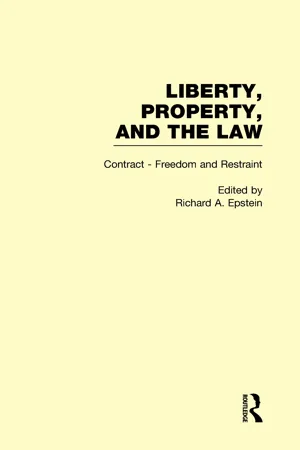
First Published in 2000. Where a well-run society should rest on the continuum between public and private control has been the most contentious and thorny issue of legal and social theory throughout the generations. This series sets out to provide answers to this ongoing dispute contained in the five volumes of material assembled. The collection draws from many disciplines, including economics, law, philosophy and political science. Yet they are all directed to a topic that is worthy of examination from multiple perspectives: Liberty, Property and the Law.
| VOLUME 100 | JUNE 1987 | NUMBER 8 |
HARVARD LAW REVIEW
ARTICLE
MARKET-INALIENABILITY
Things that may be given away but not sold are market-inalienable. In this Article, Professor Radin explores the significance of market-inalienability and its justifications. The author considers and rejects two archetypes that fail to recognize market-inalienability as a separate category of social interaction. One, universal commodification, holds that everything should in principle be subject to market transfer; the other, universal noncommodification, holds that the market should be abolished. Professor Radin also explores and ultimately rejects attempts based on economic analysis and liberal philosophical doctrines to justify particular distinctions between things that are and things that are not appropriately traded in markets. She then offers an alternative justification for market-inalienability that relates it to an ideal of human flourishing. This theory takes into account both the rhetoric in which we conceive of ourselves and our situation in nonideal circumstances. Professor Radin concludes by demonstrating how the theory might be applied to three contested market-inalienabilities: prostitution, baby-selling, and surrogate motherhood.
SINCE the declaration of “unalienable rights” of persons at the founding of our republic,1 inalienability has had a central place in our legal and moral culture. Yet there is no one sharp meaning for the term “inalienable.” Sometimes inalienable means nontransferable;2 sometimes only nonsalable.3 Sometimes inalienable means nonrelinquishable by a rightholder;4 sometimes it refers to rights that cannot be lost at all.5 In this Article I explore nonsalability, a species of innlienabilitv I call market-inalienability. Something that is market inalienable is not to be sold, which in our economic system means it is not to be traded in the market.
Controversy over what may be bought and sold — for example, blood or babies — pervades our news. Although some scholars have considered whether such things may be traded in markets, they have not focused on the phenomenon of market-inalienability. About fifteen years ago, for example, Richard Titmuss advocated in his book, The Gift Relationships,6 that human blood should not be allocated through the market; others disagreed.7 More recently, Elisabeth Landes and Richard Posner suggested the possibility of a thriving market in infants,8 yet most people continue to believe that infants should not be allocated through the market.9 What I believe is lacking, and wish to supply, is a general theory that can illuminate these debates. Two possibilities for filling this theoretical gap are traditional liberalism and modern economic analysis, but in this Article I shall find them both wanting.
The most familiar context of inalienability is the traditional liberal triad: the rights to life, liberty, and property. To this triad, liberalism juxtaposes the most familiar context of alienability: traditional property rights. Although the right to hold property is considered inalienable in traditional liberalism, property rights themselves are presumed fully alienable, and inalienable property rights are exceptional and problematic.
Economic analysis, growing out of the liberal tradition, tends to view all inalienabilities in the way traditional liberalism views inalienable property rights. When it does this, economic analysis holds fast to one strand of traditional liberalism, but it implicitly rejects — or at least challenges — another: the traditional distinction between inalienable and alienable kinds of rights. In conceiving of all rights as property rights that can (at least theoretically) be alienated in markets, economic analysis has (at least in principle) invited markets to fill the social universe. It has invited us to view all inalienabilities as problematic.
In seeking to develop a theory of market-inalienability, I argue that inalienabilities should not always be conceived of as anomalies, regardless of whether they attach to things traditionally thought of as property. Indeed, I try to show that the characteristic rhetoric of economic analysis is morally wrong when it is put forward as the sole discourse of human life. My general view deviates not only from the traditional conception of the divide between inalienable and alienable kinds of rights, but also from the traditional conception of alienable property. Instead of using the categories of economics or those of traditional liberalism, I think that we should evaluate inalienabilities in connection with our best current understanding of the concept of human flourishing.
To develop this theory, which will help us to decide what things ought not to be bought and sold, I must lay a rather complex groundwork. In Part I, I articulate the various meanings of inalienability and introduce the idea of commodification. In Part II, I explore an economic view that sees all things as exchangeable, first reflecting generally on the rhetoric and methodology of the market and then examining how inalienability is seen as a method of correcting market failures. In Part III, I consider a critique of the economic view that would reject markets entirely. I find this Utopian vision to be flawed by a pervasive problem of transition, but suggest we take seriously its philosophical connection between rhetoric and human flourishing. In Part IV, I consider the traditional liberal divide between market and nonmarket realms and show that the philosophical commitments of the liberal view have tended to push it toward the economic view. Finally, in Part V, I advocate a nonideal, pragmatic evaluation of market-inalienabilities based on a conception of personhood or human flourishing that differs from that of traditional liberalism or economics. In developing this analysis, I attempt to address the transition problem that plagues our pursuit of social ideals. To show how the analysis I recommend might illuminate specific issues of market-inalienability that deeply trouble us, I conclude by bringing it to bear on commodification of sexuality and reproductive capacity: prostitution, baby-selling, and surrogacy.
I. MARKET-INALIENABILITY AND NONCOMMODIFICATION
In order to focus effectively on market-inalienability and its moral and social significance, it will be helpful first to have an overview of the range of meanings of inalienability, as well as an idea of the framework connecting alienability and commodification.
A. Traditional Meanings
Theorists have seldom recognized that we have no one sharp meaning of inalienability.10 Nevertheless, the traditional meanings of inalienability share a common core: the notion of alienation as a separation of something — an entitlement, right, or attribute11 — from its holder. Inalienability negates the possibility of separation. Meanings proliferate because the separation that constitutes alienation can be either voluntary or involuntary, and can result in the entitlement, right, or attribute ending up in the hands of another holder, or in its simply being lost or extinguished.12 Any particular entitlement, right, or attribute may be subject to one or more forms of inalienability.
In one important set of meanings, inalienability is ascribed to an entitlement, right, or attribute that cannot be lost or extinguished. If involuntary loss is its focus, inalienable may mean nonforfeitable13 or noncancelable; if voluntary loss is its focus, inalienable may mean nonwaivable14 or nonrelinquishable.
In another important set of meanings, inalienability is ascribed to an entitlement, right, or attribute that cannot be voluntarily transferred from one holder to another.15 Inalienability in these uses may mean nongiveable, nonsalable, or completely nontransferable. If something is nontransferable, the holder cannot designate a successor holder.16 Nongiveability and nonsalability are subsets of nontransferability. If something is inalienable by gift, it might be transferred by sale;17 if it is inalienable by sale, it might be transferred by gift.18 This nonsalability is what I refer to as market-inalienability. In precluding sales but not gifts, market-inalienability places some things outside the marketplace but not outside the realm of social intercourse.
Market-inalienability negates a central element of traditional property rights, which are conceived of as fully alienable.19 But market-inalienability differs from the nontransferability that characterizes many nontraditional property rights — entitlements of the regulatory and welfare state — that are both nongiveable and nonsalable.20 Market-inalienability also differs from the inalienability of other things, like voting rights, that seem to be moral or political duties related to a community's normative life; they are subject to broader inalienabilities that preclude loss as well as transfer.21 Unlike the inalienabilities attaching to welfare entitlements or political duties, market-inalienability does not render something inseparable from the person, but rather specifies that market trading may not be used as a social mechanism of separation. Finally, market-inalienability differs from the inalienability of things, like heroin, that are made nontransferable in order to implement a prohibition,22 because it does not signify that something is social anathema. Indeed, preclusion of sales often coexists with encouragement of gifts. For example, the market-inalienability of human organs does not preclude — and, indeed, may seek to foster — transfer from one individual to another by gift.23
B. The Commodification Issue
Market-inalienability often expresses an aspiration for noncommodification. By making something nonsalable we proclaim that it should not be conceived of or treated as a commodity.24 When something is noncommodifiable, market trading is a disallowed form of social organization and allocation. We place that thing beyond supply and demand pricing, brokerage and arbitrage, advertising and marketing, stockpiling, sp...
Table of contents
- Cover
- Half Title
- Series Contents
- Title Page
- Copyright Page
- Table of Contents
- Series Introduction
- Volume Introduction
- The Basis of Contract
- Contracts of Adhesion — Some Thoughts About Freedom of Contract
- Economic Duress — An Essay in Perspective
- The English Common Law Concerning Monopolies
- Unconscionability and the Code — The Emperor's New Clause
- Employment at Will vs. Individual Freedom: On Limiting the Abusive Exercise of Employer Power
- In Defense of the Contract at Will
- Market-Inalienability
- Opting Out of the Legal System: Extralegal Contractual Relations in the Diamond Industry
- Acknowledgments
Trusted by 375,005 students
Access to over 1.5 million titles for a fair monthly price.
Study more efficiently using our study tools.
Frequently asked questions
Yes, you can cancel anytime from the Subscription tab in your account settings on the Perlego website. Your subscription will stay active until the end of your current billing period. Learn how to cancel your subscription
No, books cannot be downloaded as external files, such as PDFs, for use outside of Perlego. However, you can download books within the Perlego app for offline reading on mobile or tablet. Learn how to download books offline
Perlego offers two plans: Essential and Complete
- Essential is ideal for learners and professionals who enjoy exploring a wide range of subjects. Access the Essential Library with 800,000+ trusted titles and best-sellers across business, personal growth, and the humanities. Includes unlimited reading time and Standard Read Aloud voice.
- Complete: Perfect for advanced learners and researchers needing full, unrestricted access. Unlock 1.5M+ books across hundreds of subjects, including academic and specialized titles. The Complete Plan also includes advanced features like Premium Read Aloud and Research Assistant.
We are an online textbook subscription service, where you can get access to an entire online library for less than the price of a single book per month. With over 1.5 million books across 990+ topics, we’ve got you covered! Learn about our mission
Look out for the read-aloud symbol on your next book to see if you can listen to it. The read-aloud tool reads text aloud for you, highlighting the text as it is being read. You can pause it, speed it up and slow it down. Learn more about Read Aloud
Yes! You can use the Perlego app on both iOS and Android devices to read anytime, anywhere — even offline. Perfect for commutes or when you’re on the go.
Please note we cannot support devices running on iOS 13 and Android 7 or earlier. Learn more about using the app
Please note we cannot support devices running on iOS 13 and Android 7 or earlier. Learn more about using the app
Yes, you can access Contract - Freedom and Restraint by Richard A. Epstein in PDF and/or ePUB format, as well as other popular books in Law & Contract Law. We have over 1.5 million books available in our catalogue for you to explore.