- 350 pages
- English
- ePUB (mobile friendly)
- Available on iOS & Android
eBook - ePub
About this book
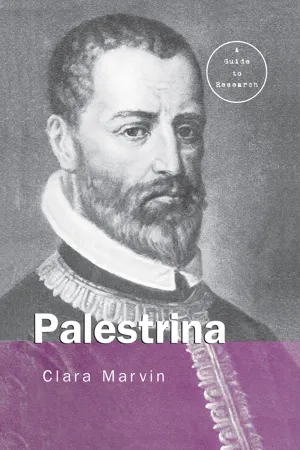
First Published in 2002. This guide introduces students and scholars to the literature on Palestrina as well as the complicated history of the publication of his works. This bibliography is divided into four primary sections: historical background on musical, social, and cultural life; biographical literature; studies of sources, music, and style; and reception history. They are divided roughly into the periods dating from Palestrina's lifetime to about 1750; from about 1750 to about 1914; from 1914 to the present. This title also contains historical research on performance conditions and practices as they would have applied in Palestrina's time.
Information
Chapter 1
Chronology and Biographical Outline
Part I: 1525–1544
Giovanni Pierluigi is born, probably between February 3, 1525 and February 2, 1526, either in the town of Palestrina or in Rome, to Santo (also spelled Sante) Pierluigi and his wife, Palma. The precise date of the child’s birth remains unknown, but the obituary written by Melchior Major describes him as having lived sixty-eight years. It has been suggested that his birthday might have been December 27, the feast day of the composer’s name saint, John (Heinemann 1994). In a Roman census in early 1527, one “Santo de Prenestino” is listed as head of a household of twelve in the rione Monti, a neighborhood near the church of St. John Lateran (Casimiri 1918–1922).
The first documentary evidence of his life is in the form of a will made on October 22, 1527 by his paternal grandmother, Jacobella (Cametti 1903). In the will she divided her estate among her four children, two sisters, a daughter-in-law Palma (Santo’s wife), and “il piccolo Giovanni,” her grandson. The particular mention of Giovanni suggests hat he may have been a firstborn grandchild (Bianchi 1995 [E0079]).
On January 16,1536, the composer’s mother, Palma Pierluigi dies.
A contract dated October 25,1537 lists “Giovanni da Palestrina” as the second of six pueri chorialis at Santa Maria Maggiore (Casimiri 1918–1922) entitled to receive musical instruction and an education as well as clothing and care. Hypothetically, he may have entered the basilica as early as 1533, for the typical age of admission for such children was around six to eight years of age. The music masters at the basilica in the period 1538–1540 included Rubino Mallapert (1538–1539), “Robert” (perhaps Robert de Fevin), and Firmin Le Bel (1540).
On May 11, 1540, Santo Pierluigi, Giovanni’s widowed father, married Maria Gismondi. Five children were eventually born of the marriage.
Part II: 1544–1571
| 1544–1549 | A contract dated October 28, 1544 indicates that “Giovanni ftglio di Sante Pietro Aloisio da Palestrina” has been engaged as an organist at the church of San Agapito in Palestrina. He was required to play the organ on feast days and to lead the choir at mass, vespers, and compline. He was also expected to instruct the clergy in plainchant or else to undertake the musical education of some of the choirboys (Casimiri 1924; see item E0105). Further documentation of Giovanni’s professional activities in Palestrina is lacking until 1551. |
On December 13, 1545, the Council of Trent (the Nineteenth General Council of the church) is opened. | |
On June 12, 1547, Palestrina marries Lucrezia Gori, the daughter of the deceased Francesco de Goris. On November 7, the couple receive a dowry of 130 florins from the estate of Lucrezia’s father, while on November 16 the division of property is made, and Lucrezia receives various household items from her family inheritance. Sancta Gori, Lucrezia’s mother, dies on December 13. | |
In Rome, Philip Neri with Persiano Rosa founds the confraternity of SS. Trinità dei Pellegrini in 1548, while Marcello Cervini (afterwards pope) becomes head of the Vatican Library. | |
Lucrezia and Giovanni’s son Rodolfo is born sometime in 1549 or 1550 (and dies in 1572). | |
1550 | On February 8, after an extended conclave due to political conditions, Cardi-nal Giovanni Maria Ciocchi del Monte (bishop of Palestrina) is elected Pope Julius III. The new pope’s successor in the bishopric of Palestrina, Cardinal Luigi Borbone, names Giovanni Pierluigi as organist and maestro di cappella at San Agapito. |
1551–1553 | Palestrina’s second son Angelo is born (dies 1571). On September 1, Pope Julius III appoints the composer maestro di cappella at the Cappella Giulia (San Pietro). He receives a salary of 10 scudi per month, plus four more for the maintenance of two choirboys. Mallapert meanwhile leaves the Vatican to assume another position at Santa Maria Maggiore. Together with the chapel choir, Palestrina probably also participates in confraternity, processional, and other extramural activities. Some Magnificat and other works are datable to this early Vatican period, around 1552. |
1554 | Palestrina publishes Missarum liber primus [Dorico] with a dedication to Pope Julius III (Giovanni Maria del Monte). This is the first single publication of masses issued in Rome by a native Italian composer. In the same year, the madrigal Con dolce altiero appears in a Venetian anthology published by Gardano. |
1555 | On January 13, Palestrina is admitted to the Sistine Chapel at the command of Pope Julius, in spite of being married and without being examined or with the consent of the singers. As he was not considered to have a particularly good voice, he was most likely admitted on the basis of already demonstrated compositional skill (Sherr 1994). On March 23, however, Julius III dies, and on April 9 he is succeeded by the humanist cardinal Marcello Cervini, who takes the name Marcellus II. On April 12, three days after his election, as reported in the diary of Angelo Massarelli, the new pope’s private secretary, Marcellus admonishes the papal singers to sing the divine services “with properly modulated voices, and … in such a way that everything could be heard and understood.” However, after a pontificate of only three weeks, Marcellus dies (April 30). He is succeeded on May 23 by Giovanni Pietro Caraffa, Pope Paul IV. |
Beginning in mid-July, the composer apparently suffers from a serious illness for several weeks. | |
On July 30, a decretal is issued forbidding the presence of married singers in the chapel membership. In September, Palestrina and two other married singers are dismissed from the Cappella Sistina as the chapel’s rule requiring celibacy of its members is enforced. He receives a pension, however. But on October 1, he is named maestro di cappella of St. John Lateran, the pope’s episcopal seat, where he remains until 1560. His payment is 6 scudi per month. | |
During this year, II primo libro di madrigali a quattro voci is published ... |
Table of contents
- Cover
- Half Title
- Routledge Musical Bibliographies
- Title Page
- Copyright Page
- Table of Contents
- Introduction
- Abbreviations
- 1. Chronology and Biographical Outline
- 2. Primary Sources: Printed Music
- 3. Primary Sources: A Checklist of Manuscripts
- 4. Modern Editions of Palestrina's Music I: Comprehensive Editions
- 5. Modern Editions of Palestrina's Music II: Collected and Individual Works
- 6. Bibliography of Secondary Literature
- 7. Discography
- Index
Trusted by 375,005 students
Access to over 1.5 million titles for a fair monthly price.
Study more efficiently using our study tools.
Frequently asked questions
Yes, you can cancel anytime from the Subscription tab in your account settings on the Perlego website. Your subscription will stay active until the end of your current billing period. Learn how to cancel your subscription
No, books cannot be downloaded as external files, such as PDFs, for use outside of Perlego. However, you can download books within the Perlego app for offline reading on mobile or tablet. Learn how to download books offline
Perlego offers two plans: Essential and Complete
- Essential is ideal for learners and professionals who enjoy exploring a wide range of subjects. Access the Essential Library with 800,000+ trusted titles and best-sellers across business, personal growth, and the humanities. Includes unlimited reading time and Standard Read Aloud voice.
- Complete: Perfect for advanced learners and researchers needing full, unrestricted access. Unlock 1.5M+ books across hundreds of subjects, including academic and specialized titles. The Complete Plan also includes advanced features like Premium Read Aloud and Research Assistant.
We are an online textbook subscription service, where you can get access to an entire online library for less than the price of a single book per month. With over 1.5 million books across 990+ topics, we’ve got you covered! Learn about our mission
Look out for the read-aloud symbol on your next book to see if you can listen to it. The read-aloud tool reads text aloud for you, highlighting the text as it is being read. You can pause it, speed it up and slow it down. Learn more about Read Aloud
Yes! You can use the Perlego app on both iOS and Android devices to read anytime, anywhere — even offline. Perfect for commutes or when you’re on the go.
Please note we cannot support devices running on iOS 13 and Android 7 or earlier. Learn more about using the app
Please note we cannot support devices running on iOS 13 and Android 7 or earlier. Learn more about using the app
Yes, you can access Giovanni Pierluigi da Palestrina by Clara Marvin in PDF and/or ePUB format, as well as other popular books in Media & Performing Arts & Music. We have over 1.5 million books available in our catalogue for you to explore.