![]()
1
The protection and enhancement of sport through responsible corporate governance
Mohammed Ben Sulayem
Overview
This chapter gives an initial overview of the career of Mohammed Ben Sulayem and his current role as President of the Automobile and Touring Club of the United Arab Emirates (ATCUAE) and that of the Vice President of the Federation Internationale de LAutomobile (FIA). It introduces the reader to the power that sport exercises as a medium for building relationships in the Middle East and overcoming language, cultural and religious barriers wherever they emerge. The chapter examines how the process of effective governance plays an integral role in the delivery and organisation of modern sport and does so whilst profiling related governance matters which are manifest in the management of sport on a global scale. Issues of transparency, accountability and fairness are addressed within the chapter, and examples of the value of volunteerism, good governance, and the implications of politics and legislative matters are also provided. In this regard, a high-profile case study, dealing specifically with the issue sport governance, serves as a suitable opening to the chapter.
Case Study 1: FIA vs. Ferrari in 2010
The Fédération Internationale de L’Automobile (FIA) is the governing body that brings together 213 national motoring organisations from 125 countries. As the FIA’s Vice President, the author has a responsibility to promote the sport to the general public, but ultimately to ensure motorsport remains devoid of what many may consider to be unethical behaviour. The FIA focuses upon a code of ethics established around democracy and transparency, which it uses as a starting point for its worldwide operations. The FIA has established a series of legally binding statutes that are rigorously enforced by those in positions of responsibility throughout the FIA. The relationship between governance and legality within the sporting movement is a particular area of concern as the world at large becomes seemingly evermore bound by various legal complexities and requirements. A relevant example of the pressures faced by sport organisations is profiled in the legal battle which took place between the FIA and the Ferrari team in 2010. In the controversy that broke following the issuing of so-called ‘team orders’ by Ferrari in relation to the actions of their drivers and the team as a whole, the author was called upon to perform a central role in the resolution of this dispute.
At the F1 German Grand Prix 2010, staged at the Hockenheim circuit, Ferrari’s Felipe Massa (who had dominated the race from its beginning and was leading coming into the final laps) pulled aside and permitted his teammate Fernando Alonso to pass him in an unchallenged manner. Alonso had been leading the F1 Driver’s Championship and it may have been considered by some to be in the best interests of the Ferrari team to secure a first and second place finish in the race, with Alonso of course claiming first prize. This act by Ferrari was thought to have constituted a ‘team order’, which is deemed illegal within the sport of F1 as it is seen to affect an unnatural outcome to an otherwise competitive race. The incident provoked a widespread backlash against Ferrari from other teams and indeed fans and commentators of the sport argued its actions had damaged the credibility of motorsport as an industry. Ferrari argued that this act did not constitute a ‘team order’, but nevertheless the stewards decided that it had contravened Article 39.1 of the sporting regulations, which states that ‘team orders which interfere with a race result are prohibited’ and article 151 (c) of the International Sporting Code, which outlaws ‘any fraudulent conduct or any act prejudicial to the interests to any competition or the interests of motor sport generally’. The stewards at the race decided to impose a maximum fine of US $100,000 on Ferrari and also forwarded their decision to the World Motor Sport Council (WMSC), meaning that Ferrar could have faced further repercussions in the wake of the stewards’ verdict at the event.
After the fine had been imposed on the team, and maintaining Ferrari’s innocence, Team Director Stefano Domenicali stated: ‘…in the interests of sport, we have decided not to go through a procedure of appealing against it, confident that the World Council will know how to evaluate the overall facts correctly’. Felipe Massa, who pulled aside to let his teammate overtake him in the dying moments of the race, responded to critics by saying, ‘In my opinion this was not a case of team orders: my engineer kept me constantly informed on what was going on behind me, especially when I was struggling a bit on the hard tyres; so I decided to do the best thing for the team, and a one-two finish is the best possible result’. The FIA decided that there was insufficient evidence to prove any guilt on Ferrari’s part. However, it did decide to uphold the financial penalty placed upon the team, but also agreed that it (the FIA) would review the rules in relation to team orders from that point forward.
This was an interesting case in terms of governance issues within a modern sport organisation. Both Ferrari and the FIA had instructed legal teams to represent them at the hearing in Paris, whilst members of the FIA essentially constituted the jury throughout its hearing. Although conflicts of interest will inevitably arise in various situations relating to this style of governance, it is important that an organisation such as the FIA can regulate and enforce the rules of its sport in an independent manner, without the need for recourse to the wider legal or political communities. In order for an organisation to sustain such privileges, it is clear that the FIA and other major sports governing bodies must govern in a professional, democratic and completely impartial manner.
A boy’s story
I, Mohammed Ben Sulayem, am a proud Emirati and from my birth in 1961 my ambition was always that one day I would become an internationally established rally driver. Growing up in the UAE, the event that was closest to my heart, and one which I most sought victory in, was the FIA Middle East Championship. By the close of my competitive career I was lucky enough to have won this series on numerous occasions and indeed to have competed in many other such events around the world. As Vice President of the FIA and President of the Automobile and Touring Club of the United Arab Emirates (ATCUAE), it is now my responsibility to oversee all motorsport events in the UAE, to influence similar practices across the region and to play a key leadership role in the sport globally. I view my election as a tremendous honour for my family and I whilst it is my ambition to see motorsport in the UAE, and indeed the Middle East, become a major factor in the lives of the general public living there.
As Vice President of the FIA I am also very proud to be a part of an organisation that strives to provide leadership and direction in how sport organisations should operate around matters of transparency, professionalism and corporate social responsibility. As an organisation, we were founded in 1904, with headquarters in Paris, France and, as we did then, we continue to operate on a not-for-profit basis. All revenue generated by the FIA is invested back into motorsport in order to further grow and expand the horizons of the sport. The FIA’s jurisdiction encompasses 132 different countries and some 227 national motoring and sporting organisations situated on five continents. The scope of membership of the FIA extends not just to motorsport but also to casual motor car users and represents millions of people worldwide. As part of my responsibility as Vice President of the FIA I actively seek to protect the interests of the federation’s membership base through various campaigns and initiatives orchestrated by the governing body.
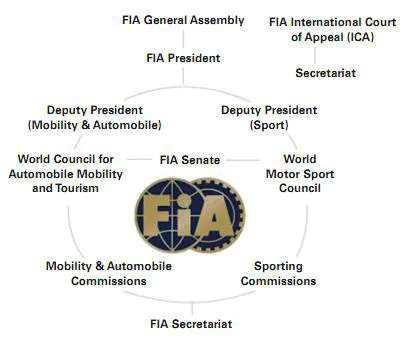
Indeed, people, quite understandably it might be said, often overlook the non-sporting aspect of our organisation, but a significant proportion of the FIA’s workforce focus on promoting our members’ interests in respect to safety, mobility, the environment and consumer law at the United Nations, European Union and through other relevant international organisations. Currently the FIA performs a key role in promoting the UN ‘Decade of Action’ to reduce road accidents, via the FIA Foundation, which is a UK-based charity. However, the governance of motorsport throughout the world is also of utmost importance and is central to our daily operations. As part of this responsibility the FIA administer the rules and regulations for all four-wheel motorsport events, and of particular significance in this regard is the FIA Formula One World Championship, FIA World Rally Championship and FIA World Touring Car Championship (FIA, 2011). The FIA’s governance structure is shown in Figure 1.1.
Governance structure of the FIA
As President of ATCUAE I am also very pleased to see how motorsport continues to develop and gain traction throughout the Middle East. In any type of business, it is always encouraging to be able to say that we are extremely active to the point that we now oversee approximately 140 events that constitute the UAE motorsport calendar, incorporating various forms of motorsport, including circuit racing, rallying, drag racing and motocross. With such a robust schedule, it is essential that we ensure all events are compliant with current FIA standards and that the issue of health and safety for competitors, spectators, media and the general public is afforded top priority. We are also active on a daily basis in the marketing of our events, drivers and other club activities. In my view, without a professional communications strategy and
1.1 Governance structure of the FIA
Source: www.fia.com/en-GB/the-fia/governance/Pages/governance.aspx
trained managers in each of these areas, no modern sporting organisation can develop and grow in the way it needs to in order to keep pace with the demands of sport in its present form.
First established in 1965, ATCUAE has now evolved to the point where we have offices in Abu Dhabi, Dubai and the other Emirates. An important aspect of our activities, and one which I find to be of particular significance, is that we also partake in non-racing-related initiatives such as safety training for our volunteers and staff and commissioning research to assess how we might manage and retain our some 1,000+ volunteers. In this process we can avail ourselves of expert assistance and support via the FIA Institute, a specialist unit of the FIA designed to elevate standards in the areas of safety and sustainability. I strongly believe that volunteers are worth much more than the limited publicity and praise that they typically receive in the media. In the absence of the commitment and dedication of volunteerism, events such as the Abu Dhabi Formula One Grand Prix would simply not take place. In accordance with this, in 2009 I initiated an academic research program that would examine this very issue. The research findings strongly suggest that:
Emiratis are driven by a sense of national pride and a moral obligation to serve and give back to their country when they answer the call for volunteers at major sporting events … UAE nationals who came forward to work as marshals for the Formula One Etihad Airways Abu Dhabi Grand Prix (in 2010) also displayed a strong desire to act as role models for youngsters by doing something they considered to be worthwhile. By comparison, the strongest motivation for expatriate volunteers was their great love of motorsport and a desire to be as close as possible to the Formula One action
(ATCUAE, 2010)
Case Study 2: driving motorsport forward together – FIA Middle East Strategy 2010–2014
Motorsport first began in the Middle East region at the beginning of the last century, when the Automobile and Touring Car Club of Lebanon (ATCL) was created in Lebanon in 1919. Under Italian rule, the Tripoli Grand Prix (GP) was held in 1925, as was the Moroccan GP staged during the same year. The late King Hussain of Jordan adopted the sport in the 1950s and substantially contributed to its development, both in terms of its image and popularity, from that point forward.
The first formal International Motorsport series in the region was the Rothmans Gulf Challenge, which began in 1976 and was staged initially in Kuwait, Bahrain, Qatar and Oman. It was therefore a marketing initiative from its very inception, one that witnessed the sponsors introduce European organisational expertise and a public relations and promotional strategy for the series, which was designed to capture the inte...