- 384 pages
- English
- ePUB (mobile friendly)
- Available on iOS & Android
eBook - ePub
About this book
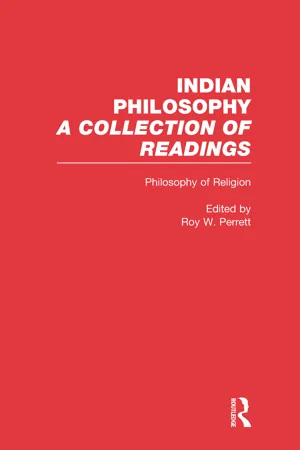
First Published in 2001. No anthologist succeeds in including everyone's favorites, so a few words about the principles of selection seem appropriate. Firstly, as with other volumes in this series, priority has been given to journal articles, rather than book chapters. However, some essential book chapters have been included, and the introductions to each volume include references to significant books. Secondly, the emphasis throughout is on philosophical studies of Indian philosophy. Consequently, much excellent historical and philological work has been omitted. Thirdly, the desire to make Indian philosophy accessible to interested Western philosophers has meant not only that all the selections are in English, but also that most of them use a minimal amount of unglossed Sanskrit terminology.
Information
A. L. Herman Indian theodicy: Śarhkara and Rāmānuja on Brahma Sūtra II. 1. 32–36
Whatever other differences the two major proponents of Vedānta may have, they reach a high accord in their comments on Badarayana's Brahma Sūtra or Vedānta Sūtra IL 1. 32–36.1 This high accord centers on the proper treatment, handling, and solution of what in the West is called “the problem of evil” and in particular “the theological problem of human evil.” Both Śarhkara and Rāmānuja deal with the problem of evil elsewhere in the Brahma Sūtra bhaṣyas, where the question is taken up as to whether or not Brahman's nature is compromised by the imperfect world,2 but nowhere else does their treatment reach the high pitch and sustained philosophic force as in the passages under discussion here.
The principal question taken up in BS. II. 1. 32–36 is whether or not Brahman (God) created the world. The answer that both Śarhkara and Rāmānuja give is in the affirmative. But the way to that answer provides us with some highly interesting philosophic jousts with the problem of evil, and some entertaining answers to numerous insistent objectors along that way. Let me take the sūtras one at a time, freely translate each of the five, and then attempt to explain what is going on as that going-on is understood by Śarhkara and Rāmānuja. The program of argument here calls for certain unnamed objectors supporting the thesis that God cannot be the cause of the world, followed by replies from the opponents of this view, Śarhkara and Rāmānuja. In each case, the latter two Vedāntists build up the objector's position with reasonable arguments and then attack these arguments with reason and scripture (śruti and smṛti).
Bādarāyaṇa opens with the summary of an objector's argument:
II. 1. 32. Brahman cannot be the cause of the world because to cause or create involves motives or purposes (and if Brahman has either, He is imperfect).
Śarhkara puts the argument supporting the objector's conclusion into the form of a dilemma: “Either God had a purpose or he didn't, a motive or not.” If “purpose” is rendered “desire,” I think the force of the objection can be seen in a number of interesting ways, and ways that relate to what might be called “the creator paradox.” For if God created the world, He did it for a purpose. If He had a purpose then He desired some goal. But if He desired something, then He was lacking something. But if He lacked something, then He's not perfect, that is, not wholly fulfilled. Śaṁkara summarizes this objection, which he and Rāmānuja will shortly attempt to answer, as follows: “Now, if it were to be conceived that this endeavor of the Highest Self is useful to itself because of its own desire, then such supposition would contradict the scriptural statement about the Highest Self being always quite contented.”3 Thus that horn of the dilemma leads to a contradiction.
But suppose Brahman created without a purpose. This way, too, there is a problem. For to act without purpose is in effect not to act at all. And if creating is an act, then one could not create without some purpose. A contradiction results: If one tries to create without purpose, then one cannot create, for to create means to act purposefully. God ends up purposelessly purposing, a contradiction. Śaṁkara states this horn of the dilemma as follows: “If, on the other hand, one were to conceive no such purpose (behind such endeavor), one would have to concede that (in such a case) there would not be any such endeavor….”4 In summary, if God creates with purpose, then this act exposes a glaring inconsistency in the nature of God. On the other hand, if God tries to create (endeavor, desire, act) without desire, endeavor, or action, this proves contradictory and impossible. But must we be hung on these horns? No. Bādarāyaṇa slips between them followed by a host of Vedāntins. Both of our commentators must step a narrow line in what follows: first, between having God as the cause of the world while avoiding the conclusion to which the creator paradox leads ; and second, having God as the cause of the world while avoiding the conclusion that God brought evil into it since He was the cause of it. The latter puzzle is, of course, the problem of evil.
II. 1. 33. But as with men at times, so with God, creation is a mere sport.
Sport (līlā) is understood here to be a third sort of activity. It is therefore neither purposive nor purposeless, those words being inapplicable to what God's sport is really like. Śaṁkara uses the example of breathing—it is not an act of will but follows simply “the law of its own nature.”5 Thus līlā prompts creation out of sheer joy, an overflowing from God's great and wonderful sportive nature. We have here, then, a solution of sorts to the problem of evil. It amounts to saying that while evil exists in the creation, it cannot be due to its “creator,” since what He did was not really an act of creation at all; the creation is a kind of playful overflowing of His joyful inner nature. Suppose we call this “the evil-in-the-world-is-not-from-God-who-did-not-create-it-but-merely-sported-it solution” or “the līlā solution.” Rāmānuja speaks to the līlā solution with an entertaining example: “We see in ordinary life how some great King, ruling this earth with its seven dvīpas, and possessing perfect strength, valor, and so on, has a game at balls, or the like, from no other motive than to amuse himself….”6 Moreover, it is not in creation alone that līlā is evidenced, but in the world's ultimate destruction as well: “… there is no objection to the view that sport only is the motive prompt-ing Brahman to the creation, sustentation, and destruction of this world which is easily fashioned by his mere will.”7 Some comments follow on this attempted solution to the problem of evil.
1. The Vedāntists actually don't need the līlā solution to counter objections raised by the problem of evil. All objections can be handled rather neatly, we shall see, by what we shall call “the rebirth solution.” For, as we shall show, all superhuman, human, and subhuman suffering or evil can be explained or adequately accounted for by the rebirth solution, together with one or two slight additions involving, for example, the nonbeginningness of the world.
2. Līlā solves nothing as far as the problem of evil is concerned, for while līlā may be a purposeless act, it is surely an activity about which we can ask, Who did it? That is to say, labeling līlā as mere motiveless, goalless sport, sensible enough in itself, does not rule out asking, Whose intention was it to engage in this motiveless activity ? God is not responsible for the purposes in līlā, for supposedly there are none, but He is surely responsible for the act that brings līlā into existence. Let me make this clearer. Suppose I am going to play a game. Suppose the game I play is like observing a work of art, an aesthetic activity, in which there are no goals, purposes, or ends, but just activity for activity's sake, enjoyment without repercussions (that is, I am not doing it to win a prize, raise my blood pressure, impress my peers, or work up a sweat). But while I have no desires raised and satisfied in the aesthetic or game activity itself, I did have an antecedent desire and it was only realized when I subsequently played the game. If we distinguish between the play as activity, aesthetic in itself, and the play as a-something-to-be-done, a goal in itself, then we can see that the former is consequenceless and goalless at the time the activity is going on, and since there is no motive being satisfied, it is like līlā-play without purpose. However, the latter, involving a decision to play, the getting of the ball, the going to the museum, the bringing about of the act of play, aesthetic indulgence, or līlā, surely has a goal or aim, namely, goalless or aimless activity. I am not responsible for the purposes in līlā, for there are none. But I am responsible for the act that brings līlā about. Thus I may be responsible and to blame for what happens after līlā is over, or after separate acts of līlā have been made.
3. I bounce a ball on the wall. My neighbors are annoyed. They say, Why did you bounce the ball? I say, I had no purpose. They say, but your bouncing keeps our baby awake, disturbs our reading, frightens my wife, angers my mother-in-law, cracks our walls. Now, can I say, I'm not to blame—I was only playing, and we all know there are no purposes in playing? That would be silly. What am I responsible for ? The bouncing. Does the bouncing bother anyone? No. It's the noise from the bouncing that bothers. Could I conceivably argue that I'm not responsible for the noise? Nonsense. In the act of play, from my point of view, what I do is without purpose. From my neighbor's point of view, what I do has results that are all too evident.
4. I pull the wings and legs off a baby bird, as Richard Brandt has said Navajo children do in their play. Someone says, What are you doing? and I say, Playing. I have not excused my act, only described it. Granted that in a game the purpose is lost, that is, the game's purpose is lost in the game, to say this does not excuse what results from the game, but simply labels a certain sort of activity, and rules out silly questions like, Why are you playing a game? Thus to describe God's activity as līlā is to describe the play act from two possible points of view. From God's point of view, it is a description of a purposeless, aimless play, without motives, without intentions. But from the neighbor's point of view, from the suffering bird's point of view, līlā is fraught with effects and consequences that are undesirable. Līlā cannot be used to justify the results that follow from the act; līlā merely describes the act. The Vedāntists have mistaken the description of līlā for a justification of līlā.
5. While one cannot ask, Why are you playing that game? after one has been told that a game is being played, one can, nonetheless, ask, Why are you playing that game that way? If I move the king two places in a chess game (and I am not castling) and you say, Don't you know the rules of chess!?, your question would be quite legitimate. If the game has rules and one violates the rules, one can ask, What game are you playing? If God plays a game of creation, and seems to violate rules for playing the creation game, we might very well ask, Doesn't He know the rules of the game of creation? I assume this question is at the very heart of the problem of evil. And philosophers are notorious for having all sorts of legitimate suggestions for better ways of playing, and better rules for, the creation game.
6. Some games which one plays in a sportive mood can be won or lost. Chess and most card games can be played to such a conclusion. Some games, like bouncing a ball on my neighbor's wall, cannot be played to a winning or losing conclusion. But all games can be played better or worse, with greater or less facility, more or less joy, commitment, playfulness, indulgence, and what-have-you. “A man full of cheerfulness on awakening from sound sleep dances about without any motive or need but simply from the fullness of spirit, so is the case with the creation of the world by God.”8 But such a joyful man can dance poorly or well, better this time than last. To leap out of bed and dance on the sides of one's feet, clumsily, is no good at all. One can learn to express one's sportive feelings better than, that. Practice in expressing joy is possible and necessary to true joyfulness. If I leap out of bed, overflowing with Gemütlichkeit or Freude, and then trip all over my feet in expressing my feelings, I am not going to be very joyful for very long. One expresses one's joy and sorrow, and one's feelings in general, in appropriately tried and tested ways: at the piano, singing in showers or cars, kissing and hugging friends or one's self. One can get better at such expressions, just as one can improve one's self in other purposeless or goalless activities, like games. It is therefore legitimate to ask, When Brahman, through līlā, expressed His joy, why didn't He do it better? If He is perfect He could, and if He's good He would want to, so why didn't He ? We are back once again to the problem of evil.
7. Śaṁkara's example of breathing is curious, but the same question raised above can be applied to it. Some people are poor breathers—“shallow breathers,” my physician calls them. They breathe at the very top of their lungs; their rate of respiration, instead of the normal sixteen per minute, runs twenty-five to thirty. They must breathe fast, for only one-fourth to one-third of their lung's capacity ...
Table of contents
- Cover
- Half Title
- Series Contents
- Title Page
- Copyright Page
- Table of Contents
- Series Preface
- Series Introduction
- Volume Introduction
- Indian Theodicy: Śaṃkara and Rāmānuja on Brahma Sūtra II. 1. 32–36
- A “Constitutive” God — An Indian Suggestion
- Unity and Contradiction: Some Arguments in Utpaladeva and Abhinavagupta for the Evidence of the Self as Śiva
- The World as God's “Body”: In Pursuit of Dialogue With Rāmānuja
- A Death-Blow to Śaṅkara's Non-Dualism? A Dualist Refutation
- Hindu Doubts About God: Towards a Mīmāṃsā Deconstruction
- Principled Atheism in the Buddhist Scholastic Tradition
- Buddha and God: A Contrastive Study in Ideas about Maximal Greatness
- Reason, Revelation and Idealism in Śaṅkara'S Vedānta
- The Question of Doctrinalism in the Buddhist Epistemologists
- Rebirth
- The Naturalistic Principle of Karma
- Karma as a “Convenient Fiction” in the Advaita Vedānta
- Notes Towards a Critique of Buddhist Karmic Theory
- Inherited Responsibility. Karma and Original Sin
- Imperatives and Religion in India
- Religion and Politics in India: Some Philosophical Perspectives
- Towards a Pragmatics of Mantra Recitation
- The Meaninglessness of Ritual
- Analysis of the Religious Factors in Indian Metaphysics
- Three Myths about Indian Philosophy
- Acknowledgments
Trusted by 375,005 students
Access to over 1.5 million titles for a fair monthly price.
Study more efficiently using our study tools.
Frequently asked questions
Yes, you can cancel anytime from the Subscription tab in your account settings on the Perlego website. Your subscription will stay active until the end of your current billing period. Learn how to cancel your subscription
No, books cannot be downloaded as external files, such as PDFs, for use outside of Perlego. However, you can download books within the Perlego app for offline reading on mobile or tablet. Learn how to download books offline
Perlego offers two plans: Essential and Complete
- Essential is ideal for learners and professionals who enjoy exploring a wide range of subjects. Access the Essential Library with 800,000+ trusted titles and best-sellers across business, personal growth, and the humanities. Includes unlimited reading time and Standard Read Aloud voice.
- Complete: Perfect for advanced learners and researchers needing full, unrestricted access. Unlock 1.5M+ books across hundreds of subjects, including academic and specialized titles. The Complete Plan also includes advanced features like Premium Read Aloud and Research Assistant.
We are an online textbook subscription service, where you can get access to an entire online library for less than the price of a single book per month. With over 1.5 million books across 990+ topics, we’ve got you covered! Learn about our mission
Look out for the read-aloud symbol on your next book to see if you can listen to it. The read-aloud tool reads text aloud for you, highlighting the text as it is being read. You can pause it, speed it up and slow it down. Learn more about Read Aloud
Yes! You can use the Perlego app on both iOS and Android devices to read anytime, anywhere — even offline. Perfect for commutes or when you’re on the go.
Please note we cannot support devices running on iOS 13 and Android 7 or earlier. Learn more about using the app
Please note we cannot support devices running on iOS 13 and Android 7 or earlier. Learn more about using the app
Yes, you can access Philosophy of Religion by Roy W. Perrett in PDF and/or ePUB format, as well as other popular books in Philosophy & Eastern Philosophy. We have over 1.5 million books available in our catalogue for you to explore.