- 304 pages
- English
- ePUB (mobile friendly)
- Available on iOS & Android
eBook - ePub
About this book
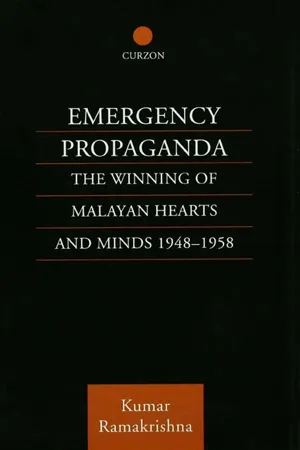
Sheds new light on the hitherto neglected years of the Emergency (1955-58) demonstrating how it was British propaganda which decisively ended the shooting war in December 1958. The study argues for a concept of 'propaganda' that embraces not merely 'words' in the form of film, radio and leaflets but also 'deeds'.
Information
Chapter One

Propaganda in the Malayan Emergency
The Missing Dimension
The Malayan Emergency is one of the few post-war insurgencies which the insurgents did not win, and this fact has generated much interest in the reasons as to why the Government of the Federation of Malaya was eventually able to overcome the revolt led by the Malayan Communist Party (MCP). The conventional view holds that Government succeeded because of its effectiveness in the administrative, military and political spheres. Administratively, by constructing New Villages that provided ‘supplies of clean water, schools, community centres, basic medical care, some agricultural land’ and some other basic essentials, Government is said to have secured the all-important ‘hearts and minds’ of the Malayan Chinese, who were the MCP’s support base.1 Complementing hearts-and-minds tactics were the ‘severe penalties’ of ‘mass detention, deportations and resettlement’, which, by removing the Chinese from the jungle fringes, disrupted the MCP’s supply line and effectively broke the back of the Emergency.2 Militarily, it is suggested that Government beat the MCP because it had an overall plan which co-ordinated administrative, Police and Army measures at all levels and sought to secure its own base areas before embarking on a military campaign against the terrorists. Moreover, the Security Forces were eventually able to secure better intelligence on the terrorists and mount effective food control operations which deprived the terrorists of their essential supplies. Furthermore, by adhering to the time-honoured ‘principles’ of small-unit operations instead of large scale ones and importantly, the use of minimum force in operations in support of the civil power, Government was able to function within the law and defeat the terrorists without alienating the public.3 Finally, the conventional view posits that Government, because it was committed to a ‘clear political aim’ – granting the non-Malays, especially the Chinese, a political stake in the country as a prelude to Merdeka or independence – was able to steal the MCP’s thunder, as the latter was supposedly fighting for that very outcome. Hence, political reforms in the form of elections at not only the State and Federal but particularly the New Village level, were necessary to the defeat of the Insurrection.4
The fundamental problem with the conventional perspective outlined above is that it conflates the political and military dimensions of the Emergency. Essentially, it suggests that the defeat of the military insurgency was contingent on the attainment of political security for the Malayan Chinese: once the Chinese were assured of a political stake in an independent Malaya, they deprived the MCP of their support and the insurgency collapsed. As we shall see, however, while progress in the insurgency certainly contributed to the pace of advance toward Merdeka, the converse was not true: mere political reforms did not ipso facto confer on Government the initiative in the shooting war. This is because the resolution of the military insurgency did not depend on securing the hearts and minds of those Chinese interested in political, constitutional questions, but rather those who were the least enamoured of such issues: the rural Chinese. In essence, there were really two Emergencies. First, a political one in which the British strove to create an anti-Communist, friendly, united Malayan nation governed by a multiracial Government. The key to this political Emergency was the Malay and Chinese elites represented by the United Malays National Organisation (UMNO) and the Malayan Chinese Association (MCA). The second Emergency embraced the military insurgency in the rural areas of Malaya, and the key to the resolution of this campaign lay as we shall see, with the rural Chinese. This crucial distinction has been obscured in the conventional view, which essentially asserts that it was political advance toward Merdeka which won the hearts and minds of the rural Chinese. In fact a recurring theme in this study will be that Government’s ability to win over the rural Chinese depended not so much on whether the latter were provided the opportunity to become Federal citizens and to shape their political destiny, but rather if their basic needs for physical and socio-economic security were met. Securing these less abstract, more concrete needs was the real key to rural Chinese hearts and minds.
The issue of ‘hearts and minds’ brings us to a second problem with the conventional analysis: the absence of conceptual rigour as to what ‘hearts and minds’ refers to in the Emergency. While Cloake and Stubbs for instance take the meaning of the phrase as self-evident and instead seek to identify when the term was first used during the Emergency, Carruthers merely suggests that the hearts and minds of not only colonial, but also metropolitan, peoples were an important objective for the British to secure.’5 Moreover, while Mockaitis gives the impression that the hearts and minds of the public were most important,6 Hack distinguishes between ‘civilian’ and ‘military’ hearts and minds, and places political concessions, schools and piped water under the ‘civilian’ category, and propaganda, rewards for information, surrender policies and limiting collateral damage, under ‘military’. He, however, makes no attempt to explain this distinction.7 A third shortcoming with the received wisdom exists: although the psychological connotation of the phrase ‘hearts and minds’ is apparent, analysts pay relatively little attention to the psychological dimension of the Emergency. The emphasis has been on the functional aspects of counterinsurgency methods and techniques such as resettlement, food control, intelligence, civil-military co-operation and small unit operations. The ways in which such measures also generated mental pressures on the public and the terrorists – with operational consequences – have been far less noticed. Those few writers who do recognise the significance of psychological elements focus separately – and in a piecemeal fashion – on their effect on different groups in Malaya: the Malayan public, the MCP terrorists, and British troops. No work systematically examines the impact of psychological pressures on the key players in the rural insurrection: the MCP rank and file and the rural Chinese public.8
The final problem with the prevailing view derives directly from the general neglect of the psychological dimension: the relative marginalisation of the role of Government propaganda in the Emergency, despite acknowledgement that it was very effective.9 This marginalisation has taken two forms: at one level, ‘propaganda’ has been narrowly conceived as Government’s spoken, printed and broadcast output: leaflets and posters, mobile cinema shows, roving lectures by Surrendered Enemy Personnel, rewards for information, Voice Aircraft broadcasts and Civics Courses for instance. Such a limited perspective has meant that previous analysts have ignored the propaganda implications of certain Government policies as well as the behaviour of senior officials and the Security Forces amongst the public, and the ways in which Security Force pressure and food denial schemes also constituted ‘propaganda’ to harassed and starving terrorists. In addition, even with respect to Government spoken, printed and broadcast output – propaganda as conventionally understood – past works have opted for a descriptive rather than an analytical approach, failing to explain the philosophy underlying the usage of such propaganda media in Malaya and where it came from. Furthermore, there is disagreement on the relative contributions of Hugh Carleton Greene, Head Emergency Information Services (1950–1951) and A.D.C. Peterson, Director-General Information Services (1952–1954). While some writers highlight only Peterson,10 others focus on Greene.11 Very few have attempted to assess in detail the contributions of both.12 Moreover, because most analyses treat Templer’s departure from Malaya in mid-1954 as the virtual end of the Emergency and regard the remaining years as a long ‘mopping up’ process,13 there has been little attention paid to the contributions of Yaacob Eatiff, Director of Information Services from July 1954, and C.C. Too, Head Psychological Warfare Section from 1956, to Government propaganda in the decisive period January 1955 to December 1958. As we shall see, the actual collapse of terrorist morale compelling the MCP to demobilise occurred during this period, and Government propaganda played a decisive role.14
In light of these omissions in the literature, this study will show that fundamentally, Government was able to defeat the MCP’s rural insurgency because it was gradually able, despite an inauspicious beginning, to secure the ‘hearts and minds’ – or more accurately the ‘confidence’ – of not only the rural Chinese public but also that of the terrorist rank and file. We shall see that Government was able to achieve these outcomes through the propaganda of not merely its ‘words’, but even more importantly ‘deeds’ which promoted the physical and socio-economic security of the rural Chinese and ultimately even the terrorists. At the same time, we shall note that the MCP inadvertently contributed to Government’s eventual success through serious doctrinal errors; mistakes constituting in themselves ‘propaganda’ which completely alienated the mass of the rural Chinese as well as the bulk of its own rank and file. Within this overarching framework, the study will also pursue five supplemental aims: it will examine the origins and evolution of certain Government attitudes and practices which had considerable propaganda implications in Malaya; analyse the origins and evolution of the media, organisation and philosophy of Government spoken, printed and broadcast propaganda in Malaya; evaluate the respective contributions of the key propagandists Hugh Greene and Alec Peterson to the development of Government propaganda; analyse the contributions of Yaacob Latiff and C.C. Too to Government propaganda during the final phase of the Insurrection between 1955 and the end of 1958; and finally show, from a propaganda perspective, that 21 December 1957 was the date which marked the beginning of the collapse in MCP morale, culminating in the mass surrenders of 1958. In line with these aims, this introductory chapter will briefly sketch out the historical and historiographical context of the Emergency, develop a model of propaganda applicable to the conflict, and identify the imperial and wartime antecedents of British propaganda in the Emergency.
The Malayan Emergency: History and Historiography
In order to defend the eastern flank of the Indian Empire on the one hand and the security of the China trade route on the other, the British East India Company recognised that control of the Straits of Malacca was essential. Beginning in 1786, therefore, the Company established Settlements at Penang, Singapore, and Malacca, which were united formally in 1826 as the Straits Settlements. Control of the Settlements passed directly to the Colonial Office in 1867, when the Settlements became a Crown Colony. Between 1874 and 1895, moreover, British power was further extended into the interior, encompassing the Malay States of Perak, Selangor, Negri Sembilan and Pahang. In these States, Malay Rulers allowed British Residents to tacitly assume effective administrative control over all matters except those pertaining to Malay religion and custom. In 1896, these Protected States were unified in the interests of administrative efficiency and referred to henceforth as the Federated Malay States. The Governor of the Straits Settlements became concurrently High Commissioner to the Federated Malay States. Furthermore, in 1909, the four northern States of Kedah, Perlis, Trengganu and Kelantan passed to British control from Siam, and in 1914, Johore was added. These five States were known collectively as the Unfederated Malay States, and accepted British Advisers with remits similar to those of the Residents in the Federated States. Hence, between 1874 and 1914, British control of the internal administration and foreign policy of the Malay States was consolidated.15
British intervention involved developing the resources of Malaya, principally tin and rubber, and this in turn demanded a labour force. The indigenous Malays – and the migrants from the surrounding archipelago who assimilated with them – lived in villages located near coasts and river estuaries, were primarily farmers and fishermen, and demonstrably unenthusiastic about working a fixed number of hours each day for wages.16 This meant that immigrant labour was needed. The British thus encouraged Chinese and Indian immigration into Malaya, thereby shaping the country’s demographic destiny. Indian immigration – mainly Madrasi Tamils from south India – tended to match the expansion of the Malayan rubber industry. Hence when the total acreage under rubber grew from 50,000 acres in 1900 to 3,272,000 acres by 1938 – making Malaya the world’s largest producer of natural rubber – the Indian population – only 30,000 in 1870 – shot up to 625,000 in 1931. Plantation labour proved the most important economic activity of the Malayan Indians, employing 53 percent of the Indian population as late as 1947. By this date, however, other sectors were employing other Indians as well. These included English-educated Jaffna or Ceylon Tamils who had been brought in from the 1890s to staff clerical posts in the Railway, Postal Services, Accounts and Treasury Departments in particular; Sikhs, Punjabis and north Indians who filled jobs in the Police and other Government departments; Tamil professionals and south Indian Muslim retailers who filled the private sector; and the wealthy Chettyar Tamils who were principally money-lenders.17
Matching the diversity of Indian immigration, eclipsing it in terms of scale and crucially important to our understanding of the Emergency was Chinese immigration. The earliest Chinese immigrants, from the 1500s, had been Hokkiens from Fukien in south China who settled in Malacca, many of whom intermarrying with the Malays and producing the progeny that became known as the Straits Chinese or Babas. It was however the growth in European, especially British, demand for Straits tin from the 1850s and 1 860s that led to a massive increase in Chinese coolie immigration into the tin-rich States of Perak, Selangor and Sungei Ujong (later part of Negri Sembilan). Thus by 1901 65 percent of the population of Selangor was Chinese. However, because these immigrant Chinese considered Malaya as a temporary abode, a place to make money before returning, there was considerable ebb and flow in migration between Malaya and China in the first decades of the 20th century. Nevertheless, up to the late 1920s, there was a considerable migrational gain to Malaya. However, following the worldwide tin and rubber slump in 1930, serious unemployment prompted thousands of Chinese to return to China. In addition, the Federated Malay States (FMS) Government passed the Immigration Restriction Ordinance in 1930 which sharply curtailed Chinese male immigration into Malaya. Hence while there had been 192,809 Chinese arriving in 1928, by 1933 the number had declined to 13,535. While the 1933 Aliens Ordinance also imposed a quota on male immigration, very significantly, it imposed none on female immigration. Thus between 1933 and 1938 190,000 Chinese females arrived in the Federated Malay States. This had the effect of improving the sex ratio: while there had been 5 females to every 10 Chinese males in 1931, by 1947, there were 8 females to every 10 males. These women were aged between 18 and 40, were mainly peasants and entered the rubber, tin and building industries as well as factories. They married the male coolies and settled in Malaya. Furthermore, indentured workers who had worked off their debts returned to Chin...
Table of contents
- Cover
- Half Title
- Title Page
- Copyright
- Contents
- Acknowledgements
- List of Abbreviations
- Map
- 1. Propaganda in the Malayan Emergency: The Missing Dimension
- 2. The Malayan Communist Party and its Impact on Terrorist and Rural Chinese Confidence
- 3. Propaganda in Disarray: The Mistakes of the Gurney Years, June 1948–May 1950
- 4. Propaganda on the Mend: The Impact of Briggs and Greene, May 1950–February 1952
- 5. Propaganda Turning Point: Templer, February 1952–May 1954
- 6. Propaganda Most Optimal: Tunku Abdul Rahman and the Collapse of the Communist Terrorist Organisation, June 1954–December 1958
- Conclusion
- Notes
- Bibliography
- Index
Trusted by 375,005 students
Access to over 1.5 million titles for a fair monthly price.
Study more efficiently using our study tools.
Frequently asked questions
Yes, you can cancel anytime from the Subscription tab in your account settings on the Perlego website. Your subscription will stay active until the end of your current billing period. Learn how to cancel your subscription
No, books cannot be downloaded as external files, such as PDFs, for use outside of Perlego. However, you can download books within the Perlego app for offline reading on mobile or tablet. Learn how to download books offline
Perlego offers two plans: Essential and Complete
- Essential is ideal for learners and professionals who enjoy exploring a wide range of subjects. Access the Essential Library with 800,000+ trusted titles and best-sellers across business, personal growth, and the humanities. Includes unlimited reading time and Standard Read Aloud voice.
- Complete: Perfect for advanced learners and researchers needing full, unrestricted access. Unlock 1.5M+ books across hundreds of subjects, including academic and specialized titles. The Complete Plan also includes advanced features like Premium Read Aloud and Research Assistant.
We are an online textbook subscription service, where you can get access to an entire online library for less than the price of a single book per month. With over 1.5 million books across 990+ topics, we’ve got you covered! Learn about our mission
Look out for the read-aloud symbol on your next book to see if you can listen to it. The read-aloud tool reads text aloud for you, highlighting the text as it is being read. You can pause it, speed it up and slow it down. Learn more about Read Aloud
Yes! You can use the Perlego app on both iOS and Android devices to read anytime, anywhere — even offline. Perfect for commutes or when you’re on the go.
Please note we cannot support devices running on iOS 13 and Android 7 or earlier. Learn more about using the app
Please note we cannot support devices running on iOS 13 and Android 7 or earlier. Learn more about using the app
Yes, you can access Emergency Propaganda by Kumar Ramakrishna in PDF and/or ePUB format, as well as other popular books in Social Sciences & Ethnic Studies. We have over 1.5 million books available in our catalogue for you to explore.