- 360 pages
- English
- ePUB (mobile friendly)
- Available on iOS & Android
eBook - ePub
About this book
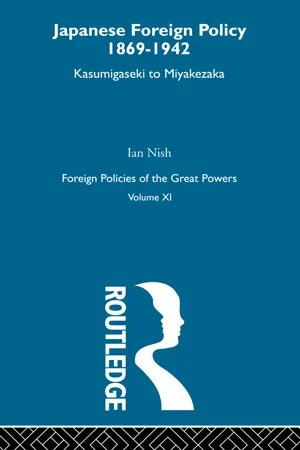
First published in 2001. This is Volume XI of the Foreign Policies of the Great Powers eleven part series and focuses on the policies of the Japanese, from 1869 to 1942. It includes sections on the Iwakura period, the Mutsu period, Aoki, Komura, Kato, Ishi, Shidehara, Tanaka, Uchida, Hirota, Konoe and ending with the Matsuoka period in 1941.
Information
Chapter 1
The Iwakura Period 1869-83
In the middle of the nineteenth century the fate of China was a source of no small concern for Japan. The Middle Kingdom with its reputation for great wealth and vast population became a prey for the commercial countries of the West. They wanted trade and, when they found that it was restricted, they were ready to resort to warlike means. When their superiority was established over China as it was by wars in 1842 and 1858, they concluded Western-style commercial treaties which secured for them open ports with extra-territorial rights and consular representation and jurisdiction. These concessions were extended by most-favoured-nation provisions to all their trading rivals. These were involuntary concessions by China because the strength of the maritime Powers could not be resisted.
If China was unable to resist the inroads of the foreign merchants and their governments, Japan, a much smaller country, was doubly at risk. In mid-century she was governed by the Tokugawa shogunate which had ruled by a stern autocratic regime for two and a half centuries. In order to consolidate their power, the rulers had issued regulations which ensured that Japan continued for two centuries as a ‘secluded country' with only minimal contacts with the West. By the 1850s this state of seclusion was breaking down. The Tokugawa and their feudal rivals, the clans on the periphery of the Japanese islands, were cultivating relations with foreigners for the technical know-how which they obviously possessed and the Japanese badly wanted.
When Commodore Perry of the United States navy visited Japan in 1853-4, the shogunate was inclined to drift in the direction of opening the country. More or less on its own responsibility, it concluded that it was too weak to withhold from the Americans the full commercial treaty which they sought. Such was the Treaty of Edo (Tokyo) of 29 July 1858 which was signed with the American representative, Townsend Harris - the first of the so-called ‘unequal treaties’. While this was an act of wisdom in so far as the shogun’s government had a realistic appreciation of Japan’s inability to resist, it was an act of political desperation within Japan where its opponents at court who were bitterly opposed to dealings with foreigners could make political capital by dwelling on the unpopular foreign treaties. The ‘unequal treaties’ were indeed to be used as the thin end of a wedge which was to be driven into the already-crumbling Tokugawa administration in the hope of bringing about its complete collapse. Thus, from the very start of the New Japan, issues of foreign relations were to be sensitive factors in the domestic politics of the country.
At this time Iwakura Tomomi (1825-83) was an official of the court of the emperor at Kyoto, which had throughout the Tokugawa period played no part in government but had performed some formal state functions. (1) As the Tokugawa regime fell into difficulties, the court officials were not unaware that they might be able to organize a coalition which would topple the shogunate. It was from a standpoint of opposition that Iwakura regarded the treaties. Since he had no hand in their making, he was ready to see them reversed. (2) But, when the shogunate pleaded that to end the treaties would only annoy the foreigner and convince him of Japan’s bad faith, Iwakura was ready to concede the danger inherent in this: ‘the five enemy Powers [presumably Britain, France, the United States, Prussia and Russia], crowding in upon our ports, might open hostilities, interfere in our domestic politics, and seize by aggression such territory as they covet.’ Such was the fear common to all those in authority: Japan was growing up in a hostile world and must build up her military strength before she could beat off the challenge of her ‘enemies’. Iwakura’s view was that the shogunate was too weak to resist the foreigner effectively and that its weakness could be exploited by the court in order to secure the restoration of its authority; but it would be better to hasten slowly in order to prevent the outbreak of civil war, which would only encourage foreign intervention. If an anti-foreign atmosphere were to be created, Iwakura thought, men of violence might well take advantage of the situation by damaging the premises of the five foreign Powers; and, under the pretext of protecting their nationals against civil disorder, the foreign Powers would make common cause and lay claim to territories along the Japanese coast. Whatever was done should not give foreigners any justification for raising their flags on Japanese soil. (3)
Such was the early view of one who, while he had a political axe to grind, was obsessed with the foreign danger. While Iwakura was no admirer of the shogunate, he would not go along with the incautious anti-shogun forces if they were likely to lay Japan open to the treatment that the European countries had meted out to China. This is typical of the balanced and far-sighted approach which was to characterize Iwakura’s long public career.
After the restoration of the emperor to power in 1868, Iwakura was appointed a member of the imperial council and acted as foreign minister between July and November 1871. This might suggest that he had a poor claim to be regarded as the dominant figure in the early Foreign Ministry. Yet the claim is tenable. Prince Iwakura was one of the prime movers in the imperial restoration and an influential politician in the new Japan. The fact that he was prepared to accept the office of foreign minister (gaimu kyo) suggests that it was the intention of the new leaders that the Foreign Ministry should be one of the key instruments of the new government. His reputation in foreign affairs was enhanced by his statesmanlike mission to the United States and Europe (1871-31. After his return, Iwakura, by using the Japanese convention of governing from behind the scenes, was able to exercise a close surveillance over the making of external policy for a decade. After the death of Okubo Toshimichi by assassination in 1878, Iwakura enjoyed a natural ascendancy at the head of affairs until his death in 1883.
Who was this Iwakura? Unlike the samurai clansmen who came to prominence in the new Japan, he owed his status to his being a court noble. In the restive period of the Bakumatsu, he had been a chamberlain at the imperial court in Kyoto and appears, at first, to have advocated an anti-foreign policy. But, when he was converted to the need for a more moderate approach, he lost the favour of the Emperor Kōmei (1848-67). When he was expelled from the imperial capital in 1863, he sought asylum with the Chōshū clan and through it built up a political base against the Tokugawa rulers. The young Emperor Meiji (1867-1912) smiled on Iwakura when he came to the throne. Hence Iwakura was in a favourable position to forge a link between the outer clans and the new imperial government, as a result of which the Tokugawa shogunate was finally overthrown.
The man himself is more elusive. Yet he opened windows to his soul through his ‘jikki’ [true records]. These are memoranda on policy, of which some were written by Iwakura himself while others later in his career were issued in his name but written by Inoue Kowashi (1844-95), the capable servant of many Meiji statesmen. These writings give a good indication of Iwakura’s political ideas, the style of his statesmanship, his tactics and his cautious temperament. Although they are plentiful enough, they are not easy to use; and there are many aspects of his character and influence which still elude scholars today.
Many Japanese at this period seem to have been drawn to the study of diplomacy and an awareness of the primacy of foreign affairs. As Iwakura wrote pointedly in April 1869
We must guard our country’s independence. Foreign troops have been stationed in our open ports, and even when foreigners who live in our country violate our laws, we are forced to stand by while agents of their governments exercise jurisdiction over them. Our country has never before known such shame and disgrace. (4)
As he reiterated time and again, Japan was independent in name but not independent in practice. Probably this was a pessimistic estimate of Japan in the 1870s: Japan was not as much under foreign tutelage as he liked to emphasize; nor were the Western Powers as anxious to take over Japan as he feared. But the threat was grist to his mills it enabled him to appeal to his countrymen to increase their wealth and strength on Western lines. This was Iwakura’s message of nationalism.
ORIGINS OF THE FOREIGN MINISTRY
The Board of Foreign Affairs of the new imperial government (gaikokukan) addressed the five Powers represented at the port of Hyogo in January 1868. It informed them that domestic and foreign affairs would henceforth come under the Tennō of Japan and that the word Taikun which had been used in earlier treaties should be replaced by ‘Tennō’. Officers were appointed to deal with external reiations. (5) A month later the foreign diplomats and the members of the Board met and arrangements were made for the foreign representatives to meet the emperor. This was a symbolic act to indicate that the Tennō’s government was ready to open up connections with foreigners. Doubtless the hope was that in the struggle which was expected, it should receive if not the help, at least the benevolent neutrality, of foreign countries. By the time that the imperial government through Iwakura Tomomi summoned the foreign representatives at Yokohama on 3 December, the civil war was more or less at an end. By the end of the year, therefore, the ministers of France, Britain and the United States (among others) had given up their earlier neutrality and offered to support him.
When the Dajokan or imperial government was set up on 8 July 1869, a Foreign Ministry (6) was provided for in the official regulations (Shokuinrei) as one of the six ministries to be instituted. Sawa Nobuyoshi was appointed as the first minister (1869-71). The background to Iwakura's appointment as his successor is not known. But, according to Okubo’s plan for the new government structure, the Foreign Ministry was to be a first-rank ministry. Hence Iwakura's acceptance of the appointment can hardly be taken as a surprise. His actual tenure of office was remarkably short: on 8 October 1871 Iwakura was appointed minister of the right and instructed to head the mission of senior statesmen who were about to proceed overseas. Since no successor was named straightaway, he continued with his diplomatic functions a while longer. Iwakura was succeeded as foreign minister by his vice-minister, Soejima Taneomi of Saga. He was a Chinese scholar and was to prove a tough-minded negotiator when he went to China on an important mission in 1873. In the absence of Iwakura and his party, Soejima strongly advocated the need for a Japanese expedition to Korea. He must certainly be judged to have been a protagonist of expansion for Meiji Japan. When the members of the Iwakura mission returned from Europe and succeeded in getting the plans for a Korean expedition dropped, Soejima was discredited and resigned. Iwakura, now on the crest of the wave of power, was able to appoint as foreign minister the more moderate and more amenable Terajima Munenori, who held the post until 1879. Terajima had returned from two years’ service as minister to Britain. His overseas experience stood him in good stead since he had been in London while the Iwakura mission was carrying out its investigations there. As a Satsuma clansman, he was moreover a useful asset to the new government.
Since the Foreign Ministry was only establishing itself, one should not expect to find a pattern in its working. Those who presided over it in its first decade differed one from the other. Some like Iwakura and Inoue Kaoru were the leading statesmen of the day; others tended to be subordinates who were responsible for handling routine affairs and the execution of policies decided over their heads by their seniors. The senior whose voice tended to carry most weight in the 1870s was Iwakura himself. When he was out of Japan on his world mission, many of the issues seemed to be held pending until he returned.
As in so many other fields, Japan proved to be a fast learner. Soon after the inauguration of what might be identified as the Foreign Ministry in 1869, the Japanese found themselves adapting well to the complicated patterns of international diplomacy. The office was to be located in the new capital of Tokyo at Kasumigaseki with a branch at Yokohama for dealing with foreigners. (7) It soon developed a hierarchy with an intricate system of ranking and’a host of bureaucratic regulations. These were not Western importations so much as something that had passed down from the Tokugawa period.
Nor was Japan starting from scratch. Certainly since Perry Japanese had become aware of the need for understanding foreign countries and travelling abroad. They had also turned to the learning of foreign languages. One of the first departments set up within the Ministry had therefore to be a language school. While the learning of foreign languages was not easy for Japanese, they were able to adapt to social patterns and social conventions with some expertise. Indeed, judging from the experiences of those who went abroad in the nineteenth century, they were probably happier and better adapters than some of their successors in the twentieth.
It is one thing to melt chameleon-like into the foreign scene; it is another to feel at home with the paraphernalia and protocol which had grown up over the centuries to deal with the relations of one Western state with another. It is recorded that the first American minister in 1858 had instructed the Japanese in the law of nations and that works such as Heaton’s ‘Elements of International Law' (1836) and Phillimore’s ‘Commentaries on International Law’ (1854-7) were circulating in translation by the late 1860s. One of the early tasks of the Ministry was to translate Britain’s most recent treaties in order to achieve some standard of comparison for those they had concluded since the coming of Admiral Perry. There can be little doubt that Japan learnt fast.
The adaptability of Japan’s first representatives abroad was also beyond question. They did not suffer the indignities associated with the earliest Chinese envoys abroad whose clothes were often regarded as outlandish and attracted the derisory comments of small boys. The Japanese imitated the West in dress and manners. Typical in this respect was the aggressively Westernized Mori Arinori C1847-89), the first envoy to the United States. While he was studying in Britain (.1865-7) as one of those selected by his own Satsuma clan, he was attracted to Thomas Lake Harris, an American spiritualist, and decided to join him in America at his community, the Brotherhood of the New Life. When he heard the news of the Meiji restoration, Mori together with Samejima Hisanobu who was later to serve as Japan’s first minister in Paris accepted Harris’s advice to return to Japan. Mori was appointed by the new government as representative in Washington in 1870 at the age of twenty-three and served as acting minister for two years, during Japan’s important mission there. In 1879 he became minister to Britain and stayed there for five years, conducting diplomatic business but also studying means of modernization, especially in the educational field. It was no surprise, therefore, that on his return to Japan he should become the first minister for education in 1885 and serve in this capacity until his assassination four years later. (8) It would be wrong to submit Mori as the representative of a group - he was too individualistic for that. Yet he had an open-mindedness and readiness to learn which seems to have been shared by many of his young contemporaries who were adventurous enough to go overseas.
Mori’s career also reminds us of the swift promotion which was possible in the early Meiji period. Many of the young clansmen who entered the new Foreign Ministry soared in their profession. (9) While they were thrown into responsibility at an early age, they were still held on a tight rein by their elders in Tokyo. This is only to be expected when one remembers the circumstances behind the appointments in the early Meiji period. Consider again the case of Mori as acting minister (dairi kōshi) in Washington. His appointment was due to his facility in English and to his experience of the country, both of which were considerable. It was not due to Tokyo’s confidence in Mori’s judgment. When Mori’s patrons - Iwakura and Okubo - were in the capital, things went smoothly; but, when they were out of Japan, there were frequent disagreements between Mori and Tokyo, Because the Americanized Mori was hot-tempered and argumentative rather than submissive, he often got into hot water with his home authorities. Because he was despite his youth inclined to be outspoken, he sometimes ran into trouble with the government to which he was accredited. Thus, the British government at a later date was to question Japan’s wisdom in appointing callow youths to major diplomatic assignments.
The early appointments were due to the talent-spotting of the individual leaders. They were, therefore, somewhat haphazard. For example, Mori and his companion, Samejima, on their return from the United States, had a fortunate interview with Iwakura, the new national leader in 1868, and evidently pleased him. Through his patronage, they received their first posts. When Mori fell out of favour in 1872, it was left to Iwakura to administer the necessary rebukes. It was again Iwakura who secured his restoration to favour in the following year. Mori and his contemporaries owed their careers to their special relationships with the great. They had no idea that they were part of a secure professional service. Perhaps they did not yet look on themselves as diplomats so much as agents for their country abroad on the broadest plane, cultural, commercial as well as diplomatic.
In this process the Foreign Ministry had to learn through its foreign advisers. The earliest of these was Erasmus Peshine Smith, an adviser from 1871 until 1880; he was succeeded by Henry W. Denison who served Japan until his death in 1914. Of Smith, a graduate of Columbia and Harvard, who had worked in the State Department as legal claims adviser, F.V. Dickins, a British resident of the treaty ports, was to write:
The salaried prompters of Japanese foreign policy were not men of high professional standing or experience. The first of them was an American lawyer of some eminence, Mr Peshine Smith, who did his best to bring his employers into ridicule by going about in a Japanese split jacket and loose trousers with a couple of swords in his girdle and declaring in public that ‘not one foreigner in ten in Japan was murdered who ought to have been murdered’. (10)
Dickins for personal reasons was a jaundiced witness. Evidently Smith, like some foreigners who came to reside in Japan, responded to his e...
Table of contents
- Cover Page
- Half Title page
- FOREIGN POLICIES OF THE GREAT POWERS
- Title Page
- Copyright Page
- Original Title Page
- Contents
- Acknowledgments
- Foreign Ministers
- Introduction
- Chapter 1 The Iwakura Period 1869-83
- Chapter 2 The Mutsu Period, 1884-96
- Chapter 3 The Aoki Period, 1896-1901
- Chapter 4 The Komura Period, 1901-11
- Chapter 5 The Katō Period, 1911-15
- Chapter 6 The Ishii Period, 1915-19
- Chapter 7 The Shidehara Period, 1920-7
- Chapter 8 The Tanaka Period, 1927-31
- Chapter 9 The Uchida Period, 1931-3
- Chapter 10 The Hirota Period, 1933-7
- Chapter 11 The Konoe Period, 1937-40
- Chapter 12 The Matsuoka Period, 1940-1
- Postscript
- Documents
- Notes
- Select Bibliography
- Index
Trusted by 375,005 students
Access to over 1.5 million titles for a fair monthly price.
Study more efficiently using our study tools.
Frequently asked questions
Yes, you can cancel anytime from the Subscription tab in your account settings on the Perlego website. Your subscription will stay active until the end of your current billing period. Learn how to cancel your subscription
No, books cannot be downloaded as external files, such as PDFs, for use outside of Perlego. However, you can download books within the Perlego app for offline reading on mobile or tablet. Learn how to download books offline
Perlego offers two plans: Essential and Complete
- Essential is ideal for learners and professionals who enjoy exploring a wide range of subjects. Access the Essential Library with 800,000+ trusted titles and best-sellers across business, personal growth, and the humanities. Includes unlimited reading time and Standard Read Aloud voice.
- Complete: Perfect for advanced learners and researchers needing full, unrestricted access. Unlock 1.5M+ books across hundreds of subjects, including academic and specialized titles. The Complete Plan also includes advanced features like Premium Read Aloud and Research Assistant.
We are an online textbook subscription service, where you can get access to an entire online library for less than the price of a single book per month. With over 1.5 million books across 990+ topics, we’ve got you covered! Learn about our mission
Look out for the read-aloud symbol on your next book to see if you can listen to it. The read-aloud tool reads text aloud for you, highlighting the text as it is being read. You can pause it, speed it up and slow it down. Learn more about Read Aloud
Yes! You can use the Perlego app on both iOS and Android devices to read anytime, anywhere — even offline. Perfect for commutes or when you’re on the go.
Please note we cannot support devices running on iOS 13 and Android 7 or earlier. Learn more about using the app
Please note we cannot support devices running on iOS 13 and Android 7 or earlier. Learn more about using the app
Yes, you can access Japanese Foreign Policy 1869-1942 by Ian Nish in PDF and/or ePUB format, as well as other popular books in Historia & Historia japonesa. We have over 1.5 million books available in our catalogue for you to explore.