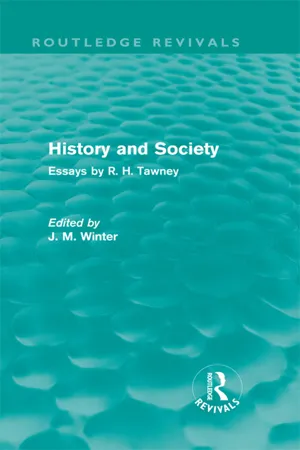
R. H. Tawney believed that the subject of economic history raises questions which touch the fundamental concerns of all thinking people. By setting economic development firmly within the framework of cultural and political life, he provided an alternative to the recent fragmentation of economic history into a number of increasingly technical specialisms.
First published as a collection in 1978, these ten essays, spanning the length of Professor Tawney's career remain as controversial and potent as ever, and the original introduction by J. M. Winter provides the first full evaluation and significance of R. H. Tawney's approach to economic history. Among the essays included in this volume are the indispensible studies of 'The Rise of the Gentry' and 'Harrington's Interpretation of His Age', as well as 'The Abolition of Economic Controls, 1918-1921', here published in full for the first time. Other selections, such as Tawney's celebrated inaugural lecture as Professor of Economic History at the London School of Economics in 1933, 'the Study of Economic History', offer a representative sample of the range and sweep of Tawney's historical imagination. Taken together, these essays demonstrate the validity of Tawney's conviction that economic historians must confront not only the creation of wealth, but also the moral questions surrounding its distribution.
- 260 pages
- English
- ePUB (mobile friendly)
- Available on iOS & Android
eBook - ePub
About this book
Information
Historical Essays
1
The Study of Economic History (1933)*1
No one can speak in this place on the Study of Economic History without recalling the names of those who have done so before him. The first book on the subject which I read was a volume in the library of classics by one of whom we are all the pupils, our encyclopaedic chairman. The first lecture on it which I attended was by a research student of this School, later a master to whom a host of apprentices owed their instruction in the craft, George Unwin. The personality who gave it its place in our curriculum was Lilian Knowles, the most inspiring of teachers and most lovable of human beings. A student who inherits a corner of their estate must feel gratitude for their labours and humility at his own.
It is not only the memory of distinguished predecessors which fills me with diffidence. When I realised that the penalty of a Professorship was an Inaugural Lecture, I breathed a prayer to the bright goddesses of enterprise and self-help, who are ever at the elbows of teachers of this School. They frowned but did their best. ‘Do not attempt,’ they said, ‘anything original or profound. It is not your line. Conform to the practice of the representative form, if, wretched historian, you know what that means. For once show real initiative. Study the addresses delivered on similar occasions by more illustrious persons. Aim at the median and you may hit the lower quartile.’
As always, when addressed by the voice of economic reason, I trembled and obeyed; but, as my researches proceeded, my despondency increased. If, as they inclined me to believe, one function of an Inaugural Lecture is to vindicate the claims of the department of knowledge represented by the lecturer against bold, bad men who would question its primacy, I am conscious of an incapacity for that entertaining branch of literature to be excused only, if at all, by a misspent youth. I came to the study of economic history, not as one dedicated from childhood to the service of the altar, but for reasons so commonplace that I am ashamed to admit them. When I reached years of discretion—which I take to mean the age at which a young man shows signs of getting over his education—I found the world surprising; I find it so still. I turned to history to interpret it, and have not been disappointed by my guide, though often by myself.
A student who is more interested in wild life than in museum specimens must be prepared to annoy gamekeepers by following it across country. If, in addition, he is an historian, with the historian’s irreverent propensity for treating the most venerable institutions, from capitalism to university curricula, as historical categories, his need for indulgence is increased. He can only hope that he may be pardoned if he confesses to regarding what academic convention distinguishes as ‘Subjects,’ not as independent entities, poised each in majestic isolation on its private peak, but as fluid and provisional divisions, with frontiers corresponding less to the articulations of the universe than to the exigencies of a world in which examinations last for three hours and a humane rubric requires that four, and not more than four, questions shall be attempted by candidates. It would be convenient if the question, Where is wisdom to be found? could be answered by referring the inquirer to the appropriate university department. But she appears to prefer the debatable land where titles are ambiguous and boundaries intersect; nor is her business much advanced by what in humbler spheres are known as demarcation disputes. So I hope that I shall not be thought less attached to the branch of knowledge which is my own, if I do not regard it as an appropriate object for proprietary defensiveness or patriotic fervour.
I
Since histories were first written, references to the work and wealth of mankind have found a place in them. But to distinguish between incidental allusions, which are forgotten as made, and the recognition of the significance of an aspect of life which leads to its systematic exploration, is the first canon of criticism; and to inflict upon you a history of Economic History is not my intention. If its springs are to be sought, they may be found, as far as England is concerned, in two movements in the century which gave both English economic life and English political institutions their decisive stamp. One of them, the attempt to offer a sociological explanation of the political breakdown, produced several pieces de circonstance and one masterpiece. But, when the stability of the edifice was assured, speculations as to its foundations fell out of fashion. While much of the best recent work in France has been prompted by curiosity as to the economic antecedents of the Revolution, the economic forces behind the English constitutional struggles continued to be almost ignored by historians till the theme was taken up in our own day by Russian scholars.
The highest landmark in the early history of English economic thought was the foundation of the Royal Society. The second influence found its motive in an attempt on the part of men closely in touch with the natural science of the day to apply an analogous technique to the investigation of contemporary economic phenomena, of which the paradox of Dutch prosperity, a pyramid balanced on its point, was the most arresting. A generation later the realisation that the quantitative methods employed, as a conscious innovation, by Graunt, Petty, King and Davenant to the study of the present could be applied with equal effect to throw light on the past, produced the work of Fleetwood, and later of Smith, Postlethwaite and Anderson, which links the Political Arithmetic of the seventeenth century to the statistical compilations of the early nineteenth. But it was an age of annalists and antiquarians, rather than of historians, and the giants of erudition, like Madox and Hearne, eschewed generalisation. The synthesis which proved, not for the last time, that the best fish are caught when poaching came neither from an historian nor an economist, but from a Professor of Moral Philosophy.
It is a truism that the central theme of The Wealth of Nations is historical. It is the emancipation of economic interests from the tyranny of custom, predatory class ambitions, and the obstruction of governments pursuing sinister ends in congenial darkness. The passages devoted to that vast movement, in which Smith, a good bourgeois, sees the clue to the progress of civilisation in Europe, are among the greatest attempts at philosophical history; and no one who studies his work, not in detached snippets of doctrine, but as composed by its author, will doubt that, without several generations of historical investigation, it could not have been written. His limitations are partly those of his generation, partly the penalty of any grand construction. He brings all things to one standard; finds the similarity of man’s needs in different periods and climates more significant than contrasts of environment and circumstance; and, worlds apart as he is from the naivete of his political popularisers, who selected their quotations to suit their interests, is not without complacency. Writing in the age before the deluge, in which it still seemed possible that the old regime might be reformed from above by men who were his friends, he is more conscious of the solidarity which rests on a rational appreciation of common interests than of unseen foundations and subterranean fires.
In the year before his death, the deluge came. When, a quarter of a century later, the waters receded, it was evident that, with a new society, a new history had been born. As always, it took its character from contemporary interests. In the study of economic development the decisive influences were three—the Revolution, Nationalism, and the progress of Capitalist industry, for which Blanqui coined the phrase that began as an epigram, continued as a platitude, and is now criticised as a fallacy. Of these England experienced the two first only at second hand. The serious achievements were those of continental scholars, of whom one, and not the least powerful, found his materials in London.
They came both from historians and from economists. In France the pioneers were the first. It was inevitable that men who were the heirs of the Revolution should inquire into the forces which had set the cataclysm in motion, and that, as they pressed their analysis, they should find the economic to be not the least important. Writers who did not accept Saint Simon’s view, that the only history which matters is the history of industry, found themselves driven behind politics and the sacred formulae of 1789 to the material foundations. Louis Blanc’s propagandist Histoire de dix ans revealed the new influence, and the Revolution of 1848, with its doctrine of a fourth estate to be emancipated, underlined the lesson. De Tocqueville, whose L’Ancien regime appeared in 1855, has not usually been regarded as an economic historian; but his masterpiece is a watershed in the wild border region between economic and political history, where rivers have their source. The immense body of recent work by French and foreign scholars on the economic conditions of pre-revolutionary France, and the magnificent series of volumes in the Collection de documents inedits sur I’histoire economique de la revolution frangaise, the publication of which was undertaken by the Government on the suggestion of Jaures, are among the streams which descend from it.
The movement which in France started from the side of the historians came in Germany from men whose interests were primarily economic. In a country economically retarded and with a strong authoritarian tradition, doctrines of relativity, of successive stages of development, of an economic apprenticeship to be passed under the tutelage of the state, found a congenial climate. List, the journalist of genius who popularised the new ideas, was a propagandist who travelled light. In his treatment of English history, his favourite arsenal of arguments, he sees design where in reality there was nothing more recondite than a commonplace struggle of interests, ascribes to farsighted statesmanship measures prompted by the necessities of an empty Exchequer, and selects as a golden example of mercantilist statecraft an episode which subsequent research has shown to be an unmitigated disaster. The book of Roscher, whose Lectures on Political Science according to the Historical Method appeared in 1843, was on a different plane. His materials were inadequate, and the title of his volume, like that of Knies, Political Economy from the Historical Standpoint, promised more than could be performed. The work of these scholars was important less for the new light which they threw on specific topics, than because they realised that the study of economic development requires a scheme and categories of its own, which do not coincide with those either of the theorist or of the political historian. Together with Hildebrand, they have the best title to be regarded as the fathers of the science as an academic discipline, with an assured status and a continuous tradition.
Judged, however, not by its immediate effect but by its influence in widening horizons and creating a ferment which would work, by action and reaction, on future generations, the most dynamic discovery of the forties was not made in a university. It was the conclusion reached by a young German journalist, in the process of revising Hegel’s Philosophy of Law, that ‘juristic relations and political forms are neither to be understood by themselves, nor explained by the general progress of the human mind, but are rooted in the material conditions of life,’ and that ‘the real foundations of which legal and political institutions are the superstructure are to be found in the relations into which men enter as producers.’ To examine the implications of that conception of social development is a task for philosophers, who have the wings of an eagle, rather than for a pedestrian historian, and I shall not attempt it. But the significance of a pioneer is to be judged less by the number of professed followers who march under his banner than by his influence in determining the direction taken by subsequent explorers. In setting Capitalism in its place as one phase in the moving panorama of economic civilisation, with a pedigree to be investigated and a title to permanence not more assured than its predecessors, Marx opened a new chapter in historical discussion, which, two generations after his death, is still unclosed. His hints have become books by writers unconscious of plagiarism; and, if the verdict of Croce—that his effect is that of spectacles on the short-sighted—requires to be supplemented, it is, perhaps, only with the remark that there are defects of vision which are incurable by oculists. In so far as it is concerned with the economic foundations of society, serious history to-day whether Marxian or not, is inevitably post-Marxian.
For much of this ferment of ideas England supplied the text; from all of it she stood apart. In the period which the fashionable historian of his day described as that of ‘the most enlightened generation of the most enlightened people that ever existed’—there were neither doubts as to social stability nor a grudge against history as an unfriendly stepmother, to set eyes scanning the economic past for clues to the economic future. The economic present was the province of a group of thinkers among whose virtues the capacity to see the characteristic achievements of their age as a strange, transitory episode was not the most conspicuous. Buckle in the fifties could describe The Wealth of Nations as ‘probably the most important book that has ever been written’. But applause was not imitation; and, after Malthus, successors capable of developing the whole of Smith’s estate had not been forthcoming. They were hardly to be expected.
Hence in England, while much of value was done in assembling materials, attempts at construction were few and feeble. Macaulay’s famous third chapter, appropriately published in 1848, when its concluding pages on ‘The Benefits derived by the Common People from the Progress of Civilisation’ had a topical interest, was, for all its brilliance, less argument than ornament. Rogers, who produced the first volume of his History of Agriculture and Prices in 1866, laid all subsequent students under his debt by his great collection of data, which only now is being superseded by Sir William Beveridge and his colleagues. But, writing at a time when the institutions which supplied them had hardly yet been explored, he was stronger as an investigator than an interpreter. With a keen eye for facts, he took his doctrines second-hand from contemporary shop windows, where they had already gathered some dust, with the result that his generalisations not infrequently throw less light on the practice of earlier generations than on the prejudices of his own. The territory nearest to economic history where progress was first made was the province of the lawyers. Maine had opened in 1861 a brilliant chapter, which was continued by Vinogradoff, Maitland, and, in our own day, Professor Holdsworth. But the best work on English economic history continued down to the eighties to be done by Germans—Brentano, whose introduction to Toulmin Smith’s collection of gild ordinances laid the foundations for all subsequent work on gild history, and who lived to publish three volumes on English economic development half a century later; Schanz, who first explained to English scholars the significance of the commercial politics and social crises of Tudor England; and Held, whose account of the Industrial Revolution appeared three years before Toynbee’s well-known lectures and may profitably be compared with them.
Partly because the legal historians had been first in the field, partly through the example of German masters, the characteristic feature of the work of the two scholars who did most to give the subject a place in English Universities was the strong institutional bias revealed when the first full-dress economic history of England appeared in 1882. Schmoller, who influenced both Cunningham and Ashley, had done much of his work on the mercantilist statecraft of the Prussian monarchy. He was somewhat heavily charged, it is perhaps fair to say, with the political assumptions natural to a German of his generation, and presented a picture of the part played by the state in economic progress, which, if a just corrective to a superficial individualism, would not always bear scrutiny. When his structure crumbled, with much else, laymen who knew economic history only through his interpreta...
Table of contents
- Cover Page
- Half Title Page
- Title Page
- Copyright Page
- Title Page
- Copyright Page
- Table of Contents
- Introduction: Tawney the Historian
- Editorial Note
- Part I Historical Essays
- Part II Reviews and Revaluations
- Index
Trusted by 375,005 students
Access to over 1.5 million titles for a fair monthly price.
Study more efficiently using our study tools.
Frequently asked questions
Yes, you can cancel anytime from the Subscription tab in your account settings on the Perlego website. Your subscription will stay active until the end of your current billing period. Learn how to cancel your subscription
No, books cannot be downloaded as external files, such as PDFs, for use outside of Perlego. However, you can download books within the Perlego app for offline reading on mobile or tablet. Learn how to download books offline
Perlego offers two plans: Essential and Complete
- Essential is ideal for learners and professionals who enjoy exploring a wide range of subjects. Access the Essential Library with 800,000+ trusted titles and best-sellers across business, personal growth, and the humanities. Includes unlimited reading time and Standard Read Aloud voice.
- Complete: Perfect for advanced learners and researchers needing full, unrestricted access. Unlock 1.5M+ books across hundreds of subjects, including academic and specialized titles. The Complete Plan also includes advanced features like Premium Read Aloud and Research Assistant.
We are an online textbook subscription service, where you can get access to an entire online library for less than the price of a single book per month. With over 1.5 million books across 990+ topics, we’ve got you covered! Learn about our mission
Look out for the read-aloud symbol on your next book to see if you can listen to it. The read-aloud tool reads text aloud for you, highlighting the text as it is being read. You can pause it, speed it up and slow it down. Learn more about Read Aloud
Yes! You can use the Perlego app on both iOS and Android devices to read anytime, anywhere — even offline. Perfect for commutes or when you’re on the go.
Please note we cannot support devices running on iOS 13 and Android 7 or earlier. Learn more about using the app
Please note we cannot support devices running on iOS 13 and Android 7 or earlier. Learn more about using the app
Yes, you can access History and Society by R.H. Tawney, J.M. Winter in PDF and/or ePUB format, as well as other popular books in Social Sciences & Sociology. We have over 1.5 million books available in our catalogue for you to explore.