![]()
Part I
The Josef Rutenfranz Lecture
THE JOSEF RUTENFRANZ LECTURE
Professor Dr Josef Rutenfranz was the leader of the group of eight scientists who conceived PWP in a café in Berlin in 1967, and organized the first PWP symposium in Dortmund in 1968. Josef Rutenfranz chaired the first meeting and remained the unofficial “Chairman of the Board” until his untimely death at the age of 60, on 28th February 1989. At PWP 1989, in Hungary, later that year it was decided that subsequent PWP symposia should begin with the Josef Rutenfranz Lecture.
| 1991 | Per-Olaf Astrand | Children and Adolescents: Performance Measurements, Education |
| 1993 | Dan M. Cooper | New Horizons in Paediatric Exercise Research |
| 1995 | Oded Bar-Or | Safe Exercise for the Child with a Chronic Disease |
| 1997 | Han C. G. Kemper | A Scientific Voyage through Research in Children’s Health – From Heart via Muscle to Bone |
| 1999 | Frank Galioto | The Challenges of the Future: Are We Ready? |
| 2001 | Anna Farkas | What About Girls? |
| 2003 | Gaston Beunen | Physical Growth, Maturation and Performance: Back to the Future |
| 2005 | Beat Villiger | News on Exercise-Induced Asthma |
| 2007 | Willem Van Mechelen | A Behavioural and Ecological Perspective to Energy-Balance-Related Behaviours in Children |
| 2009 | Emmanuel Van Praagh | The Child as a Source of Mechanical Power |
| 2010 | Viswanath Unnithan | Preventive Efficacy of Team Sports: Cardiovascular and Cardio-Respiratory Insights for Health and Performance |
| 2011 | Neil Armstrong | From Playground to Podium |
| 2013 | Robert M Malina | Youth, Sport, and Physical Activity |
![]()
CHAPTER NUMBER 1
YOUTH, SPORT, AND PHYSICAL ACTIVITY
Robert M. Malina
University of Texas at Austin and Tarleton State University, USA
Several key topics in the long history of paediatric work physiology research are highlighted in the title. Youth are the children and adolescents who are the focus of research. Sport is perhaps the most popular and visible context of physical activity (PA) among youth. PA is a topic of heightened public health interest. Organized youth sports are a major feature of the lives of children and adolescents in many parts of the world, and are driven largely by adults – administrators, coaches and parents.
Paediatric work physiology has evolved from a largely physiological focus into a variety of disciplines highlighting interactions of biology and behaviour in the context of physical activity and sport from laboratory to the playing field to the clinic. This overview evaluates (1) trends in PA, physical fitness (PF) and associated factors among youth in the past 50 years or so, and (2) trends and issues in organized youth sport, and then attempts to relate the two. Primary focus is on data for the U.S., though data from other countries are cited where appropriate.
1.1 TRENDS IN PHYSICAL ACTIVITY
Productivity statistics for agriculture and manufacturing suggest a decline in physically demanding work in the U.S. Estimated hours of work required to produce 100 bushels of corn or wheat declined by about 75% between 1900 and 1950, and then by 91% for corn and 70% for wheat between 1950 and 1980. Weekly hours in manufacturing work declined by 30% between 1900 and 1950, but did not change between 1950 and 2000 (Floud et al., 2011). Improvements in agricultural and industrial technologies contributed to more efficient production and reduced physical activity demands.
The shift to less physically demanding occupations was more apparent over the past two generations. Moderate intensity occupations (≥3 METS) in U.S. adults decreased from about 48% in 1960 to 20% in 2008 while light intensity (2.0-2.9 METS) and sedentary (< 2 METS) occupations increased over this interval from 37% to 55% and from 15% to ∼25%, respectively. Mean occupation-related energy expenditure also decreased by about 100 calories per day (Church et al., 2011). Estimated weekly time in occupational and home/domestic work, work-related travel and active leisure among U.S. adults declined from 235 to 160 MET hours/week (32%) between 1965 and 2009, while time sedentary increased, ∼25 to 37 hours/week. Estimates for U.K adults between 1961 and 2005 indicated a, decline in physical activity from 216 to 173 MET hours/week (20%) and an increase in time sedentary from 27 to 42 hours/week (Ng and Popkin, 2012).
Corresponding estimates for earlier samples of youth are not available. Many youth were engaged in agricultural and manufacturing work early in the twentieth century, while boys in “street” occupations (errands/delivery, newspapers, shoeshine) were quite active. Lower heart rates, for example, were noted in boys with a newspaper route; their “efficiency” was attributed to regular activity: the boys covered 3 to 9 miles daily delivering papers (McCurdy, 1913).
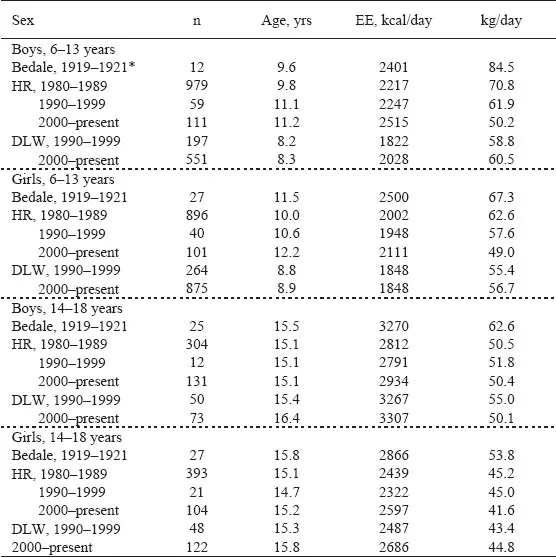
Estimates of daily energy expenditure (EE) among students at a boarding school in the U.K. in 1919–1921 provide early insights (Bedale, 1922–1923). The Douglas bag technique was used; BMR was measured in bed. Energy costs of school and non-school activities (walking, sports, outdoor work, gardening, haymaking, etc.) were derived and total daily EE on “typical school days” was estimated. Estimated costs of some activities in younger students were based on observation. Results are summarized in Table 1.1.
EE (total, per unit mass) based on heart rate (HR, some with calorimetry) and doubly labeled water (DLW) in contemporary youth are included for comparison. HR estimates date to the 1980s and DLW to the 1990s. Allowing for age and methodological variation, EE is lower in all samples compared to the estimates from ∼1920 (except boys 14-18 years, DLW). EE is related to body size; trends must be viewed in context of secular gains in body mass compared to youth of 3–4 generations ago. Estimated absolute and relative EE (HR) declined between ∼1920 and the 1980s; HR estimates also suggested a continued decline in relative EE from the 1990s to the present in boys and girls <14 years of age. DLW estimates suggested a decline in relative EE between ∼1920 and the 1990s, but no subsequent changes.
The most variable component of EE is PA (AEE). The prevalence of Canadian youth 12–14 and 15–19 years with leisure time AEE ≥ 3 and ≥ 6 kcal/kg/day (questionnaire) increased between 1981 and 1988 in only boys, but did not change appreciably between 1988 and 1998 in both sexes (Eisenmann et al., 2004). About 20% of boys in both age groups and girls 12–14 years and 10% of girls 15–19 years exceeded the AEE recommendation for youth (≥ 6 kcal/kg/day) in 1998.
In contrast to EE, PA is a behaviour and contexts of PA are variable. Estimates of PA based on questionnaires and diaries are subjective. Accelerometry is objective, but there is a need to relate accelerometry to specific contexts of PA. Both subjective and objective estimates of PA show a decline in PA from late childhood through adolescence, although there is variation among studies, contexts and scales. Boys are more active than girls, on average; the sex difference is attenuated during adolescence if data are expressed relative to maturation rather than chronological age (Thompson et al., 2003). Current emphasis is largely focused on levels of PA associated with health benefits; the current recommendation for school age youth is ≥60 minutes of moderate-to-vigorous PA (MVPA) daily (Strong et al., 2005).
Table 1.1 Estimated energy expenditure (EE) in youth: 1920–2011.
It is often assumed that levels of habitual PA of children and adolescents have declined over time. Data addressing this issue, however, are limited in time depth. Self-reported PA and variable criteria for levels of PA have also been used and data are limited to adolescents. The Youth Risk Behavior Survey (YRBS) is a major source of data for American high school youth. A slight decline was noted in physically active boys (“exercise and sports activities that make you sweat and breathe hard for 20 minutes or more on three or more days in the past week”) between 1993 and 2003, 75% to 70%, but not in girls, 56% to 55% (Adams, 2006). In contrast, no change was noted in percentages of boys and girls reporting moderate PA (did not make students sweat or breathe hard) and vigorous PA (made students sweat or breathe hard) between 1993 and 2005 (Li et al., 2010). Moderate PA did not appreciably differ between boys (29%) and girls (24%), while vigorous PA was higher in boys (72%–75%) than girls (56%). Guidelines in the U.S. have since been modified to include both aerobic (≥60 minutes per day, 7 days per week) and muscle strengthening (≥3 days per week) activities (US Department of Health and Human Services, 2010). In the 2010 National Youth Physical Activity and Nutrition Study, small percentages of boys (22%) and girls (8%) met the aerobic criteria (“increased your heart rate and made you breathe hard for some of the time”), while more youth (boys 65%, girls 37%) met the muscle strengthening criteria (“such as push-ups, sit-ups, or weight lifting”). Only 19% of boys and 26% of girls met the criteria for both. Results for muscle strengthening were similar to the 2003 YRBS while those for aerobic acti...