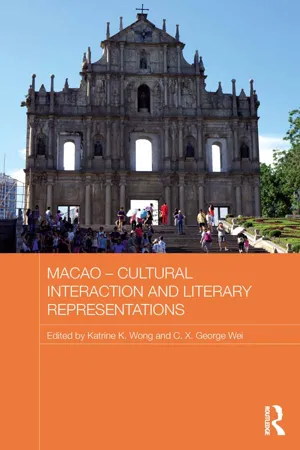
Macao, the former Portuguese colony in southeast China from the 1550s until its return to China in 1999, has a long and very interesting history of cultural interaction between China and the West. As an entity with independent political power and a unique social setting and cultural development, the identity of Macao's people is not only indicative of the legacy and influence of the region's socio-historical factors and forces, but it has also been altered, transformed and maintained because of the input, action, interaction and stimulation of creative arts and literatures. Held together by racial accommodation and tolerance and active cultural interactions, Macao's phenomenon can be characterized as hybridization. This book is a presentation of the ongoing hybridization of Macao and is in itself a hybrid, covering a wide range of issues. Putting forward substantial new research findings, the book explores the nature of cultural interaction in Macao, and how the city has been constructed and perceived through literature and other art forms. It is a companion volume to Macao – The Formation of a Global City .
An examination of early Portuguese and Western archival materials
Wu Zhiliang and Jin Guoping
The origins of Macao and how the spelling of ‘Macau’ was derived have been two of the basic and yet confusing issues which have generated great interest among many. Numerous scholars, including the authors, have made much effort in investigating the matters related to these two topics with fruitful results.1 The question of the origins of the name ‘Macau’ has been essentially clarified. With the rapid development of information technology and digitialization of archival materials that has significantly enhanced the legibility of ancient documents, the research of the investigation regarding origins of the spelling of ‘Macau’ has made some profound progress.2
A detailed catalogue of Japonica-Sinica, Goa, and Malabar archives currently reserved at the Archivum Romanum Societatis Iesu (ARSI) (Archives of the Society of Jesus) in Rome, which mostly contains details about Chinese affairs, is yet to be published.3 Currently, only a concise description in Latin is given in each volume of the archives. If we could examine this set of archives in detail, we may have discovered many documents relating to as yet unknown incidents that occurred during the final phase of the Ming Dynasty, the early phase of the Qing Dynasty, as well as in Macao. Unfortunately, we did not have enough time to do that. However, we have obtained new information from the electronically-scanned versions of the Japonica-Sinica, Goa, and Malabar archives given by the ASRI to the Fundação Oriente, which could revise or supplement our past research and provide further clues to questions that were thought to have been concluded or are still at early stages of investigation. As a result, we made use of the precious source materials related to early Macao from this set of archives, together with the documents and other collections in Japanese deposited at the Archive of the Indies in Seville of Spain, to investigate once again the origins of the spelling of ‘Macau’.4 This investigation is principally based on primary archival materials instead of published versions of archives by third parties. This is because different orthographic rules and different individual understandings in different periods could result in different spellings of the same term. Such differences cannot reflect the originality of archival materials, and readers could be misled as well.
What ‘early’ means in this chapter is the time before 1600. In other words, this investigation will focus on documents related to the first 50 years during which Macao was established. Since we are still unable to thoroughly investigate the materials concerning the spelling of ‘Macau’ contained in this set of archives, we restrict our discussion to its earliest part, with the hope to offer a few observations that may ignite interest among others in continuing with such investigation.
In reality, all Portuguese variations of the word ‘Macau’, such as ‘Maçhoam’, ‘Ama Cuão’, ‘amaquan’,5 as well as ‘Amacão’, ‘Amacuão’, ‘Amaquão’, ‘Amangão’, ‘Amagão’, ‘Amaquam’, ‘Machoam’ and ‘Maquão’,6 reflect the nasal coda. Before that, we usually referred to how ‘Macau’ was written from various copies of the letter by Fernão Mendes Pinto from ‘Ya/A Ma Gang’
on 20 November 1555, which caused much confusion as the spellings varied among translators. Reference to primary sources is therefore essential for studies of the origins of the spelling of ‘Macau’. We are pleased to report that the original handwritten copy of the said letter was uncovered from the ARSI deposits, which was also the first letter by Fernão Mendes Pinto when he was serving with the Jesuits. It can even be considered that this letter is the ‘birth certificate’ of the Portuguese word, ‘Macau’. We initially searched the Japonica-Sinica archival set, but to no avail, and the letter, which was archived among the Goa set, was out of our expectation.7 Verification with Pinto's letter to Bernando Neri on 15 March 1571 shows that the handwriting style and signature are identical,8 thus the hypothesis of the letter being written by Pinto himself can be confirmed. Until then, all documents signed by Pinto were understood to be those left in Almada, near Lisbon, when he returned from the East. This letter is so far the only one that was written by him when he was still a student at the Jesuits. The discovery of this document not only has great significance to the studies of the history of Macao, but also to the studies of the life of Pinto and his masterpiece, Peregrinação.
It is noted that the word ‘amaquão’ appeared at both the beginning and the end of this letter,9 in which there is the nasal coda of ‘ão’. Since ‘quão’ is the same as ‘cão’, ‘amaquão’ is hence pronounced as ‘amacão’. ‘Amacão’ corresponds to ‘Ya/A Ma Gang’
in Chinese, which serves as the origin of all kinds of geographical names in Portuguese that end with the nasal coda. The geographical names of a number of places where the Portuguese had been at that time also exist in the letter, such as ‘São choão’ (now ‘São João’), ‘llâpacau, lãpaqãu’ (now ‘Lampacao’ or ‘Lampacau’), and ‘quãtão’ (now ‘Cantão’, or ‘Canton’ in English). The original spelling is therefore ‘amaquão’.
The formal spelling of ‘Macau’ in Latin appeared as ‘Machao’ in the bull of Pope Gregory XIII on 23 January 1576, in which the establishment of the Diocese of Macao, the first Catholic diocese in East Asia, whose jurisdiction included China, Japan and other islands and neighbouring regions, was promulgated. The text of the bull refers to the geographical location of Macao as ‘in loco de Machao, dictæ de Machao Insulæ’. In Portuguese, ‘Macao’ is in fact ‘Macão’ without tilde. The earliest known document in whi...
Table of contents
Cover Page
Half Title page
Series page
Title Page
Copyright Page
Contents
Figures
Tables
List of Contributors
Foreword by Yao Feng
Introduction
Part I Socio-cultural evolution Naming, reading and speaking in Macao
Part II Intercultural representations Macao in print
Part III Visual and aural representations Hybridized Macao
Glossary
Index
Trusted by 375,005 students
Access to over 1.5 million titles for a fair monthly price.
Study more efficiently using our study tools.
Frequently asked questions
Yes, you can cancel anytime from the Subscription tab in your account settings on the Perlego website. Your subscription will stay active until the end of your current billing period. Learn how to cancel your subscription
No, books cannot be downloaded as external files, such as PDFs, for use outside of Perlego. However, you can download books within the Perlego app for offline reading on mobile or tablet. Learn how to download books offline
Perlego offers two plans: Essential and Complete
Essential is ideal for learners and professionals who enjoy exploring a wide range of subjects. Access the Essential Library with 800,000+ trusted titles and best-sellers across business, personal growth, and the humanities. Includes unlimited reading time and Standard Read Aloud voice.
Complete: Perfect for advanced learners and researchers needing full, unrestricted access. Unlock 1.5M+ books across hundreds of subjects, including academic and specialized titles. The Complete Plan also includes advanced features like Premium Read Aloud and Research Assistant.
Both plans are available with monthly, semester, or annual billing cycles.
We are an online textbook subscription service, where you can get access to an entire online library for less than the price of a single book per month. With over 1.5 million books across 990+ topics, we’ve got you covered! Learn about our mission
Look out for the read-aloud symbol on your next book to see if you can listen to it. The read-aloud tool reads text aloud for you, highlighting the text as it is being read. You can pause it, speed it up and slow it down. Learn more about Read Aloud
Yes! You can use the Perlego app on both iOS and Android devices to read anytime, anywhere — even offline. Perfect for commutes or when you’re on the go. Please note we cannot support devices running on iOS 13 and Android 7 or earlier. Learn more about using the app
Yes, you can access Macao – Cultural Interaction and Literary Representations by Katrine K. Wong, C.X. George Wei, Katrine K. Wong,C.X. George Wei in PDF and/or ePUB format, as well as other popular books in Social Sciences & Ethnic Studies. We have over 1.5 million books available in our catalogue for you to explore.