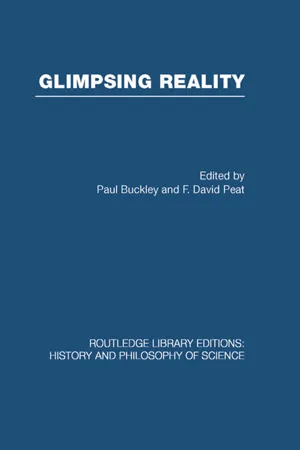
Originally published in 1979. This reprints the revised and expanded edition of 1996. In this volume, physicists, biologists and chemists, who have been involved in some of the most exciting discoveries in modern scientific thought explore issues which have shaped modern physics and which hint at what may form the next scientific revolution. The major issues discussed are the understanding of time and space, quantum and relativity theories and recent attempts to unite them and related questions in theoretical biology.
- 207 pages
- English
- ePUB (mobile friendly)
- Available on iOS & Android
eBook - ePub
About this book
Information
Conversations
Werner Heisenberg
While a Student of Arnold Sommerfeld at Munich in the early 1920s Werner Heisenberg (1901–75) first met the Danish physicist Niels Bohr. He and Bohr went for long hikes in the mountains and discussed the failure of existing theories to account for the new experimental results on the quantum structure of matter. Following these discussions Heisenberg plunged into several months of intensive theoretical research but met with continual frustration. Finally, suffering from a severe attack of hay fever, he retreated to the treeless island of Helgoland. After days spent relaxing and swimming Heisenberg suddenly experienced the giddy sensation of looking down into the heart of nature and conceived the basis of the quantum theory. He took this theory to Bohr at Copenhagen, and for the next few weeks they argued and probed its implications long into the night. The results of these discussions became known as the ‘Copenhagen interpretation of quantum theory’ and are accepted by most physicists. Aspects of the interpretation include Heisenberg's uncertainty principle and Bohr's principle of complementarity.
Heisenberg made other important discoveries in physics, and became one of the most distinguished physicists of the century. He was awarded the Nobel Prize for Physics in 1932. His scientific attitudes reflect a debt to philosophy and in particular his respect for Plato. Some of his thoughts on science and society are recorded in a readable autobiography entitled Physics and Beyond.
In recent years Heisenberg adopted the unpopular position of criticizing research in elementary particle physics and proposing that symmetries and not elementary particles form the fundamental starting-point for a description of the world. Towards the end of this chapter he touches upon this theory and its reception.
Professor Heisenberg was interviewed one sunny morning in his office at the Max Planck Institute in Munich. We began by asking Heisenberg to recall the early days of quantum theory but it became apparent that great men have no desire to live in the past and he was just as eager to talk about the future of physics.
DP Could you reminisce about the time when you arrived at the idea of quantum mechanics?
At that time, there was general discussion among young physicists about the possible ways to establish a coherent quantum theory, a coherent quantum mechanics. Among the many attempts, the most interesting for me was the attempt of H.A. Kramers to study the dispersion of atoms and, by doing so, to get some information about the amplitudes for the radiation of atoms. In this connection, it occurred to me that in the mathematical scheme these amplitudes behaved like the elements of a mathematical quantity called a matrix. So I tried to apply a mathematical calculus to the experiments of Kramers, and the more general mechanical models of the atom, which later turned out to be matrix mechanics. It so happened at that time I became a bit ill and had to spend a holiday on an island to be free from hay fever. It was there, having good time to think over the questions, that I really came to this scheme of quantum mechanics and tried to develop it in a closed mathematical form.
My first step was to take it to W. Pauli, a good friend of mine, and to discuss it with him, then to Max Born in Göttingen. Actually, Max Born and Pascual Jordan succeeded in giving a much better shape and more elegant form to the mathematical scheme. From the mathematical relations I had written down, they derived the so-called commutation relations. So, through the work of Born and Jordan, and later Paul Dirac, the whole thing developed very quickly into a closed mathematical scheme.
I also went to discuss it with Niels Bohr, but I can't be sure whether this was in July, August, or September of that year [1925].
Half a year later the first papers of E. Schrödinger became known. Schrödinger tried to develop an older idea of Louis de Broglie into a new mathematical scheme, which he called wave mechanics. He was actually able to treat the hydrogen atom on the basis of his wave mechanical scheme and, in the summer of 1926, he was also able to demonstrate that his mathematical scheme and matrix mechanics were actually two equivalent mathematical schemes, that they could be simply translated into each other. After that time, we all felt that this must be the final mathematical form of quantum theory.
DP Had you and Bohr begun the interpretation of this work before Schrödinger's paper came out?
Of course, there was continuous discussion, but only after Schrödinger's paper did we have a new basis for discussion, a new basis for interpreting quantum theory. In the beginning there was strong disagreement between Schrödinger and ourselves, not about the mathematical scheme, but about its interpretation in physical terms. Schrödinger thought that by his work physics could again resume a shape which could well be compared with Maxwell's theory or Newton's mechanics, whereas we felt that this was not possible. Through long discussions between Bohr and Schrödinger in the fall of 1926, it became apparent that Schrödinger's hopes could not be fulfilled, that one needed a new interpretation. Finally, from these discussions, we came to the idea of the uncertainty relations, and the rather abstract interpretation of the theory.
PB Did Schrödinger ever like that interpretation?
He always disliked it. I would even guess that he was not convinced. He probably thought that the interpretation which Bohr and I had found in Copenhagen was correct in so far as it would always give the correct results in experiments; still he didn't like the language we used in connection with the interpretation. Besides Schrödinger, there were also Einstein, M. von Laue, M. Planck, and others who did not like this kind of interpretation. They felt it was too abstract, and too far removed from the older ideas of physics. But, as you know, this interpretation has, at least so far, stood the test of all experiments, whether people like it or not.
PB Einstein never really liked it, even until the day he died, did he?
I saw Einstein in Princeton a few months before his death. We discussed quantum theory through one whole afternoon, but we could not agree on the interpretation. He agreed about the experimental tests of quantum mechanics, but he disliked the interpretation.
DP I felt that at some point there was a slight divergence between your views and Bohr's, although together you are credited with the Copenhagen interpretation of quantum mechanics.
That is quite true, but the divergence concerned more the method by which the interpretation was found than the interpretation itself. My point of view was that, from the mathematical scheme of quantum mechanics, we had at least a partial interpretation, inasmuch as we can say, for instance, that those eigenvalues which we determine are the energy values of the discrete stationary states, or those amplitudes which we determine are responsible for the intensities of the emitted lines, and so on. I believed it must be possible, by just extending this partial interpretation, to get to a complete interpretation. Following this way of thinking, I came to the uncertainty relations.
Now, Bohr had taken a different starting-point. He had started with the dualism between waves and particles — the waves of Schrödinger and the particles in quantum mechanics — and tried, from this dualism, to introduce the term complementarity, which was sufficiently abstract to meet the situation. At first we both felt there was a real discrepancy between the two interpretations, but later we saw that they were identical. For three or four weeks there was a real difference of opinion between Bohr and myself, but that turned out to be irrelevant.
DP Did this have its origin in your different philosophical approaches?
That may be. Bohr's mind was formed by pragmatism to some extent, I would say. He had lived in England for a longer period and discussed things with British physicists, so he had a pragmatic attitude which all the Anglo-Saxon physicists had. My mind was formed by studying philosophy, Plato and that sort of thing. This gives a different attitude. Bohr was perhaps somewhat surprised that one should finally have a very simple mathematical scheme which could cover the whole field of quantum theory. He would probably have expected that one would never get such a self-consistent mathematical scheme, that one would always be bound to use different concepts for different experiments, and that physics would always remain in that somewhat vague state in which it was at the beginning of the 1920s.
DP In the interpretation you gave at that time, you seemed to imply that there did exist an ideal path and that somehow the act of measuring disturbed the path. This is not quite the same as the interpretation that you hold now, is it?
I will say that for us, that is for Bohr and myself, the most important step was to see that our language is not sufficient to describe the situation. A word such as path is quite understandable in the ordinary realm of physics when we are dealing with stones, or grass, etc., but it is not really understandable when it has to do with electrons. In a cloud chamber, for instance, what we see is not the path of an electron, but, if we are quite honest, only a sequence of water droplets in the chamber. Of course we like to interpret this sequence as a path of the electron, but this interpretation is only possible with restricted use of such words as position and velocity. So the decisive step was to see that all those words we used in classical physics — position, velocity, energy, temperature, etc. — have only a limited range of applicability.
The point is we are bound up with a language, we are hanging in the language. If we want to do physics, we must describe our experiments and the results to other physicists, so that they can be verified or checked by others. At the same time, we know that the words we use to describe the experiments have only a limited range of applicability. That is a fundamental paradox which we have to confront. We cannot avoid it; we have simply to cope with it, to find what is the best thing we can do about it.
DP Would you go so far as to say that the language has actually set a limit to our domain of understanding in quantum mechanics?
I would say that the concepts of classical physics which we necessarily must use to describe our experiments do not apply to the smallest particles, the electrons or the atoms — at least not accurately. They apply perhaps qualitatively, but we do not know what we mean by these words.
Niels Bohr liked to tell the story about the small boy who comes into a shop with two pennies in his hands and asks the shopkeeper for some mixed sweets for the two pennies. The shopkeeper gives him two sweets and says ‘You can do the mixing yourself.’ This story, of course, is just meant to explain that the word mixing loses its meaning when we have only two objects. In the same sense, such words as position and velocity and temperature lose their meaning when we get down to the smallest particles.
DP The philosopher Ludwig Wittgenstein originally started off by thinking that words were related to facts in the world, then later reversed his position to conclude that the meaning of words lay in their use. Is this reflected in quantum mechanics?
I should first state my own opinion about Wittgenstein's philosophy. I never could do too much with early Wittgenstein and the philosophy of the Tractatus Logico-philosophicus, but I like very much the later ideas of Wittgenstein and his philosophy about language. In the Tractatus, which I thought too narrow, he always thought that words have a well-defined meaning, but I think that is an illusion. Words have no well-defined meaning. We can sometimes by axioms give a precise meaning to words, but still we never know how these precise words correspond to reality, whether they fit reality or not. We cannot help the fundamental situation — that words are meant as a connection between reality and ourselves — but we can never know how well these words or concepts fit reality. This can be seen in Wittgenstein's later work. I always found it strange, when discussing such matters with Bertrand Russell, that he held the opposite view; he liked the early work of Wittgenstein and could do nothing whatsoever with the late work. On these matters we always disagreed, Russell and I.
I would say that Wittgenstein, in view of his later works, would have realized that when we use such words as position or velocity, for atoms, for example, we cannot know how far these terms take us, to what extent they are applicable. By using these words, we learn their limitations.
DP Would it be true to say that quantum mechanics has modified language, and, in turn, language will re-modify the interpretation of quantum mechanics?
There I would not quite agree. In the case of relativity theory, I would agree that physicists have simply modified their language; for instance, they would use the word simultaneous now with respect to certain coordinate systems. In this way they can adapt their language to the mathematical scheme. But in quantum theory this has not happened. Physicists have never really tried to adapt their language, though there have been some theoretical attempts. But it was found that if we wanted to adapt the language to the quantum theoretical mathematical scheme, we would have to change even our Aristotelian logic. That is so disagreeable that nobody wants to do it; it is better to use the words in their limited senses, and when we must go into the details, we just withdraw into the mathematical scheme.
I would hope that philosophers and all scientists will learn from this change which has occurred in quantum theory. We have learned that language is a dangerous instrument to use, and this fact will certainly have its repercussions in other fields, but this is a very long process which will last through many decades I should say.
Even in the old times philosophers realized that language is limited; they have always been sceptical about the unlimited use of language. However, these doubts or difficulties have, perhaps, been enhanced through the present developments in physics. I might mention that most biologists today still use the language and the way of thinking of classical mechanics; that is, they describe their molecules as if the parts of the molecules were just stones or something like that. They have not taken notice of the changes which have occurred in quantum theory. So far as they get along with it, there is nothing to say against it, but I feel that sooner or later, also in biology, one will come to realize that this simple use of pictures, models, and so on will not be...
Table of contents
- Cover
- Half Title
- Full Title
- Copyright
- Dedication
- Contents
- Preface to the Revised Edition
- Preface to the First Edition
- Introduction to the Revised Edition
- CONVERSATIONS
- ESSAYS
- Appendix: the troubles of quantum theory
- Glossary
Trusted by 375,005 students
Access to over 1.5 million titles for a fair monthly price.
Study more efficiently using our study tools.
Frequently asked questions
Yes, you can cancel anytime from the Subscription tab in your account settings on the Perlego website. Your subscription will stay active until the end of your current billing period. Learn how to cancel your subscription
No, books cannot be downloaded as external files, such as PDFs, for use outside of Perlego. However, you can download books within the Perlego app for offline reading on mobile or tablet. Learn how to download books offline
Perlego offers two plans: Essential and Complete
- Essential is ideal for learners and professionals who enjoy exploring a wide range of subjects. Access the Essential Library with 800,000+ trusted titles and best-sellers across business, personal growth, and the humanities. Includes unlimited reading time and Standard Read Aloud voice.
- Complete: Perfect for advanced learners and researchers needing full, unrestricted access. Unlock 1.5M+ books across hundreds of subjects, including academic and specialized titles. The Complete Plan also includes advanced features like Premium Read Aloud and Research Assistant.
We are an online textbook subscription service, where you can get access to an entire online library for less than the price of a single book per month. With over 1.5 million books across 990+ topics, we’ve got you covered! Learn about our mission
Look out for the read-aloud symbol on your next book to see if you can listen to it. The read-aloud tool reads text aloud for you, highlighting the text as it is being read. You can pause it, speed it up and slow it down. Learn more about Read Aloud
Yes! You can use the Perlego app on both iOS and Android devices to read anytime, anywhere — even offline. Perfect for commutes or when you’re on the go.
Please note we cannot support devices running on iOS 13 and Android 7 or earlier. Learn more about using the app
Please note we cannot support devices running on iOS 13 and Android 7 or earlier. Learn more about using the app
Yes, you can access Glimpsing Reality by Paul & F David Buckley & Peat in PDF and/or ePUB format, as well as other popular books in Philosophy & Philosophy History & Theory. We have over 1.5 million books available in our catalogue for you to explore.