Originally published 1968, the book examines the ways in which the definitions of education held by different groups with power have changed since 1800 and traces which social institutions exercised the preponderant influence on the growth of the English educational system during the seminal period in which the state system was founded and grew to its present position. Especial attention is given to the influence of the ideologies of the various social classes, to the growing demands of the economy on the educational system and to changes in the structure of the family.
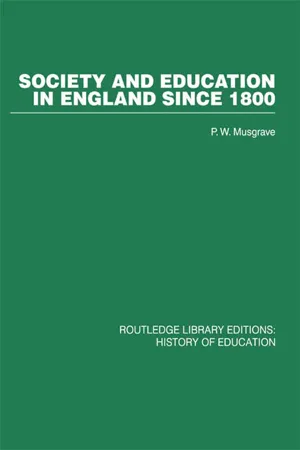
- 176 pages
- English
- ePUB (mobile friendly)
- Available on iOS & Android
eBook - ePub
Society and Education in England Since 1800
About this book
Information
CHAPTER ONE
INTRODUCTION
The history of the English educational system has usually been written in one of two ways. Firstly, there are descriptions of how educational institutions have developed over given stretches of time and of the legislation that has governed this growth. Often aspects of the political struggles leading to such legislation are considered. Secondly, there are very detailed investigations of particular institutions or branches of educational endeavour. Sometimes these investigations are related to the social setting in which the institutions existed. But there seems to be a lack of a short, yet broad, examination of the historical development of the English educational system as a social institution that shows the changing inter-relationships of education with such other social institutions as the family, the economy or the social class system. One aim of this brief account is to fill this gap for those students of education, sociology or history who wish to examine the sweep of educational history over the last century and a half. This may be called the academic aim of this book.
There is also a very practical aim. Serving teachers define the situations that they meet in a specific way and act on their definitions. Both the situations and the way that they define them are to a large extent the products of past historical circumstances. Therefore, if teachers are to act efficiently in their positions they must know something of how the system within which they are serving came to be what it is. The history of education has great intrinsic interest to many, especially to those who are professionally concerned with the schools. But the subject has also a practical importance in that a knowledge of it will enable teachers to be more effective in their work, and the practical aim of this book is to enable teachers to be just this by knowing how the English system developed to its present state and what forces are at work on them in the school as they go about their task of teaching children.
The first and more academic aim of examining the development of education as an institution in its social setting can be met by employing a more sociological approach than is usual when considering educational history and basically this book is an essay in historical sociology. The concept of ‘the definition of the situation’ is central to the method used here. In any institutional sphere, such as education, the definition of what that institution is thought to be at any one time can be discovered from historical sources. Thus Acts of Parliament, the speeches of politicians, administrative regulations and official reports all reveal in some measure how institutions were viewed at the time. In a democratic political system these definitions are usually the end product of a bargaining process. They constitute a truce situation. A study of any particular definition and the circumstances in which it was achieved will reveal the values, attitudes and forces playing on its formulation.
From a definition of education, action follows. Goals are given to the educational system or to that particular part of the system for which the definition is relevant. Resources of manpower and materials are claimed for education. Schools are built and teachers allocated to their staffs. As the system grows in complexity coordination becomes essential and administrators try to integrate the various parts of the system. They must, for example, control the movement of children from early schooling into the more specialized types of schools that cater for older children. Various types of administrative mechanisms have to be evolved to cope with the increasingly complicated nature of the educational system. Growth seems to lead to greater differentiation in all systems. For instance, schools or institutions of higher education become more specialized and very often this complexity in itself demands a redefinition of the system so that the legal framework, or even the conceptual framework with which people think about the system, can be brought up-to-date.
Finally, once any system has been established, steps have to be taken to ensure that the pattern into which it has been formed is maintained. Thus, in an educational system measures are needed to see that new teachers act in such a way that the goals given to the system are fulfilled. This is mainly achieved by the careful selection and training of teachers. Again, it is necessary to ensure that the products of the various levels of schools meet the requirements laid upon the system by the ruling definition. One way of achieving this is through some form of examination system.
The definitions of education that are made official by, for example, Acts of Parliament or administrative regulations do not last for ever. The sources of change may be either internal or external to the system. Change can come from outside the system in various ways. The balance of power responsible for the last truce situation may change and a new truce follow. The values governing one particular institution that inter-relates closely with education may alter with the result that it assumes greater or less importance. Thus a higher value may be put on the economy or a lower value on religion, with consequent effects for education. Or change may come from within the educational system itself; that is, the system may autonomously generate change.
This latter case is common in an atmosphere of laissez-faire, since any definition will tend to allow a range of tolerable action. In itself this is wise since a certain amount of tension can be permitted within the system without the necessity for constant redefinition. In concrete terms there will be no need for new Education Acts every few years. In addition, such indeterminacy in definitions allows cumulative movement within the system towards the limits of the definition, thereby influencing the direction of the next definition from within the educational system itself. Such a process is very important for the analysis of the development of English education because the educational system grew in a period when the philosophy of laissez-faire was strongly supported by those in power. As a result scope for freedom and experiment has been usual at every level of the educational system. In such a situation minor changes can accumulate until a threshold is reached; but beyond that point a small strain may result in the need for a massive redefinition.
Briefly, then, this book will proceed by examining the way in which definitions of education have given goals to the system so that resources are drawn into the educational sector. This process leads to increasing complexity; coordination becomes more difficult, as does the problem of maintaining the existing pattern of the whole educational system. By examining the strains that lead to redefinitions and also the power struggles that result in new truce situations the sources of change that affect the educational system should be apparent. Lastly, because of the great emphasis put upon freedom in England during the last hundred and fifty years, allowance has been made in the analytical framework so that any autonomous development that may have occurred within the educational system itself can be noted and examined.
There have been three major definitions of education in England since about 1800 from which major administrative changes have flowed. These were made by and as a result of the Education Acts of 1870, 1902 and 1944. These Acts in the main refer to the schools rather than to higher, technical or further education. But very often definitions of these parts of the educational system were made at much the same time and because of much the same social strains. It will, therefore, be possible to interweave the story of these institutions with that of the schools so as to give a more complete picture of the relationship of society and education during the period.
The next chapter will study the development of the rather primitive educational system of this country in the first half of the nineteenth century and the strains that produced the 1870 Education Act. In Chapters 3 and 4 the Education Acts of 1902 and 1944 will be examined in the same way. In Chapter 5 the growth of the system since 1944 will be considered, and the strains at present at work between education and other social institutions will be examined. The recent definitions by various official reports will be described with a view to looking forward to the nature of the next redefinition. The final brief chapter will look at some of the educational and sociological generalizations that are possible as a result of using this particular conceptual framework to order the historical material presented here.
CHAPTER TWO
THE BIRTH OF THE EDUCATIONAL SYSTEM
The first attempts by the state to intervene in education in the nineteenth century were unsuccessful. Following a severe outbreak of fever in 1795 in Manchester a committee on health was established of which the first Sir Robert Peel was a member. Through his pressure in parliament the Health and Morals of Apprentices Act was passed in 1801. Factory owners were now supposed to provide adequate instruction in the three R's during the first four of the seven years of a child's apprenticeship. This schooling was not to be given before 6 a.m. nor after 9 p.m. An interesting point to note is that here education was defined as a state responsibility only inasmuch as parliament should make the rules by which it was to be supplied. The definition was not such that the state should actually supply educational facilities or levy taxation for this purpose.
The extremely simple education clauses of this Act were ineffective because of the impossibility of enforcing them at a time when the machinery of government was minimal. For the same reason the educational clauses of the 1819 Factory Act had no real success. It was not until 1833 that in a lightly attended sitting the House of Commons passed a motion to grant up to £20,000 per year to certain recognized religious societies as a subsidy for educational building and maintenance. By 1839 this sum had risen to £30,000 and it was clear that some special body was necessary to administer the grant. What constraints were working at this time to prevent more extensive state intervention in education? Why was the first successful intervention on such a comparatively small scale, and why was it restricted to the supply of monies for others to spend as opposed to the actual provision of educational facilities?
1 Constraints
At the start of the nineteenth century Britain was leading the world in industrial and commercial development. Certainly, if the rulers of this country had so wished, there was wealth enough available to allocate a larger proportion of the national income to educational purposes than was then the case. This allocation could have been made either by the state or by private citizens; more especially the wealthy could have bought more education through the almost completely laissez-faire economic system of the time. Yet compared with the economic system, which even in 1800 was an extremely complicated one, the educational system remained in a very simple and undeveloped state.
Though the economy was complex its smooth running did not yet depend upon the educational system for a supply of formally educated manpower, whether at the managerial or the operative level. In almost every job, except in the traditional professions of the law, medicine and the church, a man could learn by doing the job. The size of the average industrial unit was not so large as to make management a very difficult task. Many businesses were still under family ownership and there was no really strong and continuing political opposition to such nepotism. Able men who were illiterate could rise from the lower classes to the position of foreman and even into managerial positions. For the vast majority of jobs, even when skilled, a knowledge of the three R's was just not necessary. Manufacturers were proud of the skill of the British working man and spoke of the factory as the school for workmen. In general, labour was in easy supply and a demand for raw labour to learn the many new jobs created by technological change could easily be met by workers moving off the land or, especially in the mid-1840s, by Irish immigrants.
The laissez-faire values implicit in this view of the economic system and of the labour market were also powerful in contemporary political discourse. In 1776 Adam Smith had written The Wealth of Nations. This book had great influence and provided the theoretical framework within which both economic and political argument was pursued. A policy of minimum intervention was almost unquestioned by those in power, except in matters of defending the state against such external dangers as invasion or such internal threats as rebellion. Strong arguments against the provision of education by the state were based upon the claims of individual liberty in so crucial a sphere as education. Adam Smith was, however, a Scot who knew from experience that education was the basis of good civil government, of much economic activity and of social progress. Like Jeremy Bentham, a powerful laissez-faire theoretician of the period, he considered that state intervention might be necessary if private enterprise failed to provide what was essential for the good of the state. Therefore, when by the early nineteenth century some voices demanded more education, there was in the final resort a theoretical position to which appeal could be made. But, once it was granted that intervention was to occur, there were two very important questions to be decided. The first was who in the long run was to find the resources from which more adequate educational provision could be made and the second was what was to be taught, to whom and to what depth.
The books, including school textbooks, available to the early Victorians showed the general attitude that was adopted towards education. This reinforced many of the central political, moral and religious attitudes of the time. One of the best examples is Samuel Smiles's Self Help, first published in 1859. This widely read book was a series of homilies on the qualities necessary for success in life and an encouragement to all to help themselves to success by cultivating these individualistic qualities. Many of the cheap books provided earlier in the century by the upper classes for the lower classes were of a similar nature, and revealed their total lack of understanding of how the working class was really thinking at the time.
The demand for any sort of reading material was restricted in three ways. Firstly, the rate of literacy was low; in 1841, 33 per cent of men and 49 per cent of women marrying in England and Wales made their mark on the register as opposed to writing their signature.1 Though at this time more could read than write, these figures are some measure of contemporary literacy. Secondly, political control of newspapers and magazines was an influential factor since there was a fairly heavy stamp tax on such material until as late as 1855. These taxes were originally imposed in the period just after the Napoleonic wars with the aim of checking the spread of revolutionary ideas. Yet their ultimate effect was to stir up opposition to the government. The experience of such political movements as those at the time of the Reform Bill agitation in the early 1830s and those associated with the Chartists during the years 1836 to 1848 was a very real education in itself for the illiterate millions of the working class. They learnt new aims amongst which was the demand for education, a demand based on its individual, rather than on its social, benefits.
The third restriction on the demand for reading matter was rooted in the sheer lack of leisure amongst the vast majority of the working population, tied as they were to the factory or the fields for the very long working hours of the time. Most labourers were at work by 6 a.m. and except for short meal breaks worked through until 8 p.m. It is not surprising, therefore, that in the 1850s the approximate daily circulation of newspapers was 60,000, whereas on Sundays the demand rose to about 275,000 copies.2 Nor, in view of the education that the working class had received in the political struggles of the period after the Napoleonic wars, is it very surprising that, as soon as the tax on advertisements was removed in 1853 and the Stamp Act was repealed in 1855, seventeen provincial daily papers were founded. A substantial working-class demand was implicit in such a growth.
Each social class had a different view of what its own education should be, and the upper classes also had opinions on what education the other social classes should have. These definitions of education might be implicit in their behaviour and attitudes or made explicit in public statements or in writings. Even after the Reform Act of 1832 the English aristocratic upper class was for many years a powerful group. To members of this class education for their children was not needed for any immediate practical purpose, but more to acquire social graces. This was a leisured class of rulers and their leisure was regarded by them as one important symbol of high status. Unproductive knowledge such as that of the classics or literature gave prestige in much the same way as did gaming and hunting. If this class considered the education of the other classes at all, its view was that their education, as any other commodity they needed, should be bought.
The middle class grew in size and economic importance as the country became more industrialized after the middle of the eighteenth century. This changed economic status was translated into greater political power in the reformed parliament after 1832. The upper middle class wanted to demonstrate their apparent rise in status by giving their children the same education as was normal for the upper class. They therefore imitated the educational methods of the aristocrats which then relied mainly on private tutors and on the public schools. The middle class as a whole had much the same laissez-faire view of the education of the working class as the upper class had of middle-class education. The one exception was that some of the middle class who lived in small country towns had come to expect a cheap or even free education at local grammar schools, most of which were heavily subsidized by endowments made in the past. The increasingly numerous lower middle class, especially in the industrial areas where their strength lay, wanted enough education for their boys for them ‘to get on’. They were, therefore, keen that the curriculum of such local grammar schools as existed should consist of more utilitarian subjects like mathematics and French rather than the classical diet which was almost universal. But such a change in curriculum was not easy to achieve. In 1795 the governors of Leeds Grammar School went to the Court of Chancery to try to change the legal basis of their endowment so as to provide a more modern curriculum. But in 1805 Lord Chief Justice Eldon decided that these modern subjects could only be included as ancillary to the basic curriculum of the classics. He based his judgment on the definition of a grammar school found in Dr Johnson's dictionary, namely that it was a school where the learned languages are taught grammatically.
The working-class view of education was far less formed than that of the other classes. The members of this class did not question the way in which the middle and upper classes defined their own education and were only beginning to formulate their own educational needs. During the political agitations associated with Robert Owen around 1830 strong working-class support was gathered for an ideal of social justice which included a demand for popular education. This demand was also an ingredient in the Chartist movement of the period up to 1848. But it was only at the height of these movements that it can be said that there was a strong demand from the masses for education and at such times the demand was vague, not extending to the sp...
Table of contents
- Front Cover
- Half Title
- Title Page
- Copyright
- Title Page
- Copyright
- Contents
- Preface
- 1 Introduction
- 2 The Birth of the Educational System
- 3 Towards One System
- 4 The Expansion of the System
- 5 Towards a Fair System
- 6 Conclusions
- Further Reading
- Index
Trusted by 375,005 students
Access to over 1.5 million titles for a fair monthly price.
Study more efficiently using our study tools.
Frequently asked questions
Yes, you can cancel anytime from the Subscription tab in your account settings on the Perlego website. Your subscription will stay active until the end of your current billing period. Learn how to cancel your subscription
No, books cannot be downloaded as external files, such as PDFs, for use outside of Perlego. However, you can download books within the Perlego app for offline reading on mobile or tablet. Learn how to download books offline
Perlego offers two plans: Essential and Complete
- Essential is ideal for learners and professionals who enjoy exploring a wide range of subjects. Access the Essential Library with 800,000+ trusted titles and best-sellers across business, personal growth, and the humanities. Includes unlimited reading time and Standard Read Aloud voice.
- Complete: Perfect for advanced learners and researchers needing full, unrestricted access. Unlock 1.5M+ books across hundreds of subjects, including academic and specialized titles. The Complete Plan also includes advanced features like Premium Read Aloud and Research Assistant.
We are an online textbook subscription service, where you can get access to an entire online library for less than the price of a single book per month. With over 1.5 million books across 990+ topics, we’ve got you covered! Learn about our mission
Look out for the read-aloud symbol on your next book to see if you can listen to it. The read-aloud tool reads text aloud for you, highlighting the text as it is being read. You can pause it, speed it up and slow it down. Learn more about Read Aloud
Yes! You can use the Perlego app on both iOS and Android devices to read anytime, anywhere — even offline. Perfect for commutes or when you’re on the go.
Please note we cannot support devices running on iOS 13 and Android 7 or earlier. Learn more about using the app
Please note we cannot support devices running on iOS 13 and Android 7 or earlier. Learn more about using the app
Yes, you can access Society and Education in England Since 1800 by P W Musgrave in PDF and/or ePUB format, as well as other popular books in Education & Education General. We have over 1.5 million books available in our catalogue for you to explore.