This set comprises forty volumes covering nineteenth and twentieth century European and American authors. These volumes will be available as a complete set, mini boxed sets (by theme) or as individual volumes.
This second set compliments the first sixty-eight volume set of Critical Heritage published by Routledge in October 1995.
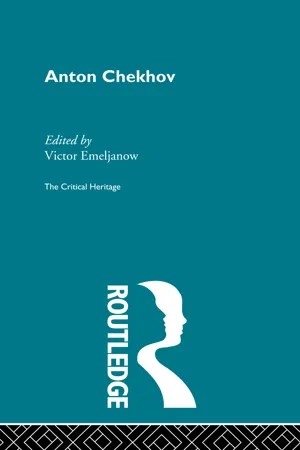
- 496 pages
- English
- ePUB (mobile friendly)
- Available on iOS & Android
eBook - ePub
Anton Chekhov
About this book
Information
1. AN EARLY EVALUATION OF THE YOUNG WRITER CHEKHOV
1891

From Recent Russian Literature, a periodic causerie written by E.J. Dillon in ‘Review of Reviews’, July-December 1891, iv, 79-83. Most of the article is concerned with political censorship in Russia and calls Chekhov a Russian Maupassant.
The writer by whom at one time Turghenieff’s mantle seemed to be dexterously caught up and gracefully donned, is a physician of great promise and not very great performance. M. Chekhov, who is still a young man, with time enough before him to fulfil his most liberal promises, is a literary miniaturist, whose work gives one the impression of great power studiously kept in reserve; a man of considerable insight and remarkable power of combination, who courageously dives into the mysterious depths of the ocean of human life, and brings up - shreds and seaweed. His chief merits (and they are unanimously acknowledged by enemies and friends) consist in that unruffled calm and artistic objectivity in which his colleagues are so sadly deficient; in his complete exemption from that petty party bias which discolours and disfigures some of the very best productions of Russian literature, and lowers then to the level of the political philippics and pleadings of a daily newspaper; and in that wonderful fidelity to nature with which he delineates the complicated social types of modern Russia. . . .
No man, whatever his craft or calling, is more completely fettered and crippled than a Russian writer. In Italy in former times a versifier often had some scores of rhymes given to him in a certain order, to which he undertook to tack on words, and turn out a ‘poem’ with some tolerable meaning. In Russia the theme, the moral, the allusions and the omissions are all specified along with the order, and the author has to sit down and execute the command without reasoning or discussion. . . .
[Dillon goes on to show how public and private censorship has affected even distinguished writers like Tolstoy although Chekhov has somehow managed to avoid editorial strictures.]
He is as free as the March wind. Independent of editors, he can treat with publishers on terms of equality, and can afford to be courageous enough to say exactly what he thinks and to give artistic form to what he sees and hears. And he has seen much of Russian life, its bright and seamy sides, in Europe and in Asia, young though he is. His sketches, though short and fragmentary, are artistic; and as his collection of Russian types is unanimously admitted to be faithful to the life, a glance at his album cannot but interest the foreigner, who is bewildered by the contradictory accounts he reads of Russia and the Russians. . . . This gallery of typical portraits is remarkably complete, embracing all classes, all ages, and both sexes. . . . But it is impossible to read five or six of them in succession without losing all traces of pleasure in a feeling of profound melancholy, such as might damp the spirits of a philanthropist who should wander over the field of slaughter the day after the battle. The precocious children of seven or eight years, who saucily discuss problems of happiness and misery, a la Marie Bashkirtseff; the citizens of seventeen who have already seen enough of life to prefer death by suicide to seeing any more; the ignorant, feather-brained, world-reforming student; the nervous fickle women whose virtue bends and plies to every gust of wind that attacks or caresses it; the dreamy, patient, fatalistic peasants, and the feeble, disenchanted, helpless old men of thirty, who are dying before they have begun to live, are revelations as sad and as striking as the sights that met the eyes of Bluebeard’s wife when she crossed the threshold of the secret chamber. . . .
. . .And it is thus all through the portrait gallery of Russian types painted by Chekhov, successor to Turghenieff - briberty, rottenness, precocious knowledge, and precocious vice, children with old men’s heads on their shoulders, men and women with disordered nerves instead of heart, and paroxysms of illness in lieu of impulses and sentiments, and human life wasting away like a candle burning at both ends. Chekhov plainly intimates that life in Russia has but two seasons, like the steppe - winter with its paralysing frost, before nature gives any sign of life or movement, and summer which with its fierce heat eats up everything green, leaving nought but parched drooping grass behind. . . .
2. ABRAHAM CAHAN ON THE NEW WAVE OF RUSSIAN WRITERS
1899
From The Younger Russian Writers in ‘Forum’, September 1899, xxviii, 119-28. Cahan followed this up with an article on The Mantle of Tolstoy in ‘Bookman’, 1902, xvi, 328-33. The essays are valuable because they show that Russian literary critics were not dissimilar in their reactions to their Anglo-Saxon counterparts. Abraham Cahan (1860-1951) was in fact Russian born - a journalist who went to the United States in 1882, and wrote in both English and Yiddish.
. . .No nation has a theory of art so clearly defined, nor one so firmly imbedded in the traditions of the intelligent classes, as is the theory which forms the underlying principle of Russian criticism; and one of the essential points of this theory is, that a work of art must also be a work of education. ‘Art for art’s sake’ is out of the question in a country where the poem must take the place of the editorial, and where the story-teller, who does not make his fiction a criticism of life is looked upon as something like a public officer who betrays his trust.
A literary creed such as this would seem to be fatal to art, and the fiction based upon it doomed to degenerate into that species of sermon-novel which is a bad sermon and a worse novel. Yet, so far as Russia is concerned, the curse has turned out to be a blessing. Sermonizing is just what the censor will not allow; so the novelist must try to make his pictures talk, to let life expose its own wounds. For, like those well-bred ladies of whom Thackeray tells us that they did not mind looking at the trousers of hundreds of men, though they would have been shocked to hear the word uttered, the censor, as a rule, does not prevent a subject of the Czar from painting a spade, but he will not let him call it by its name.
To make a story such a vehicle of expression two things are necessary. It must be a faithful transcript of life, and it must be a work of art; that is, not a dead ‘protocol’ of events, nor yet a series of retouched photographs, but a picture vivified by the breath of genius and carrying the illusion of pulsating reality. . . .
. . .In the above sense Turgeneff was a propagandist. His every novel was written with a purpose; and yet they are anything but ‘novels with a purpose,’ as the term is used in American and English criticism. Turgeneff’s works are the artistic incarnation of social ideas; so are Pisemsky’s, Tolstoy’s, Dostoyevsky’s, Ostrovsky’s; and so are the stories and sketches of Vladimir Korolenko.
Korolenko is of an affectionate, self-sacrificing nature. He thinks the present order of things in his country unjust, and his heart goes out to every victim of it. He has suffered for the sympathies which form the groundwork of his art; and the public and the critics love him as much for his sacrifices as for his talent. In short, Korolenko is a radical; and the ‘facts of life which strike him’ most keenly, and which he portrays in his works, are such as, according to the critics, contain his advanced views. Not so Chekhov, who is neither a radical nor a conservative, but a man without convictions, who writes for no other ‘purpose’ than the pleasure which he takes in his work. As a result, the applause which his genius received in the early days of his career was half-hearted and accompanied by howls of disapproval.
He made his bow to the public in the latter part of the eighties as a writer of short sketches for newspapers; and he had not been known a year, before it became evident that a great, new star had appeared on the literary horizon of Russia. But then he was a man without social ideas; so the critics took a tone with him which made it appear as if they begrudged him his powers and challenged his title to them. That he has overcome all the obstacles in his way to fame, and has been universally recognised as the greatest master of the Russian short story and the most powerful living writer in his country after Tolstoy, is one of the proofs of the magnitude of his genius.
Speaking of Chekhov’s earlier sketches, Skabichevsky, in his ‘History of Recent Russian Literature’, remarks that they ‘reveal a vigorous talent and bristle with art and humor, but suffer from one vital shortcoming, and that is their lack of a unifying idea. The author abandons himself to fleeting impressions which he hastens to convey within the space of some two hundred newspaper lines. The upshot of it is that next to a heart-wringing life-drama he will offer you a series of vaudeville scenes obviously written for the sole purpose of making his readers laugh. His longer stories, as, for example, The Steppe and Flames are characterized by the same kaleidoscopic quality and by the absence of any central ideas’.
Since 1892, when the above passage was written, Chekhov has taken himself more seriously. His Ward No. 6 where a country physician - a lonely thinker and passionate reader, misunderstood by his neighbors - is locked up as a madman by his rival physician; The Black Friar, which portrays the picturesque hallucinations of an overworked professor and his misery upon recovering from his blissful megalomania; The Butterfly, which is the quiet tragedy of a good natured man of science married to an unsuccessful painter, who, unable to appreciate her husband’s gifts and the importance of his work, is abandoned to the recklessness of Bohemian life till she violates her plighted troth; The Kiss, which a shy bachelor received in a dark room from a charming woman, who mistook him for her lover, and the tragic-comic effect it had upon his psychology; The Peasants, where the grim truth of village life in Russia is laid bare - these and many other short stories and sketches are irresistible works of art, strong, deep, true, and beautiful. But they too, are devoid of ‘underlying ideas;’ and so, while the critics have come to agree that the appearance of a new story by Chekhov is an important even in the literary history of Russia, they still frown upon him as a kind of political heathen.
Nicolai Constantinovitch Michailovsky, the leading critical authority of the present generation, who is one of the irreconcilable literary enemies of the younger master, points to the following passage in ‘A Dull Story’ by Chekhov, as true of the author himself.
‘In all my ideas and feelings of men and things’, says the hero of the narrative, ‘there is a lack of that unifying something which might link them into an organic whole. Each sensation and each thought lives in me by itself, and all my reasonings upon science, literature, the drama, as well as all the images in my mind, are detached and independent of one another; so that the most ingenious analyst would fail to discover in them that which is called “unifying idea” or “the God in the living man”. Now, where this is lacking all real interest in life is lacking’. . . .
Another critic who finds fault with Chekhov’s social views observes apropos his Peasants:
‘But Chekhov becomes a really remarkable master when, casting all ideas to the winds and obeying his artistic instincts alone, he sets out to paint life in his own objective and simple way. It is a long time since Russian literature congratulated itself upon the appearance of a piece of art like The Peasants’.
Verisimilitude, then, is a first consideration; and no amount of cleverness and fine writing can atone for the lack of it. To win the attention of the educated Russian, it is absolutely necessary that the author should have the gift of making things seem real. Chekhov possesses this gift in a marvellous degree. One of the striking features of his stories is their absolute naturalness. Korolenko, Potapenko, Gorki, and a score of lesser lights are endowed with a sense of character and can draw a life-like picture; but Chekhov, of all Russian writers of the younger generations, seems to tell a true story. It is impossible to read half a dozen sentences in any of his tales without beginning to feel that all was only spirited gossip about people with whom author and reader are personally acquainted. Chekhov seems to be too keenly interested in these people, and too anxious to tell you about them, to indulge in a prettily turned phrase, a jest, or a piece of rhetoric. Indeed, his works teem with irresistible humor; his style is a model of grace; a few simple words sketch off the character so that it lives and moves before the reader; and, above all, almost every sentence exposes to view some interesting nook of the human soul. But all these results are achieved in a most casual way. The author enjoys his gossip too intensely to be aware of his own cleverness.
The stories mentioned, except The Peasants, have been selected, because they belong to those of Chekhov’s productions in which something happens, so that the ‘point’ or the simple little plot can be presented in a nutshell. The typical Chekhov story, however, the one which shows his genius at its best, is so absolutely storyless that there is not enough even to fill a nutshell. From five to ten thousand words are bestowed upon the most trivial bit of every-day life. But then it is life itself, not a mere réchauffé of it; and the plain, hum-drum people and things, to whom nothing out of the ordinary happens, turn out to be thrillingly interesting.
The great point of Chekhov’s genius is his wonderful artistic memory for the caprices and fleeting trifles of reality - for the wanton dissimilarities as well as for the similarities of life. Almost everything the author says sets the reader wondering how it ever occurred to him to mention such a thing at all. It seems to have so little in common with what writers, good or bad, usually put in their descriptions or dialogues. It is one of those evanescent flinders of life which one can neither remember nor invent, and which are as fresh and unexpected, in every instance, as they are characteristic of the period and place to which they relate. His stories are full of these little surprises, and the illusion is entrancingly complete. Tolstoy is the only writer who possesses this quality in a higher degree for psychical analysis; but even he yields first place to Chekhov in the description of external phenomena. . . .
3. R.E.C. LONG DISCUSSES SOME OF CHEKHOV’S SHORT STORIES AND HIS PLACE IN RUSSIAN LITERATURE
1902
From ‘Fortnightly Review’, July-December 1902, lxxii, 103-18. Long translated ‘The Black Monk and Other Stories’ in 1903 and a second collection, ‘The Kiss and Other Stories’ in 1908. See also Nos 5, 6, 18.
. ...
Table of contents
- Cover Page
- Half Title page
- Series
- Title Page
- Copyright Page
- General Editor's Preface
- Contents
- Preface
- Acknowledgments
- Note on The Text
- Introduction
- 1. An Early Evaluation Of The Young Writer Chekhov 1891
- 2. Abraham Cahan On The New Wave Of Russian Writers 1899
- 3. R.E.C. Long Discusses Some Of Chekhov's Short Stories And His Place In Russian Literature 1902
- 4. Leo Wiener On Chekhov's 'Pessimism' 1903
- 5. Unsigned Comment On The Short Stories 1903
- 6. Unsigned Review Of R.E.C. Long's Translation Of The Short Stories, 'Outlook' 14 November 1903, xii, 433
- 7. Chekhov As A Purveyor Of Lunacy 1903
- 8. A Look At Chekhov's Achievement 1904
- 9 Obituary in ‘The Times’, July 1904
- 10. An Obituary And Assessment Of Chekhov, 'Times Literary Supplement' 22 July 1904, 229
- 11. Valeri Briusov Announces The First Performance Of Chekhov's Last Play 1904
- 12. Christian Brinton Assesses Chekhov 1904
- 13. Christian Brinton On Chekhov And Russian Actors 1906
- 14. Maurice Baring On Chekhov And Russian Theatre, 'New Quarterly' 1907-8, i, 405-29
- 15. St John Hankin Writes About The Quality And Method Of A Chekhov Play, 'Academy' 15 June 1907, lxxii, 585
- 'The Seagull' Royalty (Glasgow), 2 November 1909
- 16. Unsigned Notice In The Glasgow 'Evening Times' 3 November 1909
- 17. Unsigned Notice In 'Glasgow Herald' 3 November 1909, 9
- 18. Pseudonymous Notice By 'Jacob Tonson', 'New Age' 18 March 1909, 423
- 19. Ashley Dukes On Chekhov The Innovator 1911
- ‘The Cherry Orchard’, Aldwych (London), 29 May 1911
- 20. Unsigned Notice In 'The Times' 30 May 1911, 13
- 21. Unsigned Notice, 'Daily Telegraph' 30 May 1911, 14
- 22. Unsigned Notice In 'Morning Post' 30 May 1911, 6
- 23. 'H.W.M.' in 'Nation' (London) 1911
- 24. J.T. Grein In 'Sundax Times' 4 June 1911, 6
- 25. Pseudonymous Notice By 'Jacob Tonson' (Arnold Bennett), 'New Age' 8 June 1911, 132
- 26. George Calderon Analyses Chekhov's Method 1912
- 27. Unsigned Comment On Calderon's Translations Of 'The Seagull' And 'The Cherry Orchard', 'Times Literary Supplement’ 1 February 1912, 45
- ‘The Seagull’, Little (London), 31 March 1912
- 28. Unsigned Notice In 'The Times' 1 April 1912, 12
- 29. Unsigned Notice In 'Daily Telegraph' 1 April 1912, 13
- 30. Unsigned Notice In 'Academy' 13 April 1912, 471
- 31. John Palmer Criticises The Reception Of Chekhov In London, 'Saturday Review' 13 April 1912, cxiii, 653-4
- 32. Huntly Carter Finds Chekhov And 'The Seagull' Less Than Great, 'New Age' 25 April 1912, n.s. x, 619
- 33. W.L. Courtney On Chekhov's Tragi-Comedy, 'Quarterly Review' July 1913, ccxix, 80-103
- 34. 'H.W.M.' On Chekhov As The Writer Of Tragedy 1913
- 35. Storm Jameson On Chekhov As Anti-Determinist 1914
- 36. Barrett Clark Analyses 'The Seagull' For Students Of The Theatre 1914
- ‘Uncle Vanya’, Aldwych (London), 11 May 1914
- 37. Unsigned Notice In 'The Times' 12 May 1914, 11
- 38. Unsigned Notice In 'Daily Telegraph' 12 May 1914, 6
- 39 ‘S.R.L.’ in ‘Daily Chronicle’, May 1914
- 40. 'E.A.B.' IN 'Daily News And Leader' 12 May, 1914, 3
- 41. 'H.W.M.' IN 'Nation' (London) 16 May 1914, xv, 265-6
- 42. Desmond Maccarthy In 'New Statesman' 16 May 1914, 180-1
- 43. Egan Mew In 'Academy' 23 May 1914, lxxxii, 662-3
- 44. Unsigned Comment In 'Dramatist' July 1915, vi, 590-1
- 45. Henry Seidel Canby Compares The Formulaic Quality Of Short Story Writing In America With Chekhov's Artistic Freedom 1915
- 46. E.M. Forster Reviews Some Short Stories In 'New Statesman' 24 July 1915, v, 373-4
- 47. Unsigned Notice, 'Times Literary Supplement' 25 November 1915, 428
- ‘The Seagull’, Bandbox (New York), 22 May 1916
- 48. 'F' In 'Nation' (New York) 1 June 1916, 603
- 49 Unsigned notice in ‘New York Times’, May 1916
- 50. From An Unsigned Notice, 'World' 23 May 1916, 9
- 51. From An Unsigned Notice In 'New York Herald' 23 May 1916, 9
- 52. From An Unsigned Notice In 'New York Tribune' 24 May 1916, 11
- 53. 'P.L.' In 'New Republic' 17 January 1916, vii, 175
- 54. An Early Discussion Of 'Three Sisters' 1916
- 55. Chekhov's Eastern Inheritance 1916
- 56. Robert Lynd Looks At Chekhov As Story Teller, 'New Statesman' 18 November 1916, 159-60
- 57. From An Article On Chekhov's Dramas 1916
- 58. Unsigned Notice On 'The Russian Craze', 'New York Times Book Review' 29 April 1917, 171
- 59. Unsigned Notice On A Production Of 'The Wedding', 'Star' 15 May 1917
- 60. Hamilton Fyfe Thinks Chekhov Overrated, 'English Review' May 1917, xxiv, 408-14
- 61. The Moscow Art Theatre 1917
- 62. Leonard Woolf On Chekhov's Contradictions, 'New Statesman' 11 August 1917, 446-8
- 63. H. Granville-Barker At The Moscow Art Theatre, 'Seven Arts' September 1917, 659-61
- 64. Alexander Bakshy On Chekhov And The Moscow Art Theatre, 'Drama Magazine' February 1919, 31-61
- ‘The Seagull’, Haymarket (London), 2 June 1919
- 65. M. Lykiardopoulos In 'New Statesman' 7 June 1919, 238-9
- 66. Gilbert Cannan In 'Nation' (London) 7 June 1919, xxv, 293
- 67. Sydney Carroll In 'Sunday Times' 8 June 1919, 4
- ‘A Triple Bill’, St Martin’s (London), 25 January 1920
- 68. 'S.R.L.' In 'Pall Mall Gazette' 26 January 1920, 3
- 69. M. Lykiardopoulos In 'New Statesman' 31 January 1920, 496
- 70. Robert Lynd Reviews Chekhov's Letters To His Friends, 'Nation' (London) 28 February 1920, 742
- ‘Three Sisters’, Royal Court (London), 8 March 1920
- 71. Unsigned Notice, 'Morning Post' 9 March 1920, 5
- 72. Frank Swinnerton In 'Nation' (London) 13 March 1920, 806
- 73. Desmond Maccarthy Compares Chekhov With Shaw And George Gissing, 'New Statesman' 13 March 1920, 676-7
- 74. Ralph Wright In 'Everyman' 20 March 1920, xv, 513-14
- 75. 'F.H.' Discusses Chekhov's Detachment, 'New Republic' 21 April 1920, 254
- 76. From An Unsigned Notice In 'Nation' (New York) 10 July 1920, cxi, 48
- 77. From An Unsigned Notice In 'New York Times Book Review' 27 July 1920, 22
- ‘The Cherry Orchard’, St Martin’s (London), 12 July 1920
- 78. Unsigned Notice In 'Morning Post' 13 July 1920, 10
- 79 From a notice by ‘E.A.B.’ in ‘Daily News’, July 1920
- 80. Frank Swinnerton In 'Nation' (London) 17 July 1920, 498
- 81. St John Ervine In 'Observer' 18 July 1920, 11
- 82. Sydney Carroll In 'Sunday Times' 18 July 1920, 6
- 83. Virginia Woolf In 'New Statesman' 24 July 1920, 446
- 84. Storm Jameson And Chekhov's New Form 1920
- 85. John Middleton Murry On Chekhov's Unity 1920
- 86. Chekhov As A Behaviourist, 'Times Literary Supplement' 21 April 1921, 257
- 87. J. Middleton Murry On Chekhov's Notebooks, 'Nation And Athenaeum' 4 June 1921, 365
- 88. Chekhov's Sense Of Humour 1921
- 89. Edward Garnett On The Modernity Of Chekhov, 'Quarterly Review' October 1921, ccxxxvi, 257-69
- ‘Uncle Vanya’, Royal Court (London), 27 November 1921
- 90. Unsigned Notice, 'Referee' 4 December 1921, 7
- 91. 'H.M.W.' In 'Sunday Times' 4 December 1921, 6
- 92. Desmond Maccarthy In 'New Statesman' 3 December 1921, 254
- 93. James Agate In 'Saturday Review' 21 December 1921, cxxxii, 658
- 94. A Comparison Between 'Uncle Vanya' And 'Heartbreak House' 1921
- 95. William Lyon Phelps Reviews What Is Known About Chekhov In The Light Of Recent Publications 1922
- 96. Chekhov's Universality 1922
- 97. Chekhov's Distrust Of 'Programmes Of Action' And Bourgeois Attitudes 1922
- ‘The Cherry Orchard’, Jolson’s (New York), 22 January 1923
- 98. Percy Hammond In 'New York Tribune' 23 January 1923, 8
- 99. A Comparison Between The Moscow Art Theatre And Broadway 1923
- 100. Edmund Wilson, Jun., In 'Dial' January 1923, lxxiv, 319
- ‘Three Sisters’, Jolson’s (New York), 29 January 1923
- 101. Percy Hammond In 'New York Tribune' 30 January 1923, 6
- 102. Alexander Woollcott In 'New York Herald' 31 January 1923, 10
- 103. John Corbin In 'New York Times' 31 January 1923, 14
- 104. R.A. Parker In 'Independent' 17 February 1923, cx, 140
- 105. Unsigned Notice In 'New York Times Book Review' 4 March 1923, 11
- 106. Stark Young Imagines A Greek And An Elizabethan Theatregoer At The Moscow Art Theatre 1923
- 107. Another Attempt To Define Chekhov's Individuality 1923
- 108. William Gerhardie On The Secret Of Chekhov's Literary Power 1923
- ‘Ivanov’, Jolson’s (New York), 27 November 1923
- 109. 'L.S.' In 'World' 28 November 1923, 12
- 110. A.E. Coppard Reviews Gerhardie's Book On Chekhov 1923
- ‘Uncle Vanya’, Jolson’s (New York), 28 January 1924
- 111. Unsigned Notice In 'World' 29 January 1924, 13
- 112. Johan Smertenko Reviews A New Collection Of Chekhov's Letters On The Art Of The Writer 1924
- 113. Chekhov's Attitude To His Characters 1925
- 114. Chekhov's Self-Effacement As An Artistic Principle 1925
- ‘The Cherry Orchard’, Lyric (London), 25 May 1925
- 115. 'A.E.W.' In 'Star' 26 May 1925, 6
- 116. 'E.A.B.' In 'Daily News' 26 May 1925, 8
- 117. Unsigned Notice, 'The Times' 26 May 1925, 14
- 118. Francis Birrell In 'Nation And Athenaeum' 30 May 1925, 267
- 119. James Agate In 'Sunday Times' 31 May 1925, 4
- 120. 'R.J.' In 'Spectator' 6 June 1925, 924
- 121. Ashley Dukes In 'Illustrated Sporting And Dramatic News' 6 June 1925, 632
- 122. Arnold Bennett Goes To 'The Cherry Orchard' And Congratulates Himself 1925
- 123. J.B. Priestley On Chekhov As Critic And Teacher 1925
- ‘The Seagull’, Little (London), 19 October 1925
- 124. Unsigned Notice In 'The Times' 20 October 1925, 12
- 125. Unsigned Notice In 'Stage' 22 October 1925, 18
- 126. J.C. Squire In 'London Mercury' December 1925, xiii, 200
- 127. 'R.J.' in 'Spectator' 31 October 1925, 753-4
- 128. ivor brown in 'Saturday Review' 24 October 1925, 472-3
- 129. S.P. Sherman On Chekhov, Chekhovians, Chekhovism, 'New York Herald-Tribune Books' 15 November 1925, vi, 1
- ‘Ivanov’, Duke of York’s (London), 6 December 1925
- 130. Unsigned Notice In 'Morning Post' 8 December 1925, 9
- 131. 'E.A.B.' In 'Daily News' 8 December 1925, 9
- 132. Unsigned Notice In 'Stage' 10 December 1925, 31
- 133. Desmond Maccarthy In 'New Statesman' 19 December 1925, 301
- 134. J.T. Grein Listens To Komisarjevsky On Chekhov 1926
- ‘Uncle Vanya’, Barnes (London), 17 January 1926
- 135. Unsigned Notice In 'Morning Post' 18 January 1926, 7
- 136 Unsigned notice in ‘Daily Telegraph’, January 1926
- 137. 'Phi' In Praise Of Komisarjevsky, 'Daily Herald' 18 February 1926, 4
- ‘Three Sisters’, Barnes (London), 16 February 1926
- 138. 'E.A.B.' In 'Daily News' 17 February 1926, 5
- 139. 'A.E.W.' In 'Star' 17 February 1926, 3
- 140. Ivor Brown In 'Saturday Review' 27 February 1926, cxli, 257
- 141. J.T. Grein In 'Illustrated London News' 27 February 1926, 366
- 142. A Review Of The 1925-6 Chekhov Season 1926
- 143. Desmond Maccarthy Reviews The 1925-6 Chekhov Season, 'New Statesman' 6 March 1926, 645
- 144. C. Nabokoff Discusses Chekhov On The English Stage, 'Contemporary Review' January-June 1926, cxxix, 756-62
- ‘The Cherry Orchard’, Barnes (London), 28 September 1926
- 145. From An Unsigned Notice In 'The Times' 29 September 1926, 10
- ‘Three Sisters’, 14th Street (New York), 26 October 1926
- 146. 'R.W.', Jun., In 'New York Herald-Tribune' 27 October 1926, 21
- 147. Joseph Wood Krutch In 'Nation' (New York) 1926, cxxiii, 488
- 148. Unsigned Review Of The First Translation Of 'The Wood Demon', 'Times Literary Supplement' 11 November 1926, 790
- 149. From A Review Of Eva Le Gallienne's First Season 1927
- 150. M. Robinson Replies To The Notion That Chekhov's Characters 'Are Forever Conquered By Life', 'Adelphi' May 1927, iv, 683-7
- 151. Chekhov And The Americans 1927
- 152. D.S. Mirsky On The English Cult Of Chekhov, 'Criterion' October 1927, vi, 292-304
- 153. Brooks Atkinson Reviews The Fagan Company's Production In New York, 'New York Times' 11 March 1928, pt 8, 1
- 154. 'I.B.' On The Group De Prague And 'The Cherry Orchard', 'Manchester Guardian’ 12 April 1928, 10
- 155. James Agate Berates The So-Called Lovers Of Chekhov, 'Sunday Times' 15 April 1928, 6
- 156. 'J.B.W.' On The Moscow Players, 'New Statesman' 28 April 1928, 81-2
- ‘Uncle Vanya’, Garrick (London), 30 April 1928
- 157. 'H.M.W.' In 'Daily Telegraph' 1 May 1928, 8
- 158. 'H.H.' In 'Observer' 6 May 1928, 15
- 159. Unsigned Comment On The Group De Prague And Russian Acting, 'The Times' 29 May 1928, 10
- 160. A Constructivist Experiment With Chekhov At Vassar College, 'Theatre Arts Monthly' January 1928, xii, 70
- ‘The Cherry Orchard’, 14th Street (New York), 14 October 1928
- 161. Richard Watts, Jun., In 'New York Herald-Tribune' 16 October 1928, 26
- 162. Joseph Wood Krutch In 'Nation' (New York) 31 October 1928, cxxvii, 461
- 163. Brooks Atkinson In 'New York Times' 18 November 1928, pt 9, 1
- ‘The Seagull’, Arts (London), 16 January 1929
- 164. 'W.A.D.' In 'Daily Telegraph' 17 January 1929, 7
- 165 Unsigned notice in ‘Era’, January 1929
- 166. 'Omicron' In 'Nation And Athenaeum' 26 January 1929, 584
- ‘The Seagull’, Comedy (New York), 9 April 1929
- 167. Brooks Atkinson In 'New York Times' 10 April 1929, 32
- 168. Joseph Wood Krutch In 'Nation' (New York) 22 May 1929, cxxviii, 626
- ‘Uncle Vanya’, Morosco (New York), 24 May 1929
- 169. Alison Smith In 'World' 25 May 1929, 13
- 170. Brooks Atkinson In 'New York Times' 25 May 1929, 17
- 171. Brooks Atkinson On The 1929 Chekhov Season, 'New York Times' 2 June 1929, pt 8, 1
- 172. Chekhov - Twenty-Five Years After 1929
- ‘The Seagull’, 14th Street (New York), 16 September 1929
- 173. Stark Young In 'New Republic' 9 October 1929, 205
- ‘The Seagull’, Fortune (London), 25 September 1929
- 174. Unsigned Notice In 'The Times' 26 September 1929, 10
- 175. St John Ervine In 'Observer' 29 September 1929, 15
- 176. Hannen Swaffer In 'Sunday Express' 29 September 1929, 5
- 177. A Russian Look At English Actors In Chekhov 1929
- ‘Three Sisters’, Fortune (London), 23 October 1929
- 178. Unsigned Notice In 'The Times' 24 October 1929, 14
- 179. ‘E.A.B.’ in ‘Daily News’, October 1929
- 180. Harris Deans In 'Illustrated Sporting And Dramatic News' 2 November 1929, 294
- 181. Unsigned notice in ‘Nation and Athenaeum’, November 1929
- 182. Unsigned Notice In 'Graphic' 9 November 1929, 275
- ‘Uncle Vanya’, Cort (New York), 15 April 1930
- 183. Robert Littell In 'World' 16 April 1930, 15
- 184. Brooks Atkinson In 'New York Times' 16 April 1930, 26
- 185. Jed Harris And Chekhovian Humour 1930
- 186. John Hutchens In 'Theatre Arts Monthly' April 1930, xiv, 460-2
- 187. Stark Young In 'New Republic' 30 April 1930, 299-300
- 188. 'L.R.' Reviews Three Short Plays In 'Era' 9 December 1931, 10
- 189. Chekhov's Positive Vision 1932
- 190. John Galsworthy And The Dangerous Appeal Of Chekhov 1932
- ‘The Cherry Orchard’, New Amsterdam (New York), 6 March 1933
- 191. Lucius Beebe In 'New York Herald-Tribune' 7 March 1933, 10
- ‘The Cherry Orchard’, Old Vic (London), 9 October 1933
- 192. Unsigned Notice In 'The Times' 10 October 1933, 12
- 193. Leslie Rees In 'Era' 11 October 1933, 8
- 194 W. A. Darlington in ‘Daily Telegraph’, October 1933
- 195. Desmond Maccarthy On Charles Laughton And Athene Seyler, 'New Statesman And Nation' 21 October 1933, 481-2
- ‘Three Sisters’, Old Vic (London), 12 November 1935
- 196. 'A.D.' In 'Manchester Guardian' 13 November 1935, 6
- 197. Ivor Brown In 'Observer' 17 November 1935, 17
- 198. James Agate In 'Sunday Times' 17 November 1935, 6
- 199. Michael Sayers In 'New English Weekly' 21 November 1935, 113
- ‘The Seagull’, New (London), 20 May 1936
- 200. 'J.G.B.' In 'Evening News' 21 May 1936, 7
- 201 Stephen Williams in ‘Evening Standard’, May 1936
- 202. Desmond Maccarthy In 'New Statesman And Nation' 30 May 1936, 858-60
- 203. H.K. Fisher In 'Life And Letters Today' Autumn 1936, xv, 162-3
- 204. 'P.T.' In 'New English Weekly' 18 June 1936, 194-5
- 205. Charles Morgan In 'New York Times' 4 June 1936, sect. 9, 1
- 206. Chekhov's Attitudes To Work 1936
- ‘Uncle Vanya’, Westminster (London), 5 February 1937
- 207. Unsigned Notice In 'The Times' 6 February 1937, 10
- 208. Ivor Brown In 'Observer' 7 February 1937, 15
- 209. Desmond Mccarthy Offers Some Advice On The Interpretation Of 'Uncle Vanya', 'New Statesman And Nation' 13 February 1937, 241-2
- ‘Three Sisters’, Queen’s (London), 28 January 1938
- 210. John Grime In 'Daily Express' 29 January 1938, 15
- 211. Lionel Hale In 'News Chronicle' 1 February 1938, 9
- 212. Unsigned Notice In 'Stage' 3 February 1938, 10
- 213. 'P.F.G.' In 'Time And Tide' 5 February 1938, 186
- 214. Desmond Maccarthy On The Attraction Of 'Three Sisters', 'New Statesman And Nation' 5 February 1938, 205-7
- 215. 'P.T.' In 'New English Weekly' 10 February 1938, 354-5
- ‘The Seagull’, Shubert (New York), 28 March 1938
- 216. The Lunts On 'The Seagull' And Playing Chekhov, 'New York Herald-Tribune' 27 March 1938, pt 6, 2
- 217. Richard Watts, Jun., In 'New York Herald-Tribune' 29 March 1938, 10
- 218. Brooks Atkinson In 'New York Times' 29 March 1938, 19
- 219. G.J. Nathan In 'Newsweek' 11 April 1938, 22
- 220. Unsigned Notice In 'Time' 11 April 1938, 36-7
- 221. Stark Young On Translating 'The Seagull', 'Theatre Arts Monthly' October 1938, xxii, 737-42
- 222. Henry Adler Discusses Michel Saint Denis's Production Methods, 'London Mercury' November 1938, xxxix, 47-55
- ‘Three Sisters’, Longacre (New York), 14 October 1939
- 223. Richard Watts, Jun., In 'New York Herald-Tribune' 16 October 1939, 11
- 224. On 'Grandmothering' Chekhov, 'Theatre Arts Monthly' November-December 1939, xxiii, 862
- ‘The Cherry Orchard’, New (London), 28 August 1941
- 225. Unsigned Notice In 'The Times' 29 August 1941, 6
- 226. Graham Greene In 'Spectator' 5 September 1941, 235
- 227 ‘F.S.’ in ‘Theatre World’, September 1941
- 228. From A Notice In 'Time And Tide' By Alan Dent 6 September 1941, 752
- ‘Three Sisters’, Barrymore (New York), 21 December 1942
- 229. Stark Young In 'New Republic' 28 December 1942, 858
- 230. Burton Rascoe In 'New York World-Telegram' 22 December 1942
- 231. Mary Mccarthy In 'Partisan Review' 1943, x, 184-6
- ‘Uncle Vanya’, Westminster (London), 2 September 1943
- 232. Desmond Maccarthy Comments On Some Performances In The Norman Marshall Production Of 'Uncle Vanya', 'New Statesman And Nation' 11 September 1943, 167-8
- ‘The Cherry Orchard’, National (New York), 25 January 1944
- 233. Rosamond Gilder On Directing And Playing 'The Cherry Orchard' 1944
- 234. Unsigned Notice In 'Commonweal' 11 February 1944, xxxix, 420
- ‘Uncle Vanya’, New (London), 16 January 1945
- 235. Unsigned Notice In 'The Times' 17 January 1945, 6
- 236. Beverley Baxter In 'Evening Standard' 29 January 1945, 6
- 237. Ivor Brown In 'Observer' 21 January 1945, 2
- 238. Herbert Farjeon In 'Sunday Graphic' 21 January 1945, 12
- 239. Desmond Maccarthy And The Old Vic Company's 'Uncle Vanya', 'New Statesman And Nation' 27 January 1945, 55-6
- Appendix
- Bibliography
- Index
Trusted by 375,005 students
Access to over 1.5 million titles for a fair monthly price.
Study more efficiently using our study tools.
Frequently asked questions
Yes, you can cancel anytime from the Subscription tab in your account settings on the Perlego website. Your subscription will stay active until the end of your current billing period. Learn how to cancel your subscription
No, books cannot be downloaded as external files, such as PDFs, for use outside of Perlego. However, you can download books within the Perlego app for offline reading on mobile or tablet. Learn how to download books offline
Perlego offers two plans: Essential and Complete
- Essential is ideal for learners and professionals who enjoy exploring a wide range of subjects. Access the Essential Library with 800,000+ trusted titles and best-sellers across business, personal growth, and the humanities. Includes unlimited reading time and Standard Read Aloud voice.
- Complete: Perfect for advanced learners and researchers needing full, unrestricted access. Unlock 1.5M+ books across hundreds of subjects, including academic and specialized titles. The Complete Plan also includes advanced features like Premium Read Aloud and Research Assistant.
We are an online textbook subscription service, where you can get access to an entire online library for less than the price of a single book per month. With over 1.5 million books across 990+ topics, we’ve got you covered! Learn about our mission
Look out for the read-aloud symbol on your next book to see if you can listen to it. The read-aloud tool reads text aloud for you, highlighting the text as it is being read. You can pause it, speed it up and slow it down. Learn more about Read Aloud
Yes! You can use the Perlego app on both iOS and Android devices to read anytime, anywhere — even offline. Perfect for commutes or when you’re on the go.
Please note we cannot support devices running on iOS 13 and Android 7 or earlier. Learn more about using the app
Please note we cannot support devices running on iOS 13 and Android 7 or earlier. Learn more about using the app
Yes, you can access Anton Chekhov by Victor Emeljanow in PDF and/or ePUB format, as well as other popular books in Literature & Literary Criticism. We have over 1.5 million books available in our catalogue for you to explore.