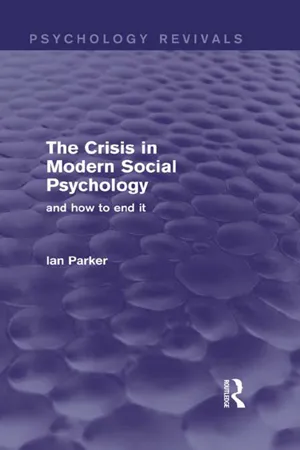
The Crisis in Modern Social Psychology (Psychology Revivals)
and how to end it
- 174 pages
- English
- ePUB (mobile friendly)
- Available on iOS & Android
About this book
In the late 1960s a 'crisis' erupted in social psychology, with many social psychologists highly critical of the 'old paradigm', laboratory-experimental approach. Originally published in 1989, The Crisis in Modern Social Psychology was the first book to provide a clear account of the complex body of work that is critical of traditional social psychological approaches. Ian Parker insisted that the 'crisis' was not over, showing how attempts to improve social psychology had failed, and explaining why we need instead a political understanding of social interaction which links research with change.
Modern social psychology reflects the impact of structuralist and post-structuralist conceptual crises in other academic disciplines, and Parker describes the work of Foucault and Derrida sympathetically and lucidly, making these important debates accessible to the student and discussing their influence. He assesses the responses from both mainstream social psychology and from avant-garde textual social psychology to the influx of these radical ideas, and discusses the promises and pitfalls of a post-modern view of social action.
Frequently asked questions
- Essential is ideal for learners and professionals who enjoy exploring a wide range of subjects. Access the Essential Library with 800,000+ trusted titles and best-sellers across business, personal growth, and the humanities. Includes unlimited reading time and Standard Read Aloud voice.
- Complete: Perfect for advanced learners and researchers needing full, unrestricted access. Unlock 1.4M+ books across hundreds of subjects, including academic and specialized titles. The Complete Plan also includes advanced features like Premium Read Aloud and Research Assistant.
Please note we cannot support devices running on iOS 13 and Android 7 or earlier. Learn more about using the app.
Information
Table of contents
- Cover
- Half Title
- Title Page
- Copyright Page
- Critical Psychology
- Original Title Page
- Original Copyright Page
- Table of Contents
- Acknowledgements
- Introduction
- Part one: ‘Crises’
- Part two: Responses
- Part three: Alternatives
- Further reading
- References
- Index