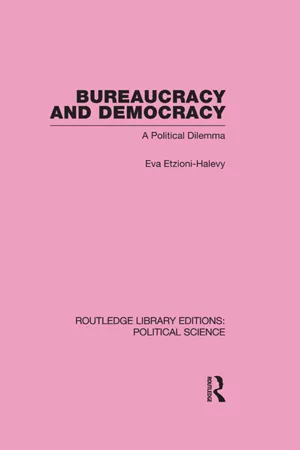
Although a powerful, independent bureaucracy poses a threat to democracy, it is indispensable to its proper functioning. This book provides an overview of the complex relationship between bureaucracy and the politics of democracy and is essential reading for students of sociology, political science and public administration. It is designed to guide students through the maze of classical and modern theories on the topic, to give them basic information on the historical developments in this area and the present them with case histories of the actual relationship between bureaucrats and politicians in democratic societies.
- 284 pages
- English
- ePUB (mobile friendly)
- Available on iOS & Android
eBook - ePub
Bureaucracy and Democracy
About this book
Information
Part I
Theoretical Perspectives
This part of the book presents an overview of classical theories (chapters 1–2) and modern theories (chapters 3–6) on the relationship between bureaucracy and politics. The overview is designed to serve several purposes: firstly, to supply students with some basic knowledge, help guide them through this field, and make them privy to the intellectual debates going on in it. Secondly, it is designed to make students aware of the significance, contribution as well as shortcomings of each school of thought or theory, and thus stimulate them to take sides in the intellectual debate. Finally, the overview is meant to provide the theoretical background and lead up to the theses developed in the last chapter (chapter 7) of this part of the book.
Chapter 1
Classical Theories: Marx, Michels, Mosca1
Interest in bureaucracy and its relation to democracy predates the advent of sociology as a discipline. The term bureaucracy itself is usually attributed to the physiocrat and political economist Vincent de Gournay, who is said to have coined it in 1745. It was originally used pejoratively for government by officials and for excessive official power. In early nineteenth-century Europe, the bureaucracy was often the target of ridicule for its alleged laziness and inefficiency, for the high-handed manner of its officials and for its tendency to over-regulate social life and abuse power. Much of bureaucracy’s work was thought to be self-generated as well as oppressive and debilitating for the rest of society. Honoré de Balzac, for instance, referred to bureaucracy as a gigantic power set in motion by dwarfs; Frédéric Le Play, for his part, saw it as a diseased form of administration, whereby officials are accountable to no one and citizens are turned into children. This derogatory view was also held by Marx, the first among the founding fathers of sociology to make a significant contribution to the analysis of bureaucracy.
The Ideas of Karl Marx (1818–83)
Bureaucracy, the State and the Ruling Class
Marx first developed his ideas on bureaucracy through a critique of Hegel in his essay, Critique of Hegel’s ‘Philosophy of Right’ (written in 1843). For Hegel, the state represented the general interest as against civil society, a collection of groups, corporations and estates, which represented particular and clashing interests. The role of bureaucracy was to mediate between the two. Marx accepted Hegel’s distinction between the state and civil society but modified its content. For him, the state did not represent the general interest any more than civil society did, and this held for bureaucracy as part of the state as well. The bureaucracy purports to advance the common welfare, but under the cloak of universality it actually furthers its own. Its apparent idealism is but a cloak for its materialist ends. The bureaucracy can mask its true role through the secrecy that shrouds its actions and through the creation of special myths which sanctify them. These, moreover, are applied not only to outsiders but to insiders as well. In this manner, bureaucracy manipulates the world as well as its own members:
The bureaucracy has the being of the state … in its possession; it is its private property. The general spirit of the bureaucracy is the secret, the mystery, preserved inwardly by means of the hierarchy and externally as a closed corporation…. But at the very heart of the bureaucracy, this spiritualism turns into a crass materialism…. As far as the individual bureaucrat is concerned, the end of the state becomes his private end: a pursuit of higher posts, the building of a career. (1970, p. 47)
By 1845 Marx’s theory, generally known as historical materialism, had been fully developed and his ideas on the state, especially the capitalist state, had been more clearly crystallized. In The German Ideology (written in 1845–6), Marx came to regard the state as ‘nothing more than the form of organization which the bourgeois necessarily adopt … for the mutual guarantee of their property and interests’ (1969c, p. 77).
At that stage he thought that the state may have a certain independence, but only where the traditional estates still exist, where they have not been superseded by modern classes, and where no one section of the population can therefore achieve dominance over any other. This situation prevailed in Germany at the time, but only for a transitional period. Once the transitional stage is passed and the bourgeoisie has established itself as the ruling class the state loses its independence and becomes nothing more than that class’s representative, or as Marx put it most concisely in the Manifesto of the Communist Party (written in 1848): ‘The executive of the modern State is but a committee for managing the common affairs of the whole bourgeoisie’ (Marx and Engels, 1969, pp. 110–11).
The coup d’état of Napoleon III in 1851 in France challenged these assertions, for through it the political power of the French bourgeoisie was clearly eroded, while the power of the state — a dictatorship based on a bureaucratic machine — was clearly overwhelming. In The Eighteenth Brumaire of Louis Bonaparte (written in 1852) Marx tried to reconcile this reality with his conception of the state.
Under the absolute monarchy, during the French revolution, and under Napoleon I, Marx argued, the bureaucracy had been the means of preparing for the class rule of the bourgeoisie; under the Restoration and under the parliamentary republic, it has become the instrument of this rule. Only under the second Bonaparte (Napoleon III) did the state seem to gain independence of the bourgeoisie. The bourgeoisie had built up the power of the state in order to enhance its own power. It now seemed as if the servant had turned against the master. This had taken place because the bourgeoisie’s economic interests had to be secured by a strong state, but subsequently the bourgeoisie was too weak to control the state it had strengthened.
This state of affairs, however, was merely an apparent contradiction to Marx’s basic conception. For the bourgeoisie only gave up political power to secure its economic powers; it only gave up its crown to serve its purse. Bonaparte’s own power rested on the fact that he had broken the political power of the bourgeoisie while protecting its material power. ‘But by protecting its material power, he generates its political power anew’ (1969d, pp. 484–5).
While the Bonapartist regime, and the bureaucracy by which it ruled, protected the bourgeoisie, they were based to a large extent on the small-holding peasantry, the most numerous class in France. This class comprised people who were isolated from each other and so were unable to organize. They were therefore easily dominated, providing the ideal basis for bureaucratic power. By representing different classes, Bonaparte’s government thus set itself contradictory tasks, which explains ‘the confused groping about which seeks now to win, now to humiliate first one class and then another …’ (1969d, p. 485). In any case, Bonapartism and its bureaucracy were merely a transitional response to a crisis. Soon the small-holding peasantry would be undermined and the bureaucracy based on it would collapse as well.
In The Civil War in France (written in 1871) Marx developed some of these ideas somewhat further. As he now saw it, the French bourgeoisie had attempted to augment its power through the parliamentary republic, with Louis Napoleon as its president. At that time, they had used the state power mercilessly ‘as the national war engine of capital against labour’ (1969a, p. 219). To do so, however, they were bound not only to invest the executive with increased powers of repression but also to divest their own power stronghold — the National Assembly — of its means of defence against the executive. This made possible the transition to the Second Empire of Napoleon III, and with it the erosion of the bourgeoisie’s political power. But once the bourgeoisie was freed from political care it attained unprecedented economic prosperity; this led, eventually, to the recapture of its political power as well.
In sum, then, Marx did not see the state (which included the bureaucracy) as a passive tool of the ruling class. For certain, limited periods, the state even seemed to gain autonomy from it. This was so, especially under the dictatorial regime of the Second Bonaparte, when the state and its bureaucracy accummulated considerable power over all classes. But even then, the state still promoted the interests of the ruling class.
Bureaucracy and Democracy
Marx’s analysis of the Second Empire in France shows that he recognized different forms of the modern state, especially the difference between dictatorship and what came to be known as ‘bourgeois democracy’. Marx was not enthusiastic about such democracy, and in The Class Struggles in France (written in 1848–50) he denounced the democratic republic of 1848 as nothing but a purely developed form of bourgeois rule. Nevertheless, he thought, it had some advantages because it deprived the bourgeoisie of absolute power and of the absolute assurance of its power:
The classes whose social slavery the constitution is to perpetuate, proletariat, peasantry, petty bourgeoisie, it puts in possession of political power through universal suffrage. And from the class whose old social power it sanctions, the bourgeoisie, it withdraws the political guarantees of that power. It forces the political rule of the bourgeoisie into democratic conditions, which at every moment help the hostile classes to victory, and jeopardise the very foundations of bourgeois society. (1969b, pp. 235–6)
The virtues of democracy are evident especially in comparison to authoritarian regimes such as that of the Bonapartist state. In The Eighteenth Brumaire of Louis Bonaparte, Marx noted that this regime was distinguished by an extreme concentration of executive power, by an overwhelming military organization and by an immense bureaucracy that stifled the life of civil society. All parts of civil society were now made the object of bureaucratic intrusion. The bureaucracy had become an ‘appalling parasitic body, which enmeshes the body of French society like a net and chokes all its pores’ (1969d, p. 477). Thus, in Marx’s view, democracy was valuable not only because it was inversely related to bourgeois power but also because it was inversely related to the concentration of state power, and with it to the concentration (or over-concentration) of power in the bureaucracy.
However, the bourgeoisie cannot afford to let democracy prevail in the long run, as it would eventually destroy the bourgeoisie’s rule. Whenever that rule is really threatened, the bourgeoisie does not hesitate to repudiate universal suffrage. This is precisely what made possible the coup d’état of the Second Bonaparte. For this reason, Marx was rather sceptical about the possibility of achieving socialism by democratic means. He thought it conceivable that this would occur in some cases, but he did not expect it to be the common pattern. In most cases, socialism could come about only through a revolution.
After the Revolution
It is only after the revolution, and with the advent of a communist society, that true democracy can develop. For only in this society would there be true individual freedom, the abolition of classes, and with it the abolition of the ruling class, which had prevented the realization of democracy in capitalist society. Also, it is only in this postrevolutionary society that the state that represents the interests of the ruling class would wither away, and with it, oppressive bureaucracy would wither away as well.
Marx never clarified what this ‘withering away’ would entail. ‘He did not express himself any more clearly about the dismantling of bureaucracy in the socialist state than about the withering away of the state in general’ (Eisenstadt and Von Beyme, 1972, p. 332). Apparently, what he had in mind was that bureaucracy, like the state in general, would lose its coercive and exploitative character, and that its functions would gradually be absorbed into society at large. The administration of public affairs would not disappear, but it would now be carried out in a democratic manner: administrative tasks would be everyone’s concern; all citizens would be administered and administrators at one and the same time. This would all be part of the general transformation in communist society, in which the division of labour would wither away as well, and in which each person would be free to do one thing today and another thing tomorrow.2
The Ideas of Gaetano Mosca (1858–1941)
Marx dealt with the problems of bureaucracy mainly to the extent that they coincided or overlapped with other problems, such as those of class exploitation, which was his primary concern. In contrast, Mosca treated bureaucracy as a central topic of inquiry in its own right and viewed the bureaucratic order as a distinct type of political organization. Also, Marx integrated his thoughts on bureaucracy with a theory of an economically dominant (ruling) class. In contrast, Mosca developed his ideas on bureaucracy as part of a theory on a politically dominant (ruling) class.
The Nature of the Ruling Class
In his book The Ruling Class (written in 1895, with some later additions) Mosca argues that in all societies — from the simplest to the most advanced — two classes of people appear: a class that rules and a class that is ruled. The first monopolizes political power and enjoys the advantages that power brings, while the second is controlled by the first. The ruling class may be a group of warriors, a group of religious functionaries, a landholding aristocracy, a wealth-holding or a knowledge-holding class, or some combination of these. In any case it is its political power that sets it apart from the rest of society.
The ruling class is always less numerous than the class which it rules. According to democratic theory majorities rule minorities. In fact, however (writes Mosca), minorities rule majorities. Because they are minorities they have the ability to organize themselves, while the masses remain unorganized. The political domination of an organized minority over an unorganized majority is inevitable. When a ruling class is deposed, there will be another one to take its place. Indeed, the whole history of civilization comes down to the struggle between existing ruling classes and their contenders.
Ruling classes never rule merely by brute force; they justify their rule by political formulas, i.e. by abstract principles (such as ‘divine right’ or ‘the sovereignty of the people’) which frequently are accepted by those they rule. When ruling classes are vigorous in their capacity to impose their political formulae, to manage society and render a service to it, when they are open to the more talented and ambitious people among the ruled, gradual rejuvenation of the ruling class itself and gradual change and progress in society will take place. But when ruling classes lose their vigour, when they cease to find scope for their capacities, when they can no longer render their previously rendered services or when they become closed to talented and competent outsiders, violent upheavals are likely to take place. These frequently result in the total replacement of the ruling classes. There usually follows a period of rapid innovation in which people from the bottom of the social ladder can easily force their way up. This, in turn, is often followed by a period of crystallization of the new ruling class, which also spells a period of social stability. Thus, the character and structure of the ruling class is of major importance in determining the rate of change and progress in society. It is also important in determining a society’s political regime.
The Ruling Class in the Bureaucratic State
There are a few major types of such regimes into which all political entities may be classified — most important among them are the feudal and the bureaucratic. The feudal system is one in which the same members of the ruling class exercise all the governmental functions: the economic, the judicial, the administrative, and the military. In this system too, the state itself is made up of small social aggregates, each of which possesses all the organs required for self-sufficiency. Europe of the Middle Ages offers the most familiar example of such a regime, but there are many others in the past or contemporary history of other people.
The bureaucratic regime is one where there is a greater specialization within the ruling class. There, the various governmental functions have become separated from each other and have become the exclusive domain of distinctive sections of the ruling class. Among these sections are the bureaucracy and the military establishment. Under this type of regime the government conscripts a considerable portion of the social wealth by taxation and uses it to maintain an extensive number of public services and military forces, both of which are manned by large numbers of salaried personnel.
In a bureaucratic state the ruling class exerts more power over those it rules than it does in a feudal state, but the power it wields is less personal. Society is less under the control of an individual personality, more under that of the ruling class as a whole. Egypt and the Roman Empire furnish examples of highly bureaucratized states in antiquity. Later on, with the close of the Middle Ages, feudalism gradually evolved into absolute bureaucratic monarchies in Europe, and this is one of the processes that has most profoundly affected world history.
Bureaucracy and Democracy
The absolute bureaucratic state may be regarded as fully and permanently established in Europe in the seventeenth century. In less than a century and a half, however, it was transformed into the modern representative, parliamentary state.
The representative regime does not spell the sovereignty of the people, government by consent of the governed and majority rule as democratic theory would have it. ‘What happens in other forms of government — namely, that an organized minority imposes its will on the disorganised majority — happens also and to perfection, whatever the appearance to the contrary, under the representative system’ (1939, p. 154). This happens because the only candidates who have any chance of succeeding in elections are those who are championed by organized minorities.
Moreover, the representative system on its own does not even provide adequate curbs on ruling-class power. Elected representatives and assemblies tend to concentrate excessive power in their own hands, in which case the whole government machinery falls prey to their irresponsible tyranny. Government control goes astray under per...
Table of contents
- Cover Page
- Half Title page
- Title Page
- Copyright Page
- Dedication
- Contents
- Preface
- Acknowledgments
- Introduction
- Theoretical Perspectives
- Classical Theories: Marx, Michels, Mosca1
- Classical Theories: The Weberian Framework1
- Modern Theories: Pluralism and Government Overload
- Modern Theories: The Technocratic View
- Modern Theories: the Corporatist View
- Modern Theories: The Marxist View
- Bureaucratic Power – a Democratic Dilemma
- Empirical Perspectives
- The Development of Western Bureaucracy: Overview and Explanation1
- Recent Developments: Some Apparent Counter-Trends
- Bureaucratic Development and the Power of Bureaucracy
- Bureaucracy and Party Politics
- Bureaucracy and Electoral Manipulation
- Bureaucracy in a Double Bind – Some Case Studies
- Conclusion
- Notes
- Bibliography
- Index
Trusted by 375,005 students
Access to over 1.5 million titles for a fair monthly price.
Study more efficiently using our study tools.
Frequently asked questions
Yes, you can cancel anytime from the Subscription tab in your account settings on the Perlego website. Your subscription will stay active until the end of your current billing period. Learn how to cancel your subscription
No, books cannot be downloaded as external files, such as PDFs, for use outside of Perlego. However, you can download books within the Perlego app for offline reading on mobile or tablet. Learn how to download books offline
Perlego offers two plans: Essential and Complete
- Essential is ideal for learners and professionals who enjoy exploring a wide range of subjects. Access the Essential Library with 800,000+ trusted titles and best-sellers across business, personal growth, and the humanities. Includes unlimited reading time and Standard Read Aloud voice.
- Complete: Perfect for advanced learners and researchers needing full, unrestricted access. Unlock 1.5M+ books across hundreds of subjects, including academic and specialized titles. The Complete Plan also includes advanced features like Premium Read Aloud and Research Assistant.
We are an online textbook subscription service, where you can get access to an entire online library for less than the price of a single book per month. With over 1.5 million books across 990+ topics, we’ve got you covered! Learn about our mission
Look out for the read-aloud symbol on your next book to see if you can listen to it. The read-aloud tool reads text aloud for you, highlighting the text as it is being read. You can pause it, speed it up and slow it down. Learn more about Read Aloud
Yes! You can use the Perlego app on both iOS and Android devices to read anytime, anywhere — even offline. Perfect for commutes or when you’re on the go.
Please note we cannot support devices running on iOS 13 and Android 7 or earlier. Learn more about using the app
Please note we cannot support devices running on iOS 13 and Android 7 or earlier. Learn more about using the app
Yes, you can access Bureaucracy and Democracy by Eva Etzioni-Halevy in PDF and/or ePUB format, as well as other popular books in Politics & International Relations & Politics. We have over 1.5 million books available in our catalogue for you to explore.