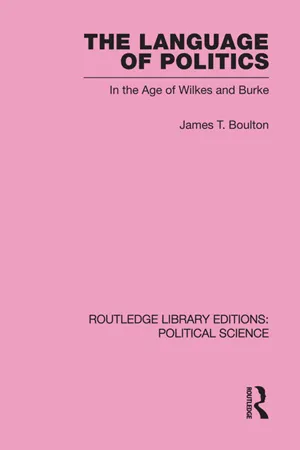
This book focuses on the literature produced at the time of the controversy over Wilkes and the Middlesex elections and by the debate in England over the French Revolution. Writings by Junius, Johnson, Burke, Paine, Mackintosh, Wollstonecraft and Arthur Young among others are examined in order to identify and estimate the effectiveness of the persuasive techniques used by these writers to communicate ideas to their respective audiences. Godwin is also given a new assessment. A view of the extent and urgency over the French Revolution is provided by the chronological survey of replies to Burke's Reflections given in an appendix.
- 300 pages
- English
- ePUB (mobile friendly)
- Available on iOS & Android
eBook - ePub
The Language of Politics
About this book
Trusted by 375,005 students
Access to over 1.5 million titles for a fair monthly price.
Study more efficiently using our study tools.
Information
Subtopic
PoliticsPart One
Political Controversy
1769–1771
1769–1771
I
Wilkes and the Middlesex
Election: A Brief Survey
Election: A Brief Survey

‘THAT devil Wilkes’ (to quote George III) was notoriousfrom 1763 onwards. In that year, because of the out-spoken attacks on the Court and Government in his journal,The North Briton, he was arrested. Wilkes took his stand, how-ever, on the illegality of general warrants and on his privilege asthe Member for Aylesbury, and was liberated; he also took hisopportunity to present himself to the public as a symbol of theindividual battling for liberty against the tyranny of the Crown.Later in the same year the Government retrieved the positionto some extent when the Commons voted the famous North Briton No. 45 a seditious libel and removed the protection of privilegefrom Wilkes. Whereupon he fled to France and remained thereuntil 1768. In his absence (in February 1764) he was tried forseditious libel and for publishing the pornographic Essay on Women; since he was contumacious, his punishment was out-lawry.
Almost at once on his return to England Wilkes stood as a candidate in the Middlesex parliamentary election and topped the poll.1 However, the convictions for seditious libel, publishing pornographic literature, and contumacy still stood against him; he was arrested and sentenced to imprisonment. But he was now a Member of Parliament and claimed privilege; moreover, economic distress in and around London was widespread, strikes were numerous, and there were disorderly, potentially violent crowds who regarded Wilkes as a symbol of revolt against injustice. Nevertheless, the Government stood firm and, on the grounds that he was still an outlaw when he was elected, the Commons expelled Wilkes from his seat in February 1769. He was at once returned unopposed by his constituency; again he was expelled; a third time he was returned and a third time expelled. At the fourth election candidates were found to stand against him, but out of a total poll of just over 1,400 Wilkes received more than 1,100 votes and his three opponents the rest. The Commons were now faced with the most serious challenge to their authority; they resolved the problem, in May 1769, by declaring that Wilkes was ineligible as a candidate because he was in prison when nominated; his nearest rival, Colonel Luttrell (who received 296 votes), they deemed to have been elected.
It is clear that out of a situation which delighted the Opposition because of the embarrassment caused to the Government, a constitutional issue of real moment had been raised. Were the Commons right to declare Luttrell elected on a minority vote, a fifth of the votes cast? As Mr. Steven Watson observes, the issue turns on the degree of coercion, whether from the executive or from popular pressures, that is thought to be legitimate.2 Some contemporaries felt that the pressure exerted by the mobs and organised Wilkites to secure Wilkes’s election was unconstitutional and that therefore the administration’s action was justified. Others believed that this action revealed an executive, backed by court influence, wielding too great a power for the healthy functioning of the legislature, and consequently that the administration had wrongfully arrogated to itself the power to nominate a member of the Commons. Broadly speaking, these are the questions debated by the pamphleteers whose writings will be discussed.
There can be no doubt but that the furore over the election was a godsend for the Opposition, despite their reluctance to be associated with the disreputable Wilkes; as Burke told Rockingham in September 1770:
We have never had, and we never shall have a matter every way so well calculated to engage [the people]; and if the spirit that was excited upon this occasion were sufïerd to flatten and evaporate, you would find it difficult to collect it again, when you might have the greatest occasion for it.3
Moreover, the energy (modified in the case of the Rockingham group) with which Opposition parties engaged in the business of promoting petitions to Parliament for redress and to the King for dissolution, is evidence of their opportunism. Wilkes as an individual proved a liability in some respects. Burke, for example, was relieved by the presence, at a meeting to consider the Yorkshire petition, of ‘a considerable Number of the Clergy … because some people were willing to cast a stain of pro-phaneness upon our Conduct, from our supposed Patronage of Wilkes’.4 But the principles involved were larger than the fortunes of one man; the Rockingham view of them is contained in part of a proposal for the terms of a petition included in a letter from the Marquess to Burke, 29 June 1769:
Might it not set forth—that the great and continual increase of the power and influence of the Crown in the course of this century (if the Crown should unfortunately be led by weak—wicked and arbitrary ministers and surrounded by evil counsellors) would operate most dangerously to the Constitution.5
This is the theme which, in some shape or other, constantly reappears in the letters of the Rockingham Whigs, who seem to have been thoroughly convinced, even if without much foundation, that in this ‘great Crisis’6 they were the only opposition group acting on principles which were other than self-centred. Undoubtedly part of the intention of the Present Discontents was self-justification; it was to show
the ground upon which the Party stands; and how different its constitution, as well as the persons who compose it are from the Bedfords, and Grenvilles, and other knots, who are combined for no publick purpose; but only as a means of furthering with joint strength, their private and individual advantage.7
At least it cannot be denied that the Rockingham group had one objective to which they consistently directed their efforts: the destruction of what they chose to think was a Court Party or, as Burke called it, ‘the Bute faction’.8 Whatever may be the truth about the reality of such a party, the frequency with which the Rockingham Whigs refer to it is at least proof that it existed for them if only as an impetus to united effort. Bute for them was ‘the Thane’,9 and moves to quieten the Opposition by bringing men from various groups into the administration were seen as attempts to make yet another government dependent on ‘the Court System’.10 Burke writes to the Marquess in October 1769:
nor can it be thought that by sending for Lord Chatham they mean anything else than to patch a Shred or two, of one, or more of the other parties, upon the old Bute garment; since their last piecing is worn out.11
The Rockingham Whigs believed themselves able to provide the Government with a new set of clothes. They looked for a union of Opposition groups, ‘of all the Parties into one’; it was to be a union based on principles and the ‘great principle’ Burke had outlined to Temple: ‘that the King’s men should be utterly destroyed as a Corps’.12 We can be certain that the letter (written in November 1769) in which this remark is recorded reflects Burke’s fascination with the arguments he was then expounding in the Present Discontents; the ‘king’s men’ had become an obsession with him. Rockingham is more balanced in his comment on the importance of the forthcoming pamphlet:
I wish it read by all the members of Parliament—and by all the politicians in town and country prior to the meeting of Parliament. I think it would take universally, and tend to form and to unite a party upon real and well founded principles—which would in the end prevail and re-establish order and Government in this country.13
There is greater balance here, but the claim for the urgent importance of Burke’s pamphlet is also great. Both Burke and the Marquess recognised that fundamental principles—of lasting value as we can now see—were involved; it was not a publication ‘animated by a direct controversy’14 but a statement of a ‘political Creed’15 given extra relevance and a particular focus by the furore over Wilkes. And there is some irony in the way it was received: the ‘Courtiers’ admitted ‘it to be a piece of Gentlemanlike Hostility’16; the fiercest denunciation came from the extreme radical members of the Society for the Defence of the Bill of Rights, a body founded (in February 1769) to secure Wilkes’s election to Parliament.
Wilkes in 1770 was interested primarily in John Wilkes; it was left to others to debate the issues and principles raised by his earlier activities. The writings of Junius, Johnson, and Burke provide ample evidence of the differing levels of literary achievement called forth by the debate.
1 For an informative analysis of the political repercussions of Wilkes’s return and subsequent career, see Lucy S. Sutherland, The City of London and the Opposition to Government, 1768–1774 (1959) See also George Rudé, Wilkes and Liberty (Oxford, 1962).
2 The Reign of George III, p. 138.
3 Ed. Lucy S. Sutherland, The Correspondence of Edmund Burke (Cambridge,1960), II, 155. (Burke’s Correspondence is used as the main evidence for this ‘outline’ because of the leading part he played in the pamphlet debate.)
4 Ibid., II, 96.
5 Ibid., II, 38
6 Ibid., II, 54.
7 Ibid., II, 101.
8 Ed. Lucy S. Sutherland, The Correspondence of Edmund Burke II, 43.
9 Ibid., II, 59n.
10 Ibid., II, 105.
11 Ibid., II, 101.
12 Ibid., II, 113.
13 Ibid., II, 92.
14 Ed. Lucy S. Sutherland, The Correspondence of Edmund. Burke II, 109.
15 Ibid., II, 136.
16 Ibid., II, 139.
II
The Letters of Junius
IT has invariably been assumed that, among the polemicalwriters connected with the Wilkes furore, Burke was pre-eminent, but the validity of the assumption has never beensatisfactorily tested. The principal difficulty hitherto has beento see his achievement in perspective, as a passage from Cole-ridge’s Friend makes abundantly clear.
The fact was, that Burke in his public character found himself, as it were, in a Noah’s ark, with a very few men and a great many beasts. He felt how much his immediate power was lessened by the very circumstance of his measureless superiority to those about him: he acted, therefore, under a perpetual system of compromise—a compromise of greatness with meanness; a compromise of the philosopher (who, armed with the twofold knowledge of history and the laws of spirit, as with a telescope, looked far around and into the remote distance) with the mere men of business, or with yet coarser intellects, who handled a truth, which they were required to receive, as they would handle an ox, which they were desired to purchase.1
While Coleridge’s remarks go far beyond our present purpose, they serve to focus attention on the problem which has bedevilled most attempts at a literary assessment of Burke’s performance: the belief that there was no controversialist of the day with whom it is profitable to compare him. Coleridge’s remarks also suggest a possible corollary to this first problem—that other political writers may have been unjustly depreciated in order to demonstrate Burke’s ...
Table of contents
- Cover
- Half Title
- Title Page
- Copyright
- Dedication
- Contents
- Preface
- Acknowledgments
- Introduction
- Part One: Political Controversy 1769–1771
- Part Two: Political Controversy 1790–1793
- Conclusion
- Appendix: Chronological Survey of the Controversy concerning Burke’s Reflections, 1790–1793
- Index
Frequently asked questions
Yes, you can cancel anytime from the Subscription tab in your account settings on the Perlego website. Your subscription will stay active until the end of your current billing period. Learn how to cancel your subscription
No, books cannot be downloaded as external files, such as PDFs, for use outside of Perlego. However, you can download books within the Perlego app for offline reading on mobile or tablet. Learn how to download books offline
Perlego offers two plans: Essential and Complete
- Essential is ideal for learners and professionals who enjoy exploring a wide range of subjects. Access the Essential Library with 800,000+ trusted titles and best-sellers across business, personal growth, and the humanities. Includes unlimited reading time and Standard Read Aloud voice.
- Complete: Perfect for advanced learners and researchers needing full, unrestricted access. Unlock 1.5M+ books across hundreds of subjects, including academic and specialized titles. The Complete Plan also includes advanced features like Premium Read Aloud and Research Assistant.
We are an online textbook subscription service, where you can get access to an entire online library for less than the price of a single book per month. With over 1.5 million books across 990+ topics, we’ve got you covered! Learn about our mission
Look out for the read-aloud symbol on your next book to see if you can listen to it. The read-aloud tool reads text aloud for you, highlighting the text as it is being read. You can pause it, speed it up and slow it down. Learn more about Read Aloud
Yes! You can use the Perlego app on both iOS and Android devices to read anytime, anywhere — even offline. Perfect for commutes or when you’re on the go.
Please note we cannot support devices running on iOS 13 and Android 7 or earlier. Learn more about using the app
Please note we cannot support devices running on iOS 13 and Android 7 or earlier. Learn more about using the app
Yes, you can access The Language of Politics by James T. Boulton in PDF and/or ePUB format, as well as other popular books in Politics & International Relations & Politics. We have over 1.5 million books available in our catalogue for you to explore.