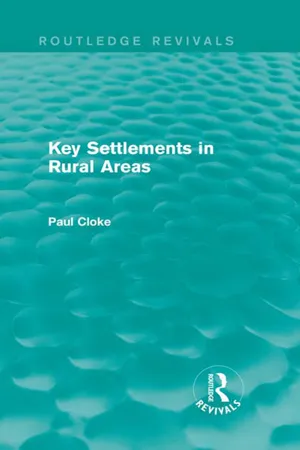
The problems of providing essential services in a constrained economic climate, and of conserving the rural environment whilst protecting rural people, are of immediate importance. This book, first published in 1979, was the first major piece of published research on the topic of rural settlement planning. It examines in detail the history and theory behind key settlement policies, and their practical application within the British rural planning system. Using Warwickshire and Devon as two very different case studies, Paul Cloke measures the outcome of settlement planning and discusses the wider implications of the 'concentration-dispersal' debate. This reissue will provide essential background for students of rural and social geography, and rural sociology and economics.
- 260 pages
- English
- ePUB (mobile friendly)
- Available on iOS & Android
eBook - ePub
Key Settlements in Rural Areas (Routledge Revivals)
About this book
Information
1
Rurality and
Rural Change
The administrative system of rural planning has failed to respond to changing social and economic needs of villages and rural industry and is leading rapidly to an imbalanced growth pattern throughout Britain ….
Graham Moss's (1978, 131) indictment of post-war rural settlement planning typifies a current sense of dissatisfaction with the theory and practices which have been enlisted to deal with the pressing problems caused by anachronistic settlement patterns in a dynamic countryside. This general discontent has led geographers and planning practitioners alike to embark upon a critical review of rural planning which is both long overdue and essential for the forward planning of the rural areas.
One product of the generally recognized need for rural reexamination has been an extreme reaction against current planning systems. Indeed, the warnings sounded by many authors, including Cherry (1976), Davidson and Wibberley (1977), Gilg (1978) and Woodruffe (1976), have provided some justification for those critics who postulate sweeping changes in rural planning methods. On the other hand, there has been a realization that rural areas have invariably been the poor relation in the worldwide study and practice of town and country planning. Naturally, the speed and scale of urban growth have necessitated an urban bias in post-war planning, research and problem-solving. It is, however, unfortunate that this concentration on urban problems and their solutions has been detrimental to countryside planning in that the understanding of rural planning systems has been hampered by the use of diluted urban and regional planning techniques which are ill-suited to the rural scale. Consequently there would appear to be some support for the viewpoint that this hard-earned experience should not be discarded lightly. While most workers in the rural field would fall somewhere between these reactionary and ameliorative stances, few would deny the urgent need for a fuller understanding of rural systems and processes, especially in view of the opportunities for implementing new or improved types of policy under the Structure Plan framework.
Perhaps the single most important facet of post-war rural settlement planning has been the key settlement policy. This planning device has often been regarded as a panacea for the rural ills existing both in areas of remoteness and in areas subjected to intense urban pressures, and has therefore formed the basis of most rural settlement policies in one guise or another. The widespread implementation and continuing importance of the key settlement policy has made it a prime contender for critical attention under the more general review of rural planning and its methods. Indeed, it is no longer feasible for planners to accept this form of rural planning without first considering the efficacy with which the policy has been implemented in the past and the denouement resulting from the policy's impact on present and future rural activities.
Much of the recent discussion concerning key settlement policies (e.g. McLaughlin, 1976; Ash, 1976) has been of a theoretical and moralistic nature revolving around the relative merits of ‘concentration’ and ‘dispersal’ in rural planning. However, several stages of investigation into the whole key settlement issue are required prior to such discussion if future policy decisions are to be based on hard evidence rather than conjecture, and on understanding of systems and processes rather than reactions to sets of circumstances. One of the central themes around which criticism has been levelled against the key settlement policy concerns the seemingly blind adoption of this form of planning, regardless of both the type of rural area involved and of the particular problems encountered in the particular region to be planned. Therefore at the outset of any examination of the key settlement policy it is necessary to define what is meant by ‘different types of rural area’, and having done that, to summarize the changes taking place within these areas which have generated the environment in which the key settlement policy was put into operation.
1.1 An Index of Rurality
Most people will have an intrinsic awareness that rural areas are ‘different’ from urban areas and that there are internal differences within rural areas themselves. However, the task of translating these perceived differences into meaningful spatial distributions is a difficult yet important one, for by studying different categories of rural area the various planning mechanisms operating within them may be better understood. To achieve an effective spatial categorization of rural areas, the concept of rurality itself must be defined.
Definition of rurality
Until recently, planners have leaned heavily on sociological theories of rural and urban relationships. Two basic models have been invoked in this context. The original idea of ‘rural’ and ‘urban’ as two poles of a dichotomy was soon found to be unrepresentative of the real world situation (Stewart, 1958). As Sorokin and Zimmerman (1929, 16) pointed out, ‘in reality the transition from a purely rural community to an urban one … is not abrupt but gradual’. Realization that the extremes of the dichotomy were easily recognized but that the threshold between their respective influences was not readily identifiable, led to the conceptualization of the rural- (or folk-)urban continuum pioneered by Redfield (1941). Support for this concept came from investigators such as Queen and Carpenter (1953, 38) who noted a ‘continuous graduation in the United States from rural to urban rather than a simple rural-urban dichotomy’.
However, the continuum model has also been seen to be unrepresentative in that it is both oversimplified and misleading (Mitchell, 1973). By way of compensation increasing complexity has been introduced into the theory of rural-urban relations. Pahl (1966a, 327) argues that the continuum concept might be replaced by ‘a whole series of meshes of different textures superimposed on each other, together forming a process which is creating a much more complex pattern’. A natural progression from this idea is outlined by Bailey (1975, 117–18), who argues that ‘the crux for the sociologists is that the defining parameters of social problems are the same for rural as for urban areas’. Thus the treatment of the rural-urban distinction in sociology has changed from the study of two extremes to the recognition of common social variables in these extremes, which allow a unified field of study, and preclude the separation of ‘rural’ from ‘urban’.
When faced with a fluid conceptual framework such as this, it seems likely that an inductive approach might yield more positive and useful results when attempting a definition of rurality for use in the planning of rural areas. This approach inherently accepts some form of continuum model, and rightly so, for geographers and planners are not yet ready to follow sociologists into a non-spatial view of rural and urban as a unitary area, simply because of the vast differences in scale, resources and environment between the two extremes.
An inductive approach suggests that certain selected variables may be measured to ascertain whether an area inclines towards the rural or urban pole. The definition of rurality is therefore inherent in the choice of these variables, and so it is necessary to include some test of significance to ensure that the selected variables are indicative of rural or urban (and therefore non-rural) inclination. Schnore (1966, 135) warns that all such definitions incorporate a degree of arbitrariness. ‘In this case, the major difficulties stem from the fact that the characteristics which have been singled out for attention … are literally variables, i.e. they exhibit differences in degree from place to place and time to time.’ However, these difficulties would appear to be advantageous in the construction of an index. Areal variation is necessary to gain a widespread pattern of the distribution of rurality, and variation over time is likely to offer an interesting insight into the changing nature of rurality.
In 1971, the Department of the Environment (1971a, 1972) reported on an investigation into the nature of rural areas and small towns in England and Wales. Incorporated in this study was the measurement of three variables to define rurality, and the calculation of an index by which degrees of rurality could be measured. This study pioneered the inductive approach in this field but an updated index has since been developed which makes use of multivariate statistical techniques (Cloke, 1977a). The need to replace subjective and nebulous expressions of rurality with a more objective statistically-based view is paramount as a foundation to the study of rural areas and their settlements. It is therefore important to produce a definitive statement of the different types of rural area which exist, with particular reference to those areas using the key settlement planning system.
The indexing technique
The use of multivariate techniques to create an index of rurality was based on the measurement of sixteen variables for each rural district in England and Wales for 1961 (table 1.1). These data were subjected to a principal component analysis in which selection of the input variables suggested that the prin...
Table of contents
- Cover
- Half Title
- Title Page
- Copyright Page
- Dedication
- Original Title Page
- Original Copyright Page
- Table of Contents
- Preface
- 1 Rurality and Rural Change
- 2 Conceptual Evolution of Key Settlements
- 3 Evolution of Key Settlements in the Planning Framework
- 4 Key Settlements in a Pressured Rural Area: a Case-study of Warwickshire
- 5 Key Settlements in a Remoter Rural Area: a Case-study of Devon
- 6 An Assessment of Key Settlement Performance
- 7 Key Settlements and the Future
- Bibliography
- Index
Trusted by 375,005 students
Access to over 1.5 million titles for a fair monthly price.
Study more efficiently using our study tools.
Frequently asked questions
Yes, you can cancel anytime from the Subscription tab in your account settings on the Perlego website. Your subscription will stay active until the end of your current billing period. Learn how to cancel your subscription
No, books cannot be downloaded as external files, such as PDFs, for use outside of Perlego. However, you can download books within the Perlego app for offline reading on mobile or tablet. Learn how to download books offline
Perlego offers two plans: Essential and Complete
- Essential is ideal for learners and professionals who enjoy exploring a wide range of subjects. Access the Essential Library with 800,000+ trusted titles and best-sellers across business, personal growth, and the humanities. Includes unlimited reading time and Standard Read Aloud voice.
- Complete: Perfect for advanced learners and researchers needing full, unrestricted access. Unlock 1.5M+ books across hundreds of subjects, including academic and specialized titles. The Complete Plan also includes advanced features like Premium Read Aloud and Research Assistant.
We are an online textbook subscription service, where you can get access to an entire online library for less than the price of a single book per month. With over 1.5 million books across 990+ topics, we’ve got you covered! Learn about our mission
Look out for the read-aloud symbol on your next book to see if you can listen to it. The read-aloud tool reads text aloud for you, highlighting the text as it is being read. You can pause it, speed it up and slow it down. Learn more about Read Aloud
Yes! You can use the Perlego app on both iOS and Android devices to read anytime, anywhere — even offline. Perfect for commutes or when you’re on the go.
Please note we cannot support devices running on iOS 13 and Android 7 or earlier. Learn more about using the app
Please note we cannot support devices running on iOS 13 and Android 7 or earlier. Learn more about using the app
Yes, you can access Key Settlements in Rural Areas (Routledge Revivals) by Paul Cloke in PDF and/or ePUB format, as well as other popular books in Biological Sciences & Ecology. We have over 1.5 million books available in our catalogue for you to explore.