This study focuses primarily on the nature of "direct action" in relation to contemporary movements, and considers the role of direct action methods in past campaigns for constitutional and social rights. Boycotts, sit-ins, obstructions, civil disobedience and other unconstitutional forms of protest are examined to see whether they necessarily lead to violence. The political conditions which encourage violence and the effects of various type of violent action are also discussed. The theoretical issues raised by direct action in a parliamentary system are also discussed.
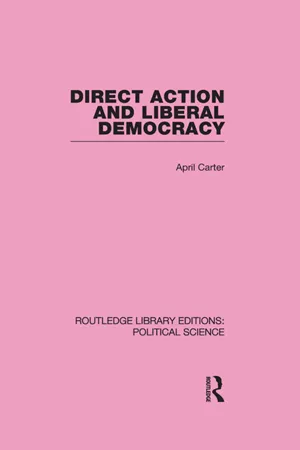
eBook - ePub
Direct Action and Liberal Democracy (Routledge Library Editions:Political Science Volume 6)
- 188 pages
- English
- ePUB (mobile friendly)
- Available on iOS & Android
eBook - ePub
Direct Action and Liberal Democracy (Routledge Library Editions:Political Science Volume 6)
About this book
Information
1 The Meaning of Direct Action
Direct action is currently a popular but somewhat ambiguous term. It suggests that people are taking to the streets, having abandoned the processes of discreet lobbying in the corridors of power. But a conventional march through the streets of London—which has become a standard pressure group tactic—would not today count as ‘direct action’, since direct action is associated with sit-downs and arrests, or with violent confrontations with the police.
Direct action cannot, however, be defined solely in terms of the methods used. It depends also on the political context and on the mood surrounding the event. Holding a march in defiance of a banning order, or as a form of demonstration in a situation of mass unrest, might well constitute direct action.
The purposes of direct action are also extremely varied. It may involve an attempt to assert what are regarded as basic constitutional rights—for instance, holding a meeting. It may be a more dramatic substitute for lobbying the government, but have the same goal: to bring pressure to bear in order to attain a limited and specific reform. It may be designed to demonstrate in action the answer to a particular problem—homeless families squatting in empty council houses, for example. It may be primarily a symbolic act of protest or solidarity in relation to a wider struggle, for instance, a boycott of South African goods. Or it may be a method used to repudiate the entire political system and promote insurrection.
Strict definition of direct action in terms of method, goal, or of the persons using it is likely to become sterile and misleading. But if it is not to shade off into meaninglessness, it must be distinguished from constitutional and parliamentary styles of activity on the one hand, and from guerrilla warfare on the other. Neither is direct action simply a synonym for protest or for violence, though it is closely associated with protest movements, and may result, unintentionally or intentionally, in some forms of violence.
The most illuminating approach to an understanding of what is entailed in the idea of direct action is to consider which movements have consciously used direct action, and what theoretical connotations surround their use of the phrase. This chapter therefore draws on the writings of advocates of direct action, and on studies of particular direct-action campaigns.
The major influences on the current conception of direct action have been anarcho-syndicalism; the western adaptation of Gandhian nonviolence in the civil rights protests in the United States and in demonstrations against nuclear weapons; the evolution of the movement against the Vietnam war; the student movements of the late 1960s; and political manifestations of youth counter-culture, for instance, the ‘Provos’ in Holland and the ‘Yippies’ in the United States. In the past few years there has also been a growing tendency for groups without any conscious theoretical commitment to direct action to resort to forms of physical intervention or civil disobedience in order to make the streets safe for their children, to preserve or improve the amenities of their community, or to gain a home for their families. This tendency has spread to workers in Britain faced with the threat of unemployment, who have resorted to new forms of militant industrial action to safeguard their jobs.
Anarcho-Syndicalism
The anarchist and syndicalist traditions are perhaps the earliest, but most continuously significant, contribution to the present theory of direct action. Daniel Guérin in his recent book on Anarchism quotes the Russian anarchist Voline:
True emancipation can only be brought about by the direct action ... of those concerned, the workers themselves, through their own class organizations (production syndicates, factory committees, cooperatives, etc.) and not under the banner of any political party or ideological body (37).
In their account of the events of May 1968 Daniel and Gabriel Cohn-Bendit, who consciously relate themselves to Kronstadt and to Makhno’s anarchist movement in the Ukraine in 1918–21, illustrate this theme :
Perhaps the most concrete expression of this new sense of purpose was the occupation of the Sud-Aviation works in Nantes. The workers, by ‘imitating the students’, were rediscovering a form of action that they had far too long discarded while playing the parliamentary game of the reformists and Stalinists ... on 20 May, even the most apathetic joined in, the Citroen works were occupied and a host of others followed suit soon afterwards. Recourse to direct action changed the whole tenor of the struggle, for the workers’ self-confidence is enormously increased once they act without delegating any of their power to political parties or trade unions (Obsolete Communism, 67).
A similar definition of ‘direct action’ was given by Bill Haywood of the Industrial Workers of the World in testimony given to the Industrial Relations Commission in 1915. Haywood states that his goal—working class control of industry—cannot be achieved by political action :
Commissioner O’Connell: ‘Have you in mind some other method by which it can ?’
Mr Haywood: ‘Yes sir; I think it can be done by direct action. I mean by the organization of the forces of labour’ (in Lynd (ed.), Nonviolence in America, 225).
Direct action is relevant not only to the final aim of seizing power in industry, but as a method of improving conditions. Haywood comments about the United Mine Workers:
They can compel the introduction of safety appliances, of ventilation systems, and save in that way thousands of lives every year. ... If they have the power to bring that about by direct action, they have the power to reduce their hours; they have the power to increase or at least to better the laboring conditions round the mines and have better houses (ibid., 226).
The miners in their fight for better conditions sometimes resorted to direct action, as did civil rights demonstrators later, in order to try to enforce the existing laws. Haywood described before the Commission the Cripple Creek strike of 1903 in sympathy with the men working in the mills of Colorado city, who had gone on strike to enforce the Colorado state law guaranteeing an eight-hour day. After its formation in 1905 the IWW soon got involved in action to promote the right to free speech, by-speaking in front of employment agencies in Spokane. The authorities threw between five and six hundred men and women into jail. The following year came the Fresno, California, free speech fight. Haywood comments: ‘There the authorities started to arrest men merely for speaking on the street corner, not causing a congestion of traffic’ (ibid., 222).
The ‘Wobblies’ used direct action at times to enforce existing laws, at times in defiance of immediate rules or authorities but on behalf of broader constitution principles, and at times to gain limited reforms. They aimed to use it eventually to usher in revolution. Cole and Postgate comment on the development of syndicalism in Britain prior to the First World War:
Within the ranks of the working class, unparliamentary action remained an aspiration. No actual revolutionary movement took place; the destructive tendencies of Direct Actionists were expressed solely in strikes and sabotage.
The new philosophy was called Syndicalism or industrial unionism, two names with much the same meaning, but the first indicating a French inspiration and the second an American.
The boycott, the sympathetic strike, no peace with the employers, the smashing of the old reactionary Unions, the breaking of all agreements when convenient, the forcing of non-unionists out of existence, the use of sabotage—all of these principles were taken over in theory from the IWW, but their application was much milder and the enemies far less savage (The Common People, 481–2).
Rudolph Rocker in his analysis of anarcho-syndicalism comments that direct action is the only method which has been able to achieve political results:
And the bourgeoisie in its struggles against absolutism has also made abundant use of this method, and by refusal to pay taxes, by boycott and revolution, has defiantly asserted its position as the dominant class in society.
By direct action the Anarcho-Syndicalists mean every method of immediate warfare by the workers against their economic and political oppressors. Among these the outstanding are: the strike, in all its gradations from the simple wage-struggle to the general strike ; the boycott; sabotage in its countless forms; anti-militarist propaganda; and in peculiarly critical cases, such, for example, as that in Spain to-day [1930s], armed resistance of the people for the protection of life and liberty (.Anarcho-Syndicalism, 136).
What Rocker means by sabotage is not, however, primarily the destruction of property. He comments that: ‘The term itself is derived from the French word sabot, wooden shoe, and means to work clumsily as if by sabot blows.’ He cites the policy of ‘ca’canny’ (go slow) as the first and most effective form of sabotage, and also gives the example of the ‘grève perlée’ by the railway workers of France and Italy—who delayed all the trains by working to rule. He also links sabotage with the sit-down strike inside factories, and the related opportunity to put the machines out of order. In the conception of direct action adopted in this book, sabotage is a borderline case, depending on the context and the aim. Armed insurrection, however, involves a quite different level and type of struggle, and it would be unnecessarily confusing to equate it with direct action.
Gandhian Non-Violent Action
The ethos of Gandhian non-violence is far removed from the class struggle of syndicalism, but when translated into more secularized and militant modes ‘non-violent action’ is not necessarily very different from the syndicalist concept of direct action. In the American civil rights struggle the initial phase of the movement was marked by conscious adherence to Gandhian philosophy, which was allied to Christian belief. Martin Luther King, who became the leader of the 1955–6 Montgomery Bus Boycott, wrote in Stride Towards Freedom :
I became deeply fascinated by his [Gandhi’s] campaigns of non-violent resistance. I was particularly moved by the Salt March to the Sea and his numerous fasts. ... I came to feel that this was the only morally and practically sound method open to oppressed people in their struggle for freedom (90–1).
In his writings of 1963, Why We Can’t Wait, King observed:
Nonviolent direct action did not originate in America, but it found its natural home in this land, where refusal to cooperate with injustice was an ancient and honorable tradition and where Christian forgiveness was written into the minds and hearts of good men. Tested in Montgomery during the winter of 1955–56, and toughened throughout the South in the eight ensuing years, nonviolent resistance had become, by 1963, the logical force in the greatest mass-action crusade for freedom that had ever occurred in American history (25).
Before 1963 the impetus of the civil rights movement had, however, already shifted from King’s Southern Christian Leadership Conference— the SCLC—to the more pragmatic, more impatient and inventive student movement loosely co-ordinated by the Student Non-violent Co-ordinating Committee—the SNCC. This movement started with the sit-in on 1 February 1960 in Greensboro’, North Carolina. The sit-ins spread to sixty other cities. Howard Zinn comments in SNCC : The New Abolitionists:
The sit-ins represented an intricate union of economic and moral power. To the store owner, they meant a disruption of normal business; liberal and moderate people in the city and in the nation now, perhaps for the first time, faced their own status as a privileged group in American society (28).
The type of action embodied in the sit-in was rapidly extended to attack segregation in other places. There were ‘read-ins’ at libraries, ‘kneel-ins’ at churches, ‘walk-ins’ at parks and theatres and ‘wade-ins’ at swimming pools and beaches.
The next dramatic move in the civil rights struggle was the use of direct action to challenge the segregation of facilities at the terminals of interstate buses—the 1961 ‘freedom rides’. The original freedom ride took place in 1947, a year after the Supreme Court decision prohibiting segregation in interstate travel. The 1961 rides also came after a Supreme Court decision the previous year—this time outlawing segregation in restaurants, waiting rooms and other facilities at terminals. Thirteen freedom riders set out on 4 May to journey from Washington, DC, to New Orleans. In South Carolina the group were greeted by mob violence. Really serious violence occurred on 14 May when their bus was set on fire by a mob near Anniston, Alabama, and when on their arrival in Birmingham they were savagely beaten. Students trying to carry on with the ride were assaulted on arriving in Montgomery and were escorted by National Guardsmen to Jackson, Mississippi, where they were arrested. Volunteers arrived in Jackson for the next three months in a campaign to fill the Mississippi jails.
In the summer of 1961 one wing of the SNCC was created to concentrate on registering negro voters, and in August a registration campaign started in McComb, Mississippi. But voter-registration sometimes merged into direct action, as in Selma, Alabama, when the people lining up to register were demonstrating their defiance before the press cameras, and were beaten up and arrested by the police. Part of the campaign for registering voters was the use of mass marches, designed in Arthur Waskow’s assessment for: ‘mobilizing Negro strength, destroying the old white images of Negro passivity, demonstrating Negro solidarity both to the Negroes themselves and to local white power structures, and attracting national attention both to their old plight and their new militance’ (From Race Riot to Sit-In, 232). Many Southern police chiefs decided these orderly marches were illegal—as Eugene ‘Bull’ Connor did during the 1963 campaign in Birmingham.
The Birmingham campaign combined the sit-in tactics to desegregate public places with an economic campaign designed to stop discrimination in the employment of negroes. Bayard Rustin commented :
The response to Birmingham has been immediate and spontaneous. City after city has come into the fight, from Jackson, Mississippi, to Chesterton, Maryland. The militancy has spread to Philadelphia, where the ‘city fathers’ and the trade-union movement have been forced to make reluctant concessions. . . . Before Birmingham, the great struggles had been for specific, limited goals. . . . The package deal is the new demand (in Goodman (ed.), Seeds of Liberation, 318).
The Birmingham campaign, which brought school children into the struggle and dramatized the brutality of the white power structure through the unrestrained violence of the police, was the climax of non-violent direct action and Luther King’s last major success.
Extension of direct action methods to the North was tried, and made some impact. The methods included school boycotts to end de facto segregation in schools; and rent strikes by tenants in slum houses. Consumer boycotts were also organized against firms which discriminated against negroes in employment—for example, against Sears Roebuck in 1962; and the Congress of Racial Equality (CORE) experimented with direct obstruction on work sites in protest against the highly discriminatory building trade. A more direct challenge to the government was tried through blockades of council meetings, sit-ins at governmental offices, and ‘stall-ins’ of traffic by sit-downs on roads and bridges. Waskow comments that ‘the tactic of social disruption is much more radical than the other techniques of creative disorder.... For what disruption essentially does is challenge the entire society as a racially discriminatory system’ (From Race Riot to Sit-In, 246). But the general verdict by many inside and outside the civil rights movement was that direct action was inadequate to deal with the problems of the Northern slums, rooted as they were, not in the anachronistic, openly colonial attitudes of the South, but in the government of the cities and the nature of the American economy. Anger and despair in the ghetto slums erupted in the riots of the summer of 1965.
Peace Movement
During the period in which non-violent action was the accepted tactic of the civil rights movement, it was also adopted as part of the movement against the H-bomb in Britain and the United States. Non-violent direct action meant picketing nuclear research stations, blocking missile bases, trespassing on to air bases and trying to block or board Polaris submarines. A number of attempts were made to enter nuclear testing areas, ranging from the voyage of the Golden Rule towards the Eniwetok H-bomb-testing zone in the Pacific in 1958 to the repeated efforts of an international team in 1960 to enter the French Sahara atom site via French West Africa. In the United States non-co-operation was extended to tax refusal and refusal to take part in compulsory civil defence exercises. Annual protests against these exercises in New York started in 1955 when a dozen people refused to take shelter. In i960 numbers had grown to a thousand, and a number of jail sentences were awarded to the protesters.
The tone and style of these protests tended to stress non-violence, open breaking of the law and willingness to go to jail. The Direct Action Committee in Britain also tried to promote trade union action in the form of token strikes and blacking work on nuclear bases and bomb production. The Committee of 100, which succeeded it, tried to extend the trade union ethos to its own civil disobedience demonstrations, which were based on the idea of mass solidarity and collective responsibility. The first Committee of 100 demonstrations were planned as mass sit-downs in front of government offices in London, and could be seen as a move towards social disruption and a direct challenge to the authorities. The Committee of 100 was less influenced by Gandhian non-violence, and more receptive to anarchist and syndicalist ideas.
The Guerrilla Image
The idea of non-violent direct action was discredited among those sections of the movement against the war in Vietnam which switched their emphasis from demanding peace to supporting the victory of the National Liberation Front. There were other reasons for this switch of allegiance, in particular among students, from non-violence to violence. In the civil rights campaign the relative success of non-violent action in challenging Southern segregation was not repeated in the Northern ghettos, despite efforts to adapt action tactics to the city slums. The quick governmental response to the riots which erupted in the summer of 1965 also encouraged a black militancy which turned in part to violence as an instrument of social change. Spokesmen for black Americans had also begun to challenge publicly the goal of integration in a white American society—the goal of the sit-ins and freedom rides—and to question the values and nature of that society; a process hastened by the Vietnam war. But the symbolic figure of the Asian, Latin American or African guerrilla was central to the romantic rhetoric, though not to the political ...
Table of contents
- Cover
- Half Title
- Title Page
- Copyright
- Contents
- Acknowledgments
- Introduction
- 1. The meaning of direct action
- 2. Direct action in the constitutional tradition
- 3. The politics of direct action campaigns
- 4. Violence and power
- 5. Civil disobedience and constitutionalism
- 6. Direct action and liberal values
- 7. Direct action and democracy
- Conclusion
- Bibliography
- Index
Trusted by 375,005 students
Access to over 1.5 million titles for a fair monthly price.
Study more efficiently using our study tools.
Frequently asked questions
Yes, you can cancel anytime from the Subscription tab in your account settings on the Perlego website. Your subscription will stay active until the end of your current billing period. Learn how to cancel your subscription
No, books cannot be downloaded as external files, such as PDFs, for use outside of Perlego. However, you can download books within the Perlego app for offline reading on mobile or tablet. Learn how to download books offline
Perlego offers two plans: Essential and Complete
- Essential is ideal for learners and professionals who enjoy exploring a wide range of subjects. Access the Essential Library with 800,000+ trusted titles and best-sellers across business, personal growth, and the humanities. Includes unlimited reading time and Standard Read Aloud voice.
- Complete: Perfect for advanced learners and researchers needing full, unrestricted access. Unlock 1.5M+ books across hundreds of subjects, including academic and specialized titles. The Complete Plan also includes advanced features like Premium Read Aloud and Research Assistant.
We are an online textbook subscription service, where you can get access to an entire online library for less than the price of a single book per month. With over 1.5 million books across 990+ topics, we’ve got you covered! Learn about our mission
Look out for the read-aloud symbol on your next book to see if you can listen to it. The read-aloud tool reads text aloud for you, highlighting the text as it is being read. You can pause it, speed it up and slow it down. Learn more about Read Aloud
Yes! You can use the Perlego app on both iOS and Android devices to read anytime, anywhere — even offline. Perfect for commutes or when you’re on the go.
Please note we cannot support devices running on iOS 13 and Android 7 or earlier. Learn more about using the app
Please note we cannot support devices running on iOS 13 and Android 7 or earlier. Learn more about using the app
Yes, you can access Direct Action and Liberal Democracy (Routledge Library Editions:Political Science Volume 6) by April Carter in PDF and/or ePUB format, as well as other popular books in Politics & International Relations & Politics. We have over 1.5 million books available in our catalogue for you to explore.