This study, originally published in 1959, traces the origin of Buddhism in Brahmanism, and fixes its relationship to Hinduism, describing and stressing the basic importance of Buddhist contemplation. The first half of the book introduces the very heart of Buddhism, while the second part presents the Teaching itself, as handed down in the canonical writings of the ancient East.
eBook - ePub
The Buddha's Philosophy
Selections from the Pali Canon and an Introductory Essay
- 198 pages
- English
- ePUB (mobile friendly)
- Available on iOS & Android
eBook - ePub
About this book
Information
PART ONE

INTRODUCTION: BUDDHA AND DHAMMA
INTRODUCTION: BUDDHA AND DHAMMA
INTRODUCTORY
Who did write The Sonnets, Hamlet, and the rest of the plays commonly attributed to Shakespeare? Was it really the actor from Stratford-upon-Avon, or was it Lord Bacon, or again, could it have been My Lord of Derby? Or, was it that bad lad Chris Marlowe? A definite controversy exists, and precious little is known about this fellow Will Shakespeare, although he lived but 350 years back—and that was some time after the invention of printing.
Yet Gotama, who is called the most recent of the Buddhas, lived 2,500 years ago. In his day nothing was recorded in writing. The extraordinary thing for us is that we should know anything of the man or of his philosophy. Certainly of Buddhism it can be said that no other subject possesses so vast a literature woven round so slender and fragile a tradition, where over and over again the research student loses himself in a labyrinth of legend.
Man inevitably misrepresents the past: the painful is forgotten, the pleasant is exaggerated. Tradition makes of past events a metaphor, an allegory, until fact becomes fancy, and fancy fact. L'histoire n'est qu'une fable convenue, ‘for the gods love what is dark’ (Aitareya Upanishad).
All that has reached us of the original Teaching of the Buddha was passed down orally, through many generations of teacher and pupil, before it came to be committed to writing. What, then, of the Indian upon whose recitations we must depend? Has he changed with the centuries? We know that his memory for the uttered word is, by modern Occidental criteria, quite remarkable; we know also that temperamentally he has no appreciation of chronology, and possesses a flair for exaggeration that sometimes amounts to pure mendacity, and that he is even more credulous than his credulous Western brother—today we find a sidelight on this in the Indian's acceptance of trick photography in his native movies. And to all this we have to add the unbalance of mind that fanaticism gives to the religieux.
So we see that we have to remain strictly sceptical. It will appeal to some readers to learn that in so doing we shall be complying with one of the Buddha's most emphatic injunctions.
Gotama is certainly an historical personage: the author of a unique Way of Living, of a unique Way of Escape. For in so far as all religious systems are methods of escape, none is more so than that of the Buddhist who clearly sees life as characterized by imperfection and sorrow. Such, indeed, is the First of the aryan Truths perceived by Gotama, and the genuine Buddhist is the skilful escapist.
But are there any genuine Buddhists? Gotama anticipated that there would be few, if any. ‘This reality that I have reached is profound, hard to comprehend … delighting in pleasure, this race of men will find it difficult to comprehend’: such were the first thoughts of the newly enlightened Buddha. He knew man for the animal that he is, and in hesitating to cast the pearls of aryan Truth before swine, he was well aware of the mortifying effects that the inevitable changeover from quality to quantity brings to every religion or systematized philosophy. The pure, aryan quality is essential to the life of the Saddhamma, the pure, original Teaching. What the masses embrace they ultimately hug to death!
THE ĀRYANS
Ārya means Noble—noble in heart, noble in race. The history of India commences with the coming of the Āryans, while prehistoric Indian archaeology begins with the Harappā city civilization of 3000 B.C. which existed for a thousand years along a thousand miles of the great Indus Valley.
Different authorities, basing their calculations upon philological and archaeological evidence, have placed the locus of Āryan origin variously between Central Asia in the east and Central Europe in the west. Today a consensus favours the South Russian steppes and the land eastwards to the Caspian-Aral Sea as the Āryan home (see Map I). Here lived the ancestors of the Kelts, the Teutons, the Latins, and the Slavs, and of the high-caste Indians, both as agriculturists and pastoral nomads who had tamed the horse, but lacking a culture such as the cities of Harappā have evidenced. And from here tribes of Āryans appear to have commenced their migrations round about the year 2000 B.C. (to use a round figure).
The first Āryan ‘Indians’ (inhabitants of the Indus country) maintained liaison with their relatives back in Persia, and their language
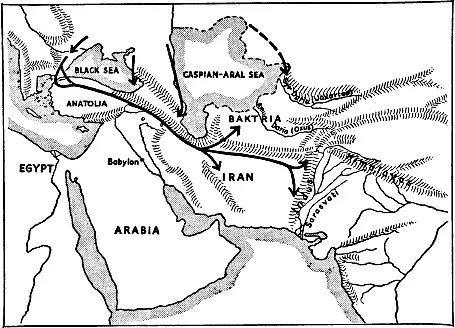
MAP I
Early Āryan Migrations
Early Āryan Migrations
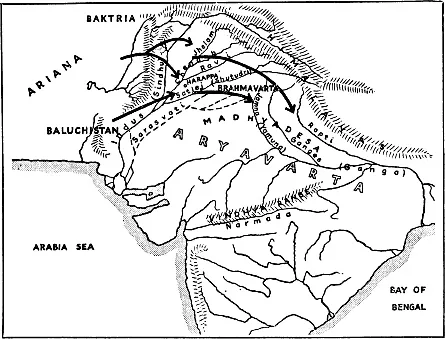
MAP II
Āryan Migration in Bhāratavarsha
Āryan Migration in Bhāratavarsha
and customs were similar for centuries after both peoples had discarded the 360-day calendar. A bond persists to this day in the name ‘Irān’, which is derived from Arian...
Table of contents
- Cover
- Half Title
- Full Title
- Copyright
- Dedication
- FOREWORD
- PREFACE
- CONTENTS
- ILLUSTRATIVE
- GLOSSARY
- PART ONE: INTRODUCTION BUDDHA AND DHAMMA
- PART TWO: THE TEACHING: DHAMMA AND DISCIPLINE
- APPENDIX A
- APPENDIX B The Pāli Alphabet
- APPENDIX C Pāli Commentarial Literature
- APPENDIX D Index of Suttas, etc
- BIBLIOGRAPHY
- INDEX
- LIST OF ABBREVIATIONS
Trusted by 375,005 students
Access to over 1.5 million titles for a fair monthly price.
Study more efficiently using our study tools.
Frequently asked questions
Yes, you can cancel anytime from the Subscription tab in your account settings on the Perlego website. Your subscription will stay active until the end of your current billing period. Learn how to cancel your subscription
No, books cannot be downloaded as external files, such as PDFs, for use outside of Perlego. However, you can download books within the Perlego app for offline reading on mobile or tablet. Learn how to download books offline
Perlego offers two plans: Essential and Complete
- Essential is ideal for learners and professionals who enjoy exploring a wide range of subjects. Access the Essential Library with 800,000+ trusted titles and best-sellers across business, personal growth, and the humanities. Includes unlimited reading time and Standard Read Aloud voice.
- Complete: Perfect for advanced learners and researchers needing full, unrestricted access. Unlock 1.5M+ books across hundreds of subjects, including academic and specialized titles. The Complete Plan also includes advanced features like Premium Read Aloud and Research Assistant.
We are an online textbook subscription service, where you can get access to an entire online library for less than the price of a single book per month. With over 1.5 million books across 990+ topics, we’ve got you covered! Learn about our mission
Look out for the read-aloud symbol on your next book to see if you can listen to it. The read-aloud tool reads text aloud for you, highlighting the text as it is being read. You can pause it, speed it up and slow it down. Learn more about Read Aloud
Yes! You can use the Perlego app on both iOS and Android devices to read anytime, anywhere — even offline. Perfect for commutes or when you’re on the go.
Please note we cannot support devices running on iOS 13 and Android 7 or earlier. Learn more about using the app
Please note we cannot support devices running on iOS 13 and Android 7 or earlier. Learn more about using the app
Yes, you can access The Buddha's Philosophy by G F Allen in PDF and/or ePUB format, as well as other popular books in Theology & Religion & Religion. We have over 1.5 million books available in our catalogue for you to explore.