- 336 pages
- English
- ePUB (mobile friendly)
- Available on iOS & Android
eBook - ePub
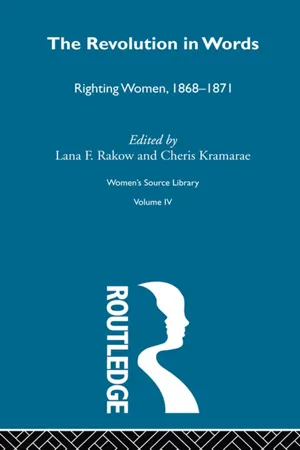
The Revolution in Words
About this book
First published in 1990. The revolution is one of the most radical periodicals of the Western women's movement. Though it only lasted a few years, it drew considerable attention to the courage and eloquence of its editors and contributors. The volume presents a wide range of exerpts from the periodical, evoking the undeminished power of these women's voices
1
Onward The Revolution
Introduction
The appearance of the first issue of The Revolution on January 8, 1868, must have been as exciting to its readers as the appearance of Ms magazine in July 1972 was to contemporary feminists. At last, letter writers responded, a publication that dared to say what they had been thinking all along.
After the Civil War, women needed a national publication to give them a voice. A number of radical, woman’s rights newspapers had been published by women since the 1850s, but most had ceased publication by the time of the Civil War. (The Sibyl, 1856–64, a dress reform and woman’s rights periodical was an exception.) Susan B. Anthony, Elizabeth Cady Stanton and Lucy Stone had talked about the need for a journal for some time, even unsuccessfully soliciting funds to begin one. The money to begin The Revolution was offered by George Francis Train, who made the offer while campaigning for women’s suffrage in Kansas with Anthony. Other abolitionists and suffragists were already alarmed that Stanton and Anthony had accepted Train’s campaign help – he was called a “Copperhead,” a southern sympathizer – so his assistance in starting a journal, called by a less than timid name, gave the journal immediate attention from a mixed readership.
Train came to be involved with Stanton and Anthony at a time when two referenda were going to the ballot in Kansas – one which would give Black men the vote and one which would give women the vote (presumably only white women unless the other amendment was also adopted). State Republicans launched an anti-woman suffrage campaign, while abolitionists refused to endorse women’s suffrage, using the justification that they did not want to jeopardize the amendment for Black men’s suffrage. Train, a Democrat, financier and activist for Irish independence from England, was well-known as a flamboyant speaker and dresser. In his speaking tour with Anthony, she would argue for passage of both amendments, while he would argue that if only one group could get the vote first, it should be white women.
The condemnation Stanton and Anthony received because of their association with Train might have been due in part to his racism, but it must be remembered that other abolitionists and women’s suffragists were also racists (Henry Blackwell, for example). Using recently discovered correspondence hidden for more than a century, Kathleen Barry (1988) concludes that Blackwell and a colleague conspired for their own political purposes, first to arrange that Train offered his campaign help in Kansas, and later to use Anthony’s association with Train to try to discredit her as a woman’s rights leader. These actions, unknown to Stanton and Anthony, may have been important factors in the painful and damaging split in the woman’s movement in 1869, Barry suggests. What the Republican men did not anticipate was that Train would offer financial support for a radical newspaper. Anthony and Stanton knew there were powerful forces working for abolition but few representatives for woman’s suffrage. Certainly most of the men they had worked with in the abolition movement were either indifferent or antagonistic to woman’s rights arguments. Anthony and Stanton thought there was no hope for their campaign unless they accepted what small offers of support were given them.
Actually, Train gave little support. Though Train’s affiliation with the journal was a source of conflict with other abolitionists and suffragists, his actual involvement in the journal was limited. The week the first issue of the journal was published, he sailed for England, only to be arrested and confined for almost a year. The journal’s financial pages, handled by Train’s friend David M. Melliss (financial editor of the New York World), continued to reflect Train’s radical financial theories such as Greenbackism (establishing greenbacks as the national currency along with a fixed national rate of interest), and Train continued to send letters which the editors published. However, the substantial financial support that he pledged never materialized. He ultimately contributed approximately $3,000 and Melliss $7,000 toward its support.
Without a stable source of financial support, the journal was always in a precarious position. In its pages, Anthony exhorted readers to get more subscribers (subscriptions peaked at 3,000, though her goal as she publicized it in The Revolution was 100,000), offering those who sold a substantial number of subscriptions such inducements as a copy of John Stuart Mill’s The Subjection of Women and a sewing machine. She chastised newspaper editors who wanted free subscriptions (she claimed that the journal exchanged with 6,000 other newspapers). Yet she and Stanton would not compromise on the kind of advertisements they would accept. Unlike other publications of its day, they refused patent medicine advertising. In addition, other advertisers generally were uninterested in advertising to women, in a controversial journal, especially when they could advertise in general circulation, conservative and moderate newspapers. The yearly price of the paper was kept at $2 as long as possible to keep it affordable to more women, was raised to $3 on June 17, 1869, but was returned to $2 after Stanton and Anthony left the paper.
In the short time that the journal was issued by Stanton and Anthony, its offices were housed in three locations, each appointed by the women with such attractions as portraits of Lucretia Mott and Mary Wollstonecraft. Initially the offices were located in the New York World building in what were the headquarters of the American Equal Rights Association. The extent of the physical difficulties the women endured in putting out the journal is illustrated by the fact that their offices were on the fourth floor of a building several blocks from the fifth floor office of their printer’s elevatorless building. In May 1869, the journal’s offices were moved to the Woman’s Bureau (49 East 23rd Street, near Fifth Avenue), a building purchased by Elizabeth B. Phelps for the use of women’s organizations. The Revolution occupied the first floor of what must have been a much more pleasant, convenient and inspiring setting. Unfortunately other organizations were apparently reluctant to be housed in the same location as the radical Revolution, so the arrangement only lasted one year. In April of 1870 the offices were moved to 27 Chatham Street.
The Revolution was not only a centralizing and organizing force for its readers but its offices were also a rallying place for like-minded women to gather, talk and support each other. Contributors to its pages as well as other supporters included Anna Dickinson, Paulina Wright Davis, Lucretia Mott, Elizabeth Smith Miller, Matilda Joslyn Gage, Eleanor Kirk [Ames], Rebecca Moore, Lillie Devereux Blake, Alice Cary, Phoebe Cary, Laura Curtis Bullard, Elizabeth Tilton and Mary Anthony (Susan’s sister). (Other contributors during Anthony and Stanton’s tenure with the paper are listed in the excerpt, “Prospectus of The Revolution for 1870.” For biographical information on those who had direct involvement with the paper and those listed as contributors, see the biographical Appendix.) Parker Pillsbury was a loyal editor (along with Stanton; Anthony was the “proprietor” or publisher) until he left for a time in 1869 for a more lucrative position, returning in 1870 on an appeal from Anthony when she went on a Lyceum tour to earn money for The Revolution and get new subscribers. Paulina Wright Davis, who had edited The Una, a woman’s rights periodical of the 1850s, served as corresponding editor beginning January 1, 1870.
Given the lack of signatures on many articles and our lack of knowledge of the day to day operations of the newspaper, it is difficult to know who was responsible for writing much of the content. In at least one case of an editorial with Stanton’s initials on it, she claims in her autobiography, Eighty Years and More, not to have written it (presumably she was referring to the excerpt in this chapter called “Garrison Crucifies Democrats, Train, and the Women of ‘The Revolution’”). Regardless of authorship, the paper was bold, crisply written and well printed, and was evidently intended to be a lasting contribution to the woman’s rights movement. (The newsprint used was of good quality and bound volumes of six months’ worth of issues were advertised as available from The Revolution office.) The editors and contributors laid out long arguments in editorials, commented on reprinted news items and speeches and provided a forum for letter writers. The newspaper attracted considerable attention – in the form of both praise and condemnation – from other newspaper editors, and it filled a void for its women readers, who must have cheered often at the boxed ears of ministers, politicians and editors. In all, The Revolution was a public display of a strong women’s movement.
Unfortunately, the paper was not to continue. Though Stanton drew no salary, Pillsbury a very small salary, and Anthony only her expenses, debts continued to mount. Given The Revolution’s precarious financial situation and its burden to Anthony, a project to create a stock company of several wealthy women for the financial foundation of the newspaper was begun. Isabella Beecher Hooker and Harriet Beecher Stowe discussed with Anthony and Stanton becoming editors, bringing their substantial personal influence to the paper. They were dissuaded from insisting that the name of the paper be changed in order for them to affiliate with it, but in the end The Revolution’s unabashed position taken in favor of a divorced woman whose former husband had killed her lover (known as the Richardson-McFarland case) dissolved the relationship.
Despite its frequent assertion by contemporaries, it is doubtful that Anthony and Stanton gave up the paper because of competition from The Woman’s Journal, begun by Lucy Stone and others in 1870. Subscriptions to The Revolution were increasing at the time the paper was passed on to other hands. But with Parker Pillsbury eager to be released to a better paying position, Stanton busy with lecturing, and Anthony increasingly burdened with the paper’s debts, Anthony reluctantly transferred possession of the paper after its May 26, 1870 issue to editor Laura Curtis Bullard and publisher Edwin A. Studwell (chairman of the Union Woman Suffrage Society at the time) for one dollar, a dollar that ironically was stolen from Anthony’s wallet a few days later. Anthony assumed the paper’s $10,000 debt, which she paid off in six years through lecture tours and donations.
Under Bullard’s editorship, the journal’s motto changed from “Men, their rights and nothing more: Women, their rights and nothing less” to “What therefore God hath joined together, let not man put asunder.” Perhaps it was this new motto that has led to the contemporary assessment that The Revolution ceased to be of interest after it was no longer associated with Stanton and Anthony. But the motto – and Bullard – were perhaps bolder and more clever than is apparent at first glance. In an editorial in the September 15, 1870 issue, Bullard explained that the motto not only referred to marriage but also to the need to restore women’s equal participation in society: “[Woman] has been systematically divorced from [man] from the beginning of time: she is now to proclaim and enforce her marriage rights. She is to be joined with him in all the great ventures of human life. She is to have an equal place with him in the trades, in the colleges, in the lyceum, in the press, in literature, in science, in art, in government, in everything.”
The newspaper now contained more pieces of fiction, more poetry, and woman’s rights literary criticism (for example, reviews of woman’s rights books by G. F. Ball and reviews of women characters in fiction by Emily E. Ford). It contained a great deal of material from foreign correspondents and travelogues from Bullard and others traveling outside the country. Well-known women were featured in biographical essays, including Margaret Fuller, English printer and Revolution correspondent Emily Faithfull and other journalists. Phoebe Cary and Augusta Larned provided Bullard with substantial editorial assistance, particularly when Bullard was traveling out of the country. The names of other women – Celia Burleigh, Lillie Devereux Blake, Lizzie Boynton, Rebecca Moore, Laura Holloway – appear frequently in the paper’s pages, suggesting a sustained support from women who had been contributors under Anthony and Stanton. Stanton on occasion provided strong articles.
The writing in The Revolution under Bullard’s editorship was more lite...
Table of contents
- Cover
- Half Title
- Title Page
- Copyright
- Dedication
- Contents
- List of illustrations
- Foreword
- Acknowledgements
- Key
- Introduction
- 1. Onward the Revolution
- 2. Aristocracy of Sex
- 3. Hester Vaughanism
- 4. The Bread Question
- 5. Man’s Sphere
- 6. Going to Unfashionable Lengths
- 7. Man/Dated Language
- 8. “What About the Babies?”
- 9. “All the Rights I Want”
- 10. Becoming Perfect Nuisances
- Appendix: Women of The Revolution
- Index
Trusted by 375,005 students
Access to over 1.5 million titles for a fair monthly price.
Study more efficiently using our study tools.
Frequently asked questions
Yes, you can cancel anytime from the Subscription tab in your account settings on the Perlego website. Your subscription will stay active until the end of your current billing period. Learn how to cancel your subscription
No, books cannot be downloaded as external files, such as PDFs, for use outside of Perlego. However, you can download books within the Perlego app for offline reading on mobile or tablet. Learn how to download books offline
Perlego offers two plans: Essential and Complete
- Essential is ideal for learners and professionals who enjoy exploring a wide range of subjects. Access the Essential Library with 800,000+ trusted titles and best-sellers across business, personal growth, and the humanities. Includes unlimited reading time and Standard Read Aloud voice.
- Complete: Perfect for advanced learners and researchers needing full, unrestricted access. Unlock 1.5M+ books across hundreds of subjects, including academic and specialized titles. The Complete Plan also includes advanced features like Premium Read Aloud and Research Assistant.
We are an online textbook subscription service, where you can get access to an entire online library for less than the price of a single book per month. With over 1.5 million books across 990+ topics, we’ve got you covered! Learn about our mission
Look out for the read-aloud symbol on your next book to see if you can listen to it. The read-aloud tool reads text aloud for you, highlighting the text as it is being read. You can pause it, speed it up and slow it down. Learn more about Read Aloud
Yes! You can use the Perlego app on both iOS and Android devices to read anytime, anywhere — even offline. Perfect for commutes or when you’re on the go.
Please note we cannot support devices running on iOS 13 and Android 7 or earlier. Learn more about using the app
Please note we cannot support devices running on iOS 13 and Android 7 or earlier. Learn more about using the app
Yes, you can access The Revolution in Words by Cheris Kramarae,Lana F. Rakow in PDF and/or ePUB format, as well as other popular books in History & World History. We have over 1.5 million books available in our catalogue for you to explore.