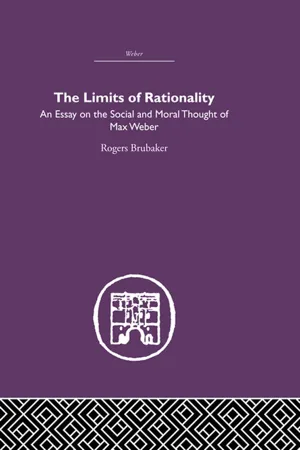
In The Limits of Rationality Rogers Brubaker explores the intimate and ambiguous interplay between Max Weber's empirical work and his moral vision, between his historical and sociological analysis of the 'specific and peculiar rationalism' of modern Western civilization and his deeply ambivalent moral response to that rationalism. Weber's ideas about rationality are central to his sociological work, and they are central to his moral perspective. But these ideas are neither easily accessible nor easily understandable, in part because Weber never systematized them, in part because his work is usually encountered piecemeal and seldom studied in its entirety. Brubaker reconstructs Weber's rich but fragmented discussion of rationalism and rationalization in a systematic fashion, thereby illuminating his empirical and moral diagnosis of modernity - a diagnosis that remains unsurpassed in pathos and anyalytical power.
- 144 pages
- English
- ePUB (mobile friendly)
- Available on iOS & Android
eBook - ePub
The Limits of Rationality
About this book
Trusted by 375,005 students
Access to over 1.5 million titles for a fair monthly price.
Study more efficiently using our study tools.
Information
1
The Specific and Peculiar Rationalism of Modern Western Civilization
A few months before his death in June 1920, Max Weber wrote a short introduction for his Collected Essays in the Sociology of Religion.1 This 'preliminary remark', as he entitled it with deceptive modesty, contains what Benjamin Nelson (1974) has called the 'master clue' to Weber's lifelong scholarly intentions. For here Weber makes explicit the underlying universal-historical perspective that endows his vast, fragmented and apparently heterogeneous corpus of empirical studies2 with thematic coherence. Basic to this perspective are two ideas: first, that modern Western civilization differs from all others in its 'specific and peculiar rationalism'; and second, that the central task of universal history is to characterize and explain this unique rationalism (AI, p. 26).3
Weber is quick to point out that 'rational', 'rationalism' and 'rationalization' are by no means unambiguous terms:
There is, for example, rationalization of mystical contemplation ... just as much as there are rationalizations of economic life, of technique, of scientific research, of military training, of law and administration. Furthermore, each one of these fields may be rationalized from many different ultimate points of view and toward many different ultimate ends, and what is rational from one point of view may well be irrational from another. Hence rationalizations of the most varied character have existed in various departments of life in all civilizations.
(GAR, pp. 11-12; AI, p. 26)
The systematic ambiguity surrounding the notions of rationalism and rationalization makes it necessary to specify 'which spheres of social life are rationalized, and in what direction' (GAR, p. 12; AI, p. 26). Only in this way can the 'special peculiarity' of modern Western rationalism—and thus the distinctiveness of the modern Western social order—be made clear. And only in this way can one begin to fulfill what Weber identifies as the central task of social science: to understand the 'characteristic uniqueness [Eigenart] of the reality in which we move' (M, p. 72).
The 'reality in which we move', for Weber as for Marx, is dominated by capitalism, 'the most fateful force in our modern life' (AI, p. 17). And the most salient characteristic of modern industrial capitalism, according to Weber, is its thoroughgoing rational calculability. This chapter begins, then, with an analysis of the rationality of the capitalist economy. Next I discuss law and bureaucratic administration, characterized by Weber as rational because of their impersonal objectivity and their reliance on formalized rules and procedures. Common to the rationality of industrial capitalism, formalistic law and bureaucratic administration is its objectified, institutionalized, supra-individual form: in each sphere, rationality is embodied in the social structure and confronts individuals as something external to them. The development of rationality in this objectified form, according to Weber, presupposed the prior development within individuals of a certain highly peculiar kind of rational inner orientation (AI, pp. 26-7). This process of internal or subjective rationalization is discussed in Section 4, which focuses on the development among ascetic Protestants of a rigorously disciplined way of life (Lebensführung) based on constant self-scrutiny and methodical self-control.
Despite their historical interconnections, processes of rationalization in the spheres of economic life, law, administration, and religious ethics cannot be collapsed into a single overarching development. Rationalization, for Weber, is not a single process but a multiplicity of distinct though interrelated processes arising from different historical sources, proceeding at different rates, and furthering different interests and values. Still, these various processes of rationalization have notable structural similarities. I try to capture these common structural components in Section 5 by tracing three motifs—those of increasing knowledge, growing impersonality and enhanced control—that recur in all Weber's discussions of the rationality of the modern social order. The chapter's concluding sections examine another unifying theme: the idea that the rationality of modern capitalism, law, bureaucracy and vocational asceticism is purely formal, and that this rationality may be judged highly irrational from a substantive or evaluative point of view. Above all, it is this purely formal character, this indifference to all substantive ends and values, that defines what is unique—as well as what is morally and politically problematic—about Western rationalism.
Capitalism and Calculability
The essence of modern capitalism, according to Weber, is its rationality.4 To begin with, exchange in the market, the basis of the capitalist economic order, is 'the archetype of all rational social action'. Unhampered by sacred taboos, by traditional status-group privileges, or by any 'obligations of brotherliness or reverence', market transactions are determined solely by the 'purposeful pursuit of interests', by an 'orientation to the commodity and only to that' (E&S, pp. 635-6). They are rational in the negative sense of being free from the constraints of tradition and sentiment and in the positive sense of being purely instrumental (zweckrational), determined by an orientation to the set of opportunities for exchange and to these alone (E&S, pp. 82, 84). The market is the paradigm of rationality in this double sense, for market exchange, more than any other type of activity, is determined by the deliberate and calculating pursuit of self interest and is free from the multifarious fetters of tradition and the capricious influence of feelings.5
Here, as throughout his empirical work, Weber uses 'rational' in a non-evaluative sense. His characterization of market relationships as rational implies no moral approval of these relationships; he explicitly notes that the very rationality and impersonality of pure market relationships is 'an abomination to every system of fraternal ethics' (E&S, p. 637). Like 'legitimacy' in Weber's sociology of domination and 'validity' in his sociology of law, 'rationality' is a neutral analytical concept, purged of the normative meaning it has in other contexts. This is not to deny that Weber harbors strong—though ambivalent—attitudes toward those aspects of the modern social order that he characterizes as rational. These attitudes, however, do not inhere in the term 'rational', which remains evaluatively neutral, conveying neither approbation nor condemnation.
Market exchange, then, is rational to the extent that it involves the calculating, purely instrumental orientation of economic action to opportunities for exchange and to these alone. But this is only one aspect of the rationality of modern capitalism. Just as important is the use of money accounting as a means of economic calculation and decision-making. While the social structure of market exchange elicits the subjective disposition to act on the basis of impersonal calculations, money accounting provides an objectified, supra-individual technology for carrying out these calculations, for determining unambiguously the 'best', meaning most profitable, opportunity for exchange.6
Monetary calculation is inherently quantitative: every good and service, every asset and liability, every factor that is (literally) 'taken into account' is assigned a numerical money value. Quantitative calculation, for Weber, is a rational means of orienting economic activity because it is exact and unambiguous:
From a purely technical point of view, money is the most 'perfect' means of economic calculation. That is, it is formally the most rational means of orienting economic activity. Calculation in terms of money is thus the specific means of rational economic provision.
(E&S, p. 86)
Monetary calculation, like market exchange, is rational only in a purely formal, non-evaluative sense. Weber explicitly contrasts the formal rationality of money accounting with what he calls the substantive rationality of economic action, the latter an inherently evaluative concept denoting the degree to which an economic system provides for the needs, furthers the ends, or accords with the values of a given social group. Moreover, he stresses the irreconcilable tension between extreme formal rationality, which requires treating the individual worker purely as a means, as a calculable instrument of production just like any material means of production, and substantive rationality. (See pp. 35-43 for a more extensive discussion of the tension between formal and substantive rationality).
The modern economy, then, is characterized by a double rationality: subjectively rational (purely instrumental) market transactions are guided by objectively rational (purely quantitative) calculations. Yet market exchange and monetary calculation alone do not define modern capitalism. For while they have developed to an unprecedented degree under modern capitalist conditions, they existed for thousands of years all over the world before the development of modern capitalism. Modern industrial capitalism is based not simply on monetary calculation but on a technically perfected form of capital accounting, not simply on market exchange but on the continuous market struggle of profit-making, bureaucratically organized enterprises employing formally free labor. These specific characteristics of modern capitalism converge on the idea of cal culability—not, however, the calculability inherent in the use of money, but a much more thoroughgoing calculability based on the technique of capital accounting, on rigorous factory discipline and the precise control by owners of all human and nonhuman means of production, on a predictable legal and administrative system, and on the 'extension of productivity of labor ... through the subordination of the process of production to scientific points of view' (PE, p. 75).
Weber's emphasis on calculability as the essential characteristic of modern capitalism involves two distinct strands of analysis. First, the production process itself—the performance of the human and non-human means of production—is calculable. Secondly, the legal and administrative environment is calculable: the actions of judges and bureaucrats, in so far as they affect economic conduct, can be reliably predicted.
The calculability of the production process rests on specific institutional foundations. Salient among these is the entrepreneur's legally assured control over workplace, tools, machinery, sources of power, and raw materials—what Weber calls 'the complete appropriation of all material means of production by owners' (E&S, p. 161). Exact calculabihty depends on this centralization of control: the entrepreneur can be sure of the performance of factors of production only in so far as he controls them. Monopolization of control by entrepreneurs presupposes the 'expropriation of the individual worker from ownership of the means of production' (E&S, p. 137). Weber of course follows Marx here. But for Weber, the expropriation of the individual from the material means of his activity and livelihood is not a phenomenon peculiar to the capitalist firm. It is just as characteristic of the modern state, army, church, and university (E&S, pp. 223, 980-3; Soc., pp. 197-9). This fundamental fact of the ' "separation" of the worker from the material means of production, destruction, administration, academic research, and finance' (E&S, p. 1394)—conditioned partly by the nature of modern technology, which is typically too large, expensive or sophisticated to be controlled by the individual worker, and partly by the greater efficiency of centrally organized activity—is the cornerstone of Weber's theory of bureaucracy (see pp. 20-2 below). Thus the rationalization of economic activity, in so far as it depends on the centralization of control over the material means of production, is part of a much broader process of rationalization that Weber subsumes under the notion of bureaucratization.
Technical knowledge is the second factor on which the calculability of the production process depends. Effective control over the means of production, as distinguished from the mere power to dispose of them at will, itself depends on reliable technical knowledge. Highly refined technical knowledge, in turn, depends ultimately on 'the peculiar features of Western science, especially the mathematically and experimentally exact natural sciences with their precise rational foundations' (S Tr, p. 338; cf. AI, p. 24). (The 'practical and ... methodical inclusion of natural science in the service of the economy', according to Weber, is important not only as a source of the exact calculability of the production process but also as 'one of the keystones in the development of the regulation of life in general' (ALW, p. 1129). Weber nowhere systematically expounds his views on the relation between the development of modern science and processes of rationalization in other domains, but it is clear that he regards the theoretical development and practical application of natural science as a central component of the distinctively Western course of rationalization, as much because of its general effect in fostering a 'rationalist and antitraditionalist spirit' (ALW, pp. 1128-9) as because of its specific contributions to technical progress.)
Finally, the calculability of the production process depends on the uniquely Western system of formally free labor and on the disciplined control of workers by entrepreneurs. Maximum calculability, according to Weber, is achieved not with slave labor, but with labor that is formally free yet economically compelled— under the 'whip of hunger' (GEH, p. 277)—to sell its services on the market:
When workers are employed for wages, the following advantages to industrial profitability and efficiency are conspicuous [Weber is comparing formally free labor with slave labor]: (a) capital risk and the necessary capital investment are smaller; (b) the costs of reproduction and of bringing up children fall entirely on the worker. His wife and children must seek employment on their own account; (c) largely for this reason, the risk of dismissal is an important incentive to the maximization of production; (d) it is possible to select the labor force according to ability and willingness to work.
(E&S, p. 163; cf. 113, 129, 150-1)
Labor must be subject to strict—and strictly rational— discipline. Weber cites the Taylor system of 'scientific management' as the limiting case of discipline and control based on knowledge:
Discipline in the factory has a completely rational basis. With the help of suitable methods of measurement, the optimum profitability of the individual worker is calculated like that of any material means of production. On this basis, the American system of 'scientific management' triumphantly proceeds with its rational conditioning and training of work performances, thus drawing the ultimate conclusions from the mechanization and discipline of the plant. The psychophysical apparatus of man is completely adjusted to the demands of the outer world, the tools, the machines—in short, it is functionalized, and the individual is shorn of his natural rhythm as determined by his organism; in line with the demands of work procedure, he is attuned to a new rhythm through the functional specialization of muscles and through the creation of an optimal economy of physical effort.
(E&S, p. 1156)
The fact that maximum calculability in economic (and other) organizations requires the disciplined control of some human beings by others is another instance of the antagonism—endemic in the modern social order—between formal and substantive rationality.
Industrial capitalism is characterized not only by the exact calculability of the production process, but also by the calculability of the legal and administrative environment within which economic action takes place. Modern capitalism, Weber argues, presupposes this calculability:
The modern capitalist enterprise ... presupposes a legal and administrative system whose functioning can be rationally predicted, at least in principle, by virtue of its fixe...
Table of contents
- Cover
- Title
- Copyright
- Contents
- Preface
- Abbreviations
- Introduction
- 1 The Specific and Peculiar Rationalism of Modern Western Civilization
- 2 The Nature and Limits of Rational Action
- 3 The Ethical Irrationality of the World
- 4 Weber's Moral Vision
- Bibliography
- Index
Frequently asked questions
Yes, you can cancel anytime from the Subscription tab in your account settings on the Perlego website. Your subscription will stay active until the end of your current billing period. Learn how to cancel your subscription
No, books cannot be downloaded as external files, such as PDFs, for use outside of Perlego. However, you can download books within the Perlego app for offline reading on mobile or tablet. Learn how to download books offline
Perlego offers two plans: Essential and Complete
- Essential is ideal for learners and professionals who enjoy exploring a wide range of subjects. Access the Essential Library with 800,000+ trusted titles and best-sellers across business, personal growth, and the humanities. Includes unlimited reading time and Standard Read Aloud voice.
- Complete: Perfect for advanced learners and researchers needing full, unrestricted access. Unlock 1.5M+ books across hundreds of subjects, including academic and specialized titles. The Complete Plan also includes advanced features like Premium Read Aloud and Research Assistant.
We are an online textbook subscription service, where you can get access to an entire online library for less than the price of a single book per month. With over 1.5 million books across 990+ topics, we’ve got you covered! Learn about our mission
Look out for the read-aloud symbol on your next book to see if you can listen to it. The read-aloud tool reads text aloud for you, highlighting the text as it is being read. You can pause it, speed it up and slow it down. Learn more about Read Aloud
Yes! You can use the Perlego app on both iOS and Android devices to read anytime, anywhere — even offline. Perfect for commutes or when you’re on the go.
Please note we cannot support devices running on iOS 13 and Android 7 or earlier. Learn more about using the app
Please note we cannot support devices running on iOS 13 and Android 7 or earlier. Learn more about using the app
Yes, you can access The Limits of Rationality by Roger Brubaker,Rogers Brubaker in PDF and/or ePUB format, as well as other popular books in Social Sciences & Sociology. We have over 1.5 million books available in our catalogue for you to explore.