![]()
THE STRANGELY FAMILIAR MARY POPPINS
THE MARY POPPINS BOOKS
The name Mary Poppins is universally recognized, yet few people have actually read or even know of the books in which this character first appeared.1 Mary Poppins achieved fame with the 1964 Disney film and is one of those familiar figures that seem to belong to the collective imagination. Her image is immediately recognizable and feeds into a certain common denominator of shared knowledge, meaning that children might dress up in Mary Poppins costumes at Halloween time or that commercials might profit by borrowing from her iconic status in order to sell products. In whatever context she appears, we find those same defining props: the parachute-like umbrella, the handbag, gloves and flower-adorned hat; and those same defining characteristics: the ability to solve all problems and soothe all worries.
Mary Poppins is present on a broadly popular and informal level as the typical and yet very particular English governess from the world of British fiction. Even those who are not entirely familiar with the precise details of the Mary Poppins books will nevertheless be aware of her defining qualities and will remember what this character is capable of doing. The Mary Poppins books were published over a period of fifty years, from the 1930s to the 1980s, and their creator, Pamela Lyndon Travers, could never have envisioned, as she sat down to write the stories, just how fascinating readers would find her protagonist.
Mary Poppins is a mysterious, fleeting character, but she is also “strangely familiar”2 (III, p.19) to the children and adults who become acquainted with her. However, the captivating fascination and popularity of this character are not the result of a spontaneous, immediate identification on the part of the reader, as is the case with much traditional narrative. What is continually highlighted in the six books that carry her name is the sense of her being unusual, of her being someone or something quite special, unique and distinct from her surroundings. In leading us toward that world to which we would never gain access were it not for our imaginations, Mary Poppins is at the same time familiar and entirely Other and becomes the emblem not of our actual selves, but of our dreams, reflections, and projections. We understand from the very outset that Mary Poppins represents something to which we as readers will probably never get, and yet she seems so intimately related to us precisely because she taps into a sense of suspension or tension that is integral to our selves, even though it is somehow unconscious, forgotten, or as yet unrevealed.
Mary Poppins represents hope, flight, and—contrary to what may be superficially thought—not just a funny and gratuitous fantasy, but rather a set of deep needs that would be unspeakable unless one turns to “fantastic” metaphors. She symbolizes the experiences of fusion and confusion that, despite being deeply necessary to our existence, have for some reason been withheld or deemed illegitimate. And if she is, on the one hand, the perfect incarnation of certain shared values (Mary Poppins is the impeccable English governess of the early twentieth century whose favorite book, as frequently mentioned, is Everything a Lady Should Know), she can also be read as a fairy-tale character, or on a deeper level, as a mythical figure.
The Disney film significantly altered the character of Mary Poppins in its portrayal of her. To put it simply but effectively, we might refer to what Caitlin Flanagan says in her interesting article, “Becoming Mary Poppins. PL Travers, Walt Disney, and the Making of a Myth,” in which she captures the essence of the changes made by Disney by asking “Why was Mary Poppins, already beloved for what she was—plain, vain and incorruptible—transmogrified into a soubrette?” Flanagan also points to Travers's private letters in which “she mercilessly criticized Disney's lack of subtlety and what she called his emasculation of the characters.”3
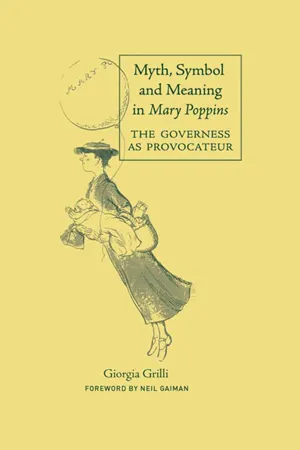
Travers's books present her as a very solid and somewhat disturbingly dark character, and the illustrations by Mary Shepard (daughter of the better-known Ernest Shepard) reinforce this image. She is the powerful woman with arms raised, encircled by animals and taking part in some strange ritual under the moonlight; or she is that ungraspable character in the raincoat with the half-closed eyes and fleeting look that suggests that what she sees is in some way different from what we might see; or again, when shown playing her gypsy-like accordion, surrounded by those insidious cats and croaking ravens of the witching-world, she becomes the solemn yet ambiguous representative of a well-defined tradition of female characters. It is interesting to note, however, that the Mary Poppins books do not actually encompass their protagonist, nor do they give the impression of in any way claiming responsibility for her creation. There is no sense that these books seek to explain the character and her story in their entirety, in terms of a beginning, middle, and end. Rather, the character is as if “borrowed” for a moment from that unknown place where Mary Poppins has always existed. It is suggested that she may have acted as governess to other fictional children before coming to the Banks household, she is considered by animals to be a sort of “a distant relative,” she is friend to the gods and so on. She is whisked through the air one stormy day by the Easterly wind and becomes, though for a limited time only, the leading light in the Banks household, which she apparently sets in order but in fact revolutionizes.
Mary Poppins descends on a very “English” England, or rather a very English city, brightened somewhat by the greenery of the inevitable London park, which, carrying a name no more inventive than that of “The Park,” acts as allegory for the archetypal park. She comes to take charge of a household characterized by domesticity and all its attendant stereotypes, including that room or sphere known as the nursery where children and the childhood world are habitually confined. The details of this stereotypical environment define the field of identification in which the subsequent adventures take place. Yet, if the space of the story is clearly defined, the time in which it takes place appears suspended, halted in some way, imprecise—it is as if the characteristics of a particular way of life, which certainly do belong to a specifically recognizable if only vaguely delimited moment in time, were perceived as symbolic, robust, and deep-seated enough to be emblematic, capable of projecting meaning well beyond the confines of the specific age in which the stories are set. Certain specific social characteristics, with all their intrinsic contradictions, point to a sort of archetypal “reality principle,” the dimension against which, regardless of time or place, the ontological and psychological struggle for freedom, authenticity and individual possibility takes place. The stories then are set against the backdrop of an England caught between the end of the long and burdensome Victorian era and the beginnings of the more frivolous Edwardian age, a moment characterized as much within the pages of narratives as without by a sought after compromise between an inevitable sense of intellectual adventure and an equally un-relinquishable traditional morality (bordering on exasperation and liable to transform itself into a rather interesting and highly dramatic rigor of form): this past that refused to pass defined the period going from the end of the nineteenth century, through the years preceding World War I and extending up to the threshold of World War II.
Mary Poppins arrives like a blessing and neatly inserts herself into the daily routine of this middle-class family in which the mother, Mrs. Banks, is beside herself with the responsibility of having to take care of her children and run the household at the same time. Mary Poppins is a model of competency and efficiency, the perfect governess come to help a family that, despite being quite normal (and maybe precisely because it is so normal), would otherwise find itself in grave difficulties. The mother of the family corresponds to the stereotype of the fragile, hysterical, and hesitating woman; the four children are boisterous, argumentative, sincere, and yet quite unmanageable—and there is another child on the way. To all this is added the various vagrant, annoying, and inept figures such as the servants, all of whom must be accounted for by the hardworking and bad-tempered father who spends all his time at the office. These characteristics signal the type of society focused on by these narratives, by these “simple” children's stories.
This burgeoning Edwardian society proved itself already to be resolutely heading in the direction of modern capitalism, which, in turn, affected the way that people and their lives were organized. It was already, broadly speaking, a “money society,” even though its tastes, customs, fears, and ostentations still reflected a reluctance to accept competition, entrepreneurship, merit, and astuteness as ways of attaining social status. Society in general was not yet willing to admit that much personal and social action was the fruit of vulgar utilitarianism and the search for material gain. It still preferred to believe that action was driven by noble, disinterested, high aims, and the middle classes in particular were disturbed by their inability to boast “birth” or “blood” as natural justification for the important social positions they were beginning to conquer (by way of the money that they were making).
This scenario provides the backdrop to Travers's books. From the very first volume in the series, we are told that each morning the father of this respectable middle-class family leaves the house (with a hurried pace all too familiar to us) and heads for the city with the sole purpose of “making money.” We are given no further details about his job and so are not entirely sure whether he literally “makes money” at the Royal Mint, whether he makes money in the figurative sense that he earns it (as we adults immediately think), or whether, whatever the case is, and as the children would have it, he simply spends his days away from home in the service of the money demon.
For his book, The Edwardians, the social historian Paul Thompson interviewed a number of elderly people who were alive during the first decades of the twentieth century, and his book provides some useful insights into the period in which the Mary Poppins books were set. In one particularly relevant passage the men of the middle-class districts come under scrutiny. The character of Mr. Banks clearly springs to mind:
When the gentleman of the house arrives he is usually grumpy […] He sinks into his well-cracked, saddle-bag, gent's arm chair as one who has all the cares of the world upon him. He inquires why it is that ‘the damned dinner’ is never ready, despite the fact that there are three women in the house…4
Given the high levels of tension present in the Banks household, Mary Poppins's arrival is seen as a blessing. Efficient as she is, she is able to set the situation straight (an immediate image for which is her straight back and perfectly erect posture). Mary Poppins acts as a sort of norm, or rather, she trains the children to respect what are considered to be norms (i.e., the corpus of manners one had to learn and adopt in order to be considered “normal” and thus acceptable by that particular context). And yet paradoxically Mary Poppins also represents something quite strange, inexplicable, and abnormal. She projects a sense of surprise and the promise of adventure; she embraces the unknown, the unexpected, and the incongruous; and she continually provokes a sense of strangeness, of novelty, overturning recognized and established codes such as those governing “good manners.”
The name Travers gives her character is equally interesting—the name itself is always reproduced in full, that is, the governess is never referred to simply as “Mary” or “Miss Poppins.” This clearly points to the fact that no other character is permitted to enter into an overly intimate relationship with the governess, nor will she answer to any title suggestive of her social position or marital status. She is what she is: just herself. The surname “Poppins” is suggestive not only of the fact that the governess, as we shall find, will literally “pop in” to the lives of the Banks children (she will suddenly become part of them, but only for a short time), but also points to the little explosions and subsequent shocks heralded by the verb “to pop.” What we find therefore is a situation in which the name signals explicitly what the character will do and the effect she will have on those with whom she comes into contact. Indeed, it is in the company of Mary Poppins that the children are able to give expression to their flights of imagination and to the fantasies of which they are not yet even aware. The most unthinkable adventures are now possible, adventures toward the Other, otherwise, in places other than that in which the children habitually live, with its normal characters and normal routines. Situations formerly seen as uninteresting, lacking in curiosity, unable to provoke a response or to involve the children in any valuable or stimulating way, are now, thanks to Mary Poppins, the sites of possible adventure.
Mary Poppins is neither fairy, magician, nor witch in the classic sense. The unexpected situations she creates are the result neither of tools, nor of enchanted formulae, nor of magical ingredients. We never see her plotting or preparing in advance the fantastical situations that open up a whole different world for the Banks children. Rather, she is an ungraspable presence (or graspable only insofar as she makes herself socially recognizable) for whom anything and everything is possible, even without her intervention. Life, which had become sluggish, crystallized, and, in some way, latent, in her presence awakens; her approach seems to suggest that only if our (senti)mental capacity to really be aware of the life around us is restored, can we live the potentially epiphanic relationship between our sensations and intuitions on the one hand and the aesthetic, sensitive, and stimulating qualities of the object world on the other. It is not so much a question of our watching Mary Poppins give life to the impossible or the fantastic, as experiencing a real awakening of our consciousnesses that, now released, can interact with a brand new world that reveals itself to us as if for the first time.
Because she remains on the sidelines and gives no hint that she is in any way responsible for the fantastic events that take place, we only perceive the links connecting Mary Poppins to these experiences when we are well into the adventure. The policemen and other law-abiding passers-by who accuse Mary Poppins of being involved in the events have no evidence to support their intuitive suspicions. Our governess is in no specifically rational sense the cause of these strange happenings (even though they only take place in her presence): the intimate associations and allusions of co-implication between herself and the strange events or characters that we meet are not the result of some magical spell cast by Mary Poppins to bring into existence something that heretofore did not exist; the links of complicity result from a sense of Mary Poppins as being intimately related to and in harmony with the possible rather than the actual (which she often virulently opposes).
THE NARRATIVE STRUCTURE
The same narrative structure is repeated in the first three books of the series, Mary Poppins, Mary Poppins Comes Back and Mary Poppins Opens the Door. Mary Poppins appears somewhere in the first chapter and disappears suddenly in different and unexpected circumstances during the last. The main part of each of the books deals with the strange situations and adventures that lead the Banks children, and we readers, toward marvelous and startling encounters. We could use the word “fantastic” to define these situations, a word that refers to a specific literary genre whose main elements can certainly be found in the Mary Poppins books, starting with the way in which normal, quotidian, everyday life is essentially intertwined with the alternative dimensions of the unexpected. This intertwining would remain obscure, unexplained, lacking in any sort of logical connection were it not for the fact that this glimpsed “beyond” (i.e., that which was until now unthinkable or unknown) imposes itself as “real”: clues pointing to the fact that these particular situations did in fact take place within the narrative abound, such as the snakeskin belt that Mary Poppins sports the morning after the children experience a dream-like adventure, or the scarf belonging to Mary Poppins that Jane finds inserted into the illustration on the side of a vase. This “beyond” and its relationship with the “here” are condensed into that image of the Door, which opens and closes on difference, and allows nothing more than momentary access to that difference. That alone, however, is enough to upset what is officially recognized as “real” inside the house.
The next three books, Mary Poppins in the Park, Mary Poppins and the House Next Door, and Mary Poppins in Cherry Tree Lane do not follow the chronology of the story established by the first three books in which Mary Poppins arrived and left, before eventually returning in the sequel. In the first of these books, Mary Poppins is brought and then snatched back by the wind; in the second, she appears on the end of a kite string and is taken away again by a fairground ride; and in the third book, she descends from the sky in a rain of fireworks, only to disappear behind a reflection of the children's bedroom door at the end of the book. The fourth, fifth, and sixth books (according to the writer herself) recount other adventures that should be understood as having taken place in the time frame of one of the first three books when Mary Poppins came to fill the Banks home with her presence and the liberated potential of all things.
As in the first three books, Mary Poppins makes the Banks children enter and exit the various adventures in an equally unorthodox fashion. Yet the narrative structure framing the adventures is predominantly linear and mirrors the movement of a linear mental scheme which is interrupted, dismantled, or proved insufficient. The exit from what we would call “reality,” inspired by the “otherness” of the governess, takes place in two distinct ways. The first demands that we adopt an alternative thought process and abandon our usual rational approach to the world so as not to miss a certain incongruence present in the furtive phrases and gestures of Mary Poppins herself or one of the characters to whom she introduces us. We recall, for example, the way she very elegantly slides up the banister or the way she removes impossibly large objects from a handbag that seems far too small to have contained them (though of this we can no longer be sure), or the way she seems to talk to animals, or the fact that she can fly, that she appears and disappears at whim. A similar abandoning of our normal rationale is required when Mary Poppins introduces us to other characters so that we do not miss the statues, stars, or toys moving as if they were human, or the fact that some of them seem to be able to remove their own fingers; or again when the children find their desires instantly turning to reality, or their names unexpectedly written on balloons, or see candy walking sticks begin to fly. The second way in which we exit “reality” as we know it is via a move toward a spatial Elsewhere. Examples of this include flight through the air, underwater sea adventures, or the way in which the nocturnal park becomes a setting for the strangest and most unsettling upheavals. Rather than challenge ...