![]()
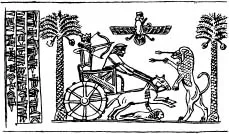
DARIUS HUNTING LIONS.
(Agate Cylinder Seal in British Museum.)
CHAPTER I
CONFIGURATION AND CLIMATE
There is a certain tawny nudity of the South, bare sunburnt plains, coloured like a lion, and hills clothed only in the blue transparent air.—R. L. STEVENSON.
A lamp gives no light in the Sun:
And a lofty minaret looks mean on the slopes of Alvand.
The Gulistan of Sadi.
The Situation of Persia.—Between the valleys of the Indus on the east and of the Tigris on the west rises what is generally termed the Iranian plateau. Persia fills the western and larger portion of this elevated tract, the eastern portion being occupied by Afghanistan and Baluchistan. These countries are surrounded on all sides by gigantic ranges, which are highest on the west and north, and the interior is divided into two chief basins. That on the west, which includes about three-fifths of Persia and is subdivided into many smaller basins, joins the eastern, the basin of Sistan, not very far from the province of that name. This latter area is chiefly drained by the classical Etymander, now termed the Helmand, and by minor rivers most of which, in flood time at any rate, discharge into the hamun or lake of Sistan.
In altitude the plateau exceeds 5000 feet at Kerman, 5000 at Shiraz, and 3000 in the region of the great northern cities of Teheran and Meshed, while Tabriz, in the extreme north-west, exceeds 4000. Of the central cities, Isfahan exceeds 5000 feet, and Yezd 4000. These figures are of interest, for they bring out the contrast between the inhabited part of the plateau and the great desert which occupies the heart of the country and lies considerably lower, although rising almost everywhere above 2000 feet.
Boundaries and Provinces.—In describing the boundaries of Persia I propose also to refer to its chief provinces, which almost all lie away from the centre and within reach of the frontiers.
The eastern province of Khorasan is bounded on the north by a series of ranges which rise in stern beauty above the steppes of Turkestan. Some years ago I visited the extraordinary natural fortress of Kalat-i-Nadiri1 and climbed its northern wall, which is one of the mountains in this range, From the crest I looked across the yellow plain, stretching northwards in level monotony, and was struck by its immensity; for I realized that it extended as far as the tundra and the distant Arctic Ocean, with no intervening mountains. This range does not form the Persian boundary throughout, but, under the names of Kopet Dagh and Little Balkans, runs off in a north-westerly direction to the Caspian Sea. A little farther west, just within the limits of Iran, lie the rich valleys of the Atrek and Gurgan. In its lower reaches the Atrek forms the Russo-Persian boundary until it discharges into the Caspian Sea.
The district of Kuchan, which lies on both banks of the upper Atrek, is the richest in Khorasan and, like Bujnurd lower down the valley, is inhabited by Kurdish tribes which were transplanted from the Turkish frontier by Shah Abbas to act as “Wardens of the Marches.” The valley of the Gurgan is also naturally rich, with an abundant rainfall and fertile lands; but at present most of the country is inhabited by only a few thousand families of nomadic or semi-nomadic Turkoman belonging to the Yamut and Goklan tribes.
The Gurgan district was the classical Hyrcania, and the Vehrkano of the Avesta, and was famous for its fertility Strabo wrote: “It is said that in Hyrcania each vine produces seven gallons of wine and each fig-tree ninety bushels of fruit. That the grains of wheat which fall from the husk on to the earth, spring up the following year; that bee-hives are in the trees, and the leaves flow with honey.”2
In the central section of the northern frontier the rich maritime provinces of Mazanderan and Gilan lie between the great Elburz range and the Caspian Sea, and present a complete contrast to upland Persia by reason of their heavy rainfall and mild climate and the dense forests these produce. To the west of Gilan, Persia again marches with Russia, the boundary, since the treaty of Turkomanchai,1 running from the frontier port of Astara almost due north until it strikes the River Aras, which in its upper reaches divides the two countries. At the north-west corner is the superb mountain mass of Ararat, the Hebrew form of Urartu, where the three empires of Russia, Turkey, and Persia meet.
The north-west province of Iran is Azerbaijan, with its chief centre, Tabriz, the largest city in Persia, situated at a point where roads from the distant Bosphorus and from Trebizond meet others from the Caucasus and the valley of the Tigris. Here the great trunk route into Persia and Central Asia is entered. The rainfall is more abundant than in the districts lying to the east, and the province is very fertile. As these pages will show, it has always played an important part in Persian history.
On the west Persia is bounded by the valleys of the Tigris and Euphrates. On this flank parallel, serrated mountains, in range after range, known to the ancients as the Zagros, divide the Iranian plateau from the plains. These rise gently, and not sheer to their full height, as do the mountains of the Armenian plateau when approached from the south. The classical empires of Media and of Persia came into existence in these bracing uplands, which are comparatively well-watered and fertile so far as the hill country is concerned; though the interior districts of Kum, Kashan, and Isfahan are arid and almost rainless.
To the west of the southern section of this barrier is the rich valley of the Karun, now the province of Arabistan, which, under the name of Elam, was the first portion of Persia to be civilized, centuries before the Aryans appeared on the scene. To the south the plateau containing the provinces of Fars and Kerman looks down upon a narrow, low-lying strip of country bordering the Persian Gulf, termed the Garmsir or “Hot Country”; and here again intercourse has been made exceptionally difficult by nature, with the result that Persians, who are no engineers, have ever been averse from the sea.1
The province of Fars is much drier, and consequently less fertile in the east than in the west, and the interior district of Yezd is more or less a sandy desert. The province of Kerman, too, is saved only by the height of its ranges from hopeless aridity. In Kerman, and still more in Persian Baluchistan, which marches with British Baluchistan, there are large semi-desert areas apart from the barren Lut.
In Persian Baluchistan, where the ranges, which invariably run parallel to the coast, trend more east and west, communication with the sea is equally difficult; and north of this outlying province is Sistan, the delta of the Helmand, with a solitary hill, Kuh-i-Khwaja, on which Sir Aurel Stein discovered ruins and frescoes of the first Buddhist sanctuary ever traced on Persian soil.2 Farther north, again, a desert divides Persia from Afghanistan until the Hari Rud is struck at the point where it makes its great bend from west to due north. Known in its lower reaches as the Tejen, this river divides the two countries until, at Zulfikar Pass, the kingdom of the Amir ends and two boundary pillars—which I saw, from the Persian side of the river, shining in the sun—mark the spot where, some thirty-five years ago, the Russo-Afghan Boundary Commission began its labours. The Tejen continues to form the boundary of Persia as far as Sarakhs, which is situated at the north-east corner of Iran, and only a few miles from grim Kalat-i-Nadiri, where our survey started.
To summarize, upland Persia is strongly protected by titanic natural ramparts along her northern frontier, except where the Tejen breaks through into the sands of Turkestan. Along the western frontier the ramparts are still more serrated, and the only natural route—a difficult one—passes through Kasr-i-Shirin, Kermanshah, and Hamadan. Farther south, the modern province of Arabistan, lying in the rich valley of the Karun, has never been fully and permanently absorbed by Persia, owing to the difficult ranges which cut it off from the province of Fars. The coast districts along the Persian Gulf, too, have always been separated from the uplands and, like Arabistan, inhabited by a non-Aryan people: and even to-day few Persians can keep their health if forced to reside at the ports on the Persian Gulf. Persian Baluchistan is a distant province of torrid deserts, where the authority of the Shah is weak. On the east, in the southern section, the deserts of British Baluchistan are as hopelessly arid and as great an obstacle to intercourse as can be imagined. But where the boundary marches with North-West Afghanistan, the routes are wide and easy. This accounts for the fact that until comparatively recently Afghanistan was a Persian province. The last campaign in which a Persian sovereign took part in person was the attempt to recover Herat in 1838. To-day, however, although Persia welcomes Afghans, who are the chief owners of camel transport, no Persian or other foreigner can enter the kingdom of the Amir without running risk, and Afghanistan can now claim the doubtful title of being the last Hermit Kingdom in Asia.
Meaning of Iran and of Persia.—Persians call their country Iran and themselves Irani, a word which is the Airiya of the Avesta and signifies the “land of the Aryans” or “Illustrious,” Thus the modern meaning of Iran is restricted when used in a political sense to apply to modern Persia only; and the geographical use of the term Iranian plateau to include part of Baluchistan and also Afghanistan is, strictly speaking, more correct. The term “Persia,” employed by Europeans and most other foreigners, is derived from the classical Persis. This latter word signified the province of Parsa, now Fars, which gave birth to the ruling dynasty of the Achaemenians, and in consequence had its meaning extended so as to include the entire country and also its people. Even to-day the province of Fars is held to be the most typically Persian province in the empire. The word farsi is employed by the Persians to describe their own language, although, when applied to an individual, it is restricted to an inhabitant of the province of Fars. It should be added that the Parsis of India are so called from being followers of the old Persian religion. Parsi is the Persian word, and Farsi its Arabic form which has been generally adopted, there being no p in the Arabic language. The term Farsistan, which some European writers affect, is incorrect.
The Formation of the Iranian Plateau.—Much work still remains to be done on the geology of Persia, many portions of it having never been visited by a geologist. At the same time it is possible to give in outline an account of the origin and history of the Iranian plateau, which would appear to be sufficient for our purpose.
During the latter part of the Cretaceous period most of Persia was under the sea. An important exception was a strip of country, which ran across what are now the straits of Hormuz, in continuation of the mountain chain of Oman and the peninsula of Musandam, and extended in a broad belt, at first northward through portions of the provinces of Fars and Kerman, and then north-westward between Kerman and Niriz, through the Isfahan province into Azerbaijan and the Caucasus. The tract to the eastward of this old land area was elevated into dry land early in the Eocene period, and, except near the coast, has never since been submerged.
The region which lay to the south-west of the old land surface continued to be open sea throughout the Eocene and most of the Oligocene periods. In the Miocene period movements of the sea floor separated portions of the Persian water area from the main body of the ocean, converting much of it into inland seas and lakes, which by their evaporation produced the great beds of salt and rock-gypsum that characterize this part of Persia. The land of Iran was, at this period, still cut off from land communication with Europe, and it was not until the very end of the Miocene period that much of the country occupied by these large bodies of water was elevated. The establishment of a land connexion between the two continents coincides with the migration of the Asiatic land-fauna to Europe, where its fossil remains have been found in abundance in Upper Miocene and Pliocene deposits.
No doubt the elevation of the Iranian plateau proceeded throughout the Pliocene period, but by far the most intense uplift seems to have occurred at the close of the Pliocene. Numerous lakes, many of them of great size, existed on the Persian plateau during the Pleistocene as they probably had in Pliocene times, and the country was covered by forests and meadows supported by a humid climate, probably even more so than that of the Caspian provinces to-day. The gradual drying up of these lakes is a phenomenon which is still in operation at the present day. We must include amongst the lake areas that region which is now occupied by the plains of Mesopotamia and the Persian Gulf. Much of this may even have been a large inland sea, but, in any case, there is distinct evidence that the old land stretching across the Straits of Hormuz was not finally submerged until after the Pleistocene period, since the traces of buried valleys beneath the sea in the neighbourhood of Musandam are still apparent, and lake deposits of recent age are to be seen in Mesopotamia as well as in some of the islands of the Persian Gulf.
During a portion of the Pleistocene period the Persian plateau, in common with Europe and Central Asia, may have experienced the rigours of the glacial epoch, and may have been buried beneath glaciers, and have been uninhabitable for long periods, which may be reckoned in millennia,1 After these cataclysms what was left in Persia? Vast lakes of salt water occupying what is now the great desert; lofty, bare ranges covered by receding glaciers; the sea penetrating into the continent, and volcanoes such as Ararat, Demavand, Sahand, and Taftan vomiting out destruction and death. The Iranian plateau was indeed at this period a land of death.
But on its western side the action of the numerous rivers began. By these soil was brought down and gradually formed a land, which was not only inhabitable, but was destined in the course of the ages—owing partly, at any rate, to its natural advantages—to be the home of what was among the earliest civilizations of the world.
The Resemblance of Persia to Spain.—In many ways Persia resembles Spain to a remarkable degree. The traveller from the north no sooner quits France than he rises through the Pyrenees on to a plateau of an average height of between two and three thousand feet, where the jagged ranges are aptly termed Sierras or “Saws,” and where the country is generally bare and treeless. Traversing this great plateau for some four hundred miles, he crosses the “hot country” of Andalusia, which corresponds to the low-lying coast district of Persia, before the sea is reached. Again to the north, as if to complete ...