- 259 pages
- English
- ePUB (mobile friendly)
- Available on iOS & Android
eBook - ePub
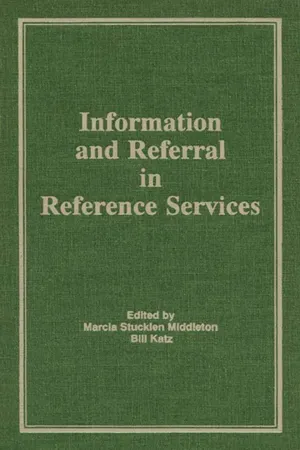
Information and Referral in Reference Services
About this book
This book investigates a wide variety of situations and models which fall under the umbrella of information and referral. It examines traditional views in public libraries and library systems as well as descriptions of programs in nontraditional settings, such as academic libraries. A human services perspective is explored and research models are presented.
Trusted by 375,005 students
Access to over 1.5 million titles for a fair monthly price.
Study more efficiently using our study tools.
Information
Topic
EducationSubtopic
Education GeneralRESEARCH AND RESOURCES
Videocassettes and I & R: A Team that Works
SUMMARY. As urban communities have expanded and changed over the years, so too have the services of public libraries evolved to reflect the needs of their constituencies. The last fifteen years have given rise to library-based community information and referral (I & R) services whose purpose is to direct the patron to resources and/or organizations which might help answer his/her questions or solve his/her problems. Well-developed listening skills are essential for the delivery of I & R service, and providers might benefit from viewing various videocassettes concerned with this subject. For library I & R providers, these videos are often available in the film department where they work.
Like many other urban institutions, the public library has found it necessary to expand beyond its traditional boundaries in order to appeal to its changing constituency. Once solely a purveyor of books, it has become much more, and now it often dispenses, among other things, toys, tools and videocassettes. It also frequently provides information and referral (I & R) services tailored to the particular social needs and problems of the community where it is located, supplying immediate answers to inquiries, or, in the absence of sufficient data to do so, directing the patron to resources and/or organizations which might help him/her.
A library-based community I & R service is, in fact, a logical extension of that institution’s established role as a repository of organized knowledge and information; the only real difference is that it represents a direct response to the population it serves. In addition, the library is usually perceived as a nonthreatening, nonjudge-mental entity, and this often makes the quest for assistance more comfortable for the patron.
Aside from a well-organized file of helping institutions and resources, the other vital component of I & R service is the provider–and the librarian whose experience includes dealing with the public can easily assume this role. Both reference assistance and I & R work are built on a solid foundation of listening skills, communication and subsequent problem-solving; the inquiry in the first situation may be simpler (“I need information on Amelia Earhart”) and less intense than in the second (“Where can I get food stamps and a place to stay?”), but the same result is being sought: a clear answer.
And, as was mentioned previously, that answer is dependent on the librarian’s listening skills and ability to communicate with the patron. Expertise in this area is an integral part of professional training, whether the librarian is conducting a reference interview or providing information and referral. In the latter case, it is particularly vital, since the questions often directly relate to the patron’s quality of life; such inquiries are frequently of a sensitive, personal nature, and the librarian working in this arena must constantly fine-tune his/her listening and communication techniques beyond those required of the basic reference interview.
This process can be accomplished in several ways. On-the-job training is most important, followed by reading articles about the delivery and philosophy of information and referral.1 A third option which can supplement the other two is viewing videocassettes dealing with listening and communication skills – and librarians providing I & R can frequently find these in the film department of their workplace.
Although there are a limited number of videocassettes which deal specifically with the provision of information and referral, the list which follows does not include these. Rather, it is a selective compilation of material stressing the importance of listening and communication in various settings, both professional and personal. Some emphasize the aspect of customer service and dealing with people, while others are more generally focused. Any of them, however, could be used to augment the other components of I & R training.
Primary research for the subsequent list was conducted using The Video Source Book (7th edition, 1985. Published by National Video Clearinghouse, Inc.), as well as current film company catalogs. Each entry includes a short annotation which is descriptive, not critical in nature, plus pertinent production information (although there were instances where some of this data, such as date of release and the producer’s name was not available.) In addition, the addresses of the distributors appear at the end of the article should an individual wish to contact any of them directly.
* * *
Body Business. 1984, 60 minutes, color. Produced and distributed by Salenger Films/Video.
Lecture/seminar by Dr. Ken Cooper stressing the importance of body language in all areas of life, both personal and professional. Shows simple methods to heighten one’s awareness of his/her body language and that of others, as well as ways to eliminate one’s own bad nonverbal habits.
Case Studies in Communication. N.D., 18 minutes, color. Produced and distributed by Salenger Films/Videos.
Two dramatizations are utilized to illustrate the major barriers to effective communication: the way we see ourselves, and the way we see others. Shows ways in which distorted perceptions of people and situations can result in communication breakdown. Helps viewer become more aware of the need for both feedback, plus his/ her own active listening, in order to deal with the situation effectively.
Communicating Non-Defensively. 1983, 25 minutes, color. Produced and distributed by CRM/McGraw-Hill.
Explores the attitudes and behavior necessary for the development of non-defensive communication. Explains how non-threatening communication skills are an asset to any situation or organization. Also presents a step-by-step plan for dealing with defensive communication, as well as pointing out circumstances under which it can occur.
Communication By Voice and Action. 1979, 14 minutes, color. Produced by Centron Films. Distributed by Coronet Films and Video.
Uses vignettes to illustrate that the nonverbal part of communication is as significant as the verbal portion –or more so.
Communication: The Nonverbal Agenda. 1975, 30 minutes, color. Produced and distributed by CRM/McGraw-Hill.
Shows how nonverbal behavior – posture, gestures, eye contact can contradict any verbal message. Demonstrates that constructively combining both verbal and nonverbal communication can produce better results.
Communications Or Confrontations. 1975, 18 minutes, color. Produced by Sandler Institutional Films, Inc. Distributed by Barr Films.
Utilizes three vignettes to demonstrate that an individual’s point of view can interfere with meaningful communication. Covers three different areas – school, home and business – and shows how different approaches can affect interpersonal encounters.
Conflicts, Conflicts! N.D. 19 minutes, color. Produced by Callner Film Productions. Distributed by Barr Films.
Five segments dramatize conflict in the making or in full swing; a Judge intervenes and makes suggestions as to the prevention or resolution of these incidents, citing some of the skills necessary for this process: willingness to compromise; criticism of the behavior, not the person; careful listening; being open and non-defensive.
Dealing With Angry Customers. 1982, 17 minutes, color. Produced and distributed by Salenger Films/Video.
Uses three vignettes to demonstrate how to effectively handle angry customers: deal with the person, then deal with the problem. Illustrates the importance of empathy and summarizing the situation to be sure that it’s understood correctly, then finding out what the customer wants done, and finally, reaching potential solutions. Intended for salespeople, but useful for anyone who deals with the public on a regular basis.
Dealing With People. 1979, 13 minutes, color. Produced and distributed by Salenger Film/Video.
Explores the issue of effective customer service as it relates to a business situation by illustrating some basic interpersonal skills. Stresses that effective service succeeds only when the customer perceives it that way.
A Gift From Mrs. Timm. 1982, 16 minutes, color. Produced and distributed by Dartnell.
Training film which explores the issue of customer relations in any situation. Dramatizes the plight of an elderly lady who is rudely treated by several employees while she is visiting a hospital. Designed for anyone who meets and works with the public, it attempts to increase that individual’s awareness and understanding of others and their problems.
Listen, You’ll See. N.D., 6 minutes, color. Produced by National Film Board of Canada. Distributed by Salenger Films/Video.
Animated segments illustrate the variations in the communication process and the many factors influencing it. Points out that how something is said is frequently more important than what is said. Heightens the viewer’s awareness of the communication process between him/herself and anyone else – customer, client or friend.
Listening Makes a Difference. 1979, 7 minutes, color. Produced and distributed by Salenger Films/Video.
Focuses on the significance of careful listening in all areas of life: home, school and business. Uses retail sales situations to demonstrate the importance of active listening. Shows that careful listening, together with appropriate questions, can clarify the wants and needs of the customer/client.
Listening- The Problem Solver. 1984, 20 minutes, color. Produced by Callner Film Productions and Veriation Films. Distributed by Barr Films.
Teaches that problems in all areas – business, school, and home – can be resolved through the use of good listening skills. Focuses on three distinct areas of listening: critical listening to separate fact from opinion and propaganda; creative listening to integrate your ideas with those of the other individual in order to formulate solutions to problems; sympathetic listening which allows the other person to talk out his/her problem in a nonjudgemental atmosphere.
Non-verbal Communication. N.D. 16 minutes, color. Produced and distributed by Salenger Films/Video.
Attempts to increase the awareness an individual has regarding the non-verbal messages he/she sends, as well as the ones sent by others. Stresses that what is said is frequently as important as what remains unspoken, and that non-verbal messages often reveal feelings and attitudes before a single word is uttered. Useful for persons in both professional and personal dealings with people.
Open the Door: A System for Better Communication. N.D. 28 minutes, color. Produced and distributed by Cally Curtis Company.
Dramatizes situations from both business and home to show how communication difficulties can be halted before they start. Viewers learn how to eliminate misundersta...
Table of contents
- Cover
- Half Title
- Title Page
- Copyright Page
- Table of Contents
- About the Editors
- Introduction
- Public Libraries and I & R: Management, Staff Training, and Evaluation
- Library System I & R Services
- Academic Libraries: The Role of I & R
- The Social Services Perspective: Networking
- Research and Resources
- History and Recent Developments
Frequently asked questions
Yes, you can cancel anytime from the Subscription tab in your account settings on the Perlego website. Your subscription will stay active until the end of your current billing period. Learn how to cancel your subscription
No, books cannot be downloaded as external files, such as PDFs, for use outside of Perlego. However, you can download books within the Perlego app for offline reading on mobile or tablet. Learn how to download books offline
Perlego offers two plans: Essential and Complete
- Essential is ideal for learners and professionals who enjoy exploring a wide range of subjects. Access the Essential Library with 800,000+ trusted titles and best-sellers across business, personal growth, and the humanities. Includes unlimited reading time and Standard Read Aloud voice.
- Complete: Perfect for advanced learners and researchers needing full, unrestricted access. Unlock 1.5M+ books across hundreds of subjects, including academic and specialized titles. The Complete Plan also includes advanced features like Premium Read Aloud and Research Assistant.
We are an online textbook subscription service, where you can get access to an entire online library for less than the price of a single book per month. With over 1.5 million books across 990+ topics, we’ve got you covered! Learn about our mission
Look out for the read-aloud symbol on your next book to see if you can listen to it. The read-aloud tool reads text aloud for you, highlighting the text as it is being read. You can pause it, speed it up and slow it down. Learn more about Read Aloud
Yes! You can use the Perlego app on both iOS and Android devices to read anytime, anywhere — even offline. Perfect for commutes or when you’re on the go.
Please note we cannot support devices running on iOS 13 and Android 7 or earlier. Learn more about using the app
Please note we cannot support devices running on iOS 13 and Android 7 or earlier. Learn more about using the app
Yes, you can access Information and Referral in Reference Services by Marcia Stucklen Middleton,Bill Katz in PDF and/or ePUB format, as well as other popular books in Education & Education General. We have over 1.5 million books available in our catalogue for you to explore.