Although everyone has goals, only some people successfully attain their respective goals on a regular basis. With this in mind, the author attempts to answer the question of why some people are more successful than others. He begins with the assumption that the key to personal success is effective decision-making, and then utilizes his own theory--The Self-Regulation Model--to explain the origin and nature of individual differences in decision-making competence. The author also summarizes a number of existing models of decision-making and risk-taking.
This book has two primary goals:
* to provide a comprehensive review of the developmental literature on the decision-making skills of children, adolescents, and adults, and
* to propose a theoretical model of decision-making skill that offers a better description of this skill than prior accounts.
Taken together, the literature review and theoretical model help the reader acquire a clear sense of the development of decision-making skills as well as reasons for the developmental differences that seem to emerge.
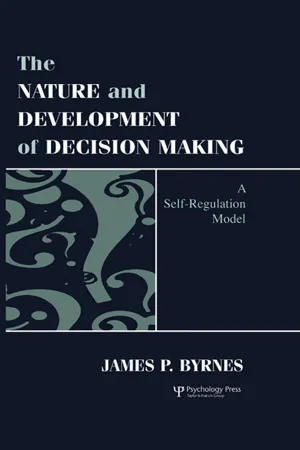
- 230 pages
- English
- ePUB (mobile friendly)
- Available on iOS & Android
eBook - ePub
About this book
Information
Publisher
Psychology PressYear
2013Print ISBN
9781138002623
9780805822878
Edition
1eBook ISBN
9781135809119
1
Introduction and Overview
Developmental psychologists have a particular interest in studying what might be called functional processes. Functional process means any process that directly affects the degree to which children adapt to their environment. The litmus test for discerning whether a process is functional is as follows: If successful adaptation covaries with certain manifestations of this process but not others (e.g., social competence covaries with secure attachment but not insecure attachment; academic achievement covaries with high intelligence but not low intelligence), then the process is judged to be functional. Those processes that are judged to be functional are often judged to be significant or important topics for study because it is assumed that knowing more about the process leads to knowing how to enhance the process, which in turn leads to programs designed to help children adapt more successfully to the world of adults.
I submit that decision making is a functional and, therefore, highly significant process that should be given a great deal of scientific attention. Whereas personal success systematically covaries with effective decision making, failure systematically covaries with ineffective decision making. It is my view that developmentalists should pay as much attention to decision making as they have paid to constructs such as attachment or intelligence. If we want children and adolescents to be successful, it stands to reason that we should want to help them become effective decision makers.
Knowing how to improve decision making, however, requires that we first have a very clear idea of what decision making is and how it develops. Although much has been learned about individual aspects of decision making in adults (see Abelson & Levi, 1985; Baron, 1994; Slovic, Lichenstein, & Fischhoff, 1988, for extensive reviews), to my knowledge no one has developed a model that effectively combines all of these aspects into a coherent, comprehensive account of decision making. Thus, it cannot be said that we have a very clear idea of what decision making is. A developmentalist who is presented with the laundry list of the individual components of decision making would be similar to a car mechanic who is presented a list of all of the parts of an automobile engine and told to make the car run better. My view is that intervention can only proceed when we know how all of the parts fit together and function. In addition, whereas hundreds of studies have been conducted with adults, there are extremely few developmental studies of decision making (Furby & Beyth-Marom, 1992). Thus, it cannot be said that we know how decision making develops either.
In this book I present a comprehensive and integrative model of decision making in order to provide much needed coherence to the field of decision making and to facilitate the conduct of developmental research. I have found it extremely difficult to conduct my own research in decision making because of the unintegrated quality of existing research. When I began my research in this area, I wanted simply to find an existing model and use it to study developmental differences. To my surprise, I discovered that there are at least 20 models of decision making that have been proposed by cognitive and social psychologists (see Abelson & Levi, 1985; or Slovic et al., 1988, for a sampling) and many others proposed by other scholars. I was handicapped by this overwhelming supply of models and issues and assumed that anyone else would be similarly hampered. I am currently using the model presented here to conduct my own research, and it is my hope that the readers of this book will find the model to be heuristic as well.
The general plan of the book is as follows. Before describing the model that I am proposing, I first comment on prior models and their shortcomings. If my model is not better than prior models, I have not really accomplished anything. Moreover, the reader who is looking for a model would have no reason to choose my model over the many other models. In the next section of this chapter, I propose some criteria for evaluating models. In chapter 2, I describe a representative sample of prior models and use this chapter’s evaluative criteria to show the shortcomings of these models. In chapter 3, I present a bare-bones description of my model in order to allow the reader to have a sense of it as whole. In chapters 4 through 7, I put flesh on the bare-bones account by elaborating on four major components of the overall model. I review both the adult and developmental literatures within these four chapters to indicate what we already know about these aspects of decision making. In chapter 8, I describe the nature and development of a process that is closely aligned with decision making: risk taking. In chapter 9, I describe and evaluate programs that have attempted to improve decision making in children or adolescents. Most of these programs have had limited success, and I comment on why this is the case. In chapter 10, I draw conclusions.
CRITERIA FOR EVALUATING MODELS OF DECISION MAKING
The statistical construct of explained variance can be helpful for thinking about what makes one model better than another. Imagine a situation in which there are 30 students who could choose either of two options presented to them (Option 1 or Option 2). If 18 students choose Option 1 (e.g., dropping out of school) and 12 choose Option 2 (e.g., staying in school), the best model would be one that could not only explain this variance in choices but could also demonstrate a 100% hit rate (i.e., all of the people who were predicted to choose Option 1 did choose Option 1, and all of those predicted to choose Option 2 did choose Option 2). At the other extreme would be the weakest model that has a 0% hit rate as well as no explanation for the low hit rate. In the middle would be models that have hit rates ranging between 0% and 99%, as well as explanations ranging from partial to sufficiently complete. In my view, any given model falls somewhere along this continuum. One model is better than another if it has a better hit rate and provides a more complete explanation than the other. In other words, the better model is a closer approximation to the best (completely correct) model.
Both the explained variance and continuum metaphors are based on the same assumption that having more of the right explanatory variables in one’s regression equation is better than having fewer variables or having many incorrect factors in this equation. To illustrate, it is useful to return to the auto metaphor. No one would disagree with the claim that a person who includes all of the components of a car engine in his or her theory of an engine would be more successful at predicting the behavior of the engine than would a person who includes fewer components or includes parts that are not there. Hence, the completeness/accuracy of an explanation goes hand in hand with predictive success. If you have the right theory, you: include the right variables in your regression equation, explain 100% of the variance in choices, and predict everyone’s choices without error. Of course, it is possible to have some predictive success when one develops a model that contains nothing but spurious correlations. But prolonged, consistent, predictive success requires deep insight into the real components of decision making.
An additional reason why we should require both predictive and explanatory success is that explanations specify variables that causally produce the choices people make. If we know which causal factors are responsible for choices, we can figure out how to alter the causal chain of events in order to produce the outcomes that we want. For example, if we find that peoples’ values are the key factors that discriminate between those who drop out of school and those who stay in school, we can attempt to alter values in order to increase the number of students who choose to stay in school. Of course, a single factor such as values is unlikely to be the sole contributor to the differences between dropouts and stay-ins, and programs that focus just on values are unlikely to reduce the dropout problem, because such unidimensional programs fail to address other equally important factors. I return to this point in chapter 9.
In summary, then, the first two criteria that can be used to evaluate models are explanatory adequacy (or completeness) and predictive adequacy (or hit rate). The third criteria is range or the number of decisions for which the model provides predictions. As I describe more fully in the next chapter, each of the 20 or so existing models were originally designed to predict certain types of choices. For example, some models were designed to predict such things as gambling choices, and other models were designed to predict such things as the choices of faculty who are viewing a stack of applications to graduate school. It is the case that models that can predict gambling choices cannot predict the decisions of the admissions committees (and vice versa). Thus, existing models can only predict some of the choices people make. The most adequate model would be able to predict any type of decision. As becomes clear in chapter 2, the notions of range and completeness are intimately connected. In particular, more complete models have a wider range.
In the next chapter, I use the criteria of explanatory adequacy, predictive adequacy, and range to evaluate the existing models of decision making. In chapters 3 and 10, I use them to evaluate my self-regulation model. For now, it is useful to examine some examples of decisions in order to lay the groundwork for later chapters.
EXAMPLES OF DECISIONS
In order to get an initial sense of decision making, it is helpful to take a simple decision and progressively elaborate it to show all of the factors that could come into play. Imagine the situation in which someone is standing in front of a refrigerator looking for something to eat. The first component of decision making that appears in this example is the idea of multiple choices or options. For example, the person might consider eating some leftover chicken (Option 1), a piece of cake (Option 2), a salad (Option 3), or nothing at all (Option 4). Assume that the person selects the piece of cake. Any adequate model of decision making has to explain why that person chose the cake and not the other options. In order to explain this choice, a theorist has to posit some hypothetical factors that may be extrinsic or intrinsic to the individual. For example, a behaviorist might argue that the cake is a reinforcing stimulus that has gained control over the reaching behavior of the person (the notions of reinforcing stimulus, gained control, and reaching behavior are all theoretical constructs). In contrast, a cognitivist might appeal to notions such as is preferences and causal beliefs. More specifically, the cognitivist might argue that decision makers develop attitudes toward objects that array themselves along a mental preference continuum. This internal preference continuum guides or constrains behavior such that objects with higher preference ratings will be selected over objects with lower ratings (when both are available). In addition, the theorist might also posit causal beliefs regarding the actions that allow a person to obtain desired objects. In examples such as the refrigerator, such causal beliefs are often overlooked by theorists, because they are subtle and invariant across decision makers. Nearly everyone who opens the refrigerator will reach for desired objects themselves (Action 1) rather than call someone else to get it (Action 2) or take out the objects with a shovel (Action 3). As is such, theorists tend to focus on factors that would explain differences among decision makers (preferences) instead of including invariant aspects of performance (causal beliefs) in their explanations of choices in these situations. However, in other situations (e.g., solving higher level math problems; choosing among fiscal policies to end a recession), both causal beliefs and preferences are needed to explain choices.
Of course, it is possible to add a variety of other factors to explain choices even in simple examples such as the refrigerator. For example, a theorist may well wonder why the decision maker is standing in front of the refrigerator instead of doing something else (e.g., working, watching TV). To explain this choice, the theorist might appeal to such things as cues (e.g., a hunger pang) and goals (e.g., “Do something to satisfy my hunger”). Again, however, we see the need to posit causal beliefs because causal beliefs create linkages between goals, actions, and desired outcomes (see chap. 4). That is, the person believes that going to the refrigerator (Action 1) is a causally effective way to eliminate feelings of hunger. Watching TV (Action 2) would be an example of an ineffective way.
Next, we might consider the person’s emotional states while standing in front of the refrigerator and after eating the cake. If someone is on a diet or knows that other people in the house have not had any cake, that person might feel guilty before and after he or she eats the cake. This person might also feel fear if he or she is afraid of getting caught cheating on the diet. Such emotions are produced because of moral beliefs held by the decision-maker (“It is wrong to be selfish”). In addition, we could also introduce preferences again by noting that our protagonist might judge the outcome of looking slim to be more desirable than the outcome of looking overweight. Finally, we can add that although it is likely that the cake will satisfy the person’s hunger, it is possible that it may not. The fact that the choice may not turn out as planned introduces an element of uncertainty into the process. A theorist could use the construct of uncertainty (and expectations) to explain why the person took a long amount of time to decide what to eat. Individuals who are more certain would presumably decide quickly.
The refrigerator example shows that the attribution of mental constructs to decision makers (e.g., cues, goals, preferences, causal beliefs, moral beliefs, emotions, expectations, and uncertainty) is all a matter of a theorist’s perspective. Whereas some theorists try to introduce as many constructs as possible, others attempt to be as parsimonious as possible. The latter may bracket a variety of factors in the same way that physicists ignore factors such as friction in their theoretical models. Moreover, some theorists focus on a particular situation (e.g., standing in front of the refrigerator) and ignore what happened before this situation (e.g., feeling hunger pangs while working) and what will happen later (e.g., feeling satisfied but guilty). In contrast, others place behaviors in a broader theoretical context. In the next chapter, we see examples of how theorists differ in such respects.
For now, I can simply point out that there are a wide variety of decisions that people make on a daily basis. For example, they make decisions about when to get up, what to wear, what to eat for breakfast, how to get to work, what projects to focus on at work, and so on. Generally speaking, a theory of decision making pertains to those situations in which there are at least two options, and there is some form of deliberation. When only one option exists (e.g., eat nothing when the refrigerator is empty) or when a person is operating through a familiar routine and not thinking about multiple options (e.g., deciding which tooth to clean first when brushing one’s teeth), it seems that behavior can be explained without appealing to most of the aforementioned constructs (although presumably one must always appeal to factors such as cues, goals, and actions). When viewed in this light, we can see that a great many behaviors studied by developmentalists fall into the category of decision-related behaviors. For example, the classic “A-not-B” task of Piaget (1952) involves decision making as does a variety of other familiar tasks (e.g., sorting, math problem solving, conflict resolution among peers, moral dilemmas, and so on). In an important sense, a theory of decision making can link all of these disparate research topics together in a coherent story. I return to this point in the final chapter.
2
Existing Models of Decision Making
In this chapter, I describe and evaluate several existing models of decision making. I focus on a small set of existing models instead of describing all prior models for two reasons: First, it is not possible to fully describe more than 20 models in a single chapter, and second, my arguments about the limitations of the selected models apply to all of the nonselected models. Hence, even if it were possible to discuss all models, I would be rather redundant in my argumentation. Because I had to limit my selection in some way, I chose to discuss the most influential of existing models. By influential, I mean that researchers tested the predictions of the model within a number of empirical studies.
Before describing these models and pointing out their limitations, it is necessary to make some initial points about two constructs that help in the comparison of models: contexts and temporal perspective.
CONTEXTS AND TEMPORAL PERSPECTIVE
Decision makers make choices within contexts. A context can be defined as a situation involving actors performing goal-directed actions at a specific time and place (Barwise, 1989; Laboratory of Comparative Human Cognition, 1983; Lerner & Kaufman, 1985). A person’s lifetime (or even a single day) can be viewed as a succession of contexts (e.g., a home context followed by a math class context followed by a social studies class context, etc.). Cultures define who may take part in certain contexts (e.g., students and teachers as opposed to other actors), what these people are supposed to do in this context (e.g., teach, study), where the activities can take place (at school vs. some other place), and when these activities can, or typically do, take place (at night vs. during the day). These cultural definitions in turn determine when one context has turned into another. For example, if we replace the actors mom and dad with teacher and fellow students, and take children from their homes and put them in a school building, the home context probably has changed into the school context.
When focusing on the decisions of someone, a theorist can either center on a single context viewed in isolation (ignoring what happened in prior contexts and what will happen in futu...
Table of contents
- Cover
- Halftitle
- Title
- Copyright
- Dedication
- Contents
- Preface
- 1 Introduction and Overview
- 2 Existing Models of Decision Making
- 3 A Condensed Description of the Self-Regulation Model
- 4 The Generation Phase of Decision Making
- 5 Components of the Evaluation Phase
- 6 Moderating Factors
- 7 The Learning Phase
- 8 Risk Taking
- 9 Improving Decision Making Through Training
- 10 Conclusion
- References
- Author Index
- Subject Index
Trusted by 375,005 students
Access to over 1.5 million titles for a fair monthly price.
Study more efficiently using our study tools.
Frequently asked questions
Yes, you can cancel anytime from the Subscription tab in your account settings on the Perlego website. Your subscription will stay active until the end of your current billing period. Learn how to cancel your subscription
No, books cannot be downloaded as external files, such as PDFs, for use outside of Perlego. However, you can download books within the Perlego app for offline reading on mobile or tablet. Learn how to download books offline
Perlego offers two plans: Essential and Complete
- Essential is ideal for learners and professionals who enjoy exploring a wide range of subjects. Access the Essential Library with 800,000+ trusted titles and best-sellers across business, personal growth, and the humanities. Includes unlimited reading time and Standard Read Aloud voice.
- Complete: Perfect for advanced learners and researchers needing full, unrestricted access. Unlock 1.5M+ books across hundreds of subjects, including academic and specialized titles. The Complete Plan also includes advanced features like Premium Read Aloud and Research Assistant.
We are an online textbook subscription service, where you can get access to an entire online library for less than the price of a single book per month. With over 1.5 million books across 990+ topics, we’ve got you covered! Learn about our mission
Look out for the read-aloud symbol on your next book to see if you can listen to it. The read-aloud tool reads text aloud for you, highlighting the text as it is being read. You can pause it, speed it up and slow it down. Learn more about Read Aloud
Yes! You can use the Perlego app on both iOS and Android devices to read anytime, anywhere — even offline. Perfect for commutes or when you’re on the go.
Please note we cannot support devices running on iOS 13 and Android 7 or earlier. Learn more about using the app
Please note we cannot support devices running on iOS 13 and Android 7 or earlier. Learn more about using the app
Yes, you can access The Nature and Development of Decision-making by James P. Byrnes in PDF and/or ePUB format, as well as other popular books in Psychology & Developmental Psychology. We have over 1.5 million books available in our catalogue for you to explore.