Julian's brief reign (360-363 AD) had a profound impact on his contemporaries, as he worked fervently for a pagan restoration in the Roman Empire, which was rapidly becoming Christian.
Julian's Gods focuses on the cultural mentality of `the last pagan Emperor' by examining a wide variety of his own writings. The surviving speeches and treatises, satires and letters offer a rare insight into the personal attitudes and motivations of a remarkable Emperor. They show Julian as a highly educated man, an avid student of Greek philosophy, and a talented author in his own right.
This elegant and closely-argued study will deepen understanding not only of Julian, but of the context of fourth century Neoplatonism.
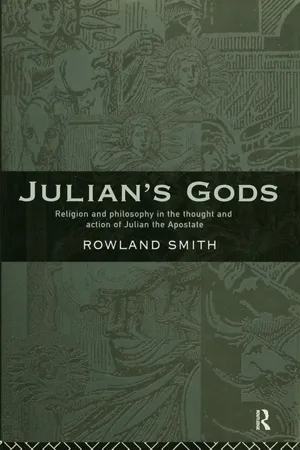
eBook - ePub
Julian's Gods
Religion and Philosophy in the Thought and Action of Julian the Apostate
- 320 pages
- English
- ePUB (mobile friendly)
- Available on iOS & Android
eBook - ePub
Julian's Gods
Religion and Philosophy in the Thought and Action of Julian the Apostate
About this book
Trusted by 375,005 students
Access to over 1.5 million titles for a fair monthly price.
Study more efficiently using our study tools.
Information
1
Introduction
The Emperor and the Writer
The Life and Reign of Emperor Julian1
Flavius Claudius Julianus, later the Emperor Julian, was born at Constantinople late in the reign of Constantine the Great, probably in AD 331. On his father’s side, the family had already produced Emperors. Julian’s grandfather, Constantius Chlorus, had risen from obscure origins in the Balkans to end his days as an Augustus in the Tetrarchy, to be succeeded by the son of his first marriage, Constantine. By a later marriage there had been other sons, half-brothers to Constantine, among them Julius Constantius, the father of Julian. Julian was thus a nephew of Rome’s first Christian Emperor, born into an emergent Christian dynasty about twenty years after his uncle’s momentous conversion of 312, and in a city that had been inaugurated the year before his birth as a Christian capital for the Empire.2
In his plans for the dynastic succession, Constantine in his last years envisaged a role for the offspring of his surviving half-brothers as well as for his own three surviving sons. He looks to have wished to resolve earlier tensions between these two sides of the family, and to establish a pattern of rule by a college of joint Emperors similar to the Tetrarchic arrangement which Diocletian had favoured in the late third century. But the rivalries within the house re-surfaced with drastic results after the death of Constantine in May 337: in September of that year, Julian’s father and seven other male members of his family were murdered in what amounted to a coup. One of Constantine’s sons, Constantius II, was very likely the instigator; certainly, Julian himself always held his cousin responsible, and the murders worked to Constantius’ advantage. The sons of Constantine now ruled alone, and Constantius was allotted the eastern portion of the Empire as his own.3
As a child of six, Julian himself was spared along with an 11-year-old half-brother, Gallus – perhaps through the influence of Bishop Eusebius of Nicomedia, a relative of Julian’s mother Basilina. Basilina had died in his infancy, and her family now took charge of the orphan. It was in their household at Nicomedia that Julian encountered Mardonius, a Scythian eunuch in the family’s service whom he was later to remember fondly as a formative influence in his childhood: Mardonius had once been Basilina’s tutor, and now inspired in Julian an early and lasting love of the Greek poets. Julian’s overall education, however, had been entrusted to Bishop Eusebius of Nicomedia, and when Eusebius was translated to the see of Constantinople around 339, Julian seems to have moved back there too. Mardonius may have accompanied him, but within a few years there was another, more disruptive, move. Constantius came to worry over the presence at Constantinople of a child of Julius Constantius, and decided that he had better be removed far away from the capital: in 342, Julian and Gallus were dispatched to Macellum, a secluded imperial estate in central Turkey, where they lived as virtual exiles for the next six years.
In his later writings, Julian looked back bitterly on this interlude as a time of mental suffering during which he lacked all intimate social contacts and endured oppressive surveillance by the spies of Constantius; he believed that it was only the passion for study previously instilled in him by Mardonius that had preserved his sanity at Macellum.4 Books and tutors, at least, were provided for him there by an Arian cleric, George of Cappadocia, and he impressed his Christian instructors as a highly gifted and pious student. In private, though, his reading of the Greek classics was apparently already kindling an adolescent interest in the pagan gods. But throughout this period, a more basic issue must have continued to prey on Julian’s mind: the possibility could never be discounted that Constantius would have him put to death.
In the event, Constantius evidently thought it safe by 348 to allow Julian and Gallus to return to the capital,5 and Julian spent the following three years in rhetorical studies there and at Nicomedia, where he apparently followed through an intermediary lectures given by the pagan rhetor Libanius, in later years an acquaintance of Julian’s and a fervent singer of his praises. In 351, his prospects improved further. By then, Constantius was the only surviving son of Constantine, and he looked to his cousins to strengthen the dynasty: Gallus was appointed Caesar (junior colleague to the ruling Augustus) and dispatched to the East, and Julian was allowed freedom of travel to complete his education with philosophic studies at Pergamum and Ephesus. The decision had important consequences. Julian quickly became familiar with a circle of pagan Neoplatonists headed by a former student of the ‘godlike’ Iamblichus, and underwent a theurgic initiation at the hands of one of them, Maximus of Ephesus. Though he kept the matter secret for a decade, he came to regard 351 as the year of his ‘conversion’ to paganism and his awakening to Iamblichan Neoplatonism and theurgy: these commitments were never to waver, and from then on he revered Maximus as an intimate friend and mentor.
Julian continued to study for several years in Asia Minor until his leisure was dramatically interrupted late in 354, when Constantius had Gallus executed on suspicion of treason. Several of Gallus’ friends were arrested and tried as conspirators, and Julian was summoned to the imperial court at Milan. It was a summons that gave good cause for worry, but Julian found an influential supporter in the Empress Eusebia and was finally cleared of complicity in the business. In the summer of 355 he was allowed to resume his studies, this time at Athens. It proved a short stay, and the end of student days. Late that year, he was recalled to Milan; there, on 6 November, Constantius appointed him Caesar and gave him his sister Helena in marriage.6
Constantius’ appointment of his cousin as a junior colleague arose from political and military necessity; an attempted usurpation in the West that year had only recently been seen off, and an imperial figurehead from the dynasty was now badly needed there. In December 355 Julian was sent to Gaul with instructions to counter barbarian incursions from across the Rhine. He quickly proved his worth as a talented and adventurous general with a series of successful campaigning seasons against the Franks and Alamanni between 356 and 359, and won a major victory near Strasbourg in 357. The earliest extant writings of Julian belong to the same period: besides letters, they include three panegyrics, two honouring Constantius, the third the Empress Eusebia. These were speeches written to be delivered at the court, and in them Julian was careful to profess his total loyalty to Constantius; in private, though, he was nursing a deep hatred and resentment of the man he held responsible for the destruction of his family. For his part, Constantius in the late 350s was becoming increasingly suspicious of Julian’s ambitions, perhaps not without cause. In any event, developments in the East in 359 gave him reason or pretext to order Julian to give up a large portion of his army for service in Rome’s long-running war against Shapur II of Persia. When the order reached Julian in his winter quarters at Paris early in 360, it precipitated a clear break between the two Emperors: Julian’s troops mutinied and acclaimed him Augustus. According to Julian, the acclamation was a spontaneous and unexpected gesture to which he acceded extremely reluctantly, but the signs are that he had tacitly encouraged it, and he made no offer to disown the title in the negotiations with Constantius that followed.7 Constantius from now on viewed him as a usurper and by 361 was preparing to move against him. Julian responded by marching his army eastwards into Italy and the Balkans, and late in the year sought to justify his move in public letters in which he denounced Constantius for crimes against his family, and disclosed his own paganism. In the event, his preparations were needless: Constantius fortuitously fell ill and died in November 361, and by mid-December Julian had entered Constantinople unopposed as sole Emperor.
Julian immediately looked to strengthen his political base. Some old enemies who had formerly been prominent advisers and administrative officials of Constantius were quickly tried and condemned. Others from the old regime, especially some of the military men, were judged acceptable and useful and were won over to Julian’s service, and pagan friends and supporters, among them Maximus of Ephesus, were invited to join him at the imperial court.8 At the same time, a structural reform of the court was begun: its complex hierarchy and elaborate ceremonial procedures were simplified, and the number of palace officials and staff greatly reduced. The motive was partly economic, but the changes also reflected the ethical outlook of a ruler of somewhat austere temperament: Julian wished to work for a change in imperial style as one aspect of reform across a broad front. Over the year and a half of his reign, he was to show remarkable energy in pursuit of strikingly ambitious public aims.
The significance of Julian’s paganism in this connection is not in doubt. One of his first acts as Augustus was to proclaim religious toleration throughout the Empire: pagan cult sacrifice, forbidden by a law of Constantius since 341, could now once again be legally performed.9 A less obvious purpose of the proclamation, but an intended one, was the exacerbation of existing tensions and schisms within the Church. Throughout the reign of Constantius, the Arian controversy had been the cause of constant disputes. Constantius’ own sympathies and his desire for a united Church had led him finally to give forceful support to the Arian cause:10 Julian’s measure allowed opponents of the Arians who had been denounced and exiled as schismatics or heretics to return to fight their corner once again. So too, the pagan activist measures of 362 which followed the proclamation of toleration were to be directed not just to the restoration of the temples and finances of pagan cults and the appointment of priests to administer them, but also to the removal of the financial subsidies and privileges that the Church had gained under Constantine.
From another perspective, these financial measures can also be viewed as part of a broader reform initiated early in the reign. In the cities of the Empire, a long-established pattern of autonomous local government had patently come under increased strain in the fourth century in the wake of Diocletian’s centralizing reform of imperial administration and Constantine’s founding of a new capital in the East.11 Political realities and fiscal necessities gave Julian very limited room for manœuvre in the matter, but he made efforts to reinvigorate the traditional pattern by selective remission of taxes and other measures aimed at the repair of the cities’ revenues, and by enlarging the numbers of men eligible for membership of their councils.12 Even here, though, his hope for a pagan restoration is likely to have impinged. Civic cult had been the heart of pagan worship; if the gods were to flourish, the cities must prosper.
Although Julian made no move to forbid Christian worship or to outlaw the clergy, his actions and utterances in the course of 362 made it plain that he aimed actively to undermine – given time, perhaps, to eliminate – the Church’s capacity to exert any significant social and cultural influence in the Empire. If he was to have any chance of achieving that, it was essential that the Christianization of the upper reaches of society be checked and reversed, and in June 362, shortly before Julian moved his court from Constantinople to Antioch, he issued a notorious edict clearly devised to help to marginalize the impact of Christian ideology at this social level in the longer term:13 Christian professors were now forbidden to teach classical literature and philosophy in the schools on the ground that by doing so they perverted the spirit and content of pagan texts; if they still wished to teach, Julian remarked, they should expound the Gospels in their churches.
The degree of attention Julian gave to the promotion of paganism cannot have failed to strike contemporaries, but his activities in another sphere were no less central to his public aims, and hardly less ambitious. Military success had been the basis of his early reputation, and its continuance was in the eyes of many subjects the fundamental test of his worth as Emperor: it is notable that in Ammianus’ account of the reign in the Res Gestae, far more emphasis is given to the story of Julian’s Persian expedition than to the measures for pagan restoration.14 As Augustus, Julian always intended to add to his previous successes in the West, and the war in the East against Shapur which he had inherited from Constantius offered him an obvious theatre. When he transferred his headquarters to the Syrian metropolis of Antioch in July 362, it was principally with that in mind: for the next eight months, the city was to be his base for the planning and preparation of the Persian campaign. As such, Antioch served its purpose, but from the writings of two well-disposed natives of the place – Libanius, by now returned to his home-city as its leading rhetor, and the historian Ammianus Marcellinus15 – it is all too plain that in other respects Julian’s stay there was not happy. The hedonism of Antioch was famous, and by this date its population was predominantly Christian: Julian’s personal reputation as an austere associate of Neoplatonists made an unfortunate impression, and his efforts to restore the city’s cults not only provoked a hostile response from its Christian majority, but apparently met with indifference among many Antiochene pagans too. It did not help matters that he arrived there at a time of local food shortages and economic difficulties, and that his concern to show proper regard for the autonomy of the city council rendered his interventions to alleviate the problem largely ineffective. As the months passed he was to become deeply unpopular in the city, and a target of popular ridicule.
The degree to which Julian’s problems with the Antiochenes were emblematic of a wider failure to win support for his projected pagan restoration is disputable, but he was certainly dismayed by their response, and in the later months of 362 his efforts to promote the restoration grew more insistent. Announcing that ‘Hellenism’ did not yet prosper as he wished, he overtly discriminated in favour of pagan individuals and communities in his appointments and judgements, and urged imperial officials to do the same. Letters were sent to newly appointed priests advising them on proper modes of priestly conduct and ritual practice; on one view, what Julian had in mind was a kind of centralized pagan church modelled in large part on Christian ecclesiastical structures. Further efforts were made too to repair prominent cult and oracular centres across the cities of the East, and to focus anti-Christian measures on sensitive points: the letters to priests, for instance, encouraged charitable expenditure at the temples as a means of countering the Church’s proven appeal in that particular. It is against this background that one of the reign’s most startling episodes – the order issued at Antioch that the Jewish Temple at Jerusalem, destroyed three centuries previously by Titus, should be rebuilt – is best appraised.16 Had that project ever...
Table of contents
- Cover
- Half Title
- Title Page
- Copyright
- Dedication
- Contents
- Abbreviations
- Preface
- 1. Introduction: The Emperor and the Writer
- 2. Julian’s Education and Philosophic Ideal
- 3. Philosophy in Practice: The Invectives Against Cynics
- 4. The Chaldaean Oracles and Neoplatonist Theurgy
- 5. The Mysteries I: Julian as Initiate
- 6. The Mysteries II: Doctrine in the Hymns and the Piety of Public Cult
- 7. The Apostate Against the Christians
- Envoi
- Notes
- Select bibliography
- Index
Frequently asked questions
Yes, you can cancel anytime from the Subscription tab in your account settings on the Perlego website. Your subscription will stay active until the end of your current billing period. Learn how to cancel your subscription
No, books cannot be downloaded as external files, such as PDFs, for use outside of Perlego. However, you can download books within the Perlego app for offline reading on mobile or tablet. Learn how to download books offline
Perlego offers two plans: Essential and Complete
- Essential is ideal for learners and professionals who enjoy exploring a wide range of subjects. Access the Essential Library with 800,000+ trusted titles and best-sellers across business, personal growth, and the humanities. Includes unlimited reading time and Standard Read Aloud voice.
- Complete: Perfect for advanced learners and researchers needing full, unrestricted access. Unlock 1.5M+ books across hundreds of subjects, including academic and specialized titles. The Complete Plan also includes advanced features like Premium Read Aloud and Research Assistant.
We are an online textbook subscription service, where you can get access to an entire online library for less than the price of a single book per month. With over 1.5 million books across 990+ topics, we’ve got you covered! Learn about our mission
Look out for the read-aloud symbol on your next book to see if you can listen to it. The read-aloud tool reads text aloud for you, highlighting the text as it is being read. You can pause it, speed it up and slow it down. Learn more about Read Aloud
Yes! You can use the Perlego app on both iOS and Android devices to read anytime, anywhere — even offline. Perfect for commutes or when you’re on the go.
Please note we cannot support devices running on iOS 13 and Android 7 or earlier. Learn more about using the app
Please note we cannot support devices running on iOS 13 and Android 7 or earlier. Learn more about using the app
Yes, you can access Julian's Gods by Rowland B. E. Smith in PDF and/or ePUB format, as well as other popular books in History & Ancient History. We have over 1.5 million books available in our catalogue for you to explore.