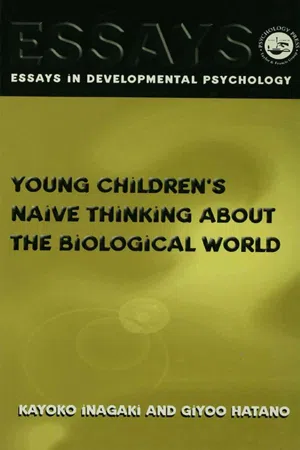
Presents research on the topic of young children's naive biology, examining such theoretical issues as processes, conditions and mechanisms in conceptual development using the development of biological understanding as the target case.
- 224 pages
- English
- ePUB (mobile friendly)
- Available on iOS & Android
eBook - ePub
Young Children's Thinking about Biological World
About this book
Information
Publisher
Psychology PressYear
2013Print ISBN
9781841690414
9781841690414
Edition
1eBook ISBN
9781134949977
1
C h a p t e r
Naive Biology as a Core Domain of Thought
Girl (6years, 0 month): [Interviewer: Hanako’s family has had a baby. Hanako wants to keep him the same size forever because he is small and cute. Can she do that?] “No, she can’t. If he eats, he will become bigger and bigger and be an adult.” [Suppose someone is given the bud of tulip that’s just coming out and wants to keep it in the same size forever. Can he do that?] “No, he can’t. Because if he doesn’t water it, it will wither, but if he waters it, it will become bigger and bigger.”
Boy (6 years, 10 months): [Interviewer: Who is more likely to catch a cold, a girl eating a lot or another girl eating little every day?] “The girl eating little, because she has little nutriment. You know there are germs in the air. They enter easily through the film at her throat (pointing to his own throat) if she has little nutriment.”
Girl (6years, 4 months): [Interviewer: What will happen to us when we eat nothing every day?] “We’ll die.” [Why?] “‘Cause we’ll have no nutriment.” [What does the nutriment do inside our body?] “It gives us power, though I don’t know much about that.”
These are excerpts obtained from our interview studies with young children before they had any formal schooling. How shall we interpret their remarks? Apparently we may claim the following: Either young children lack understanding of the world, or their reasoning skills are immature, because mapping the relationship between a human and food to that between a plant and water is not scientifically acceptable, and attributing the contagion process not to germs’ multiplication but to their physical invasion is clearly false. Even when they know difficult words such as germs and nutriment, their thought processes have severe limitations.
However, it is also possible to emphasize positive aspects of the thinking reflected in these remarks. Young children are intellectually active and inventive enough not only to make novel predictions but also to seek causal explanations for the predictions, at least for such topics as bodily phenomena. Their reasoning is plausible and firmly based on their acquired knowledge. They seem to understand, for instance, that eating is the key to growing as well as to being active and vigorous, assuming that humans take some “power” from food. They exploit their relatively rich knowledge about humans to make educated guesses about other entities, such as a tulip in the above example.
This issue of how much young children know about important aspects of the world is central to the contemporary research on conceptual development. Unlike Piagetians who focused on the structural aspect of thought and indicated that developing individuals’ competence depended on their stages, contemporary researchers pay attention to children’s representations or understandings of the world, that is, the content of thought. They also emphasize domain specificity instead of domain-general stages; now, it is almost taken for granted that children’s as well as adults’ knowledge is divided into domains, and that the acquisition and elaboration of the knowledge in each domain is supported by a variety of domain-specific constraints (factors and conditions that narrow down what are to be observed and considered). While preserving the Piagetian constructivist view, current views are at best skeptical about the Piagetian assumption that children’s thought is uniform across domains.
A growing number of conceptual development investigators have also come to agree that even young children possess “naive theories” or theorylike knowledge systems about selected aspects of the world (Wellman & Gelman, 1992, 1998). Because the term “naive theories” means coherent bodies of knowledge that involve causal explanatory devices, this conceptualization is also a distinct departure from the Piagetian position, which assumed young children to be preoperational and thus incapable of offering more or less plausible explanations in any domain. The emphasis on early competence (e.g., R. Gelman, 1979) is almost the slogan of contemporary researchers, but an important qualification here is “selected aspects of.” In other words, young children are assumed to possess naive theories only in a few selected domains, presumably those domains that have been critical for the survival of the human species.
Since the publication of the highly influential article by Wellman and Gelman (1992), consensus has built that (a) naive physics, (b) theory of mind or naive psychology, and (c) naive biology are core domains. These domains concern major kinds of understandings of the external world with which we interact and are typically represented by a grasp of, respectively, (a) the movement of solid objects, (b) goal-directed behaviors of humans, and (c) life-sustaining activities of the body of humans and other living entities. It is contemporary researchers’ hope that we can eventually build an integrated theory of conceptual development that replaces the Piagetian theory by closely studying each of these and several other core domains of thought and finding commonalities and differences among them.
In this monograph on young children’s naive biology, we examine such theoretical issues as the processes, conditions, and mechanisms for conceptual development using the development of biological understanding as the target case. Why do we choose naive biology instead of other domains, say, naive physics or psychology? Historically, children’s biological understanding has been central to major theories of children’s thinking. For example, Piaget (1929) asserted that young children were animistic and took this animistic tendency as a sign of immaturity, reflecting the fact that young children had not yet differentiated between animate and inanimate objects. However, this is not a major reason for our choice.

We give below several theoretical and practical reasons why the study of children’s biological thought will provide us with the perspective necessary to comprehend the growth of the mind and people’s attempt to understand the world. First, the targets of naive biology, that is, human bodily processes and nonhuman animals and plants, are topics of apparent concern and importance to young children themselves. The children’s remarks presented at the beginning of this chapter reveal that young children are fairly knowledgeable about these targets and willing to talk about them.
When toddlers begin to speak, they do so to request food and drink to satisfy physiological needs. Young children may talk with their parents about cuts and illnesses, especially when they have them. They may also be curious why a balanced diet is important or, more concretely for instance, why they have to eat some foods they do not like. In addition, even infants show an interest in the pets around them. Young children love to “read” picture books on nonhuman animals, watch TV programs about nature, and visit zoos. In short, naive biology is a cognitive product of young children’s interaction with a part of the world to which they spontaneously pay attention.
Second, naive biology reveals both natural schemes of the human mind and cross-cultural universalities on the one hand, and cultural influences and specificities on the other. Because humans are supposed to have domain-specific schemes of mind through which they “conceptually perceive” different aspects of the world differently (Atran, 1998), how people divide the world must be highly similar across cultures. People everywhere in the world classify entities into humans, other animals, plants, and nonliving things. At the same time, however, there are some significant and interpretable cross-cultural differences in how these categories are represented and explained. Thus, “folkbiology” (see, e.g., Medin & Atran, 1999) is central in studies on culture and cognition. Naive biology is acquired and revised in different ecological niches of faunas and floras and also in varied cultural niches (Super & Harkness, 1986). Compared with naive physics and cognitive aspects of naive psychology called a theory of mind, naive biological understanding can be expected to reveal larger cultural variations, though its core is universal.
Third, naive biology is probably the most revealing domain for the personification-based understanding of the world, an attempt to comprehend a novel entity by assuming it to be human-like. This may take the form of the person analogy or the projection of self into the target, which probably constitutes one of our most basic and useful fallback strategies for knowing.
As we will see a number of times in the following chapters, young children’s biological understanding is personifying (Carey, 1985; Inagaki & Hatano, 1987); they try to understand behaviors of other animals and plants by inductively projecting human properties and/or analogically attributing human processes based on structure mapping. Although professional biologists may claim that humans are an atypical animal, humans serve for both children and lay adults as the most familiar exemplar of biological entities against which other animals, and sometimes even plants, are compared. In contrast, naive physics is seldom human-centered; usually its prototypical entities are nonliving, solid objects. Naive psychology is seldom extended to nonhuman entities except for dogs, cats, and other pets.
Fourth, naive biology, especially naive systematics, provides us with an excellent domain to study human categorization and its resultant categories, as well as how such categories may be used in inferences. Human categorization is not solely dependent on perceptual similarities, nor on shared pragmatic values. People may be able to develop highly similar hierarchically organized structures even when they are exposed to different taxons, interact with these taxons in diverse ways, and are taught about them differently (Lopez, Atran, Coley, Medin, & Smith, 1997). At the same time, however, they may arrange species in terms of similarity to a few important exemplars (Carey, 1985). Moreover, people may make both category-based and similarity-based inferences, probably depending on the amount and organization of their relevant pieces of knowledge (Inagaki & Sugiyama, 1988). Similarly, sophisticated categories may be used differently in inferences. We can thus profitably study the developmental trajectories of categorical knowledge and inference in naive biology.
Fifth, the study of naive biology is expected to show interactions between the theoretical mode of understanding entities and the engineering mode of cultivating their usefulness for us. It seems reasonable to assume that the evolutionary bases of our biological interest and comprehension are to obtain food (Wellman & Gelman, 1992) and to take care of one’s own and family members’ health (Inagaki & Hatano, 1993). Likewise, naive biology is not just a rudimentary natural science; it includes knowledge about how to grow plants, raise animals, and avoid being taken ill due to contagion and contamination.
Such close interactions between basic theories and engineering have been lost in naive physics, at least in technologically advanced societies. Nowadays artifacts are too sophisticated to be reconstructed from the knowledge in naive physics. Naive psychology may include elements of practical skills, but they often remain at the level of how-to, without being tied specifically to naive psychological principles even among lay adults.
Finally, the study of naive biology reveals how children and lay adults explain biological phenomena, which are about neither nonliving, solid objects nor human social-psychological behaviors. They may adopt either mechanical causality from naive physics or intentional causality from naive psychology, with or without recognizing that biological phenomena do not resonate with either. Alternatively, they may use, from the beginning, an intermediate form of causality that lies between mechanical and intentional forms (a teleological or vitalistic causality, for instance). In other words, by studying young children’s biological understanding, we can examine whether there are only two primitive types of causality or there is something in-between in human cognition. This information is critical for our understanding of how our knowledge about the world is divided, considering that theories are characterized primarily in terms of causal devices.
We do not claim that naive biology constitutes a more important domain of thought than any other domain. However, we believe that its study has unique advantages. When we study naive biology, we exploit these advantages in order to add to our understanding of how the mind works and develops.
As indicated at the beginning of this chapter, one of the goals of this book is to offer a description of young children’s naive biology. The ongoing research programs by contemporary investigators of conceptual development have yet to produce complete description of children’s thought even in the core domains (except possibly for theory of mind in young children), by answering such questions as, what the initial theory is like, when it is constructed, how it emerges, what experiential factors facilitate or inhibit its acquisition, how it is revised, and so on. As Carey (1985) aptly pointed out, we need accurate and rich descriptions of conceptual development before we can refine theoretical explanations. Moreover, there have been several topics in naive biology that have been the target of heated debates in recent decades. This monograph reviews experimental findings to derive reasonable, though tentative, conclusions on these debatable issues.
Early Piaget’s Contributions
Like many other aspects of children’s naive thinking, the study of children’s biological understanding was initiated by Piaget’s (1929) book, The Child’s Conception of the World, which was one of his earliest publications. As the title of this book indicates, early Piaget, unlike middle Piaget and most of the Piagetians, was seriously interested in young children’s understandings of the world. Through a series of ingenious questions, he demonstrated how qualitatively different young children’s thought is from adults’. For instance, he asserted that young children were animistic in thinking: They tended to label nonliving entities as alive, to attribute characteristics of animals (typically, humans) to these entities, and to make predictions or explanations about the entities based on knowledge about animals (again, usually represented by humans). As we will see later in this book, his characterization of young children’s biological reasoning as personifying hit the mark. Assigning mental states (desire, beliefs, and consciousness) to nonliving things, including extraterrestrial entities (e.g., the sun) and geographical features (e.g., a mountain), provided the most impressive example of animistic (and personifying) responses. For example, “The sun is hot because it wants to keep people warm.” This animistic (or personifying) tendency was taken by Piaget as a sign of immaturity, reflecting the fact that young children had not yet differentiated between animate and inanimate objects.
Piaget (1929), using a clinical interview method, indicated that children’s understanding of living entities progresses through four stages; from the first stage, where children regard entities that perform a function or are active as alive and/or conscious, to the second and third stages, where only entities that move or move autonomously are considered as alive and/or conscious, to the fourth stage, where either animals or both animals and plants are regarded as alive. Piaget asserted that it takes 11 or 12 years to reach the fourth stage. Unlike the middle Piaget or Piagetian logico-mathematical stages, these stages regarding the understanding of an aspect of the world provided a sequence of vivid descriptions of children’s beliefs and reasoning about the target content. Let us give an example of a Stage 1 child’s animistic responses shown in the Piaget’s (1929) clinical interview.
VEL (8 years, 6 months): [Interviewer; Does a bicycle know it goes?] “Yes.” [Why?] “Because it goes.” [Does it know when it is made to stop?] “Yes.” [What does it know?] “The pedals.” [Why?] “Because they stop going.” [You think so really?] “Yes.” (We laugh.) (p. 175). … [Is the sun alive?] “Yes.” [Why?] “It gives light.” [Is a candle alive?] “No.” [Why not?] “(Yes) because it gives light. It is alive when it is giving light, but it isn’t alive when it is not giving light” (p. 196).
Piaget’s work on child animism motivated a large amount of subsequent research, especially in the 1950s and 1960s (see Looft & Bartz, 1969). Among others, Laurendau and Pinard (1962) interviewed a large number of children between the ages of 4 and 12 years in the same fashion as Piaget did. On the whole, they confirmed Piaget’s basic findings. Young children’s animistic responses were often cited in child psychology textbooks as evidence for their intellectual immaturity.
Carey and Beyond
Studies in conceptual development since the late 1970s, which have emphasized early competence (R. Gelman, 1979), especially in a few selected core or privileged domains of thought (Keil, 1981), have led developmentalists to doubt Piaget’s view on animism as a sign of immaturity and of young children’s general lack of understanding of the world. Carey (1985), among others, provided a pivotal reinterpretation of Piaget’s insightful observations. Interestingly, she, too, characterized young children’s reasoning about biological phenomena as animistic and personifying. She attributed this not to domain-general intellectual immaturity, however, but to the lack of domain-specific knowledge in biology. Since young children are familiar with humans while necessarily ignorant of most other entities, she assumed, they have to use their knowledge about humans as a reference point in inferring about other biological phenomena.
In spite of this innovative reconceptualization of the childhood animism, Carey (1985) agreed with Piaget that children’s biological understanding emerged rather late in development. Based on her own experimental findings as well as reviews of earlier studies, she concluded that children’s characteristically biological thinking emerged fairly late...
Table of contents
- Cover
- Half Title
- Title Page
- Copyright
- Contents
- Acknowledgments
- Chapter 1. Naive Biology as a Core Domain of Thought
- Chapter 2. The Living/Nonliving Distinction
- Chapter 3. Personification as Analogy in Biological Understanding
- Chapter 4. The Distinction Between Biological and Psychological Processes/Properties
- Chapter 5. Vitalistic Causality
- Chapter 6. Construction of Naive Biology Under Cognitive and Sociocultural Constraints
- Chapter 7. Conceptual Change in Naive Biology
- Chapter 8. Toward a Better Understanding of Conceptual Development
- References
- Author Index
- Subject Index
Trusted by 375,005 students
Access to over 1.5 million titles for a fair monthly price.
Study more efficiently using our study tools.
Frequently asked questions
Yes, you can cancel anytime from the Subscription tab in your account settings on the Perlego website. Your subscription will stay active until the end of your current billing period. Learn how to cancel your subscription
No, books cannot be downloaded as external files, such as PDFs, for use outside of Perlego. However, you can download books within the Perlego app for offline reading on mobile or tablet. Learn how to download books offline
Perlego offers two plans: Essential and Complete
- Essential is ideal for learners and professionals who enjoy exploring a wide range of subjects. Access the Essential Library with 800,000+ trusted titles and best-sellers across business, personal growth, and the humanities. Includes unlimited reading time and Standard Read Aloud voice.
- Complete: Perfect for advanced learners and researchers needing full, unrestricted access. Unlock 1.5M+ books across hundreds of subjects, including academic and specialized titles. The Complete Plan also includes advanced features like Premium Read Aloud and Research Assistant.
We are an online textbook subscription service, where you can get access to an entire online library for less than the price of a single book per month. With over 1.5 million books across 990+ topics, we’ve got you covered! Learn about our mission
Look out for the read-aloud symbol on your next book to see if you can listen to it. The read-aloud tool reads text aloud for you, highlighting the text as it is being read. You can pause it, speed it up and slow it down. Learn more about Read Aloud
Yes! You can use the Perlego app on both iOS and Android devices to read anytime, anywhere — even offline. Perfect for commutes or when you’re on the go.
Please note we cannot support devices running on iOS 13 and Android 7 or earlier. Learn more about using the app
Please note we cannot support devices running on iOS 13 and Android 7 or earlier. Learn more about using the app
Yes, you can access Young Children's Thinking about Biological World by Giyoo Hatano,Kayoko Inagaki in PDF and/or ePUB format, as well as other popular books in Psychology & Developmental Psychology. We have over 1.5 million books available in our catalogue for you to explore.