![]()
1 What is backpacker tourism?
Overview
Throughout the less developed world, while mass tourists sun themselves on beaches, elsewhere young western tourists with large backpacks can be seen clambering from local buses, trains or cycle rickshaws. They often peer reverently at a battered copy of a Lonely Planet or other guidebook as they search for cheap accommodation or details about ancient temples. However, despite their numbers in many Less Developed Countries (LDCs)1 and their undoubted economic, social, cultural and environmental impacts, this international tourism sub-sector has only recently started to receive serious academic study. In addition, government tourism planners in most LDCs target international tourism as the engine for economic and social development but appear to focus solely upon conventional international tourism, particularly mass tourism or, more recently, upmarket, higher-spending tourists (World Bank, 2005). In contrast, the backpacker subsector is at best tacitly ignored, or at worst actively discouraged, in official tourism planning (Richter, 1993: 185). There is a lack of baseline data or detailed research on the economic development impacts of backpackers, as well as longstanding local views about budget travellers, and this contributes to the continuation of somewhat prejudicial attitudes towards these ‘hippies’ by officials in many LDCs (McCarthy, 1994; Wilson, 1997; Hampton, 2003).
This book examines the phenomenal growth of budget youth tourism, from the overland routes to India in the 1960s to present-day backpacker tourism across the less developed world. It examines the significant impact of backpacker tourism upon the economic development of local communities in LDCs, with a particular focus on areas with the largest concentrations of backpackers (South and South-East Asia but also using case study material from Latin America and Africa). The book opens up the under-researched area of backpacker tourism by examining the characteristics of the backpackers, the infrastructure that has emerged to service them, and, crucially, the impacts upon the economic development of host LDCs. The book’s central argument is that, despite many host governments’ disinterest, backpacker tourism is highly significant for poverty alleviation and local development, since it has stronger linkages to the local economy and less economic leakage than conventional international tourism. Using evidence from several backpacker regions, the book argues that backpacker tourism can play a crucial role in many LDCs’ development strategies as a way to utilize tourism to generate local economic development.
The first chapter explores what defines backpacker tourism and its historical background of the backpackers’ ancestors and the emergence of the hippies on the 1960s India overland trail. Chapter 2 examines the culture and sociology of backpacker tourism, including the rise of the gap year, the role of key guidebooks, and, especially, the iconic Lonely Planet guidebooks and the effects of changing information technology, including websites and blogs. Chapter 3 begins to unlock the key part of the book and starts to answer the fundamental question of who wins or loses from hosting backpacker tourism in LDCs. In light of their economic importance in many LDCs, issues of economic linkages and leakages, ownership, participation, employment and the overall political economy of small-scale tourism are discussed. Government tourism planning is also examined.
Having examined the economic impacts, the book then explores this in two main areas over the following two chapters. Chapter 4 discusses backpacker tourism in urban areas and the rise of backpacker city enclaves such as Bangkok’s iconic Khao San Road area. The chapter also examines case studies from Cape Town, South Africa and Yogyakarta, Indonesia to consider how backpacker tourism affects local livelihoods in cities and how such areas have been economically transformed by hosting backpackers. It also examines issues of joint and foreign ownership. Chapter 5 turns to coastal backpacker destinations with case studies of the former ‘hippy’ resorts of Goa, the popular islands of Gili Trawangan (Lombok, Indonesia) and the Perhentians (Malaysia), and then Zipolite (Mexico). These case studies illustrate different aspects of how backpacker tourism impacts upon coastal and island communities.
The final chapter draws together the book’s main arguments that backpacker tourism can have powerful and demonstrably positive economic impacts for local communities in many LDCs. It reiterates the evidence from the case studies showing stronger economic linkages and lower economic leakages than in many forms of conventional international tourism. Employment, ownership issues and the political economy of tourism are also revisited in this chapter as it considers the fundamental question of who wins and who loses from hosting backpackers. The book ends by considering the policy implications for host governments in LDCs in Asia, Latin America, Africa and elsewhere, by arguing that backpacker tourism, whilst not a panacea, can in many cases play a significant role in local economic development and the alleviation of poverty.
What is backpacker tourism?
This first chapter begins by raising the central question, what exactly is backpacker tourism, before exploring the brief history of small-scale youth tourism and travel. It discusses the ‘Grand Tour’, tramping, youth travel and hostelling movements, and the rise of hitchhiking in the 1950s. The chapter’s main focus, however, is on the backpackers’ ancestors – the hippies – on the overland trail to India and Nepal in the 1960s and 1970s. This main section describes both the large flow of young travellers going eastwards from Europe to Asia, as well as the less-known trail westwards from Australasia to Europe. Key aspects of the overland trail are examined, including: the use of transport; trip preparation and information flows en route; accommodation, catering and other details of the journey; motivations, local economic and social/cultural impacts on the host countries; and finally, the return home.
The chapter then introduces the rise of modern backpackers noting the changes in the 1980s, particularly affordable long-haul air travel. It charts the emergence of modern backpacker tourism and the changing backpacker routes across South and South-East Asia, Latin America and southern Africa. The chapter ends by discussing more recent developments, such as market fragmentation, the ‘massification’ of backpackers and the rise of the flashpackers.
Introducing backpacker tourism
Although there is a broad popular understanding of what a backpacker is, there is no single definition accepted by either academics or the tourism industry. For a working definition, at the simplest level backpackers may initially be defined as tourists who travel with backpacks, who live on a budget, and who normally travel for longer periods than conventional holiday periods, but as both Maoz (2007) and S. Cohen (2010) comment, such blanket terms are not overly helpful. Backpackers have been commonly perceived as being western youth travelling predominantly in LDCs but this is not the entire picture, with significant flows of backpacker tourists observed in wealthier countries such as the United Kingdom and other European countries (Speed and Harrison, 2004) as well as growing numbers in Australia and New Zealand (Allon, 2004a; Allon et al., 2008; Peel and Steen, 2012). In addition, backpacker tourism has historically been predominantly generated from wealthier economies such as western Europe, North America and Australasia, but during the first decade of the twenty-first century Asian backpackers have been observed in South-East Asia and elsewhere (Muzaini, 2006; Teo and Long, 2006; Ong and du Cros, 2012). For Latin America there is also a growing regional component. Later in this chapter we will discuss the changing geographies of backpacker trails over time.
The number of backpackers worldwide remains unknown, as no global-level data has been collected by the UN World Tourism Organization (UN WTO) or other international agencies. At the national level, whilst international arrivals data is collected by most countries, very few countries disaggregate visitor types. The most useful starting point is an estimate from the government of Australia which suggested that around 10 per cent of all international arrivals to Australia were backpackers (Government of Australia, 1995). For long established backpacker regions such as South-East Asia, if this percentage is used as a starting point and applied to recent international arrivals to Thailand – since Bangkok is a main travel hub – perhaps as many as around one million backpackers were travelling in South-East Asia during 2010. Unfortunately, no useable data exists for other regions such as the so-called ‘Gringo Trail’ in Latin America or the smaller trails in southern Africa, etc.2
Lonely Planet publications – which have been closely associated with the growth and popularization of backpacker and independent travel3 – only started using the term ‘backpacker’ in the early 1980s. According to Kenny (2002: 112) the term did not appear in early Lonely Planet publications until the 1981 edition of their Papua New Guinea guidebook. Riley, one of the early academics to work in this area, defined what she termed ‘budget travellers’ as
people desirous of extending their travels beyond that of a cyclical holiday, and, hence the necessity of living on a budget … they are escaping from the dullness and monotony of their everyday routine, from their jobs, from making decisions about careers, and the desire to delay or postpone work, marriage and other responsibilities.
(Riley, 1988:317)
Even after some years, this remains a very useful summary. More recently Pearce et al. (2009: 10) added three further aspects in their own working definition: an age dimension (being under 40 years old), having flexible itineraries, and demonstrating ‘a willingness to be involved in social and participatory holiday activities’ (Figure 1.1). It is likely that Pearce (1990) was the first to use the term ‘backpacker’ in the academic literature. From the mid 1990s the term was common in the emerging academic literature, in newspaper travel columns (see Gordon-Walker, 1993; Calder, 1994), in popular fiction such as Sutcliffe’s comic novel Are you Experienced? (1998) and later in films such as The Beach (2000).
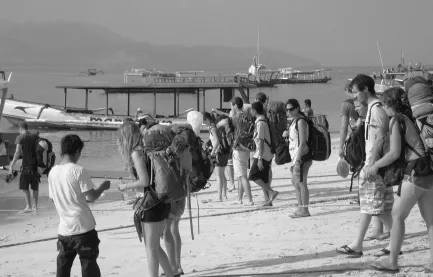
Figure 1.1 Backpackers queuing for local boats in Indonesia.
Source: Mark P. Hampton.
Bradt (1995) listed five ‘badges of honour’ common among backpackers: they survive on under US$15 a day; use local transport; carry all their belongings on their back;4 bargain for goods and services whilst guarding against rip-offs; and get away from crowds and discover new places. She argued that their low budgets reduced or removed the need for many services in LDCs, such as taxis, local guides and chambermaids, but this can be debated. We will return to employment and other economic impacts of backpackers in Chapter 3.
Although backpacker tourism was initially under-researched in the 1990s, since the early 2000s the academic literature has grown significantly. From a small number of writers, the number of studies has multiplied and researchers are now exploring many different aspects of the phenomenon.5 Research has focused on the economic impacts of backpackers in LDCs (Hampton, 1998, 2003; Spreitzhofer, 1998; Scheyvens, 2002a; Lloyd, 2003); backpackers’ behaviour, motivations and ethnography (Westerhausen, 2002; Sørensen, 2003; Muzaini, 2006; O’Reilly, 2006; Reichel et al., 2009); the Round-the-World trip (Molz, 2010); enclaves (Allon, 2004a; Howard, 2005, 2007); relations with the local community (Malam, 2008; C. Rogerson, 2008) and the local environment (Hampton and Hampton, 2009; Dodds et al., 2010). The study area has broadened from its original focus on South-East Asia to include other LDCs such as South Africa (Visser, 2004; C. Rogerson, 2007a, b, 2010, 2011); India (Hottola, 2005; Maoz, 2007); Fiji (Jarvis and Peel, 2010); Central America (Anderskov, 2002); Mexico (Brenner and Fricke, 2007); Ecuador (Bernstein, 2009); Brazil (de Oliviera, 2008; Rodrigues and Prideaux, 2012) and Columbia (Thieme, 2012). There is also a growing literature that studies backpacker tourism in more economically developed countries in Australasia and northern Europe.6
As a sub-sector of international LDC tourism, backpacker tourism has developed certain characteristics. These include: its own communication networks; a growing demand for cheap accommodation; and structure paralleling that of conventional mass tourism, comprising transport, restaurants, bars, accommodation and various support services such as travel and ticketing agencies, laundries, second-hand bookshops, bicycle and motorbike rentals and, since the 1990s, internet cafes.
A brief history of small-scale youth tourism and travel
Before the rapid expansion of mass travel for pleasure in the twentieth century, earlier periods also had examples of extended leisure travel, and sometimes, paid work. Before we turn to the expansion of tourism from the mid twentieth century it is useful to briefly consider some earlier forms of tourism that exerted some influence, including the Grand Tour, tramping and youth travel before the 1950s.
The Grand Tour, tramping and youth travel
The eighteenth-century ‘Grand Tour’ around Europe by wealthy sons of the British aristocracy and their tutors typically visited cultural centres and the great cities of western Europe. In a sense it was a travel-based ‘finishing school’ and in the academic literature it has often been seen as a general precursor of the twentieth-century’s overland trails to Asia and later backpacker tourism (for example, see Loker-Murphy and Pearce, 1995). In the final decade of the nineteenth century and early years of the twentieth century, another form of youth mobility arose, what Adler (1985) dubbed ‘tramping’, where young men, mainly of the working class, moved around from place to place depending on the available work.
S. Cohen (2009: 56–57) sees tramping as being very different from the Grand Tour, arguing that the Grand Tours could be seen as typifying education and ‘sophistication’ but late nineteenth-century tramping, following Adler (1985), can be seen as part of an older ‘craft’ tradition, where young men could learn their trade. However, this tradition of ‘tramping’ was decreasing by the start of World War One, with the decline in the craft associations and the acceleration of further industrialization. Adler (1985) argues that there was a change in perception around the first two decades of the twentieth century from tramping being seen as part of a transition from apprentice to skilled craft worker, to a growing perception of tramping as being anti-social and a sign of moral delinquency of the youth. S. Cohen (2009) amplifies this point and neatly links this to the later views from the ‘establishment’ of the 1960s’ counter-cultural ‘drop outs’ and the role played by periods of informal travel.
In the inter-war period, initially in Europe, there was the emergence of affordable youth hostels and other youth movements which were often linked to outdoor leisure pursuits such as hill walking. These initiatives allowed more affordable youth travel between the wars. Also during this period, hill stations with leisure functions developed in the European empires in Asia, particularly in British India, Malaya (now Malaysia), and the Dutch East Indies (Indonesia). Initially, hill stations such as Simla in India had emerged during the colonial period as military sanatoria or were linked to tea plantations. Some had become government administrative centres but by the 1930s many hill stations had become embryonic tourism centres for colonial officials, planters and business people as a respite from the heat of the lowlands (Kennedy, 1996; Baker, 2009). Some of these hill stations, such as Manali and Dharamsala in India and the Cameron Highlands in Malaysia, would attract hippies and later backpackers after World War Two. In a similar way some early beach resorts, such those as in French Indochina and Bali, attracted tourists from the 1920s. This was the start of a pattern that would be intensely developed via later small-scale tourism, and then specifically through the rapid development of mass coastal tourism from the 1980s onwards.
The rise of hitchhiking
Westerhausen (2002) argues that the immediate predecessor of the traveller subculture in Asia was the growth of hitchhiking in Europe in the 1950s. He argues that after the war, hitchhiking emerged in parallel with the growth of early mass tourism during the long economic boom and the rise in prosperity. Hitchhiking was the low-budget way to travel for those with time but little money. In the 1950s hitchhiking initially involved mainly students but arguably the term became broader and was linked, in some official perceptions,7 with danger, rebellion and, specifically, youth travel to demonstrations or music fes...