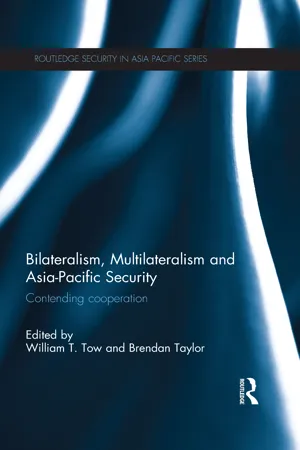
Many scholars of international relations in Asia regard bilateralism and multilateralism as alternative and mutually exclusive approaches to security co-operation. They argue that multilateral associations such as ASEAN will eventually replace the system of bilateral alliances which were the predominant form of U.S. security co-operation with Asia-Pacific allies during the Cold War. Yet these bilateral alliances continue to be the primary means of the United States' strategic engagement with the region. This book contends that bilateralism and multilateralism are not mutually exclusive, and that bilateralism is likely to continue strong even as multilateralism strengthens. It explores a wide range of issues connected with this question. It discusses how US bilateral alliances have been reinvigorated in recent years, examines how bilateral and multilateral approaches to specific problems can work alongside each other, and concludes by considering how patterns of international security are likely to develop in the region in future.
eBook - ePub
Bilateralism, Multilateralism and Asia-Pacific Security
Contending Cooperation
- 224 pages
- English
- ePUB (mobile friendly)
- Available on iOS & Android
eBook - ePub
Bilateralism, Multilateralism and Asia-Pacific Security
Contending Cooperation
About this book
Trusted by 375,005 students
Access to over 1.5 million titles for a fair monthly price.
Study more efficiently using our study tools.
Information
Subtopic
Ethnic StudiesIndex
Social SciencesPart I
Setting the context
1 Introduction
Bilateralism and multilateralism have long been regarded as dichotomous modes of security cooperation, with scholars and practitioners of Asian security politics traditionally conceiving of them in starkly zero-sum terms. Throughout the Cold War, for instance, bilateralism was regarded as the dominant mode of Asia-Pacific security cooperation, as epitomized by the US-led “San Francisco System” of alliances and the so-called “spiderweb bilateralism” that was especially prevalent in Southeast Asia during this period. With the passing of the Cold War, multilateral frameworks such as the Association of Southeast Asian Nations (ASEAN) Regional Forum (ARF) began to emerge, and with them much speculation that bilateralism was fast becoming an outdated mode of security cooperation. Contrary to those predictions, however, bilateralism and multilateralism are now flourishing simultaneously in Asia. America's alliances with Australia, Japan, and South Korea are arguably as strong as they have ever been. Speculation is also growing that America's longstanding alliance with the Philippines will take on renewed significance in an era defined largely by an intensification of strategic competition between the US and China. Against that backdrop, the US is deepening bilateral security ties with other emerging regional players, such as India, Indonesia, Singapore, New Zealand, and Vietnam. Concurrently, Asian multilateralism is burgeoning with the emergence of a raft of new and potentially influential regional bodies including the recently expanded East Asia Summit (EAS) and the ASEAN Defence Ministers’ Meeting Plus (ADMM+) process.
As Asian multilateralism continues to blossom, many scholars continue to predict the eventual demise of exclusive bilateral structures such as the US-led bilateral alliance system (Menon 2007). A handful of analysts have forecast the eventual convergence of the two modes of security cooperation as their proximity intensifies (for example, see Tow 2001). A third line of thinking points toward a “peaceful coexistence” between bilateralism and multilateralism, suggesting that existing structures can effectively be knitted together to form a “patchwork-like” regional architecture that contains elements of each (see Cha 2011). Yet the relationship between Asia's persistent bilateral structures and its newly emergent multilateral processes remains underexplored. This volume redresses that shortcoming in the literature by offering the first empirically comprehensive and conceptually systematic treatment of the emerging “nexus” between bilateralism and multilateralism in Asian security politics.
The book is divided into four parts. The first locates the study and conceptualizes the nexus – an important task not least because bilateralism and multilateralism are each highly contested concepts in political science and international relations scholarship. In the chapter immediately following this introduction, Brendan Taylor outlines four possible conceptual approaches to the so-called “nexus” between bilateral and multilateral modes of security cooperation in the Asia-Pacific. The first approach – which Taylor terms bilateral or multilateral – assumes that bilateralism and multilateralism are mutually exclusive modes of cooperation. The second approach – bilateral–multilateral – suggests that synergies between the two modes can and do exist, but that multilateralism is ultimately a smokescreen for enhanced bilateral interaction. The third – the multilateral–bilateral – reverses this causal arrow and views bilateralism as largely a “stepping stone” or “building block” to multilateralism. The fourth conceptual approach to the nexus – bilateral and multilateral – suggests that greater complimentarity and perhaps even convergence can ultimately be realized between bilateral and multilateral structures and processes.
Part two takes as its central focus the US-led alliance network, analyzing how emergent multilateral processes are impacting upon this set of strategic relationships and with what ramifications. Ajin Choi and William Tow “set the scene,” pointing to the apparent inability of America's Asian alliances to meet many of the region's emergent security challenges. At the same time, Choi and Tow contend that burgeoning multilateral structures and processes seem destined to be found equally wanting due to their large size, coupled with the tendency of their members to often work at odds with one another. Choi and Tow seek to address this conundrum by proposing a “middle ground” approach that potentially bridges the gap between exclusivist bilateral and overly inclusivist multilateral pathways. Modeled on the North Atlantic Treaty Organization experience, Choi and Tow's “inclusive but qualified” membership model of multilateral security politics is one they regard as transferable to an Asian context. Indeed, they make the case that elements of this “inclusive but qualified” model are already evident in South Korea's approach to regional security politics.
In contrast to Choi and Tow, Rikki Kersten's analysis of the Japan–US alliance – referred to by generations of American policymakers as the “lynchpin” or “cornerstone” of security in the Asia-Pacific – questions the capacity of this longstanding strategic relationship to accommodate Tokyo's increasing desire to engage more deeply with Asia via multilateral means. Kersten illuminates the interplay and the inherent tensions between Japan's emerging bilateral and multilateral policy choices, concluding that these ultimately cannot be accommodated within the Japan–US alliance, which in turn carries significant implications for the prospects of achieving a bilateral–multilateral nexus in the Asia-Pacific.
Renato Cruz De Castro examines the revitalization of the US–Philippines alliance that has occurred over the decade or more since the 11 September 2001 terrorist attacks on the World Trade Center and the Pentagon. De Castro attributes this alliance revitalization partly to the threat of global terrorism, but also to the more recently perceived security challenges that China's rise poses to both Manila and Washington. Yet while these twin threats may have served as the glue to bring the US and Philippines closer strategically, De Castro also concludes that they alone will not be sufficient to ensure a deepening and enduring alliance relationship. Instead, he proposes a greater “institutionalization” of this alliance relationship and, indeed, the San Francisco System writ large, but on a multilateral basis underwritten by the shared economic interests and the shared values of its constituent members.
In the final chapter of part two, Chulacheeb Chinwanno provides a case study of Thai security policy, which has arguably seen that country strike the most judicious balance of all between bilateralism and multilateralism. Chinwanno illustrates that Thailand's policy of “balanced engagement” is historically rooted, deriving from a strong desire to avoid repeating past mistakes that have left Thailand unduly dependent upon a single, extraregional power for its protection. It is a strategy currently manifested in Thailand's three-pronged approach of continued bilateral engagement with the US, concurrent development of informal bilateral defense cooperation with China, and active support for multilateral security arrangements such as the ARF and the ADMM. In an increasingly fluid and complex Asian security environment, Chinwanno predicts a continuation and perhaps even an intensification of these preferences on the part of Bangkok.
Part three reverses the causal arrow established in part two, and examines how Asian multilateralism is being both supported and potentially challenged by the emerging nexus between bilateral and multilateral modes of security cooperation. Ralf Emmers begins by highlighting these complementarities and overlaps via a case study of a “minilateral” defense coalition – the Five Power Defence Arrangements (FPDA) – and its ramifications for broader security cooperation in the Asia-Pacific. Emmers concludes that since its inception in 1971, the FPDA has succeeded in reinforcing both the US bilateral alliance network and the multilateral operations of ASEAN, thereby suggesting that a peaceful coexistence between these modes of security cooperation remains feasible.
Aileen Baviera then compares bilateral and multilateral approaches to territorial and maritime jurisdiction disputes in the South China and East China seas. Baviera's analysis is conducted at two levels: first, at what she terms the “claimant-centered” level where her primary focus is upon whether bilateral or multilateral approaches have thus far proven optimal from the perspective of the various claimant parties to these disputes. Second, like Emmers, she undertakes a broader “security architecture-centered” analysis wherein she asks whether US bilateral relationships can either coexist or eventually integrate into more comprehensive multilateral security approaches in direct response to these disputes.
Complementing Baviera's analysis, David Capie explores Asia's defense diplomacy, a subject that has thus far received a markedly lower degree of scholarly attention relative to other forms of economic and security cooperation in this part of the world. In his contribution, Capie traces the evolution of Asia's defense diplomacy and identifies the factors that have led states to prefer bilateral or multilateral approaches. He also seeks to account for the relatively rapid rise of high-level multilateral defense diplomacy in Asia over the past decade and examines what might be done in future to further encourage synergies between bilateral and multilateral approaches to defense diplomacy in Asia.
Part four considers the larger question of how the interaction between bilateralism and multilateralism is shaping Asia's emerging security order. Ryo Sahashi posits that Asia's security order is currently experiencing a period of profound transformation occasioned largely by the rise of China. In Sahashi's view, the uncertainties that this development is generating is encouraging small and middle powers to deepen their interactions with China and the US – both via bilateral and multilateral avenues – who are also competing for security cooperation with these regional powers in both bilateral and multilateral settings. Sahashi concludes, however, that the shape Asia's security order ultimately takes will be influenced most profoundly by the balance of competition and cooperation in the US–China relationship and that the means through which such cooperation is pursued is largely a second order issue.
In a similar vein, Hugh White examines the role of US alliances in shaping Asia's emerging security order and, contrary to conventional wisdom, contends that this set of strategic relationships will have little role to play in shaping this process. White's argument is essentially threefold. First, alliance relationships have historically reflected rather than created international orders. Second, America's Asian alliances will likely weaken in the face of China's rise as divergence between the US and each of its junior partners becomes more pronounced. Third, and consistent with this, unless China's foreign and security policies take a significantly more aggressive turn, White believes that the prospects for any “multilateralization” of America's presently bilateral alliances are extremely remote.
In keeping with the great power emphasis provided by both Sahashi and White, Evelyn Goh examines the place of bilateral and multilateral modes of cooperation in the security strategies of the US, China, and Japan. In contrast to other chapters in this section, however, Goh's analysis leads her to challenge the continued utility of the distinction between bilateralism and multilateralism – and, indeed, the very concept of the bilateral–multilateral nexus itself – on the grounds that a marked convergence between these two modes of cooperation is occurring in the individual strategies pursued by Washington, Beijing, and Tokyo. This bilateral–multilateral convergence within US, Chinese, and Japanese security strategies is, in Goh's view, a natural product or extension of emerging great power strategic competition. Against that backdrop, Goh concludes that the underlying tension in Asia's emerging security order is not between bilateral and multilateral approaches. Rather, it is divergence in the larger visions of international order as conceived of and pursued by this region's great powers that presents the greatest challenge for practitioners of Asian security going forward.
An impressive range of themes emerge from the contributions to this volume. These are addressed in greater depth by Tow in his concluding chapter. One is struck, for instance, by the subtly different approaches taken by each of the contributors to the bilateral–multilateral security nexus. This divergence notwithstanding, however, it is also interesting just how little support for the fourth of Taylor's proposed conceptual approaches – the bilateral and multilateral approach – is evident amongst the contributions. This, in turn, perhaps reflects the fairly pervasive sense of pessimism emanating from contributions to the volume as to where the future of Asia's strategic order – and particularly the relationship between the region's two heavyweights, the US and China – is headed. Consistent with this, the centrality afforded by virtually all contributors to the US-led alliance network is striking, although in the eyes of some this set of strategic relationships will not be free from its own set of quite formidable challenges. Yet it is also revealing that so little emphasis in the contributions is placed upon other modes of bilateral cooperation outside of the US-led alliance network, notwithstanding the fact that these are also clearly intensifying.1 Last but not least, the emergence of “minilateralism” both as a facilitator of greater bilateral–multilateral synergies and as a mode of security cooperation not always easily reconciled within the bilateral–multilateral conceptual dichotomy suggests that this too is an emerging cooperative mode in pressing need of much closer and more rigorous analysis.
Note
1 In his keynote address to the 2012 Shangri-La Dialogue, for instance, Indonesian President Susilo Bambang Yudhoyono (2012) made the observation that
Five decades ago, if you drew a matrix of countries in the region and tried to map out bilateral partnerships between them, you would see lots of empty boxes. Beyond Cold War alliances, and normal bilateral relations, there was not much else. However, today that same matrix is full of checked boxes, showing one important fact: that almost every country in the region has established an elaborate web of diplomatic, security or economic partnerships with other countries.
2 Conceptualizing the bilateral-multilateral security nexus
Throughout the Cold War period, bilateralism remained the dominant mode of security cooperation in the Asia-Pacific. Its leading institutional manifestation took the form of the US-led network of bilateral alliances, which was and still is often referred to as the San Francisco System (for further reading, see Calder 2004). Efforts were made to implement multilateral security structures – such as the Southeast Asia Treaty Organization – yet these efforts ultimately failed to gain much traction. The region for much of this time was generally regarded as being too diverse and too distrustful to accommodate such ventures. Indeed, the prospects for multilateral security cooperation in the Asia-Pacific remained bleak until at least the early 1990s.
The removal of the ideological strictures imposed by the superpower stalemate dramatically altered this situation. Multilateral cooperation quickly blossomed in Asia, as epitomized in the security sector by the establishment of the Association of Southeast Asian Nations (ASEAN) Regional Forum in 1993–94. According to one estimate, by the mid-1990s approximately 50 to 60 channels for multilateral security dialogue had sprung up in the Asia-Pacific, at both the track-one and track-two levels (Japan Center for International Exchange 2008). This trend has intensified in recent years with the establishment of a further raft of new and prominent groupings, such as the ASEAN Defence Ministers’ Meeting (ADMM) and the ADMM+, the Shanghai Cooperation Organisation, and the much heralded East Asia Summit. In the face of this burgeoning multilateralism, some commentators began questioning the continued viability of the San Francisco System of alliances, particularly in view of the fact that its raison d’être – balancing against the threat of Soviet power and influence – had been removed.
Yet such predictions have yet to materialize. If anything, the most prominent of America's bilateral security relationships in Asia – the US–Japan, the US–South Korea, and the US–Australia alliances – have strengthened during the period since the ending of the Cold War. A case can even been made that Washington is not only reinforcing existing elements of the system, but is also seeking to extend its geographic reach through the establishment of deeper strategic ties with India, Indonesia, Singapore, and Vietnam as part of a historic American “pivot” towards Asia (Clinton 2011a).
Against that backdrop, this chapter examines the interaction between bilateral and multilateral modes of security cooperation in the Asia-Pacific at a time when each is apparently flourishing. In so doing, the chapter attempts to conceptually unpack the bilateral–multilateral security nexus. It outlines four possible conceptual approaches to it. The first “bilateral or multilateral” approach to the nexus suggests that bilateralism and multilateralism are essentially two separate and mutually exclusive modes of security cooperation. The second “bilateral–multilateral” approach posits that synergies do exist between bilateral and multilateral modes of security cooperation, but that bilateralism is ultimately the dominant form and that multilateralism exists largely to facilitate it. Conversely, the third “multilateral–bilateral” approach assumes that such synergies revolve around the fact that bilateralism is ultimately a “stepping stone” or a “building block” to multilateralism. Finally, the “bilateral and multilateral” approach to the nexus contends that greater complementarity and ultimately perhaps even a synthesis can be realized between bilateral and multilateral security structures and/or processes in the Asia-Pacific. While a range of examples from regional security politics are used in this chapter to illustrate each of these four approaches to the bilateral/multilateral security nexus, to facilitate comparison across all four, examples are also drawn specifically from the range of diplomatic processes that have been applied to the protracted North Korean nuclear crisis.
The central argument of this chapter is that manifestations of all four approaches to the nexus will remain in evidence into the foreseeable future. Instances will remain where the relationship between bilateral and multilateral modes of security cooperation will retain a zero-sum quality, particularly during an era of emerging and, indeed, intensifying strategic competition between the US and China. Reflecting the fact that these two strands of security cooperation are coming into increased contact with one another, however, the chapter argues that the second and third approaches to the nexus are likely to be most prevalent. Due to the aforementioned and increasing incidence of great power competition, the chapter also speculates that any genuine bilateral–multilateral synthesis is most unlikely. Instead, the best that can be hoped for in relation to the fourth approach to the nexus is a more deliberate division of labor between bilateral and multilateral processes. Such functional differentiation would likely see multilateral processes continuing to focus largely on non-traditional security challenges, whereas bilaterally based structures would be geared towards more traditional security concerns. The chapter argues that the conditions of such an approach are already in place, but that these are not yet being fully and explicitly exploited. Yet even if they were, the chapter concludes that the nature of the relationship between bil...
Table of contents
- Cover Page
- Half Title page
- Series
- Title Page
- Copyright Page
- Contents
- Figure and tables
- Contributors
- Preface
- Abbreviations
- Part I Setting the context
- 1 Introduction
- 2 Conceptualizing the bilateral–multilateral security nexus
- Part II The nexus and America's Asian alliances
- 3 Bridging alliances and Asia-Pacific multilateralism
- 4 Stretching the Japan–US alliance
- 5 The US–Philippines Alliance
- 6 Thailand's Security Policy
- Part III The nexus and Asian multilateralism
- 7 The role of the Five Power Defence Arrangements in Southeast Asian security architecture
- 8 Territorial and maritime jurisdiction disputes in East Asia
- 9 The bilateral–multilateral nexus in Asia's defense diplomacy
- Part IV The Nexus and Asian Security Order
- 10 The Rise of China and the Transformation of Asia-Pacific Security Architecture
- 11 Alliances and Order in the “Asian Century”
- 12 Conceptualizing the Relationship Between Bilateral and Multilateral Security Approaches in East Asia
- 13 Conclusion
- References
- Index
Frequently asked questions
Yes, you can cancel anytime from the Subscription tab in your account settings on the Perlego website. Your subscription will stay active until the end of your current billing period. Learn how to cancel your subscription
No, books cannot be downloaded as external files, such as PDFs, for use outside of Perlego. However, you can download books within the Perlego app for offline reading on mobile or tablet. Learn how to download books offline
Perlego offers two plans: Essential and Complete
- Essential is ideal for learners and professionals who enjoy exploring a wide range of subjects. Access the Essential Library with 800,000+ trusted titles and best-sellers across business, personal growth, and the humanities. Includes unlimited reading time and Standard Read Aloud voice.
- Complete: Perfect for advanced learners and researchers needing full, unrestricted access. Unlock 1.5M+ books across hundreds of subjects, including academic and specialized titles. The Complete Plan also includes advanced features like Premium Read Aloud and Research Assistant.
We are an online textbook subscription service, where you can get access to an entire online library for less than the price of a single book per month. With over 1.5 million books across 990+ topics, we’ve got you covered! Learn about our mission
Look out for the read-aloud symbol on your next book to see if you can listen to it. The read-aloud tool reads text aloud for you, highlighting the text as it is being read. You can pause it, speed it up and slow it down. Learn more about Read Aloud
Yes! You can use the Perlego app on both iOS and Android devices to read anytime, anywhere — even offline. Perfect for commutes or when you’re on the go.
Please note we cannot support devices running on iOS 13 and Android 7 or earlier. Learn more about using the app
Please note we cannot support devices running on iOS 13 and Android 7 or earlier. Learn more about using the app
Yes, you can access Bilateralism, Multilateralism and Asia-Pacific Security by William Tow, Brendan Taylor, William Tow,Brendan Taylor,William T. Tow, William T. Tow, Brendan Taylor in PDF and/or ePUB format, as well as other popular books in Social Sciences & Ethnic Studies. We have over 1.5 million books available in our catalogue for you to explore.