First published in 1981, Labour Market Economics develops the basic economic theory of introductory courses within the context of labour market analysis and applies it both to particular features and special problems of the subject. The author begins by outlining the nature of the area and the structure of the UK labour market at the time, and proceeds to explain and elaborate the tools of theoretical analysis. These are then applied in subsequent chapters to a variety of issues, including the economic analysis of trade unions, collective bargaining and the effects of unions, unemployment, wage inflation and the inequality of pay. Throughout the book, emphasis is placed on the economic theory of the labour market and the role of empirical work in testing its predictions, and wherever available, evidence from studies of the UK labour markets is cited.
- 252 pages
- English
- ePUB (mobile friendly)
- Available on iOS & Android
eBook - ePub
Labour Market Economics (Routledge Revivals)
About this book
Trusted by 375,005 students
Access to over 1.5 million titles for a fair monthly price.
Study more efficiently using our study tools.
Information
Chapter 1
Introduction: The Economic Analysis of Labour
In 1976–7 the middle 20 per cent of income-earners in Britain received 78 per cent of their total income as earnings from employment. This book is concerned with the forces that determine the incomes that people earn from employment.
Individuals receive income from various different sources (from employment or self-employment, from the state in the form of transfer income or as investment income arising from the ownership of assets of capital or land) and although the proportion of total income received from each of these sources varies according to income level, Figure 1.1 shows that, for the population as a whole, the single largest component of total income is earnings from employment.
Labour is one of the factors of production, and the subject matter of labour economics is, broadly speaking, its pricing and allocation. The purpose of this opening chapter is to introduce the reader to the sorts of problems that are considered in this book and to provide a brief sketch of the structure of the UK labour market.
SOME BASIC QUESTIONS IN LABOUR ECONOMICS
The problems and issues analysed by labour economists are many and varied and span both the macro and microeconomic areas. The questions considered in this book include:
(1) What determines the numbers of people in paid employment, their hours of work and their rates of pay?
(2) Why do people join trade unions? What is collective bargaining, and how do unions and employers arrive at an agreed wage by negotiation? Do unions succeed in raising their members' wages and conditions of work above the levels that they would otherwise be?
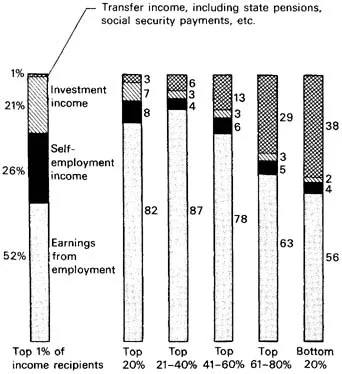
Figure 1.1 Earnings and other forms of income in Britain, 1976–7.
Source: Based on data contained in An A to Z of Income and Wealth (London: HMSO, 1980), p. 10
Source: Based on data contained in An A to Z of Income and Wealth (London: HMSO, 1980), p. 10
(3) What determines the changes in wages that occur between one year and the next, and what roles, if any, are played by trade unions and/or price expectations?
(4) What is unemployment, and what are its causes and cures? Why is it that some people remain unemployed for only short periods of time, while others remain unemployed for many months or sometimes even years? Does the payment by the state of unemployment benefit have any influence on the level of unemployment?
(5) Why do wages differ between different occupations and different industries? Why do skilled workers typically earn more than their unskilled colleagues, and why do earnings rise with a worker's level of education and training?
(6) What are the factors determining the observed movements in wage differentials over time? More specifically, why is it that in Britain the differential between the craftsman builder's wage and that of the building labourer remained virtually unchanged over the five centuries up to 1914, and why is it that the average earnings of professional workers such as doctors, dentists and solicitors in Britain fell between the First World War and the late 1970s from over five times those of the unskilled manual worker to only about two and a half times?
THE ECONOMIST'S APPROACH
In his approach to the analysis of pay determination and related matters, the economist sees wages as the price of labour, and he sees these as being determined, in analogous fashion to the prices of goods and services, by the interaction of supply and demand forces in the market for labour (Harbury, 1980, pp. 80–94). Although there are other approaches to questions of pay determination (see Phelps-Brown, 1977, pp. 10–21), emphasis is placed throughout this book on the economist's approach, utilising the tools of supply and demand analysis and examining the ways in which these forces operate and interact in the market for labour as a factor of production.
LABOUR IN THE UK ECONOMY
The market for labour has two sides: on the one hand there is the demand side, made up of producers of goods and services as employers or purchasers of labour services, while on the other there is the supply side, composed of individuals and households as sellers or suppliers of labour services.
The Demand for Labour
The demand for labour (like the demand for the other factors of production) is said to be a derived demand, because producers demand labour not directly for itself but for the contribution that it makes, when used in conjunction with other factors of production, to the production of goods and services.
In the UK economy purchasers of labour come in many different ‘shapes and sizes’, ranging from the small firm employing only a few workers to the large national and multinational companies and public corporations employing, in some cases, many thousands of workers. The largest single purchaser of labour services in the UK economy is the state. In 1978 employment in central government, local authorities and the public corporations accounted for almost 30 per cent of total employment.
As we shall see below, the amount of labour that a rational employer or employers will seek to hire at any given wage will depend on labour's contribution to the firm's revenue in relation to its effects on the firm's costs. Labour's contribution to a firm's revenue has two dimensions: first, its contribution to the firm's physical output (or labour's physical productivity) and secondly, the contribution that each additional physical unit of output makes to the firm's revenue. When analysing the forces lying behind the demand side of the labour market, it is therefore necessary to consider two things: first, the way in which firms combine the factors of production and secondly, the conditions prevailing in the firm's product market, since these will influence the contribution that each additional unit of physical output makes to its revenue.
In considering the first of these dimensions, economists distinguish between short and long-run periods. In the short run the firm has a fixed amount of some input or inputs (say capital goods) and it is concerned with the consequences of adding additional amounts of a variable factor (say labour) to its fixed stock of capital. In the long run the firm is by definition free to vary its inputs of all factors of production, so that, when considering such periods, it is necessary to take account of the fact that producers may vary the input mix of their production method, within the limits imposed by what is technically feasible, in response to changes in the relative costs of the different factors of production.
The other dimension to be considered in the analysis of labour demand is concerned with the contribution that additional units of out-put make to the firm's revenue, and to examine this it is necessary to consider the employer firm's product market. The simplest case is the one where the firm sells its output in a perfectly competitive product market. Under such circumstances each unit of output is sold at the prevailing market price and adds a constant amount, equal to the market price, to the firm's revenue. However, in the UK, as elsewhere, many employers operate in product markets that are non-perfect and therefore, after initially considering the perfectly competitive product-market case, we proceed to extend the analysis to allow for product market imperfections.
The Supply of Labour
On the sellers' side of the labour market, there are men and women of different ages, with different skills, abilities, motivations and family circumstances, who offer their labour services for hire. In the UK, as in other societies, most individuals live in a household unit of some form, and in the analysis of labour supply economists see decisions about who is to supply how much labour as being made in the house-hold context, as part of its decision regarding the optimum allocation of its members' available time between alternative uses.
In mid 1978 the total population of the UK was 55.9 million, and there were almost 26.4 million men and women (equal to about 47 per cent of the total population) recorded as either being in or seeking paid employment (which together are referred to as the labour force). However, of the total UK population of almost 56 million in 1978, some 13.2 million could be expected to remain outside the labour force, as they were under the school-leaving age of 16, while a further 9.5 million were over the official retirement age (60 for women and 65 for men). The exclusion of these people leaves a total population of ‘working age’ of about 33.2 million, and expressing the recorded labour force as a percentage of this amount we obtain a figure of almost 80 per cent.
COMPETITION IN THE LABOUR MARKET
Factor markets, like the markets for goods and services, exhibit varying degrees of competition. In the analysis of labour markets, economists frequently take the perfectly competitive model as their analytical starting point. In practice, some labour markets are highly competitive and approximate (in some cases quite closely) to the perfectly competitive model, while others display imperfections on either the demand side, the supply side or both sides. In the following chapters we begin by examining the interaction of demand and supply side forces in competitive markets and then proceed to extend the analysis to imperfectly competitive labour markets.
On the buyers' side there are some labour markets in which there is only a small number of purchasers of a particular sort of labour (in a particular geographical locality perhaps). The limiting case, where there is only a single purchaser of labour in the market in question, is known as monopsony, and this situation sometimes arises when purchasers of labour combine to form an employers' association that acts as a single purchaser in a particular labour market.
TRADE UNIONS IN THE UK
An important characteristic of the sellers' side of many labour markets is the existence of trade unions as organisations of sellers of labour. Unionisation is not a new phenomenon. By the end of 1920 there were almost 1,400 unions in the UK, with a total membership of over 8.3 million men and women, equivalent to about 40 per cent of the labour force. However, mainly as a result of union amalgamations the number of unions in the UK has fallen over the last sixty or so years to somewhat less than 500 by 1970, while their membership has risen to around 13 million.
The extent of unionisation, however, varies markedly between different labour markets, and estimates of the degree of unionisation by industry suggest that in Britain in 1971 actual union membership as a percentage of potential membership varied from as little as 11.6 per cent in distribution to 96.4 per cent in entertainment, with national government coming a close second with 94 per cent (Bain and Elsheikh, 1979, p. 138).
The existence of trade unions raises a number of questions that are of interest. For example, why do workers join unions, and what determines the observed fluctuations in union membership? What are the objectives of trade unions, and what methods do they use in their efforts to achieve these? Of particular importance is the question of whether the existence of unions causes either the wages and employment conditions of their members, or the allocation of resources in the economy, to be any different from what they would be in their absence.
COLLECTIVE BARGAINING
As we shall see below, the individual purchaser or seller of labour is a wage-taker in a perfectly competitive labour market, deciding how much labour to sell or hire at the prevailing market wage rate. In cases where labour markets are organised on both sides (say the single union and single employer case), both buyers ...
Table of contents
- Cover
- Half Title
- Title Page
- Copyright Page
- Original Title Page
- Original Copyright Page
- Table of Contents
- Preface
- 1 Introduction: The Economic Analysis of Labour
- Part One Wage Theory
- Part Two Economic Aspects of Trade Union Behaviour
- Part Three Further Topics
- Notes
- References
- Index
Frequently asked questions
Yes, you can cancel anytime from the Subscription tab in your account settings on the Perlego website. Your subscription will stay active until the end of your current billing period. Learn how to cancel your subscription
No, books cannot be downloaded as external files, such as PDFs, for use outside of Perlego. However, you can download books within the Perlego app for offline reading on mobile or tablet. Learn how to download books offline
We are an online textbook subscription service, where you can get access to an entire online library for less than the price of a single book per month. With over 1.5 million books across 990+ topics, we’ve got you covered! Learn about our mission
Look out for the read-aloud symbol on your next book to see if you can listen to it. The read-aloud tool reads text aloud for you, highlighting the text as it is being read. You can pause it, speed it up and slow it down. Learn more about Read Aloud
Yes! You can use the Perlego app on both iOS and Android devices to read anytime, anywhere — even offline. Perfect for commutes or when you’re on the go.
Please note we cannot support devices running on iOS 13 and Android 7 or earlier. Learn more about using the app
Please note we cannot support devices running on iOS 13 and Android 7 or earlier. Learn more about using the app
Yes, you can access Labour Market Economics (Routledge Revivals) by D Sapsford in PDF and/or ePUB format, as well as other popular books in Economics & Business General. We have over 1.5 million books available in our catalogue for you to explore.