eBook - ePub
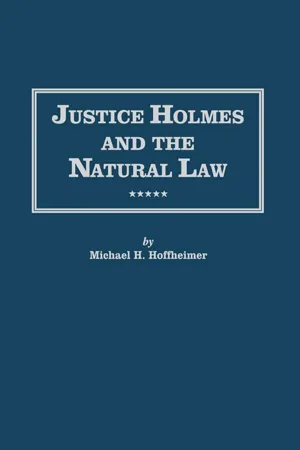
Justice Holmes and the Natural Law
Studies in the Origins of Holmes Legal Philosophy
- 160 pages
- English
- ePUB (mobile friendly)
- Available on iOS & Android
eBook - ePub
Justice Holmes and the Natural Law
Studies in the Origins of Holmes Legal Philosophy
About this book
First Published in 1993. Not intended as a new biography of Justice Oliver Wendell Holmes or as a critical study of his legal philosophy, this book's intention is to help fill a gap in the studies of Holmes. Without denying the power with which Holmes reacted against intellectual traditions of the nineteenth century, the author hopes to show that natural law and transcendentalist philosophy formed important vital sources of his mature legal theory.
Trusted by 375,005 students
Access to over 1.5 million titles for a fair monthly price.
Study more efficiently using our study tools.
Information
JUSTICE HOLMES AND THE NATURAL LAW

Problems with the Holmes Problem
THE SCHOLARSHIP on Justice Oliver Wendell Holmes was marked by polemic long before his death. Conflicting judgments about the merit of his opinions mirrored conflicting interpretations of the content of his thought.1 Holmes scholars, reflecting on the polemical character of Holmes studies and self-conscious of changes in his posthumous reputation, have come to recognize important tensions and conflicts within his thought itself. Recent biographers agree that Holmes’s life and thought were signally conflicted. One biographer describes the contradictory interpretations of Holmes and suggests that “[i]t is not possible to reduce his work to any one system.”2 Another biographer depicts Holmes as enigma.3 Still another biographer reasserts the provocative claim that, beneath his liberal facade, Holmes embraced “a kind of fascist ideology.”4
Friends tolerated the contradictions5 while critics exploited them. Lon Fuller charged that “Holmes’ case suggests furthermore that the positivistic attitude may often represent the emotional resolution of a conflict between the opposing forces of romanticism and skepticism at war in the same breast.”6 By emphasizing important inconsistencies, critics sought to debunk liberal interpretations of Holmes. His celebrated opinions that defended individual liberties7 were incompatible with other opinions that authorized seemingly unlimited government interference with such liberties.8 Mencken observed with cynicism that Holmes’s dissents in support of social welfare legislation9 expressed his judicial concern less for rights of individuals than for “rights of lawmakers.”10
Attacks on Holmes’s liberal reputation continue. Recent studies have also found internal inconsistency within opinions deferring to state legislative authority11 and within opinions treating first amendment rights.12
Despite widespread recognition of tensions in Holmes’s thought, most interpreters have dismissed the tensions as simple inconsistencies.13 A few writers have seized on the tensions as evidence that Holmes lacked any coherent intellectual position at all.14 Ironically, one reason for the neglect of central tensions in Holmes is that most have taken Holmes at his word when he attacked transcendental theories of natural law. Holmes remains considered almost universally as a utilitarian, positivist, pragmatist, or realist in his basic theory, despite the fact that sensitive scholars applying the labels have recognized the inconsistency that results from their application.
The tensions within Holmes’s theoretical writings are not superficial. They touch on his conception of the nature of law itself. His great book The Common Law (1881) demonstrated how law evolved by means of internal organic rules that led to the law’s becoming increasingly objective and aware of its own mission.15 In keeping with the vision of The Common Law, the lawyer’s task as part of the historical process was to participate actively in freeing the law from those archaic doctrines that prevented the law from consciously fulfilling its role of promoting social policy. Yet his later work The Path of the Law (1897) treated the law as the prediction of the outcome of future judicial decisions. The vision of the later work reduced the lawyer’s task to accurate prediction. The different works did not just employ two different meanings of the word “law.” They emphasized two different visions of the role of law in society, of the role of the lawyer in the practice of law, and of the ends toward which legal change ran.16
Holmes has been different things to different generations. To the present generation of legal scholars he represents a problem that needs to be pursued,17 interpreted, or simply exposed.18 Notwithstanding the growing self-reflective character of contemporary scholarship on Holmes and the recognition of important tensions in his work, his ideas are still usually explained in terms that scholars proposed earlier this century and that became fixed within a decade after his death.19
A. Scholarly Assumptions
Debate continues about the appropriate classification of Holmes as positivist or pragmatist or realist or utilitarian.20 Of course, the literature on Holmes is so vast that it includes a few oddities. One writer in 1937 claimed that Holmes was a mystic.21 But most scholars ignored such oddities, and few serious students of Holmes have doubted that he was at bottom an advocate of an extreme sort of instrumental legal philosophy. Nor have they questioned the concomitant biographical assumption that the main sources and inspirations for his work were nineteenth-century English and American analytic philosophers—with a little Comte stirred in—and writers from the German Historical School.
Prevailing interpretations of Holmes disagree in their evaluation of his coherence, originality, and worth. But they share an important assumption about what Holmes was not. They agree implicitly that he was not a proponent of natural law in any form. They assume that continental rationalist and idealist strains of thought—and American proponents like Emerson—had no important influence on the mature theory of Holmes. So, too, the literature reflects the historical assumption that Holmes’s mature philosophy marked a radical break with the philosophy of law current at the end of the eighteenth century. And it assumes his own intellectual development was achieved by a radical break with the transcendentalist views that he held in his early adulthood.
The assumption of radical discontinuity is troublesome, however, for the evidence is weak. Indeed, the reasoning behind the assumption rests on a circular argument.22 Interpretation of Holmes’s ideas as a radical innovation became a standard part of legal historiography,23 but that historiography itself rested on a sort of circular argument if Holmes’s intellectual biography did not provide concrete evidence of innovation. The historical assumptions evade rather than confront what should be central topics in modern legal history and in Holmes’s personal history.
The scholarly insistence upon Holmes’s originality has tended to obscure the contribution of natural law to modern legal thought. Holmes’s earliest criticism of legal doctrines associated with natural law actually advanced the rather limited argument that duty preceded right—logically and historically. He supported the argument with a sociological and instrumental explanation of sovereignty.24 But few scholars have examined the specific features of natural law doctrine that Holmes rejected. Natural law itself has usually not even been defined but has been understood to be the theory that there is some superlaw that exists independently of any law that is the product of a real jurisdiction’s legal system. But this conception of natural law as superlaw that informs the views of its critics is questionable.25
The prevailing assumption that natural law theory represented a metaphysical confusion of law and morals and resorted to the supersensible has obscured the origins of Holmes’s views on the important problem of the relation of law and “science.” The neglect of natural law is bound up with the assumption that the movement for legal “science” was inspired by positivism or, perhaps, the Historical School.26 But the distinction between legal science and moral philosophy did not first emerge in nineteenth-century writings but rather in the works of eighteenth-century idealist philosophers.27 And Holmes did not get the idea of a science of law from either Maine or the positivists. The idea of “science” had attained currency a generation earlier in the writings of natural law theorists. For example, Joseph Story had referred repeatedly to law as “science” a generation before Holmes.28 Commitment to natural law principles did not prevent Story from likening legal science to the natural sciences. Developments in both law and science supported Story’s vision of progress transcending limitations and moving toward an absolute:
In truth, the common law, as a science, must be forever in progress; and no limits can be assigned to its principles or improvements. In this respect it resembles the natural sciences, where new discoveries continually lead the way to new, and sometimes to astonishing, results.… It is its true glory, that it is flexible, and constantly expanding with the exigencies of society; that it daily presents new motives for new and loftier efforts; that it holds out forever an unapproached degree of excellence; that it moves onward in the path towards perfection, but never arrives at the ultimate point.29
The association of legal “science” with natural law rather than with positivism or formalism seemingly accounts for Holmes’s emphatic remark, “Law is not a science, but is essentially empirical.”30 Yet his systematic and historical defense of judicial lawmaking in The Common Law expressed a progressive understanding of the common law that was far more compatible with Story than with Austin.
Nineteenth-century natural law writings displayed characteristic doctrines and attitudes that anticipated important, distinctive features of the mature legal philosophy of Holmes. Holmes’s failure to acknowledge the influence of transcendentalism or natural law on his legal theory poses a difficulty that is not different in kind from his failure to admit the influence of pragmatism or utilitarianism, which were powerful sources of his ideas.31
His failure to acknowledge the effect of natural law and idealist philosophy contrasts with the appreciation of these sources by other legal writers in the half-century after the Civil War. Founders of the new American science of law often acknowledged a debt to natural law theory and idealist philosophy. Sheldon Amos wrote that “Modern Jurisprudence is emphatically a German creation,” and he acknowledged the Historical School, and also Kant and Hegel, among his intellectual progenitors.32 Roscoe Pound observed that nineteenth-century education was less influenced by English political writers than by natural law juristic writers and by continental philosophers permeated with Hegelian views.33
B. Holmes’s Critique of Natural Law
Holmes did not just refuse to acknowledge the influence of natural law; he attacked natural law jurisprudence repeatedly and effectively. The widespread assumption that Holmes stood in direct opposition to natural law is supported by ample evidence. His antipathy to natural law is well documented. His intellectual activity contributed to the decline of natural law theory in this century.
Criticism of natural law occupied a special place in Holmes’s theoretical iconoclasm. He brought together many of his arguments against natural law in an essay entitled Natural Law. Written in 1918 when Holmes was 77, the short essay was published in the Harvard Law Review.34 It was one of the most forceful restatements of basic ...
Table of contents
- Cover
- Title Page
- Copyright Page
- Dedication
- Contents
- List of Illustrations
- Preface
- Acknowledgments
- CHAPTER 1 Problems with the Holmes Problem
- CHAPTER 2 Philosophy at College
- CHAPTER 3 Search for Control
- Epilogue
- APPENDIX A The Early Critical and Philosophical Writings
- APPENDIX B Translation of Holmes’s Greek Prize Essay
- APPENDIX C Selection from the Apology of Socrates
- APPENDIX D Contextual Chronology
- Table of Cases
- Index
Frequently asked questions
Yes, you can cancel anytime from the Subscription tab in your account settings on the Perlego website. Your subscription will stay active until the end of your current billing period. Learn how to cancel your subscription
No, books cannot be downloaded as external files, such as PDFs, for use outside of Perlego. However, you can download books within the Perlego app for offline reading on mobile or tablet. Learn how to download books offline
Perlego offers two plans: Essential and Complete
- Essential is ideal for learners and professionals who enjoy exploring a wide range of subjects. Access the Essential Library with 800,000+ trusted titles and best-sellers across business, personal growth, and the humanities. Includes unlimited reading time and Standard Read Aloud voice.
- Complete: Perfect for advanced learners and researchers needing full, unrestricted access. Unlock 1.5M+ books across hundreds of subjects, including academic and specialized titles. The Complete Plan also includes advanced features like Premium Read Aloud and Research Assistant.
We are an online textbook subscription service, where you can get access to an entire online library for less than the price of a single book per month. With over 1.5 million books across 990+ topics, we’ve got you covered! Learn about our mission
Look out for the read-aloud symbol on your next book to see if you can listen to it. The read-aloud tool reads text aloud for you, highlighting the text as it is being read. You can pause it, speed it up and slow it down. Learn more about Read Aloud
Yes! You can use the Perlego app on both iOS and Android devices to read anytime, anywhere — even offline. Perfect for commutes or when you’re on the go.
Please note we cannot support devices running on iOS 13 and Android 7 or earlier. Learn more about using the app
Please note we cannot support devices running on iOS 13 and Android 7 or earlier. Learn more about using the app
Yes, you can access Justice Holmes and the Natural Law by Michael H. Hoffheimer in PDF and/or ePUB format, as well as other popular books in History & World History. We have over 1.5 million books available in our catalogue for you to explore.