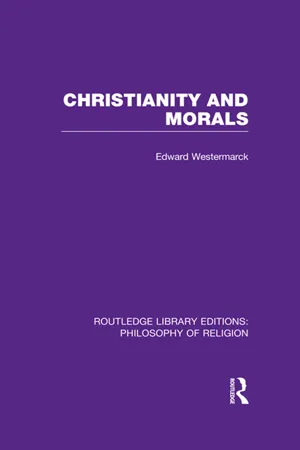
A thorough examination of many aspects of morality through the lens of Christianity, this book, originally published in 1939, is philosophical in its approach to assessing religion. It compares moral traditions of many world religions and describes their changes over time as well. Written accessibly, this is a fascinating outlay of moral theology.
- 448 pages
- English
- ePUB (mobile friendly)
- Available on iOS & Android
eBook - ePub
Christianity and Morals
About this book
Trusted by 375,005 students
Access to over 1.5 million titles for a fair monthly price.
Study more efficiently using our study tools.
Information
Topic
PhilosophySubtopic
Philosophy History & TheoryChapter I
Religion and Morality
CHRISTIANITY is in the first place a religion but, as in the case of many other religions, it contains moral aspects closely connected with the purely religious ones.
The term religion has been used in many different senses, and it is therefore necessary that I should define what I mean by it. I take religion in the abstract, so to speak, as distinguished from any concrete religion, to be a belief in and a regardful attitude towards a supernatural being, on whom man feels himself dependent and to whom he makes an appeal in his worship. This definition seems to be in agreement with the most common usage of the word. It has been criticised on the ground that it would not apply to genuine Buddhism. But Buddhism was originally a metaphysical and ethical doctrine, which was transformed into a religion when the old gods of Brahmanism came back, when Buddha himself was deified, and Buddhism incorporated most of the local deities and demons of those nations it sought to convert.
The belief in supernatural beings is undoubtedly based on a feeling of uncanniness or mystery. Men distinguish between phenomena that they are familiar with and consequently ascribe to “natural” causes, and other phenomena that seem to them unfamiliar and mysterious and are looked upon as “supernatural,” or are supposed to spring from “supernatural” causes. We meet with this distinction among savages as well as civilised races. It may be that in the mind of a savage the natural and supernatural often overlap, that no definite line can be drawn between the phenomena which he refers to one class and those which he refers to the other; but he certainly sees a difference between events of everyday occurrence or ordinary objects of nature and other events or objects which fill him with a feeling of wonder or mysterious awe. The feeling of mystery and the germ of a distinction between the natural and the supernatural are found even in the lower animal world. The horse fears the whip, but it does not make him shy; on the other hand, he may shy when he sees an umbrella opened before him or a paper moving on the ground. The whip is well known to the horse, whereas the moving paper or the umbrella is strange, uncanny, let us say “supernatural.” I had a mule that took no notice of a volley of guns discharged close to her, because she had been in war and was used to the sound, whereas she might take fright when she met a goat or saw an unusually large stone at the side of the road. Dogs and cats are alarmed by an unusual noise or appearance, and remain uneasy till they have by examination satisfied themselves of the nature of its cause.1 Even a lion is scared by an unexpected sound or the sight of an unfamiliar object;2 and we are told of a tiger who stood trembling and roaring in a paroxysm of fear when a mouse tied by a string to a stick had been inserted into its cage.3 Little children are apt to be terrified by the strange and irregular movements of a feather as it glides along the floor or lifts itself into the air.4
Supernatural qualities are not only attributed to beings who are able to work wonders at will: the supernatural, like the natural, may also be looked upon in the light of mechanical energy, which discharges itself without the aid of any volitional activity. Such energy is utilised in magic. In religion, man appeals to or worships supernatural beings by natural means, such as prayers, offerings, abstinences and so forth; in magic, he attempts to influence either natural or supernatural objects or persons by supernatural means which act mechanically and coercively. The religious attitude is in its nature respectful and humble, the magical attitude is domineering and self-assertive. At the root of the difference between religion and magic there is thus a difference in the mental state of the persons who practise them. So far as religion is concerned, this agrees well with the notion so forcibly expressed by Schleiermacher, that the religious feeling is in its essence a feeling of dependence; whereas the word magician invariably suggests the idea of a person who claims to possess power and to know how to wield it in the magic art. In order to achieve his aim he may make use of spirits, but then he coerces them; if he tried to gain their assistance by propitiation, his attitude would be religious, not magical.
This view of magic finds support in mediaeval conceptions of it. It is true that the theologians mostly attributed the success of magic to demons, who were enticed by men to work marvels; but the demons were able to do so largely through their superior knowledge of the forces of nature.5 And besides the marvels worked by spirits, there were others which were produced without their aid, simply by the wonderful virtues inherent in certain objects of nature. To marvels wrought in this manner William of Auvergne applied the term “natural magic.”6 Albertus Magnus likewise associated magic with natural forces and the stars, as well as with demons;7 and Thomas Aquinas, though upholding the opinion that magic is due to demons, gives us a glimpse of a different conception of it, according to which magicians were able by personal qualifications, by subtle use of occult natural properties, by rites and ceremonies, and by the art of astrology, either to work wonders directly and immediately or to coerce demons to work wonders for them.8
Another view concerning the difference between religion and magic has been expressed by certain writers, from Robertson Smith onwards, who maintain that religion is social in its aim and magic at any rate non-social,9 or that magic includes “all bad ways, and religion all good ways, of dealing with the supernormal, bad and good as the society concerned judges them.”10 This use of the terms, however, is not in agreement with the most authoritative traditional usage. Besides black magic there is also white magic. Even mediaeval theologians distinguished between good and bad magic. William of Auvergne (†249), whose works present an unexpectedly detailed picture of the magic and superstition of his time, sees no harm whatever in “natural magic,” unless it is employed for evil ends; he observes that the workers of it are called magi, because they do great things (magna agentes), whereas others, who work magic by the aid of demons, are to be regarded as evil-doers.11 Albertus Magnus defends the Magi of the gospel story and tries to exculpate them from the practice of those particular evil, superstitious, and diabolical occult arts which Isidore and others had included in their definitions of magic. “They were not devoted to any of these arts,” he says, “but only to magic as it has been described; and this is praiseworthy.” He was himself a believer in occult forces and marvels in nature, showed a leaning to the occult sciences, and was called, even by his panegyrists, magnus in magia and in magicis expertus.12 In the Liber aggregations, a very popular treatise on magic which has been ascribed to Albertus but is of dubious authenticity, it is said that magical science (scientia magicalis) is not evil, since by knowledge of it evil can be avoided and good attained.13
Nor does the definition according to which magic includes all bad ways and religion all good ways of dealing with the supernormal seem to me at all suitable for the purpose of scientific classification. It implies, for example, that a prayer to a god for the destruction of an enemy must be classified as religion if it is offered in a cause which is considered just by the community, but as magic if it is disapproved of. When a man makes a girl drink a love-potion in order to gain her favour, it is religion if their union is desirable from the society’s point of view, but if he gives the same drink to another man’s wife it is magic. The best part of what has been hitherto called imitative or homœopathic magic no longer remains magic at all; if water is poured out for the purpose of producing rain, it is homoeopathic magic only in case rain is not wanted by the community, but if it is done during a drought it is religion. The acceptance of the view that the very same practices are religious or magical according as they have social or anti-social ends would overthrow well-established and useful terms and deprive us of the comprehensive, convenient, and in every respect appropriate attribute “magical” for all sorts of supposed impersonal occult or supernatural forces.
In spite of the essential difference between religion and magic they have, nevertheless, been connected with each other in various ways. Owing to the element of mystery which is found in both, magical forces may be personified as spirits or gods, or be transformed into divine attributes or lead to divine injunctions; and magical practices may become genuine acts of religious worship, or acts of worship may become magical practices. Numerous instances of such transformations have been given in my book on the Origin and Development of the Moral Ideas. For example: the magical forces which give efficacy to curses have been personified as supernatural beings, like the Greek Erinyes of parents,14 beggars,15 and guests,16 and the Roman divi parentum,17 dii hospitales,18 and Terminus;19 or they may be transformed into attributes of the chief god, as in the case of Jupiter Terminalis or Zεύς ὄϱιος.20 The injurious energy attributed to work performed on the seventh day developed into a religious prohibition,21 and the uncanny feeling experienced in mentioning the name of a supernatural being readily leads to the belief that he feels offended if his name is pronounced.22 Curses and blessings become prayers;23 and on the other hand, prayers become spells which are believed to constrain the gods to whom they are addressed. This appears from the words of many formulas that are used as magical incantations. Assyrian incantations are often dressed in the robe of supplication and end with the formula, “Do so and so, and I shall gladden thine heart and worship thee in humility.”24 Vedic texts which were not originally meant as charms became so afterwards. Incantations are comparatively rare in the Rig-Veda, and seem even to be looked upon as objectionable, but towards the end of the Vedic period the reign of Brahma, the power of prayer, as the supreme god in the Indian pantheon began to dawn.25 The prayer is imbued with supernatural energy owing to the holiness of the being to whom it is addressed, and its constraining force may then be directed even against the god himself.
But the connection between religion and magic may be still more intimate. I have hitherto spoken of religion in the abstract, as distinguished from any concrete religion. In the popular sense of the word, which certainly must be respected, a religion may include many practices which are what I have called magical. In the ancient religions of the East religion and magic are indissolubly mixed up together. According to Mohammedan orthodoxy the Arabic words of the Koran work miracles. The Christian sacraments of baptism and the Eucharist are rooted in magical ideas, and the efficacy ascribed to them has always retained a more or less magical character.26 Although the magical and the strictly religious attitudes differ from each other, they are not irreconcilable, and may therefore very well form parts of one and the same religion; there is no such thing as a magic being opposed to a religion. By a religion is generally understood a system of beliefs and rules of behaviour which have reference to, or are considered to be prescribed by, one or several supernatural beings whom the believers call their god or gods—that is, supernatural beings who are the objects of a regular cult and between whom and their worshippers there are established and permanent relationships. If it is admitted that the word “religion” may thus be legitimately used in two different senses, an abstract and a concrete, I think there is little ground left for further controversy as regards the relation between religion and magic.
While the origin of religion may be traced to the feeling of uncanniness and mystery, the moral consciousness has an entirely different foundation. For a discussion not only of the general relations between religion and morality, but also of my particular subject—the relations between Christianity and morals—I find it necessary to give a summary of my views concerning the nature of the moral consciousness, which I have expounded in detail in earlier works.27 The reader will notice what a fundamental position these views occupy in my arguments.
All moral concepts, which are used as predicates in moral judgments, are ultimately based on one or the other of the two emotions, moral approval and moral disapproval or indignation. Both of them belong to a wider class of emotions, which I have called retributive emotions. Moral disapproval is a kind of resentment, by which I understand a hostile attitude of mind towards a living being (or something taken for a living being) conceived as a cause of inflicted pain; moral approval is a retributive kindly emotion, that is, a friendly attitude of mind towards such a being conceived as a cause of pleasure. They are related to other kinds of resentment or retributive kindly emotion: moral disapproval to anger and the feeling of revenge, and moral approval to gratitude. But the moral emotions differ from those non-moral retributive emotions by being disinterested and, at least within certain limits, impartial. If some one inflicts an injury upon me, or upon a friend of mine, and I feel indignant in consequence, my indignation can be called a moral emotion only if it is felt independently of the fact that it was I or my friend who was hurt; it must be possible to assume that I should have experienced the same emotion if another similar person in similar circumstances had been subjected to the same treatment. Otherwise my emotion of resentment would have been not moral disapproval, but personal anger. So also, the kindly emotion which I feel for a benefactor can be called moral approval only on condition that it is disinterested and impartial; otherwise it would be personal gratitude.
The origin of retributive emo...
Table of contents
- Cover
- Half Title
- Title Page
- Copyright Page
- Original Title Page
- Original Copyright Page
- Table of Contents
- Chapter I: Religion and Morality
- Chapter II: Religion and Morality (concluded)
- Chapter III: The Ethics of Jesus: Their Retributive Character
- Chapter IV: The Ethics of Jesus: Their Disinterestedness and Altruism
- Chapter V: The Ethics of Jesus (concluded)
- Chapter VI: The Ethics of Paul
- Chapter VII: Theological Doctrines before Augustine
- Chapter VIII: Later Theological Doctrines
- Chapter IX: Asceticism
- Chapter X: The Sacraments
- Chapter XI: Christianity and the Regard for Human Life
- Chapter XII: Christianity and the Regard for Human Life (concluded)
- Chapter XIII: Christianity and Economics
- Chapter XIV: Christianity and Slavery
- Chapter XV: Christianity and the Regard for Truth
- Chapter XVI: Christianity and Marriage
- Chapter XVII: Christianity and Divorce
- Chapter XVIII: Christianity and Irregular Sex Relations
- Chapter XIX: Christianity and the Regard for the Lower Animals
- Chapter XX: Summary and Concluding Remarks
- Index of Persons
- Index of Subjects
Frequently asked questions
Yes, you can cancel anytime from the Subscription tab in your account settings on the Perlego website. Your subscription will stay active until the end of your current billing period. Learn how to cancel your subscription
No, books cannot be downloaded as external files, such as PDFs, for use outside of Perlego. However, you can download books within the Perlego app for offline reading on mobile or tablet. Learn how to download books offline
Perlego offers two plans: Essential and Complete
- Essential is ideal for learners and professionals who enjoy exploring a wide range of subjects. Access the Essential Library with 800,000+ trusted titles and best-sellers across business, personal growth, and the humanities. Includes unlimited reading time and Standard Read Aloud voice.
- Complete: Perfect for advanced learners and researchers needing full, unrestricted access. Unlock 1.5M+ books across hundreds of subjects, including academic and specialized titles. The Complete Plan also includes advanced features like Premium Read Aloud and Research Assistant.
We are an online textbook subscription service, where you can get access to an entire online library for less than the price of a single book per month. With over 1.5 million books across 990+ topics, we’ve got you covered! Learn about our mission
Look out for the read-aloud symbol on your next book to see if you can listen to it. The read-aloud tool reads text aloud for you, highlighting the text as it is being read. You can pause it, speed it up and slow it down. Learn more about Read Aloud
Yes! You can use the Perlego app on both iOS and Android devices to read anytime, anywhere — even offline. Perfect for commutes or when you’re on the go.
Please note we cannot support devices running on iOS 13 and Android 7 or earlier. Learn more about using the app
Please note we cannot support devices running on iOS 13 and Android 7 or earlier. Learn more about using the app
Yes, you can access Christianity and Morals by Edward Alexander Westermarck in PDF and/or ePUB format, as well as other popular books in Philosophy & Philosophy History & Theory. We have over 1.5 million books available in our catalogue for you to explore.