This book represents a selected collection of the writings, from 1950 to 1960, of members of the Human Relations Research Group (HRRG), from UCLA. The writings are followed by independent comments and appraisal from different viewpoints, prepared by distinguished experts in management theory, group psycho-therapy and psychology and sociology.
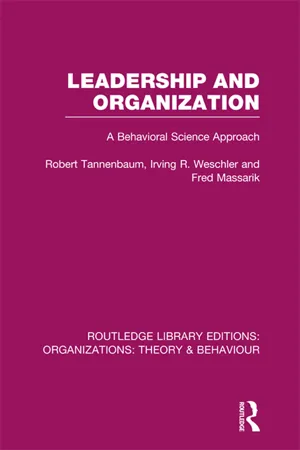
eBook - ePub
Leadership and Organization (RLE: Organizations)
A Behavioural Science Approach
- 468 pages
- English
- ePUB (mobile friendly)
- Available on iOS & Android
eBook - ePub
Leadership and Organization (RLE: Organizations)
A Behavioural Science Approach
About this book
Trusted by 375,005 students
Access to over 1.5 million titles for a fair monthly price.
Study more efficiently using our study tools.
Information
PART ONE
Leadership and the Influence Process
Introduction
Our designation as the Human Relations Research Group has had its advantages and limitations. At the time we chose the name, we could think of none better to characterize the interdisciplinary, people-oriented character of our group and its research interests. The term human relations was a relatively new one, but it was being widely used; the term behavioral sciences, with its present connotations, was not then employed extensively.
In the years which have followed, “human relations” has taken on a variety of meanings, an outcome which has confused discourse rather than clarified it. To some, the term came to designate a “new movement” of significance; to others, it appeared a miraculous panacea. For others still (perhaps for many) the term acquired negative connotations. Inevitably such negative affect may have some impact, small or great, on the mental set which our readers bring to this book.
We therefore feel it appropriate to introduce not only Part 1 but also the book with a chapter (Chapter 1) which attempts to clarify the use of the term “human relations,” to make explicit what we mean by it, and to face head-on the major expressed reasons for the negative affect. It is our hope that the reader will view our work in a context of this expression of meaning and of values.
Central to the work of our group since its formation has been the notion of leadership and the influence process. Implicitly in our early years, and explicitly in more recent years, this notion has provided a framework which has guided much of our work; no doubt, it will continue to do so.
We have found this framework to be a most useful one. The social process by which one person attempts to influence one or more other persons is encountered in a large variety of interpersonal relationships; e.g., the superior-subordinate, the staff-line, the consultant-client, the salesman-customer, the teacher-student, the counselor-counselee, the husband-wife, and the parent-child. These relationships always occur in, are affected by, and in turn affect a context of groups, organizations, and cultures. Thus, a more adequate understanding of leadership must depend upon increased insight into the nature of many personality, group, organizational, and cultural variables and their interrelationship and interaction in a system of influence.
Our framework, presented in Chapter 2, has provided the common thread which has loosely bound together our separate studies and our attempts at concept formulation. It has also helped us in our continuing efforts to integrate the findings of others with our own.
Two elements contained in our leadership framework have entered strongly into our formulations, research, and practice in recent years. These are social sensitivity (or empathy) and action flexibility (or behavioral flexibility). We consider both of these variables as being of key importance in contributing to leadership effectiveness. Our research work to date has given primary attention to the former, while our formulations and practice have leaned heavily on both.
The meaning of social sensitivity in the cultural context of today is presented in Chapter 3. An explanation is offered as to why the notion has become important and of considerable interest to many. At the same time, limits to the application of the concept are presented. In Chapter 4, the process of social perception is examined with reference to its three basic aspects: the perceiver, the perceived, and the situation or total setting within which perception occurs. Major barriers and aids to one's accuracy of social perception (or social sensitivity) are then considered and illustrated.
The challenging issue of choosing from among alternative leadership styles is presented and analyzed in Chapter 5. Types of behavior available to the leader are described, and criteria are presented to guide the leader in his choice from among these. Two major implications are drawn: the successful leader is one who is keenly aware of the forces which are most relevant to his behavior at any given time; and he is one who is able to behave appropriately in the light of such understanding. Thus, once again, these are the notions of social sensitivity and action flexibility.
Broadly speaking, the objective of all leadership attempts is change— change in motivation, in attitudes, in behavior, etc., whether at the level of the individual or of the group. Chapters 6 and 7 present different facets of the problem of change. Chapter 6 analyzes key elements underlying the effective introduction of change in an organizational context. Symptoms of resistance to change are described, and the causes of such resistance are considered. A conclusion is drawn that the resistance of managers themselves to the adoption of new methods of management may represent one of the most serious barriers to the introduction of change in organizations. Chapter 7 views participation by subordinates in the managerial decision-making process as a means for the introduction of change. Participation is defined, the advantages of participation as a managerial device are considered, and many conditions essential to effective participation are analyzed.
This part concludes with Chapter 8, in which an increasingly critical leadership problem is diagnosed—the problem of managing differences, whether within the individual or between individuals, groups, or organizations. The leader is often threatened by the existence (present or potential) of such differences and, as a result, deals with them ineffectively. But differences can be utilized constructively in the attainment of leadership objectives. Alternative methods for dealing with differences are presented, and the conditions for their use are considered.
CHAPTER 1
Some Basic Issues in Human Relations*
Human relations today has its iconoclasts and believers, critics and supporters, detractors and zealots. This is not surprising; for during the past twenty years, numerous research groups have burgeoned, and many individual investigators have become most active in the field.
There has been a fantastic outpouring of professional and popular books and articles, untold new or revised college and university offerings, a plethora of in-plant training courses, a growing number of training laboratories and seminars, and a seemingly ever-increasing schedule of meetings and speeches—all concerned, in whole or in part, with “human relations.”
It is to be expected that such a rapid and extensive development— involving persons with widely disparate education and experience, and carrying with it numerous challenges to contemporary ideas and practice—should become a focal point for controversy. In the face of such controversy, excesses (whether pro or con) have been inevitable and confusion rampant. Little wonder, then, that the innocent bystander has increasingly been asking: “What is this Tiuman relations’ all about?”
Quite recently, and appropriately, a number of evaluative articles have appeared, each attempting to appraise this new development.1 Some of them have been written by partisans; nevertheless, each makes a valuable contribution by highlighting trends, clarifying principal issues, or raising basic questions.
The present chapter represents an effort to make a further contribution to current discussion. For a number of years, we have thought extensively about, done research in, taught, and practiced in the area of human relations. With this background of experience as a base, an attempt will be made to bring some order out of the chaos which often surrounds the use of the term “human relations” and to indicate what the term now means to us. We will then present and react to some of the most frequently recurring criticisms directed at this new field.
WHAT IS “HUMAN RELATIONS”?
Writing in 1950, John W. McConnell stated: “Facetiously, someone has remarked that human relations are whatever those interested in human relations study. If one may judge by the divergent approaches of a number of research groups, no single definition is at present possible.”2 Not only have the approaches of research groups diverged, but so have the usages of teachers, speakers, writers, practitioners, and the lay public. In the decade since McConnell wrote his article, little has occurred to dispel the confusion.
Often the key source of difficulty in professional and public discourse on human relations is a semantic rather than a substantive one. Certainly the term “human relations” means different things to different men; as a result, adversaries talk about different things, frequently without knowing it. Certainly, if the term is to continue in use, greater precision in its employment will be needed.
Four principal denotations of “human relations” have developed in usage during recent decades. The term has variously referred to inter-and intrapersonal phenomena, to a tool kit for practitioners, to an ethical orientation, and to an emerging scientific discipline.
Human Relations as Inter- and Intrapersonal Phenomena
The term is most frequently employed to refer to interpersonal phenomena. These phenomena may be involved in the relations between one person and another; among the members of a group; between one group and another; among the persons and groups in an organization; between one organization and another; among the persons, groups, and organizations in a culture; and between cultures.
The individual often strives to improve his human relations. The manager refers to human relations in his plant. Municipal and community commissions on human relations concern themselves with the relations among various religious and ethnic groups. And so it goes. True, some more specific terms have emerged to denote certain relations—for example, personnel relations; group dynamics; union-management relations, or industrial relations; public relations; and international relations—and yet the term “human relations” continues to be used at times to refer to each.
The term has been used less frequently to refer to infrapersonal phenomena—variables involved in the relationship of an individual with himself. These factors have been of concern to therapists, clinicians, counselors, and educators. Illustrative of these phenomena are the characteristics of a person's internal communication network, including the relationship between his conscious and unconscious selves.
Human Relations as a Tool Kit for Practitioners
The term is often used to denote a variously conceived collection of methods and techniques for dealing with problems arising out of inter-and intrapersonal relations. In some instances, these have procedural implications, as in role playing, buzz grouping, T-group training, the use of consultants and of panels, consultative supervision, participative management, and brainstorming. In other instances, these have behavioral implications, as in listening, conveying acceptance, and avoiding defensiveness and aggressiveness. The purpose of many human relations courses, seminars, and programs offered by industrial organizations, schools, and others is to make available to the participant some new human relations devices. And these are often expectantly sought as “open sesames” to increased interpersonal effectiveness.
Human Relations as an Ethical Orientation
The term often suggests values. It implies both “good” practice in the use of the tool kit and a “high” quality of interpersonal relations. For example, human relations is “an ethical system emphasizing the positive good that may result from the right kind of interrelationships among people.” It is “a spirit of cooperation and understanding among individuals and groups at all levels of the organization”; “the attitude of one human being toward another”; “the dignity, the sense of satisfaction, the feeling of security, or the lack of it that individuals have in an organization”; “how well people get along with one another, showing ethical regard for each other”; “liking and disliking”; “considerate behavior”; “good manners”; “decencies of relationships.”3 In this usage, human relations is both a guide for behavior and a desirable end to be sought.
Human Relations as a Scientific Discipline
Finally, the term “human relations” is being used to denote a field of inquiry—one which cuts across the jurisdictional boundaries of the traditional social sciences in an effort to avoid fragmented, compartmentalized, or partial approaches to human problems.
In an important sense, this field meets an often-expressed need for a more unified approach. As early as 1928, Max Scheler felt that “ … we no longer possess any clear and consistent idea of man. The ever-growing multiplicity of the particular sciences that are engaged in the study of men has much more confused and obscured than elucidated our concept of man.”4 Twenty years later, in a context of research in industrial relations, Professor E. Wight Bakke made this closely related observation:5
It is obvious that the problem of human behavior with which we are dealing can not be understood in terms of psychology or any one of the social sciences alone. Is it not possible, therefore, that in attempting to follow the problem wherever it leads us, and employing whatever concepts and research techniques are relevant, we shall be able to define the problem in such a way and develop concepts and a theoretical framework of such a nature that a major contribution will be made to the foundation for an integrated social and psychological science? Whether or not this result appears possible or attractive to present scholars in these fields, we who are studying industrial relations are forced to work in this direction. It is not a case of choice alone, but of necessity, for we can not get results sa...
Table of contents
- Cover Page
- Half Title Page
- Title Page
- Copyright Page
- Original Title Page
- Preface
- Contents
- Part One Leadership and the Influence Process
- Part Two Sensitivity Training: A Personal Approach to the Development of Leaders
- Part Three Studies in Organization
- Part Four Commentaries
- Bibliographies
- Name Index
- Subject Index
Frequently asked questions
Yes, you can cancel anytime from the Subscription tab in your account settings on the Perlego website. Your subscription will stay active until the end of your current billing period. Learn how to cancel your subscription
No, books cannot be downloaded as external files, such as PDFs, for use outside of Perlego. However, you can download books within the Perlego app for offline reading on mobile or tablet. Learn how to download books offline
Perlego offers two plans: Essential and Complete
- Essential is ideal for learners and professionals who enjoy exploring a wide range of subjects. Access the Essential Library with 800,000+ trusted titles and best-sellers across business, personal growth, and the humanities. Includes unlimited reading time and Standard Read Aloud voice.
- Complete: Perfect for advanced learners and researchers needing full, unrestricted access. Unlock 1.5M+ books across hundreds of subjects, including academic and specialized titles. The Complete Plan also includes advanced features like Premium Read Aloud and Research Assistant.
We are an online textbook subscription service, where you can get access to an entire online library for less than the price of a single book per month. With over 1.5 million books across 990+ topics, we’ve got you covered! Learn about our mission
Look out for the read-aloud symbol on your next book to see if you can listen to it. The read-aloud tool reads text aloud for you, highlighting the text as it is being read. You can pause it, speed it up and slow it down. Learn more about Read Aloud
Yes! You can use the Perlego app on both iOS and Android devices to read anytime, anywhere — even offline. Perfect for commutes or when you’re on the go.
Please note we cannot support devices running on iOS 13 and Android 7 or earlier. Learn more about using the app
Please note we cannot support devices running on iOS 13 and Android 7 or earlier. Learn more about using the app
Yes, you can access Leadership and Organization (RLE: Organizations) by Robert Tannenbaum,Irving Weschler,Fred Massarik in PDF and/or ePUB format, as well as other popular books in Business & Business General. We have over 1.5 million books available in our catalogue for you to explore.