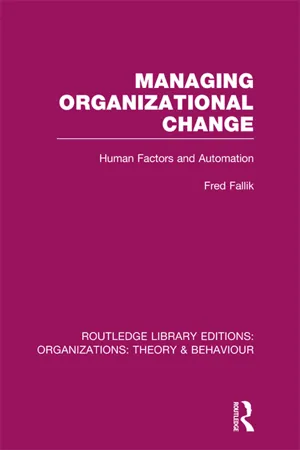
The United States Internal Revenue Service introduced a multi-million dollar program to automate its operations in the early 1980s. This book describes a multidisciplinary study of the experiences of several thousand users in this program, based primarily on questionnaires, observation and interviews. The case study gives valuable guidance to managers and their consultants involved in planning introduction of new office technology, as well as providing more academic insights into aspects of human behaviour under changing working conditions.
eBook - ePub
Managing Organizational Change (RLE: Organizations)
Human Factors and Automation
- 172 pages
- English
- ePUB (mobile friendly)
- Available on iOS & Android
eBook - ePub
About this book
Trusted by 375,005 students
Access to over 1.5 million titles for a fair monthly price.
Study more efficiently using our study tools.
Information
Subtopic
Business GeneralIndex
BusinessAppendix 1
Recommendations by the Human Resources Technology Staff
Introduction
Reacting to a concern that human factors were not being given appropriate attention as the Internal Revenue Service moves into automation, a working group was established to make recommendations on steps to be taken to address this issue.
The group has identified and will be focusing on five basic approaches to include human factors considerations in an automated environment. These five approaches will be introduced and developed during the Automated Collection System (ACS) pilots in four districts. Because of the advanced status of the ACS pilots and because of the vendor competition, such activities will be limited. Techniques developed during the pilots will be refined for use in other Service automation efforts.
The five approaches discussed in this paper are as follows:
Institute an Employee/Manager feedback system
Increase Employee/Manager interpersonal contact
Introduce new Orientation and Training modules relevant to preparing for technological change
Design innovative working arrangements to humanize work
Seek Labor/Management cooperation through early union involvement
The attached outline encompasses a series of proposed actions to incorporate human resources factors into automated systems planning and implementation. The recommendations were designed to be independent of each other. That is, the potential exists to delete one or more recommendations without seriously affecting the implementation of other recommendations. The one exception would be that actions which require the acquisition of new knowledge and skills would require training.
The outline itself is comprised primarily of two broad topic areas: The first area describes Phase I recommendations primarily concerned with the ACS pilots. Phase II recommendations will be initiated during Phase I and describe long term experiments extending beyond ACS. Phase I and Phase II of the outline focus on specific areas of concern to human resources and present recommendations to address these issues. In addition, Sections III and IV list some anticipated results of our proposals and outline Labor/Management Relations Implications.
Human Resources Technology Staff recommendations
I. Initial scope of actions to be implemented beginning now and continuing through ACS pilot
Given Assumptions:
No additional National Office personnel evaluation teams at pilot sites as a result of this proposal.
No significant work interruptions during duty hours.
Employee/manager feedback system
Employee feedback systems are designed to accomplish four broad objectives:
Provide a mechanism for identifying problems arising out of the use or anticipated use of automated equipment and potential resolutions to these problems.
Provide ‘base line’ data for assessing and evaluating the impact of automated equipment on organizational functions within a wide range of variables.
Provide an opportunity for users to suggest new applications and approaches for enhanced organizational effectiveness, e.g., tasks, procedures, group processes, structure.
To detect further training needs, refinements, etc.
The following systems would utilize a micro-computer to input, FTS lines for transmission (estimated to be up to one hour per day), and a receiving micro-computer in the National Office during the ACS pilot period. Once the vendor is selected, use of ACS equipment should be explored.
The National Office will purchase or contract for the purchasing of the computers for the ACS districts in addition to the one to be located in the Human Resources Technology Group in Washington. National Office Collection and the National Office ACS Project Team will each have a micro-computer linked to this system. Collection and ACS will be utilizing the system to transmit data related to their respective evaluation processes.
1. ELECTRONIC EMPLOYEE/MANAGER FEEDBACK
Employees and managers would be asked to record problems or suggestions for improvements on a specially designed card. These cards would then be collected and fed to the National Office work group via a computer link. The group would use these employee reactions to identify: (1) changes in employee attitudes toward work, the environment, supervision, the social atmosphere, etc.; (2) procedural, mechanical or systemic equipment problems; and (3) additional training needs.
In addition to the identification of immediate and potential problems and opportunities for improvement, results could be used in the design of long-range planning for future automation projects.
This concept could also allow for employee feeling of involvement in the test process outside of equipment testing. It may well also offset to some extent some of the negative aspects of a production oriented system.
In order to protect the vendor evaluation process, it may be necessary to pool information from all call sites in order to erase site identification. If this concern could be overcome, there is some advantage to evaluating data with site identification in the interest of overall test validation.
Such a system might also be used by the ACS System Acceptability Test (SAT)/Evaluation Team as a direct information feed to the National Office Automated Collection System organization.
It is also recommended that a system be explored to utilize the vendor's computers to provide periodic feedback to employees on the results of their contacts (such as dollar amounts of payments made).
2. EMPLOYEE QUESTIONNAIRE
An employee questionnaire would be designed to gather data on changing employee attitudes toward all aspects of their work—environment, comfort, supervision received, space, social atmosphere, etc. The questionnaire would be administered on the first day of training, at least once during the pilot, and following the pilot.
The content areas of the questionnaire would include the following:
Organizational communication patterns
Organizational leadership styles
Job satisfaction
Group processes
Feedback systems
Career orientation
Sociodemographic factors
Organizational climate
Ergonomic concerns
The questionnaire is designed to be self-administered in about 15 to 20 minutes. Responses will be both closed and open-ended. The results of this questionnaire will be computer and content analyzed for patterns of responses.
3. EXIT INTERVIEWS
During the course of the pilot project some attrition of employees is expected. While people leave a job for a variety of reasons, those reasons which arise from pilot working conditions need to be documented and evaluated.
To supplement the prescribed exit interview process, we propose to develop an interview guide. This interview guide will be focused on issues pertinent to the pilot program. More specifically, we will attempt to have the interviewer gather narrative information on ergonomic, social and administrative factors which contributed to the decision of the employee or manager to withdraw from the ACS pilot program.
Such information will be collected as an adjunct to the normal exit procedures. An interview guide will be developed by the Human Resources Technology group and distributed to appropriate staff at each test site for administration as attrition occurs. Completed forms will be forwarded to the National Office Staff following each interview.
Employee/manager interpersonal contact
Decreased personal contact due to the new automated system dictates a need for structuring alternatives for increased interpersonal dealings. Studies of computer-mediated work and offices with information technology systems indicate that people can feel isolated in an impersonal situation. They may also feel they have lost the support and assistance they previously received from communication with peers and supervisors. These feelings can hamper the productivity goals of the organization if they result in reduced job satisfaction, job commitment and appropriate risk taking.
We recommend that the following actions be considered by local managers:
1.Managers review their current practices for managerial staff meetings and employee-supervisor individual and group meetings, then determine any obvious improvements in local communication and problem-solving they feel are necessary under the existing work environment. Given the increased data available under the ACS system, they can project any improvements they wish to implement under the new system.
2.Recognizing that a 43 % overhead figure has been built into ACS staffing we recommend that managerial, employee and employee/manager team meetings should be held during duty hours. Meetings could be held periodically or weekly as needed. Length...
Table of contents
- Cover
- Half Title
- Title Page
- Copyright Page
- Title Page
- Original Copyright Page
- Table of Contents
- Dedication
- Preface
- Disclaimer
- Acknowledgements
- Section I. Background
- Section II. Automation Implementation
- Section III. Lessons Learned
- Appendix 1
- Appendix 2
- Appendix 3
- References
- Additional Resources
- Index
Frequently asked questions
Yes, you can cancel anytime from the Subscription tab in your account settings on the Perlego website. Your subscription will stay active until the end of your current billing period. Learn how to cancel your subscription
No, books cannot be downloaded as external files, such as PDFs, for use outside of Perlego. However, you can download books within the Perlego app for offline reading on mobile or tablet. Learn how to download books offline
Perlego offers two plans: Essential and Complete
- Essential is ideal for learners and professionals who enjoy exploring a wide range of subjects. Access the Essential Library with 800,000+ trusted titles and best-sellers across business, personal growth, and the humanities. Includes unlimited reading time and Standard Read Aloud voice.
- Complete: Perfect for advanced learners and researchers needing full, unrestricted access. Unlock 1.5M+ books across hundreds of subjects, including academic and specialized titles. The Complete Plan also includes advanced features like Premium Read Aloud and Research Assistant.
We are an online textbook subscription service, where you can get access to an entire online library for less than the price of a single book per month. With over 1.5 million books across 990+ topics, we’ve got you covered! Learn about our mission
Look out for the read-aloud symbol on your next book to see if you can listen to it. The read-aloud tool reads text aloud for you, highlighting the text as it is being read. You can pause it, speed it up and slow it down. Learn more about Read Aloud
Yes! You can use the Perlego app on both iOS and Android devices to read anytime, anywhere — even offline. Perfect for commutes or when you’re on the go.
Please note we cannot support devices running on iOS 13 and Android 7 or earlier. Learn more about using the app
Please note we cannot support devices running on iOS 13 and Android 7 or earlier. Learn more about using the app
Yes, you can access Managing Organizational Change (RLE: Organizations) by Fred Fallik in PDF and/or ePUB format, as well as other popular books in Business & Business General. We have over 1.5 million books available in our catalogue for you to explore.