This study offers students of religion and philosophy introductory chapters concerning the concept of natural religion. It holds that we can't engage in useful discussion about the present concept of religion without a knowledge of the philosophical history that has shaped that concept. This is discussed with reference to the notion of natural religion to illustrate certain aspects of deism and its legacy. Originally published in 1989.
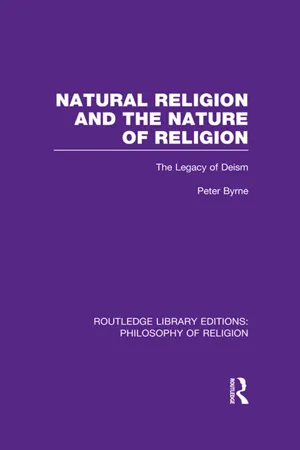
- 296 pages
- English
- ePUB (mobile friendly)
- Available on iOS & Android
eBook - ePub
About this book
Trusted by 375,005 students
Access to over 1.5 million titles for a fair monthly price.
Study more efficiently using our study tools.
Information
Topic
Philosophie1

The Concept of Natural Religion
Natural and Revealed Religion
The concept of natural religion is not a unitary notion. Of the many senses of the phrase ‘natural religion’ to be found in philosophical thought four will occupy our attention as we trace the emergence of the concept of religion. Three can be brought out by considering the oppositions or distinctions in which ‘natural religion’ or the allied ‘natural theology’ can figure. These oppositions are: (1) natural religion (theology) versus revealed peligion (theology); (2) natural theology versus civil and mythic theology; (3) natural religion versus supernatural religion. The fourth sense of ‘natural religion’ to be treated does not fit so easily into a pair of opposites, being used to refer to a natural human religiousness. All these modes of natural religion (theology) will be explored in sections of this chapter. In this section the first sense and contrast will be discussed.
The contrast between natural religion and revealed religion is likely to give the student a first aquaintance with the notion of natural religion. It is implicit in the title of Hume’s celebrated Dialogues concerning Natural Religion. A student is likely to be told by way of explaining Hume’s title that the natural religion mentioned is nothing more than an expanded version of the natural theology used by Christian apologists such as Aquinas. Natural theology contains a body of truths about God and his relationship to the world discoverable by the use of unaided human reason and is contrasted with a body of truths – revealed theology – discoverable only by reflection on God’s special revelation in history. Cleanthes’ natural religion in Hume’s Dialogues is Aquinas’ natural theology writ large and can be explained through a similar contrast. It is, however, thought capable of enjoying an independence of revealed theology/religion not contemplated by Aquinas.
The readiness to explain this distinction between natural and revealed theology by reference to Aquinas receives an initial disappointment when we turn to the classic texts which are the source of the distinction, for in neither the Summa Theologiae nor the Summa contra Gentiles is the opposition drawn in these terms. Aquinas in fact tends to use ‘natural theology’ in the second sense to be explored in this chapter. The substance, if not the terminology, of the distinction between revealed and natural theology is certainly to be found in Aquinas:
For certain things that are true about God wholly surpass the capability of human reason, for instance that God is three in one: while there are certain things to which even the natural reason can attain, for instance that God is one, and others like these, which even the philosophers proved demonstratively of God, being guided by the light of natural reason.
(Aquinas 1924:I, 3)
The distinction between these two sorts of truths is absorbed into a distinction between what theology or sacred science can demonstrate about God and what philosophy can demonstrate. The grounds of this distinction will be familiar and so need only the briefest mention here. Through the fact of the creation a general revelation of God’s existence and his nature as first cause is accessible to reason from the character of the world around us. Other matters, relating to God-as-saviour, are dependent on grace and revelation for their discovery. Aquinas’ reasons for not relying wholly on reason in the discovery of theological truth will likewise be familiar. Only a brief summary is required to enable the contrasting views of later writers, particularly the deists, to be brought out. This will facilitate some brief early comment on what needed to transpire for natural theology to expand into natural religion.
First, we note that Aquinas demands that special revelation exist as a second, better teacher of the truths about God-as-creator that natural theology deals in. For if the knowledge of God-as-creator were not reinforced in this way, then it would be enjoyed by only some, and by them only after a long lapse of time and with the admixture of many errors (Aquinas 1924:1, 4). Natural theology is deficient then in the universality, ease and certainty with which it can make its branch of religious truth available. With expanded notions of the power of human reason the deists were to affirm precisely the opposite. The deeper reason why natural theology remains a mere part of religious thought for Aquinas is brought to light when we consider his remarks on the end of human life that is the goal of religion. When we are directed toward God-as-our-end we are essentially contemplating something beyond the discoveries of unaided human reason. This is not merely because our end is in a life to come, since deists were to contend that immortality was a discovery of the unaided intellect; it is rather that the mode of blessedness that is salvation is beyond discovery. For that goal consists in an unmediated vision of God’s essence, a form of union through knowledge with him. So salvation is concerned with a kind of knowledge simply unavailable to the human reason (cf. Aquinas 1974:Ia, 1, 1; Ia, 12, 8; Ia, 12, 11).
Expanded views on human reason will produce a different account of the balance between a revealed and a natural knowledge of God’s existence and nature. But above all we will find a lowering or domestication of the notion of salvation, so that it points to merely the continuation of the kind of happiness known in this life. Then a mundane knowledge of human nature will enable us to know our destiny. It will be some such change in the relationship between salvation and human destiny that explains why it seems so obvious to many writers of the eighteenth century that unaided natural reason can produce all the important religious truths itself. By these means natural theology becomes expanded until it contains a sufficient account of God-as-creator and God-as-saviour on its own. Two things of great significance follow from this expansion: natural theology becomes enlarged into natural religion, and the distinction between natural theology and revealed theology becomes that between a chimera and a reality.
Natural theology becomes natural religion when it is thought of not merely as a body of truths about God, but as so extensive a body of truths that it can generate a religion on its own. It then becomes, in the terms of Samuel Johnson’s Dictionary of 1755 not merely a ‘science of things divine’ but a ‘system of divine faith and worship as opposite to others’ (entries for ‘Divinity/Theology’ and ‘Religion’). This expansion of natural theology into natural religion is assisted by the inclusion of a natural knowledge of morality into natural religion. Granted the premiss of the natural-law tradition that there is natural knowledge of the moral law, and the assumption that salvation consists in the securing of that happiness already contained within the best parts of human nature, then a sufficient account of what we must do to be saved will be present in ordinary human morality. Ordinary morality will contain all we need if we are to discover how human nature is to flourish and be blessed, and thus it will include a knowledge of our path to salvation. If this be added to the truths about God contained in natural theology (suitably expanded and grounded), we shall have a knowledge of God with an attendant account of how salvation is to be attained, or in other words ‘a system of divine faith and worship as opposite to others’.
Now our fundamental contrast between revealed and natural theology can become a contrast between, on the one hand, Christianity or revealed religion and, on the other, natural religion or the religion of nature (see Morgan 1739:15). We have a distinction between two systems of faith and worship. For revealed theology brings with it a special system of divine worship through rites, sacraments and prayer – all said to have the authority of revelation. The contrast does not indeed have to be thought of as an opposition. A latitudinarian theologian can regard the system of revealed religion as a harmonious supplement to that of natural religion. But for many writers, as I shall illustrate, revealed religion can only suffer by comparison with natural. First, it is regarded as unnecessary and then only as a mass of superstition. For many Enlightenment critics of Christianity the meaning attached to ‘natural theology/religion’ which comes by contrasting it with ‘revealed theology/religion’ remains crucial in understanding the notion. But it is a contrast now containing but an echo of Aquinas’ distinction between philosophy and sacred science. It is a distinction between a supposed set of divine truths specially communicated by God in history and a real system of truths available to all by the use of the unaided reason.
Natural Theology, Civil Theology, and Mythic Theology
As I have pointed out, in the Summa Theologiae the phrase ‘natural theology’ is used in a sense different from that in the distinction ‘revealed versus natural theology’. In his discussion of idolatry Aquinas lists three types of theology. Alongside natural theology there is also mythical theology and civil theology (Aquinas 1974:2a2ae, 94, l). These phrases refer to three types of pagan thought and are also found in Books 6, 7, and 8 of Augustine’s City of God. They are in turn borrowed by Augustine from Classical philosophy. Augustine preserves for us Varro’s threefold classification of the types of human thought and theory about the gods known in the Classical world. Mythical (or fabulous) theology is that branch of human thought about the divine represented in the poets’ tales of the gods. ‘Civil theology’ refers to the modes of thinking about the gods displayed in the civic temples and their ceremonies. Natural (or physical) theology, in contrast, does not belong to the public and the city but to the philosophers of paganism. It offers a philosophical commentary on the theology of poets and civic temples, and does so by seeking to interpret the better aspects of mythical and civil theology in terms of a philosophically demonstrated knowledge of the natural world. While Varro is reported by Augustine as dismissing the theology of poets and dramatists as mere superstition, some of the rites of the cities and their temples can be ‘made pure by the interpretation which makes them symbolical of natural phenomena’ (Augustine 1979: VI, 8). The philosophical investigation of the natural world is given significance as discovering the operation of the gods in nature and is made the arbiter of what is valid in the temple-worship of the cities.
This use of ‘natural theology’ is important in the first instance because it was the original use of the phrase. In the history of thought natural theology was originally contrasted with civil, and only later with revealed (see Webb 1915:9). Some of the force ‘natural theology’ (and ‘natural religion’) gains from the contrasts Augustine describes remains with the phrase and later unites with the meaning it has through the contrast with revealed theology. This will be explained below when links are made between the various senses of ‘natural religion’, but for the present we need to note two further features of Varro’s treatment of natural theology as reported in The City of God.
We should note first that the natural theology of Varro is crucially different in content from anything contemplated by Aquinas or used by the deists. Varro is reported as accepting the common philosophical opinion of his day that the world is animated and divine (Augustine 1979:VII, 5). His theology is natural, not merely in starting from facts concerning the operation of the natural world, but in describing the divine operations of nature, considered as a god and as containing divine beings. Augustine describes this body of ideas very succinctly: ‘Varro declares that the soul of the world and its manifestations are the true gods’ (Augustine 1979:VI 1, 5). This explains why Varro’s interpretations of temple-rites are natural or physical in strong senses of those terms. They make the rites symbolic of such operations in nature as are worthy of being regarded as divine. Despite the obvious differences which must then exist between this natural theology and the natural religion of the Enlightenment, there are respects in which it could be assimilated by later writers. As we shall see in Chapter 2 some seventeenth-century writers thought this pantheistic and polytheistic natural theology could itself be interpreted as symbolic. They managed to see in it an indirect reference to a single, transcendant God. If pagan philosophy could salvage parts of civil temple-worship through naturalistic interpretation, some philosophers of later date thought that both could be saved by adding an extra layer of allegory. The true meaning of pagan natural theology thus ceased to be idolatrous: Augustine himself acknowledges that in the hands of the platonists pagan philosophy ceases to be so, since the platonists transcend the idea of God as a world-soul (Augustine 1979:VIII, 1). Platonism thus represents a complication for Augustine’s dismissal of pagan thought, but provides another opportunity to make positive connections between earlier and later varieties of natural theology.
The second feature of Varro’s treatment of mythical, civic, and natural theology worthy of note is his readiness to admit that both mythic and civil varieties are human creations. The myths of the dramatists and poets contain much that is fantastic, and they are obviously fictions of human devising. Though the theology contained in the rites of the public temples is in a somewhat better state, it is equally a human creation. We cannot pretend that the rituals of the cities were actually founded by the gods themselves. The ceremonies of civil religion were founded by those responsible for the creation of all the other institutions of the city. Human communities create their institutions, as a painter creates a picture. Civil religious institutions are a province of human affairs as a consequence (see Augustine 1979: VI, 4 for the above points).
That man is the creator of pagan religion is a major point in the debate between paganism and Christian apologetics, and we shall return to it later. How far religion is humanly produced leads us on to the third sense of ‘natural religion’ to be distinguished and the final contrast in which it figures.
Natural and Supernatural Religion
This sense of ‘natural religion’ is contained in remarks from F. Max Mueller’s lectures on Natural Religion of 1889:
These two religions [Judaism and Christianity] were considered, in Europe at least, as different in kind from all the rest, being classed as supernatural and revealed, in opposition to all other religions which were treated as non-revealed, as natural, and by some theologians even as inspired by the powers of evil.
(Mueller 1889:51)
This distinction between natural religion and supernatural religion draws upon some of the strands in the previous two contrasts in which ‘natural religion’ and ‘natural theology’ have figured. It is a distinction concerning the origin and thus the explanation of modes of belief and worship in religion. Some have an origin that is human and mundane; others an origin and explanation that are divine and supernatural. A good illustration of the use of this distinction is to be found in E. B. Tylor’s study of the religions of primitive peoples in his Primitive Culture. He announces the following methodological principle to be followed in their description and explanation:
First as to the religious doctrines and practices examined, these are to be treated as belonging to theological systems devised by human reason, without supernatural aid or revelation; in other words as being developments of Natural Religion.
(Tylor 1903a:427)
Primitive religion is thus to be treated entirely as a human phenomenon, the product of human mental powers alone. Whether or not there are supernatural beings, they will not figure in the explanation of the existence and character of primitive religion
Mueller’s claim that the distinction, in point of origin and explanation, between supernatural and natural religions was for many centuries used to distinguish Judaism and Christianity from other faiths could be amply illustrated. We shall trace in Chapter 2 how Locke uses various arguments to show that Moses and Jesus deliver a divine religion, while other religious prophets do not. A similar use of Mueller’s distinction is found in The City of God. Seizing upon Varro’s admission that the theology of paganism has to be treated as a human affair, Augustine claims:
Whereas it was not any terrestrial community that established true religion [Christianity]; it was true religion, without doubt, that established the Celestial City, and true religion is given to his true worshippers by the inspiration and teaching of the true God, the giver of eternal life.
(Augustine 1979:VI, 4)
Like Locke, Augustine appears to regard the religion of the Old and New Testaments as something that has a divine origin and explanation.
Natural Religion and Natural Religiousness
The fourth sense of natural religion is best brought out after connections between the first three senses are made. These connections become plain when we consider how they are established in deistic thought.
The ruling assumption in deism is that natural religion (in its first sense of a religion of reason derived from reflection on nature) is the true religion. This true religion, including the elements of the naturally discoverable moral law, also stands as an instance of natural religion in Sense 3, being a religion having a human origin and explanation. Though a divine being is its object, it is not generated by that being but rather by mundane capacities of mind directed upon mundane facts. ‘Natural religion’ (or ‘theology’) in its second sense refers to a knowledge of divine things acquired by philosophical reflection and is contrasted with thought about the divine of poetic or civil origin. In this scheme of contrasts, the types of religion/theology distinguished may all be thought of as instances of natural religion in its third sense, all being examples of humanly produced thoughts and rituals. The connection between the third and...
Table of contents
- Cover
- Half Title
- Title Page
- Copyright Page
- Original Title Page
- Original Copyright Page
- Table of Contents
- Acknowledgements
- Preface
- 1. The Concept of Natural Religion
- 2. Humanism and Rationalism
- 3. Deism and the Case for Natural Religion
- 4. Deism and the Criticism of Religion
- 5. The Progress of the Concept of Natural Religion
- 6. Religion, Romanticism, and Idealism
- 7. Natural Religion and the Science of Religion
- 8. The Contemporary Study of Religions
- Notes
- Works cited
- Index
Frequently asked questions
Yes, you can cancel anytime from the Subscription tab in your account settings on the Perlego website. Your subscription will stay active until the end of your current billing period. Learn how to cancel your subscription
No, books cannot be downloaded as external files, such as PDFs, for use outside of Perlego. However, you can download books within the Perlego app for offline reading on mobile or tablet. Learn how to download books offline
Perlego offers two plans: Essential and Complete
- Essential is ideal for learners and professionals who enjoy exploring a wide range of subjects. Access the Essential Library with 800,000+ trusted titles and best-sellers across business, personal growth, and the humanities. Includes unlimited reading time and Standard Read Aloud voice.
- Complete: Perfect for advanced learners and researchers needing full, unrestricted access. Unlock 1.5M+ books across hundreds of subjects, including academic and specialized titles. The Complete Plan also includes advanced features like Premium Read Aloud and Research Assistant.
We are an online textbook subscription service, where you can get access to an entire online library for less than the price of a single book per month. With over 1.5 million books across 990+ topics, we’ve got you covered! Learn about our mission
Look out for the read-aloud symbol on your next book to see if you can listen to it. The read-aloud tool reads text aloud for you, highlighting the text as it is being read. You can pause it, speed it up and slow it down. Learn more about Read Aloud
Yes! You can use the Perlego app on both iOS and Android devices to read anytime, anywhere — even offline. Perfect for commutes or when you’re on the go.
Please note we cannot support devices running on iOS 13 and Android 7 or earlier. Learn more about using the app
Please note we cannot support devices running on iOS 13 and Android 7 or earlier. Learn more about using the app
Yes, you can access Natural Religion and the Nature of Religion by Peter Byrne in PDF and/or ePUB format, as well as other popular books in Philosophie & Histoire et théorie de la philosophie. We have over 1.5 million books available in our catalogue for you to explore.