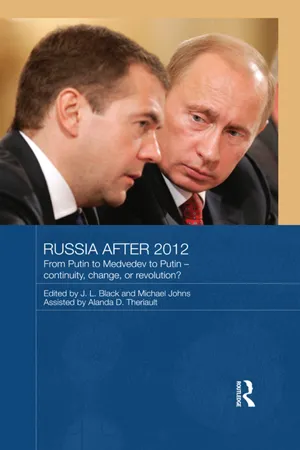
This book provides an overview of the state of Russia after the 2012 presidential election. It considers a wide range of both domestic and international issues, examining both the run up to and the consequences of the election. It covers political, economic, and social topics. It assesses the political scene both before and after the election, and discusses the nature of and likely future of democracy in Russia. The election's impact on the Russian economy is discussed in detail, as are Russia's relationships with the United States, the European Union, and other parts of the world.
eBook - ePub
Russia after 2012
From Putin to Medvedev to Putin – Continuity, Change, or Revolution?
- 234 pages
- English
- ePUB (mobile friendly)
- Available on iOS & Android
eBook - ePub
Russia after 2012
From Putin to Medvedev to Putin – Continuity, Change, or Revolution?
About this book
Trusted by 375,005 students
Access to over 1.5 million titles for a fair monthly price.
Study more efficiently using our study tools.
Information
Domestic affairs
1
The 2011–12 Russia elections
The next chapter in Russia’s post-Communist transition?
The 2011–12 election cycle marked a potential watershed in Russian politics. At a time when many specialists had written off elections as an important political event because of their “managed” nature and almost certain outcome, Russia again surprised us. The two-part “election season” involved selection of members of the State Duma (the Russian legislative body) in December 2011, and the presidential vote that followed in March 2012. Not only was the outcome of the Duma election an unexpected blow to the ruling United Russia party, but the public activism that the election elicited suggested emerging new dynamics in the relationship between state and society. A significant element of the Russian public had apparently awakened, with tens of thousands of protesters, fed by social media contacts, pouring into the streets leading to the protest epicenter at Bolotnaya Square in central Moscow. The demonstrations erupted regularly over a period of months, beginning in December 2011 and continuing at the time of this writing in June 2012. The movement was galvanized by new figures, such as the popular anti-corruption blogger and protester, Aleksei Navalny. The Moscow demonstrations were joined by smaller protests in several cities across the country. Observers were wondering if this could mark an awakening of demands for leadership accountability, which eventually could translate into a halt or reversal of the authoritarian tendencies that had been building in the Russian political system since Putin took over the presidency in 2000. This chapter endeavors to place these events in an historical and comparative context and reflect on their significance for Russia’s political development.
Leadership succession and Russian politics
As Richard Sakwa1 has pointed out, leadership transitions have been turbulent processes throughout Russian history, a feature that has also characterized post-communist politics as well. Since Mikhail Gorbachev embarked upon glasnost and perestroika in the second half of the l980s in his effort to reform the communist system, the newborn country, the Russian Federation, has experienced four leadership transitions involving the office of the presidency. The first, from Gorbachev to Boris Yeltsin, occurred in 1991 through the vehicle of radical systemic change, namely the collapse of the Soviet Union and formation of the Russian Federation as its largest successor state (along with the other 14 newly independent countries that emerged from it). A pivotal point in terms of legitimizing this transition was the direct election of Boris Yeltsin as President of the Russian Republic of the USSR in June 1991, which accorded him and the Russian Republic’s claim to independence in December 1991 a popular legitimacy that the former Soviet Union, headed by Gorbachev, had lacked. Yeltsin was confirmed as President of the Russian Federation in the 1996 election, which looked like a truly contested vote, despite Yeltsin’s heavy marshaling of Western-style public relations techniques to polish his tarnished image. In the first round, Yeltsin outpaced his leading competitor, Communist Party leader, Gennady Zyuganov, by just over three percentage points in the popular vote, pushing the contest to a second round, in which Yeltsin won 54 percent of the vote.
Perhaps ironically, Russia’s troubled democratic transition took on increasingly problematic features just as the economy began to revive after the 1998 financial crisis. Each subsequent leadership change took on a more “engineered” character, mirroring the broader depiction of Russia’s electoral politics as a manifestation of what several analysts have termed Russia’s “managed democracy.”2 Although elections played a role in each leadership transition, in every one of the subsequent cases the incumbent designated the “favored” successor, and the electoral outcome was unambiguous. As such, Russia has failed to pass what Samuel Huntington3 has called the two-turnover test of democratic consolidation, namely at least two electoral transitions to new leadership groups. While the leadership changed, the process has not involved a real shift in power from one electoral group or coalition to another.
Under the 1993 Russian constitution, the president is the most powerful political institution in the Russian system, so presidential succession dynamics have commanded particular attention. The second leadership transition, from Yeltsin to Vladimir Putin, occurred in 2000. Putin was first named by Yeltsin as acting prime minister in August 1999; he then became acting president upon Yeltsin’s resignation at the end of that year, less than four months before the next presidential election on 26 March 2000. Despite being a relative newcomer on the political scene, Putin won handily with 53 percent in the first round vote (see Appendix 1), strongly outpacing veteran politician Zyuganov, who received just 29 percent. The third transition followed in 2008, as a constitutional restriction prevented Putin from pursuing a third term. After much speculation, in December 2007 President Putin designated Dmitry Medvedev, one of his two deputy prime ministers and chair of Russia’s state-dominated natural gas company, Gazprom, as his favored successor. Medvedev won over 70 percent of the vote in contrast to Zyuganov’s distant 18 percent in the first round of the presidential vote, while Putin took over the post of prime minister and head of the government. Following the 2008 presidential election, Putin agreed to take on the post of Chair of the United Russia party, as head of the government. While the party had de facto previously been an instrument of Putin’s exercise of political power in the country, until that time the leader had maintained that, as president, it was inappropriate for him to be associated with a single party; however, as prime minister and head of the government, he considered it appropriate to head the party.
The most recent and fourth leadership transition, again “engineered” from above, went smoothly in a technical sense as it unfolded in late 2011 and early 2012. But it was surrounded by political drama. The story began to unfold after months of speculation as to whether Putin would again aspire to presidential office after a four-year hiatus (thus meeting the constitutional requirement forbidding three consecutive terms). In late September 2011, at the convention of the dominant United Russia party, President Medvedev indicated his support for Putin’s presidential candidacy, and in this way removed himself from consideration as a candidate or potential competitor to Putin. Putin accepted the mandate and at the same time indicated that Medvedev should head the United Russia list in the parliamentary elections in December 2011. Putin referred to an agreement made “several years ago” regarding the future arrangement, and was quoted as saying., “the fact that we have not been disclosing our position publicly for quite a time is a matter of political expediency and conforming to the political genus in our country – I hope our citizens understand that.”4 Effectively a pre-planned “swap” of the two positions was revealed, with Putin moving into the presidency and Medvedev to be appointed as his prime minister. While this arrangement would be subject to the approval of the electorate, first in the Duma elections of December 2011 and then the presidential vote in March 2012, the dominant position of the establishment United Russia party left little doubt about the outcome.
The legislative election of December 2011 indeed maintained the majority position of Vladimir Putin’s party in the State Duma. However, the results evidenced a significant decline in the party’s popularity as well as its ability to manage the electoral outcome. The official results of the Duma election placed United Russia with 49.3 percent of the popular vote (down from 64. 3 percent in 2007), a total that, under Russia’s proportional representation electoral system, would give it a majority (238) of the 450 seats in the State Duma. The electoral system’s high seven percent threshold for representation meant that over five percent of the electorate that voted for small parties would go unrepresented and that portion of the vote would be reallocated to those parties that crossed the threshold, giving United Russia the majority.
Behind this electoral “success,” United Russia’s popularity had been declining in the period preceding the 2011 election. While on the one hand United Russia had managed to bring into its ranks almost all of the appointed executive heads of Russia’s 83 federal units, its support in elections to regional legislative bodies had already exhibited a pattern of gradual decline after 2008. Part of the pattern may have been linked to the effects of the economic crisis of 2008–09, which led to rising unemployment, wage arrears, and periodic disruptions in some public services in some localities. At the same time, earlier in the year, the party became a public target of sometimes virulent and visible political criticism; a much repeated depiction of United Russia as a party of “crooks and thieves” was coined by Aleksei Navalny in a radio broadcast in February 2011. The term resonated with elements of the attentive public who perceived the party as abusing its power and involved in the network of corruption that characterizes the Russian political system.
In addition to United Russia, the Duma election returned the same three parties that were in the out-going Duma, with the Communist Party of the Russian Federation (KPRF) increasing its share from only 11.6 percent in 2007 up to 19.2 percent in 2011. The other two parties that exceeded the seven percent threshold also gained ground, the nationalist Liberal Democratic Party of Russia (LDPR) moving from 8.1 percent in 2007 to 11.7 percent in 2011, and the moderate left party, A Just Russia (generally considered a Kremlin creation to draw support away from the Communists), rising from 7.7 percent to 13.2 percent. Despite these increased percentages, none of the other parties offered an opposition force capable of challenging United Russia’s dominance. The Communist Party, considered by many to be the only genuine opposition party that routinely contradicted the government’s positions, had expanded its electoral base less on account of an increase in positive support and more because of the lack of other opposition voices.
The election was marked by electoral fraud, as well as biased media coverage. Instances of ballot box stuffing were documented on the Internet, leading President Putin to command the installation of video cameras in polling places for the presidential election to follow, to protect against a repeat of these charges. The observer mission of the Organization for Security and Cooperation in Europe (OSCE) reported problems such as “denial of registration to certain political parties,” “lack of independence of the election administration, partiality of most of the media, and the undue interference of state authorities at all levels.” The report concluded that this mix of circumstances “did not provide the necessary conditions for fair electoral competition.”5 The public protests that followed the election demanded that the election be rerun; it was commonly believed that without interference, the vote would have left United Russia in a minority position, at least in the popular vote. Public opinion polls preceding the Duma vote indicated a significant drop in United Russia support, from a level of 52 percent in the first quarter of 2010.6 Just before the election in 2011, about 39 percent of those surveyed indicated that they would vote for United Russia, compared to 12 percent who would vote for the Communist Party. Nonetheless, United Russia far outpaced its opponents.
In the presidential elections that followed in March 2012, Putin won easily in the first round of voting; official results gave him 63.6 percent of the vote, followed by second-runner Zyuganov at just over 17 percent. The fact that the vote for Putin fell below what Medvedev had achieved in 2008 (with 70.3 percent) was also a sign of Putin’s declining, but still strong, popularity. The presidential election results left no serious doubt as to whom the public preferred or who had won; therefore, opposition calls for their reenactment met little resonance either in the broader public or the international community, unlike the situation in Ukraine in 2004. Public opinion polls preceding the vote suggested an expected level of support for Putin to be somewhat, but not dramatically, lower than the actual outcome, but far exceeding that of any of the opposing candidates, as indicated in Table 1.1.7
“Imagine that next Sunday the election for the president of Russia is taking place. Indicate please which of the following politicians you would vote for.”
Table 1.1 Voter preferences, presidential e...
Table of contents
- Cover
- Title
- Copyright
- Contents
- List of figures and tables
- Notes on contributors
- Foreword
- Preface
- Acknowledgements
- Abbreviations and acronyms
- PART I Domestic affairs
- PART II Economic and international related issues
- PART III Foreign affairs
- Appendices
- Index
Frequently asked questions
Yes, you can cancel anytime from the Subscription tab in your account settings on the Perlego website. Your subscription will stay active until the end of your current billing period. Learn how to cancel your subscription
No, books cannot be downloaded as external files, such as PDFs, for use outside of Perlego. However, you can download books within the Perlego app for offline reading on mobile or tablet. Learn how to download books offline
Perlego offers two plans: Essential and Complete
- Essential is ideal for learners and professionals who enjoy exploring a wide range of subjects. Access the Essential Library with 800,000+ trusted titles and best-sellers across business, personal growth, and the humanities. Includes unlimited reading time and Standard Read Aloud voice.
- Complete: Perfect for advanced learners and researchers needing full, unrestricted access. Unlock 1.5M+ books across hundreds of subjects, including academic and specialized titles. The Complete Plan also includes advanced features like Premium Read Aloud and Research Assistant.
We are an online textbook subscription service, where you can get access to an entire online library for less than the price of a single book per month. With over 1.5 million books across 990+ topics, we’ve got you covered! Learn about our mission
Look out for the read-aloud symbol on your next book to see if you can listen to it. The read-aloud tool reads text aloud for you, highlighting the text as it is being read. You can pause it, speed it up and slow it down. Learn more about Read Aloud
Yes! You can use the Perlego app on both iOS and Android devices to read anytime, anywhere — even offline. Perfect for commutes or when you’re on the go.
Please note we cannot support devices running on iOS 13 and Android 7 or earlier. Learn more about using the app
Please note we cannot support devices running on iOS 13 and Android 7 or earlier. Learn more about using the app
Yes, you can access Russia after 2012 by J.L. Black,Michael Johns in PDF and/or ePUB format, as well as other popular books in Social Sciences & Ethnic Studies. We have over 1.5 million books available in our catalogue for you to explore.