- 192 pages
- English
- ePUB (mobile friendly)
- Available on iOS & Android
eBook - ePub
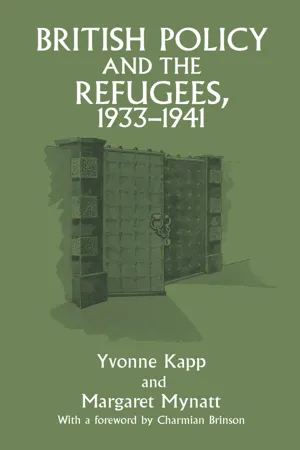
British Policy and the Refugees, 1933-1941
About this book
In the summer of 1940, with much of Europe under German domination, British authorities instigated a harsh programme of internment or deportation of those who had fled Nazi oppression. This volume, written the same year, is a critique of government policies of the day.
Trusted by 375,005 students
Access to over 1.5 million titles for a fair monthly price.
Study more efficiently using our study tools.
Information
Topic
GeschichteSubtopic
Militär- & SeefahrtsgeschichteThe Refugee Era
Exodus
Who and what the refugees are — Why and how they fled — Regulations governing entry and sojourn
1
Between the years 1933-39 the United Kingdom received some 80,000 to 90,000 refugees from countries under Nazi rule. Some 20,000 to 30,000 of these re-emigrated before the outbreak of war.
Today, when everyone remotely interested in the subject is familiar with the conception of, on the one side, 'racial' and, on the other, 'political' refugees, the precise nature of the elements that went to make up this considerable immigration is either unknown or forgotten. In the debates in Parliament, as in public speeches and private conversations, the figure of the refugee is variously represented, according to the experience of the speaker, as a helpless, wretched and pathetic victim; a militant, fearless and unbroken fighter; or a dangerous spy wearing the most treacherous of all masks to win the confidence and sympathy of a humane people. The holders of these views accuse each other of a lack of realism: each sees the other's conception as a sentimental or alarmist fiction and can cite incidents and cases to support their own view. Each would grant that there are exceptions to the general run of victims (or fighters, or spies), and that these could and should be singled out and accorded treatment different from that advocated for the mass, but beyond this concession to the probability that 60,000 persons are not all of the same kind, our legislators, like many of our public speakers and our friends, show a singular disregard for the facts and for the necessity to examine them with care, preferring, like bad novelists, to depict their characters in strong, unconvincing colours: black or white.
No research is needed to establish beyond doubt that the approximately 60,000 refugees from Germany, Austria and Czechoslovakia who found themselves in Britain at the outbreak of war were of all shades; and some, to the undoing of simple-minded people, of many. All that is needed is a cursory glance at the history of the refugee era and a little common-sense.
Who were the persons attacked, persecuted and dispossessed on Hitler's accession to power?
There were the victims of the terror which began during the night of the Reichstag fire. The leaders and prominent members of the Communist Party, as well as many other left-wing politicians and intellectuals, were killed, imprisoned and driven into illegality or exile. 'By the end of May 1933 the Communist Party was practically outlawed, most of its leaders having been killed, imprisoned, or having fled, and the rank and file driven from employment.'1
There were the Social Democrats, Trade Unionists, Liberals and Pacifists, whose organisations had been outlawed and whose leaders had been killed, arrested or driven into exile by the summer of 1933, when all parties except the National Socialist (Nazi) Party became illegal. 'It was not until the Communists were disposed of that the attack on the Social Democrats and the "free" trade unions began in earnest, although some Social Democrat leaders had been taken into protective custody and some trade-union buildings had been occupied early in March.'2
There were the civil servants, lawyers, doctors, writers, artists, actors and booksellers who were banned from the ordinary practice of their profession by the Non-Aryan laws succeeding the National Boycott Day of 1 April 1933.
There was the attack on Jewish shopkeepers and private traders which was intensified in 1934, culminating in the second wave of Jewish persecution legalised by the Nuremberg laws of September 1935, which banned Jewish employees.
There was the persecution of the Confessional Church, which gathered momentum in 1934.
There were the dissident Nazi leaders and erstwhile collaborators who, if they were not killed, had been driven into exile after 30 June 1934 (the 'Night of the Long Knives').
There were the German Nationalists (Conservatives) and old 'Front Fighters' who were eliminated from the State machinery.
There were the opponents of Hitler from the Saar, forced to flee after the Plebiscite of January 1935.
There were the big Jewish industrialists and bankers who, insofar as they had not left Germany before, were forced out of business in 1937-38.
There were the political and racial victims of the same, but more rapid process in Austria from March 1938.
There was the persecution of Catholics, given open expression in the attacks on the Church in 1938, and carried through in Germany and Austria with increasing zeal after this date.
There was the entire anti-Henlein opposition in the Sudeten areas of Czechoslovakia, exposed by the Munich Agreement to ruthless persecution.
There were the last and most numerous victims of the Jewish pogroms in Germany which followed the assassination of Vom Rath in Paris in November 1938.
There were the fugitives from all these earlier persecutions who had found asylum in Czechoslovakia and whose extradition was demanded by the German government between October 1938 and March 1939.
Finally, adding their terrible urgency to that of the hundreds of thousands of men, women and children seeking to emigrate from Germany, Austria and the Sudeten areas where they were excluded from citizen rights, there were the political and racial refugees who fled after the Nazi occupation of the rest of Czechoslovakia in March 1939.
Throughout the Nazi era, there were those who, not excluded by previous laws and persecution, became endangered owing to their active opposition to Hitler, which these laws and this persecution bred, and at the other end of the scale those German, Austrian and Czechoslovak nationals who, although not in any way directly threatened, found personal life and business dealings irksome under the Nazi regime and preferred to live elsewhere, to which category must be added the cultured liberals who were repelled by the education in barbarism which alone was offered to their children.
On the one hand, then, there were the pitiable, tormented Jews, many of whom were so politically innocent that they regarded the inescapable fate that had overtaken them as a purely individual tragedy; on the other, the Socialists, Communists, Trade Unionists, members of the active Protestant and Catholic opposition, of the democratic peace arid cultural movements and of the co - operatives, who scorned to make the compromises open to them and paid for their convictions with death, imprisonment, torture and exile.
Between these two major categories — the victims pure and simple, and the open opponents, many of whom were also Jews —there lay the little shadow-world of renegades from Left and Right; of disappointed Nazi careerists and coalitionists; of fascist adventurers, unsuccessful at home; of intriguers with small and ugly political axes to grind (and who found ready whetstones amongst the influential backstairs politicians of this and other countries); of professional spies from Central Europe who, during a period rife with opportunity, frequently changed or multiplied their employers; and, both last and least, the small residuum of paid and unpaid Gestapo agents masquerading as refugees, amongst whom must be counted the despicable but tragic wrecks, broken by concentration camps, who were released on the promise to work for their persecutors. This heterogeneous collection of shadow men and women, whose histories in many cases are not clear, since they have much to hide, provides first-class material for second-rate drama; from it many excellent morals might be drawn to adorn a speech in the House; it lends itself, indeed, to a variety of purposes, but not, it would be thought, to forming the basis of a policy. There are very good reasons for thinking this.
The uninformed belief that spies and agents could pose as refugees and hoodwink the public with the greatest of ease is contradicted by the facts.3 In the first place there is a very firm consensus of opinion concerning their fellows amongst the refugees themselves.
No group has had more to lose by tolerating shady characters in its midst than this community of exiles. Genuine refugees from Nazi oppression could never condone or view with complacency the presence of Hitler's agents. Such an attitude would be suicidal. It has to be remembered not only that the refugees include political opponents of the Nazis who have a price on their heads; that instances of political murder in exile and of kidnapping with intent to murder are not unknown; that every element despised by the Hitler regime is represented among the refugees, and also that great numbers of the refugees fled leaving behind wives or husbands, parents, children and friends, many of whom are to this day in the slaughterhouses known as concentration camps.
Such men and women have motives as deep and compelling as any moving a government department to discourage the undesirable elements amongst refugees. The political convictions of the genuine anti-fascists, of which their victimisation gives evidence, reinforced by the most intense personal interests, make it imperative that every dubious character should be scrutinised and eliminated from their company. They can only wish today that the Home Office had taken prompt and drastic action against these characters at the start.
While having the best of all reasons for exposing suspicious individuals, the refugees also have the best information on which to base their suspicions. The histories of many of the shadow men and women amongst the refugees are not clear but their activities in recent years, their contacts in Germany and, above all, the circumstances surrounding their emigration, are known to at least some section of the bona fide exiles, whose own safety demanded a very close watch on precisely these matters.
To the British public at large, the refugees are an assortment of foreigners comprising every type of alien from the enemy country. There may be very strong sympathy in Britain for the victims of the bestiality and tyranny of the Nazis but they remain foreigners in our eyes and we do not credit them at first blush with exercising the same discrimination that we would automatically apply amongst ourselves (on the analogy that many Europeans cannot see the difference between one Chinese face and another, and are inclined to believe that the Chinese cannot do so either).
Let the British reader picture himself in a foreign land, with a host of his compatriots, in circumstances where his good faith and his good conduct are the conditions of his freedom and safety. Be he a former Member of Parliament, a Trade Union leader, an active Socialist, an honest professional man, or simply a decent, obscure citizen, he will bring with him a shrewd knowledge of his fellow-countrymen in his own sphere and district and will view with alarm the inclusion in this band of exiles of any person whose character or antecedents are liable to bring disaster or discredit upon the community. Suppose your company of exiles was drawn from all regions of the British Isles and from most sections of the population, with a large admixture of people who had taken part in some organised form of political, social, religious or professional life. If an entirely unknown Englishman suddenly turned up in emigration and announced that he had been a member of the Bromley Labour Party, or secretary of the Glasgow Jewish Board of Guardians, or the Medical Officer of Health for Wythenshawe, is it not probable that the Bromley or the Glasgow or the Wythenshawe people would have something to say about this and would regard with more than common mistrust a person representing himself to be something they knew he quite certainly was not? Would they not also immediately warn the officials of the organisation to whom the impostor applied for help?
Or again, suppose yourself confronted in this emigration by a person who does not misrepresent himself but whom you have reason to doubt: perhaps a man known throughout long years of uneasy association; a person met once or twice in suspicious circumstances; a person whose reputation in your town has always been equivocal; or, on the other hand, a person so notoriously untrustworthy that he could only have passed himself off as a legitimate emigre by guile and underhand influence. In every case you would be fearfully on your guard. Add to this the perpetual dread that, if not your own life, then that of your family at home in Britain could be jeopardised by the activities of these uncertain elements, and you will understand why refugees whose own integrity is beyond doubt treat with the greatest wariness even those of their formerly reliable colleagues whose history, since they fell into the hands of the Gestapo, is not fully known, and shun like the plague those others who, however they may have presented their cases to obtain admission to this country, had an unsavoury reputation at home.
Nor must it be thought that the refugee organisations were staffed by gullible fools. Even without the refugees' own very significant reactions to their fellows, there were ways in which the 'bad hat' revealed himself quite unmistakably in the course of weekly contacts and voluminous correspondence with persons trained in social work or versed in international politics and human affairs. A 'wrong' type of refugee quite often gave himself away by the very manner of his appeals for help; he marked himself out by a display of interest in matters not legitimately the concern of refugees at all; and it was quite impossible for him to live in a fashion, or on means, or enjoy privileges not ordinarily available to refugees without the facts being known and recorded, in the course of the administrative routine, by the refugee workers. The dossiers of each case were not intended to serve as character case-histories — such researches were left to the higher authorities — but it was inevitable that the basic formal data (giving times and places of birth, of residence, date of emigration and reason for emigration, supplemented by the vast correspondence with or about the refugee, with his friends, his landlady, his local committee throughout his whole sojourn in this country and preceding it) should have presented a very clear picture of the individual's character and purposes, laying bare any discrepancies in his self-portrait, any anomalies in his story.
It has been argued that it would have been simple enough for those 'refugees' who wished to escape notice and were furnished by the Gestapo with forged documents and credentials to avoid detection by assuming the refugee personality in every particular. Apart from the safeguards provided by the vigilance of the refugees (who have a highly developed nose for the scent of the Gestapo), it must be remembered that the refugee's life was a very circumscribed one and that in the majority of cases it entailed an almost total dependence upon a refugee organisation. To be a refugee meant to live that life: to be in perpetual contact with a certain number of refugee workers whose experience of thousands of cases, even without exercising special alertness, would detect any divergence from the usual demands or activities of refugees. It meant that every detail, from unexplained journeys to new clothes, had to be accounted for, not primarily to allay suspicion, but because government funds, or funds contributed by the charitable public, were dispensed. If, moreover, to evade this niggling control, the impostor had been smuggled in as a 'private' case, on the financial guarantee and under the personal charge of an individual settled (with a bank balance) in this country, then the credentials of that individual had been scrutinised by the organisation through whom the application was made, or by the Home Office itself if the application was made directly, and the sponsor himself was unlikely to have undertaken the unlimited liability such guarantees represented unless he was either personally acquainted with the refugee and his circumstances (and could vouch for his character) or was consciously lending himself to Nazi purposes; a quite possible contingency, but one that would involve other connections and activities in this country which should not have escaped the knowledge and notice of the appropriate authorities.
There were two categories who could avoid contacts with refugees and refugee organisations and the automatic control such contacts exercised: the rich 'non-Aryans' whose own money, rather than that of some guarantor in this country, obtained for them the right of asylum and independence of movement, and the domestic servants brought to this country on Ministry of Labour permits, who might or might not be sufferers from Nazi oppression and who had no need either to mix with other refugees or to frequent the offices of the refugee organisations. These two categories suffered relatively less than the general run of refugees in the internment round-up.
There was another very good reason against the Nazi agent choosing the role of refugee: before the war, it was easier for German nationals to enter this country under any and every other guise. Provided they had money, they did so with the greatest frequency and facility as tourists, commercial travellers, businessmen and journalists.
It was therefore quite plain (and was recognised by the refugees and their protectors, the refugee organisations) that the task allotted to the 'refugee' Nazi agent was solely that of spying upon the refugees themselves. Not for them, in the course of apparently legitimate business, the interviews with industrial or government experts, the freedom of movement throughout the length and breadth of the country, the access, without arousing the suspicion of the British authorities, to the German Embassy and Consulates. Instead they experienced the frugal, often communal life of the dependent exile, without privacy, privilege or status. Not everyone's cup of tea.
Many of the arguments against accepting and treating the refugees as decent human beings rest on the absurd assumption that the genuine and tragic refugee from Nazi oppression does not exist at all. Once it is admitted that such people do exist and that their credentials have been examined, then the only tenable position is to recognise them for what they are: the first victims of the Nazi regime in Germany and the first fighters for its overthrow.
Let us now hear Mr Peake the Parliamentary Under-Secretary for Home Affairs and spokesman for the Department responsible for refugee policy:
Practically all the aliens who have come to this country in the last five or six years have been sponsored either by a refugee o...
Table of contents
- Cover
- Title
- Copyright
- Contents
- Dedication
- 1996 FOREWORD
- 1968 FOREWORD
- INTRODUCTION
- Part One THE REFUGEE ERA
- Part Two THE REFUGEE PROBLEM IN WARTIME
- INDEX
Frequently asked questions
Yes, you can cancel anytime from the Subscription tab in your account settings on the Perlego website. Your subscription will stay active until the end of your current billing period. Learn how to cancel your subscription
No, books cannot be downloaded as external files, such as PDFs, for use outside of Perlego. However, you can download books within the Perlego app for offline reading on mobile or tablet. Learn how to download books offline
Perlego offers two plans: Essential and Complete
- Essential is ideal for learners and professionals who enjoy exploring a wide range of subjects. Access the Essential Library with 800,000+ trusted titles and best-sellers across business, personal growth, and the humanities. Includes unlimited reading time and Standard Read Aloud voice.
- Complete: Perfect for advanced learners and researchers needing full, unrestricted access. Unlock 1.5M+ books across hundreds of subjects, including academic and specialized titles. The Complete Plan also includes advanced features like Premium Read Aloud and Research Assistant.
We are an online textbook subscription service, where you can get access to an entire online library for less than the price of a single book per month. With over 1.5 million books across 990+ topics, we’ve got you covered! Learn about our mission
Look out for the read-aloud symbol on your next book to see if you can listen to it. The read-aloud tool reads text aloud for you, highlighting the text as it is being read. You can pause it, speed it up and slow it down. Learn more about Read Aloud
Yes! You can use the Perlego app on both iOS and Android devices to read anytime, anywhere — even offline. Perfect for commutes or when you’re on the go.
Please note we cannot support devices running on iOS 13 and Android 7 or earlier. Learn more about using the app
Please note we cannot support devices running on iOS 13 and Android 7 or earlier. Learn more about using the app
Yes, you can access British Policy and the Refugees, 1933-1941 by Yvonne Kapp,Margaret Mynatt in PDF and/or ePUB format, as well as other popular books in Geschichte & Militär- & Seefahrtsgeschichte. We have over 1.5 million books available in our catalogue for you to explore.