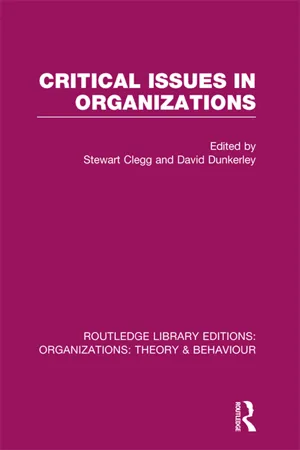
This collection highlights a number of directions in which organization theory could develop. It also argues the need for an historical analysis of the sociology of organizations. Other issues discussed are the ideological stance of contemporary organization theory and the limiting framework that tends to ignore the wider social context in which organizations exist.
- 116 pages
- English
- ePUB (mobile friendly)
- Available on iOS & Android
eBook - ePub
Critical Issues in Organizations (RLE: Organizations)
About this book
Trusted by 375,005 students
Access to over 1.5 million titles for a fair monthly price.
Study more efficiently using our study tools.
Information
Chapter 1
INTRODUCTION: CRITICAL ISSUES IN ORGANIZATIONS
Stewart Clegg and David Dunkerley
In the social sciences one can find many volumes whose titles proclaim them to be in some sense 'critical'. Indeed, such is the apparent increased frequency with which such terms are used that one might be forgiven for supposing them to be of devalued currency. Yet, here is another volume sufficiently audacious as to claim to address Critical Issues in Organizations. Such a claim cannot be lodged lightly. It behoves anyone who proposes it to argue in what way their volume is 'critical' in such a way as to be distinct from other contributions.
Many other texts on organizations exist. You may well be familiar with some of them. If so, then you will be aware of the bewildering state of disarray that exists in these texts, and which passes as 'organization theory'. Given the antecedents of organization theory such diversity is hardly surprising. The study of organizations has developed in a number of specific ways, serving different ends which have ranged from improving organizational 'effectiveness' to providing theoretical direction for those claiming a purely academic interest. Regardless of the objectives, it is clear that to speak of a body of 'organization theory' is to refer to a body of knowledge that, for pragmatic reasons, has developed both unevenly and atheoretically.
Of course, we are not alone in recognizing the problems confronting the analysis of organizations. Such problems pre-occupy professional conventions and papers. But while similar conclusions may be reached, the prescriptions suggested are quite dissimilar to those which we imply. By way of displaying contrast consider the following example. At the 1974 American Sociological Association Convention, Jerald Hage pleaded strongly for 'a new wave of attempts to create general organizational theory' (Hage, 1974, p.19). His solution was cast in terms of formal middle-range sociological theory emphasizing theoretical and operational definitions and linkages. Such an analysis presumes a certain value to what has 'preceded it, which we, and our contributors, would question. To reason as Hage does is to remain secure within the convention of thesis, whilst neglecting the dialectic of antithesis. To credit as synthetic a conversation which is conducted entirely within one thesis concerning the nature of social reality, and the appropriate way of 'regarding' it, is seriously to devalue the dialectical metaphor. But the Hage plea is in many respects entirely consistent with some aspects of contemporary American theorizing in sociology. The suggested approach would, we suspect, draw heavily upon the work of methodologists such as Blalock for its 'theory', while its paramount organizational input would be that style of research whose hegemony is maintained by the pages of the 'Administrative Science Quarterly'.
Complementary to, and sometimes in opposition to, the developments and suggestions which emanate from the tradition of 'Administrative Science Quarterly', the study of organizations has progressed in Europe. A distinctively European tradition is emergent. Methodological, theoretical and critical issues which once seemed to be condemned to silence are being re-awakened, renewed and discussed. Much of this discussion has centred on the on-going critique currently being developed by members of the 'groupe théore-tique' of the European Group for Organizational Studies (EGOS). The group has a short history to date, having emerged from the first meeting of EGOS in 1975 as a viable focus of interest among researchers. Nearly all the contributors to this volume are currently engaged in this on-going critique. The focus of the critique has been on the development of an 'institutional' approach to the study of organizations, a focus which is represented in all of the papers collected here. This speaks to our common commitment to re-awaken some critical issues for discussion.
Our 'issues' – sexism, power, capitalist development, organizational transactions and interactions, the historical inter-penetration of state and capital – are not yet found in the indexes of most texts on organizations. We hope to remedy this state of affairs through posing this absence as problematic. Thus, it would seem to be no accident that the majority of texts on organization theory place greater emphasis upon concepts such as individual motivation, needs and satisfactions, than upon the structural features of power, exploitation and historical change. The eagerness with which management theorists have adopted many of the ideas from organization theory lends further support to the argument. However, considering the way in which organization theory has almost ignored Marx, or interpreted Weber in the narrowest possible way as a progenitor of modern theories of organization structure, then this is not surprising. The interests of management and the interests of organization theory have all too often been in harmony.
A critical theory cannot allow its interest to be so defined. The function of our papers is to enable one to grasp and understand the reality of that 'life' which organizations find themselves imposed in and on. As such we distinguish our analyses from those fictions preserved in the ideology of organization theory, where the freedom of 'exchanges', 'social constructions', and the 'satisfaction' of 'needs' reigns dominant. In contrast, our papers show contemporary sources of 'unfreedom' as occasioned through organizations. We attempt thus to begin conversation with others who have been both mastered and victimized by the formulations that we oppose here.
So it is not that our 'critical issues' are 'in organizations'. They are not. They are not 'in' organizations in terms of the wide-spread consciousness of their members, any more than they are yet 'in' the widespread consciousness of the members of organization theory. Nor can our issues be constrained 'within' the boundaries of organizations. Such closure to social issues and theory is part of the stance we oppose. Our issues are 'in organizations' only in so far as organization is the metaphor under which we collect our thoughts and reflections. Organization serves merely as the rubric and the locus of our analysis. Only in as much as we constitute them as such are our issues in organizations .
In an organization theory where life has been analysed, paralysed and reduced to a series of quantifiable variables, our issues would remain unspoken. This volume is an attempt to speak this silence. For all of us, in our various voices, this articulates itself through redressing the scant consideration given to issues which are historically located, politically potent, economically relevant, and socially significant.
We neither propose to 'synthesize' existing theory, nor to 'broaden' it by importing yet another fledgling sociological stance. Rather, we propose to overcome existing organization theory. In that organisations have been left too much to the ideologists of administration, their continued existence as an ontological realm of self-sufficient enquiry has survived critical scrutiny for too long. We wish to call into question the continued existence of such a state of affairs.
Each of our papers displays this desire in the nature of a critique which intervenes in the idea of an 'organization theory'. Our topics and our styles may differ, but our underlying theme, which stresses what we would call a 'critical' and an 'institutional' approach, remains present in each contribution.
Janet Wolff's paper takes as its critical issue the topic of women in organizations. The paper analyses the social and political movement towards equality of employment for women in the United Kingdom. The review leads the writer to the conclusion that organization theory has been too myopic and apparently unaware of the wider socio-cultural environment in which organizations exist. It cannot account for the 'powerless' role of women in organizations. Three important points emerge from the analysis. First, in spite of extensive recent legislation women are relatively disadvantaged compared with men in employment. Second, this relative disadvantage cannot be accounted for by traditional organization theory. Third, while a more adequate organization theory may be constructed, it would be insufficient unless it incorporated a sociological understanding of extra-organizational factors. In spite of these shortcomings detected in organization theory, Janet Wolff does acknowledge that the theory is able to make some contribution to the understanding of this particular issue. She recognizes the movement away from a crude functionalism towards the attempt to consider meaning in particular situations and to account for informal as well as formal pressures upon the individual and the group. Essentially, the paper is a plea for widening the scope of organization theory in order to account for social, political, economic and historical influences within society in their impact in the organization. This is a fundamental criticism of organization theory that other contributors also allude to.
Clegg's paper attacks organization theory at what might be considered to be its least ideological point – its treatment of 'power' in organizations. However, he argues that it is in the analysis of 'power' that the ideology of organization theory is most transparent. Historically, organization theories of power have developed as a 'language game', in which conventional rules and concepts of enquiry have foreclosed the possibility of grasping the reality of power in organizations. Instead, these conventions have led organization theorists to substitute what can only be regarded as 'science fictions' for any critical analysis. Although alternative concepts and modes of theorizing exist within the tradition of political analysis, what is most noteworthy is their total neglect within organization theory. In distinction to the various versions of functionalism which organization theory offers as its 'understanding' of power, Clegg proposes the reconsideration of a historically grounded social theory which would question the ontological assumptions of the organization as a separate reality embedded within an 'environment'. Instead of proposing an organization theory of power for all organizations, irrespective of their institutional location, Clegg proposes that analysis should be in terms of both wider social formations and specific institutional areas within these.
Karpik's paper continues the discussion of themes which are raised in the previous paper. The broad category of 'capitalism' as a social formation, a theme of the previous paper, can be discussed in its historical specificity. Karpik locates the emergence of large technological enterprises as the most developed moment in the present production of material life. He refers to this moment as that of 'technological capitalism'. The paper defines its main task as the construction of an analysis which identifies the rule of functioning of technological capitalism in terms of the 'capacity' concept of power (puissance).
The paper achieves this by analysing the historical dynamics which give rise to the transformation of material life into this specific form of capitalism. These are the development of a specific form of the scientific institution, that of heteronomous science, as the basis of an industrial strategy which realizes profit within the enterprise neither in terms of 'efficiency' variables belonging to the organization or its environment, nor in simple modes of surplus value accumulation, but in terms of its position within an institutional rationality. This institutional rationality cuts across any of the conventional categories of either organization theorists or everyday life. It is an analytical construct which analyses not the organization but the institutional rule of functioning of a diversity of organizations. This may be seen to display a common rationality which is embedded within technological capitalism as a specific capitalist form dependent upon scientifically induced discontinuities.
The analysis serves to exemplify the possibilities of an institutional as opposed to organizational mode of analysis. Conceived organizationally, either in terms of theory or common sense, enterprises which constitute the category of technological capitalism do not belong together. They are not relatable in any way other than through .their institutional reality and the underlying structure that this traces.
McCullough and Shannon present an historical analysis of the protective role of the state in relation to the growth and decline of organizations functioning. The state, where it has featured at all in organization theory, has usually been conceptualized as little other than a residual environmental or contextual variable. Such benign indifference could only be born of the general malaise which has infected recent pluralist theorizing in political science. Of late, reality has been re-asserting itself, as various crises of legitimacy concerning state activities at home and abroad have erupted into our consciousness. The events of May 1968, the war in Indo-China and its repercussions throughout the world, the various movements for national liberation – these have all shattered the innocence which had allowed liberal-pluralist conceptions of a natural order to flourish in the vacuum where the theory of the state should be. Naturally occurring crises, just as much as Garfinkel's ethnomethodological experiments, can have a revelatory effect by disrupting what passes for normal constituted reality. McCullough and Shannon use the example of recent events in Northern Ireland to exemplify the relevance of these remarks for the analysis of organizations.
The central concern of Wassenberg's paper is to show the inadequacy of current organizational sociology when confronted with dynamic occurrences at the macro-level. In particular, he makes reference to its inability to comment in any systematic way on the recent economic depression in industrialized capitalist states. He attributes this to the one-sided development of organizational sociology as primarily focused on static comparative study. This has resulted in an analytical neglect of organizational 'interactions' and 'transactions'. Static taxonomies have been developed rather than dynamic models of the actual functioning of inter-organizational relations. In order to remedy this situation, Wassenberg poses as his dominant theme the elaboration of a view which locates organizational behaviour within a stratified and dynamic perspective. Wassenberg uses 'stratified' to refer to the multiple hierarchies of interdependence in which organizations function. He locates these within a dynamic framework which takes account of the disparate chronology of organizational location.
It is within this framework that Wassenberg locates the dialectics of 'politicization' and 'professionalization' as opposing strategies which differentially located institutionalized groups will attempt to impose upon the organization. This process is constituted by the three principles of 'bounded interdependence, rationality and legitimacy'. The development of this model helps to clarify the nature of organizational transactions. Wassenberg closes the chapter by posing some interesting new directions in which a more critical social theory of organizations might develop.
In creating a forum for debate this collection of papers suggests directions in which organization theory could develop. In the first instance, we are opposed, at the present, to the kind of synthesis that Hage has argued for. The issue of whether a universally applicable theory of organizations is possible is highly problematic. Our opinion is that at the present stage of development such an exercise would be abortive. The papers in this volume point to too many inadequacies in the present state of organization theory for a synthesis to be meaningful. Our suggestion is that these inadequacies should be exposed and debated in order that they may be overcome.
Second, we see the need for an historical analysis of the development of sociological thought on the concept of organization. We argued earlier that, in the way in which it is expounded, organization theory has a 'control' function. Having this function, it exists as another metaphor for social order and domination. Its function is not new. Indeed, this was the original function of theories of 'organic' society and of organization as developed in the writings of Europeans such as Comte, Saint-Simon and Durkheim. They turned to sociology to provide an ideology to save their moral order as a defence in the face of the political and intellectual upheaval which raged in their contemporary society. In their writings we have the germinal seed of present-day organization theory. Equally, if we turn to the industrial revolution, here we see the market theories of possessive individualism and of laissez-faire emerge as a moral justification for nineteenth-century capitalism. In time, from these early beginnings, many of the important themes in contemporary organization theory can be seen to have emerged.
This brings us back to the ideologically committed stance of organization theory. As demonstrated above, each of the papers makes this point in its own way. The impoverishment of organization theory is due, in part, to its unreflexive and ahistorical development. Any synthesis would be impossible at the present time.
It is clear that the analysis of organizations needs to be significantly broadened for any meaningful discourse to take place. Each of the contributors has made the point that the particular issue under discussion could only be discussed adequately by going beyond the existing organizational framework. Each has argued, implicitly and explicitly, for a sociology that sees the organization as structurally embedded within the wider social context. The view of organizations as a series of measurable and related internal variables normally associated with structure is rejected. In its place we have a plea for an organizational analysis that is open-ended, and which recognizes the societal nature of organizational functioning, and which is sensitive enough to respond to on-going debates outside organizational analysis but within a wider framework of social theory.
The reader of this volume should be aware that the papers that comprise it were all written and completed by the end of 1975. Consequently, there may appear to be some degree of dated-ness in the text. We feel that this in no way detracts from the theoretical arguments presented.
Chapter 2
WOMEN IN ORGANIZATIONS
Janet Wolff
I
This paper will consider the position of women in organizations, in particular women at work and women in trade unions. In surveying the literature available on women's position and progress towards equality in Britain, I shall argue that traditional sociological approaches to organizations are inadequate in accounting for the phenomenon of discrimination and for the persistent fact that women's position in organizations differs from that of men in the same organizations. Other papers in this volume demonstrate that only radically revised forms of, organization theory can account for various phenomena of power in organizations, which cannot really be explained or analysed simply in terms of organizational goals, rules or structures. In dealing with the problem of sexism and female inequality, I shall maintain that even a radically new starting-point for organization theory will not do. More sophisticated contemporary forms of organization theory go some way towards understanding the place of women in various organizations. In order to develop an analysis which is more than partial, however, it is necessary to go outside any organization theory in order to situate the organization and its structural and ideological features in the macro-social context which it inhabits. In other words, I shall use this short study of women's place in organizations to show that (a) women are at a disadvantage in relation to men in most organizations; (b) organization theory cannot account for the differential treatment and experience of the sexes unless its traditional assumptions about the existence, rationale and functioning of organizations are critically reassessed; and (c) even a modified and sophisticated organizational approach must be supplemented by a sociological grasp of extra-organizational influences on organizational practi...
Table of contents
- Cover
- Half Title
- Title Page
- Copyright Page
- Title Page
- Original Copyright Page
- Table of Contents
- 1 Introduction: Critical Issues in Organizations
- 2 Women in Organizations
- 3 Power, Organization Theory, Marx and Critique
- 4 Technological Capitalism
- 5 Organization and Protection
- 6 The Powerlessness of Organization Theory
- Bibliography
- Index
Frequently asked questions
Yes, you can cancel anytime from the Subscription tab in your account settings on the Perlego website. Your subscription will stay active until the end of your current billing period. Learn how to cancel your subscription
No, books cannot be downloaded as external files, such as PDFs, for use outside of Perlego. However, you can download books within the Perlego app for offline reading on mobile or tablet. Learn how to download books offline
Perlego offers two plans: Essential and Complete
- Essential is ideal for learners and professionals who enjoy exploring a wide range of subjects. Access the Essential Library with 800,000+ trusted titles and best-sellers across business, personal growth, and the humanities. Includes unlimited reading time and Standard Read Aloud voice.
- Complete: Perfect for advanced learners and researchers needing full, unrestricted access. Unlock 1.5M+ books across hundreds of subjects, including academic and specialized titles. The Complete Plan also includes advanced features like Premium Read Aloud and Research Assistant.
We are an online textbook subscription service, where you can get access to an entire online library for less than the price of a single book per month. With over 1.5 million books across 990+ topics, we’ve got you covered! Learn about our mission
Look out for the read-aloud symbol on your next book to see if you can listen to it. The read-aloud tool reads text aloud for you, highlighting the text as it is being read. You can pause it, speed it up and slow it down. Learn more about Read Aloud
Yes! You can use the Perlego app on both iOS and Android devices to read anytime, anywhere — even offline. Perfect for commutes or when you’re on the go.
Please note we cannot support devices running on iOS 13 and Android 7 or earlier. Learn more about using the app
Please note we cannot support devices running on iOS 13 and Android 7 or earlier. Learn more about using the app
Yes, you can access Critical Issues in Organizations (RLE: Organizations) by Stewart Clegg,David Dunkerley in PDF and/or ePUB format, as well as other popular books in Business & Business General. We have over 1.5 million books available in our catalogue for you to explore.