- 350 pages
- English
- ePUB (mobile friendly)
- Available on iOS & Android
eBook - ePub
About this book
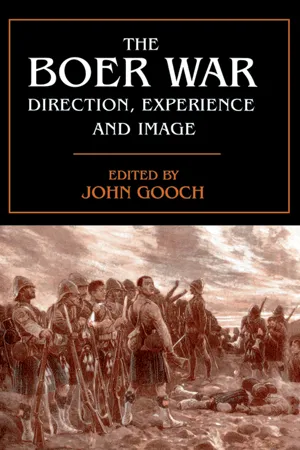
This collections of essays by leading British and South African scholars, looking at the Boer War, focuses on three aspects: how the British Military functioned; the role of the Boers, Afrikaners and Zulus; and the media presentation of the war to the public.
Trusted by 375,005 students
Access to over 1.5 million titles for a fair monthly price.
Study more efficiently using our study tools.
Information
Part One:
DIRECTION
1
Salisbury and the Soldiers
THE IMPERIAL SETTING
‘The English here are like things with their tails cut off, wrote the young radical Lloyd George, in Welsh, of the parliamentary reaction to the news that as late as March 1902 the Boers were capable of defeating a sizeable British column and capturing the general in command after some of his men had run away.1 The small-scale but resounding success against Lord Methuen at Tweebosch was taken, not altogether fairly so far as that unfortunate commander was concerned, to epitomize the failings of an army unworthy of a great power.2 Even in London Society, naturally sympathetic to the military, there were informed critics who contended that ‘our army system is rotten … (excepting a few regiments) … we should be no good against a European power’.3 A future German ambassador described the troops he had seen on parade in the British capital as a ‘rabble’.4 His French colleague, Paul Cambon, who like Wolff-Metternich was not an anglophobe, thought it ridiculous to give Lord Roberts a Roman triumph on his return from South Africa.5 The British public, shaken by the serious reverses that marked the opening stages of the campaign, was unreasonably pleased with ultimate victory. Politicians and diplomats remained acutely conscious of the decline in Britain’s prestige. The immediate causes of national and imperial humiliation were plain. That ardent patriot L. S. Amery remembered, with all the advantages of hindsight, the army he saw gathering in South Africa on the eve of war in 1899. He was left with ‘an ineffaceable impression of the incapacity of many of our senior officers, or the uselessness of most … training for the purposes of modern war, especially in South African conditions, and of the urgent need of … revolutionary reform of the Army’.6 The end of Lord Salisbury’s brilliant career was marred by the blows which the Boers dealt to British self-esteem. Prime Minister since 1885, with intervals in 1886 and 1892–95, he could not escape his share of responsibility for the military failures and all that they implied.7
Contemporaries were more understanding than posterity. For a variety of reasons, he had not acted on his perception of the need for army reform, shared by most of those who had given the matter much thought. At the time of the Cardwell reforms in the 1870s he had entertained some very radical ideas designed to make the army an instrument of foreign policy to compare with the conscript legions of the continental powers. Once he had satisfied himself that those ideas were impracticable in terms of domestic politics, he made more use of the navy than any of his predecessors at the Foreign Office since Palmerston. He liked to remind British envoys that they should not count on the availability of force beyond the range of naval guns.8 The public, he said on the platform after a rare setback in great power diplomacy, must learn to qualify their ‘very happy and salutary belief … that the British fleet can go anywhere, and do anything’.9 It was much more a defensive than an offensive weapon for an empire that valued trade and investment above territory, even in the heyday of imperialism. Like Palmerston, Salisbury regarded himself as the custodian of national security, which depended upon the continuous modernization and the readiness of the fleet. There was not enough money for the land forces because low levels of direct and indirect taxation were a political imperative which ministers ignored at their peril. The British army was practically confined to its colonial role. Nobody had any great confidence in its ability to withstand invaders who might get past the navy. As for participation in continental campaigns, Salisbury had no fear of contradiction by any of the cabinet when he could ‘hardly imagine the circumstances under which … it would be in our interest’. ‘We have no army capable of meeting even a second-class Continental Power’, he was obliged to tell his monarch, who like many of her subjects found that hard to accept. For such an army South Africa was a painful experience. Its huge growth during the war, which doubled its strength, shed a merciless light on fundamental weaknesses.10
Salisbury may seem to have been an improbable war premier. As ‘a thin frail little lower boy … writing … such clever essays’, he was so severely bullied at Eton that he had to be removed to the care of a private tutor at Hatfield.11 What he called his ‘nerve storms’ cut short his Oxford career, though he later sat successfully for a fellowship at All Souls. After he entered parliament for a Lincolnshire borough effectively controlled by another branch of the family, he was horrified to be offered the colonelcy of the Middlesex militia by his father as Lord Lieutenant of the county: ‘Your proposition gave me a stomach-ache all morning’, he exclaimed, ‘… I detest all soldiering beyond measure … my unfitness for the post … is so ludicrously glaring.’ Yet after marriage to a devoted and highly intelligent consort, he shook off the recurrent depressions of his early manhood and emerged as a formidable parliamentarian and a brilliant journalist. His political prospects quickly recovered from the resignation which failed to stop the Tory cabinet’s passage of the second Reform Bill in 1867. Recognized as the conscience of the party, he showed at the India Office in 1866–67 and 1874–78, and during his first at the Foreign Office in 1878–80, that he possessed in full measure the qualities desirable in a future party leader and head of government. He earned the grudging respect of soldiers, who were more than a little afraid of his penetrating intellect, by cutting down to size their exaggerated fears of a Russian invasion of India through Afghanistan. The former chairman of the Great Eastern Railway who rescued the company from looming bankruptcy had a better grasp of logistics than alarmist generals such as Roberts. Subsequently, his fierce but constructive criticism of Gladstonian policies in Afghanistan, South Africa, Egypt and the Sudan in the first half of the 1880s convinced Lord Wolseley that this fastidious intellectual understood war and had it in him to master the difficulties and dangers of an expanding empire.12
‘Salisbury’, wrote England’s most famous general, then, to his wife, ‘understands weak human nature, and the various fine springs and influences which act upon men, causing them to follow some leaders and refuse to move an inch for those of cold-blooded, lymphatic, jelly-fish, invertebrate temperaments …’13 Gladstonians caricatured as ‘Gunpowder and Glory’ the speeches that Salisbury delivered in the period immediately preceding his first premiership.14 In fact, he was engaged in a successful and continuing attempt to educate the new mass democracy of the day. No British minister has ever been so frank with his people. ‘Our business’, he told the delegates of the self-governing colonies in 1888, ‘is … the tendencies of human nature as we know it … in history. Where there is liability to attack, attack will come.’ As premier and Foreign Secretary, a unique combination of offices, he ensured that his country kept up in the international arms race of the late nineteenth century while expressing his dread that it would end, as of course it eventually did, in an Armageddon.15 The naval estimates rose from £12.5 million when he formed his first government to £21 million in 1900 – twice the amount spent by France with the next largest fleet. At the time of the Kruger telegram the prompt dispatch of British warships served notice on Germany and the other great powers that South Africa lay beyond their reach. Yet Salisbury was usually too conciliatory for some in his governments, the Unionist parties and Whitehall. The early complaint of the Permanent Under-Secretary at the Colonial Office who accused him of being in ‘a prodigious funk of Bismarck’ over a remote Pacific archipelago was echoed in the language used by a long succession of those who chafed at his methods.16 He might poke fun at jingoistic enthusiasm for ‘partitions of the unknown’ in an Africa still largely unexplored, but he regarded the expansion of Europe’s empires, and that of America, as inevitable and unstoppable. He may be said to have specialized in engineering agreements to prevent colonial disputes from leading to war between great powers. Fashoda is the exception that proves the rule.17
BRITISH EXPANSION AND AFRIKANER NATIONALISM
Something more is necessary by way of introduction to Salisbury’s dealings with the military in the context of the second war with the Boers. He never accepted the finality of the Gladstonian retreat from the Transvaal in 1881, the conditions of which were spelt out in the Pretoria and London Conventions (1881, 1884). The Boers’ victory at Majuba in February 1881 cost them the life of one man against the deaths of Sir George Colley and 95 of his force of 500 British regulars. ‘Is it the Hand of Judgment?’ Gladstone asked himself, troubled as he was, though well after the event, by the morality of Britain’s annexation of the Transvaal in 1877.18 He discerned a legitimate nationalism among the Transvaal Boers: but Salisbury pointed to the African majority in the republic whose fate made the London Convention an agreement ‘really in the interest of slavery’. Worse, in submitting to their defeat at the hands of the Boers, Liberal ministers had, in his view, encouraged Irish, Egyptians and Sudanese to defy them. Loss of face involved a loss of power. The Gladstone government’s intractable problem with Ireland owed much, he asserted, to the unavenged humiliation of Majuba, ‘the fatal error … the origin of all their failures’.19 ‘It may be, some day or other, that that terrible blunder will have to be repaired’, he said to a supporter in the City when he became Prime Minister in 1885.20 Nevertheless, it seemed for some years that the threat posed by victorious Afrikaner nationalism to the imperial presence in South Africa as a whole might be dispelled without resorting to force. With the development of the gold and diamond fields of the Rand, an influx of British and other European immigrants into the Transvaal made the Boers of that republic a minority in their own country by the later 1890s.
That minority’s determination to preserve the virtual independence of the Transvaal and make common cause with Afrikaners in the Orange Free State and the Cape Colony frustrated the designs of Chamberlain at the Colonial Office after 1885, and of Cecil Rhodes, premier of the Cape, the leading protagonist on the scene of a unified British South Africa. The outcome of their frustration was the Jameson Raid launched in the last days of 1895 to support an Uitlander rising which did not materialize.21 It was too late to stop Dr Jameson and his white troopers in the service of Rhodes’ chartered company when Salisbury let Chamberlain know that ‘it would be better if the revolution which transfers the Transvaal to British rulers were entirely the result of the action of internal forces, and not of Cecil Rhodes’ intervention, or of ours’.22 Chamberlain and his ministerial colleagues were quick to disown the expedition, the planning and preparation of which had been a widely shared secret. To the Boers it appeared that history was repeating itself. Once beaten, ignominiously, in the field, the British would not persist in their efforts to recover the authority lost at Majuba, and if they did, the Boers counted on defeating them again. The Jameson Raid and its aftermath encouraged the belief that Britain lacked the will to bring its relatively enormous strength to bear in an effective fashion on a tiny population bred for generations to fight on the veldt. In the circumstances, imperial pressure to enfranchise the Uitlanders had little effect. Both sides were moving towards war; a conflict that would settle the future of South Africa. The wrangling over the meaning of suzerainty in the 1881 and 1884 conventions was almost irrelevant. Salisbury made that plain in a letter to one of his Unionist backbenchers shortly before the fighting began: ‘All that we have done would have been done if the word suzerainty had never been uttered. “Neighbourhood” is quite enough’ – to warrant intervention, that is. Britain was not prepared to tolerate ‘a permanent establishment of racial and social war because the Boers are … deaf to the most elementary claims of justice’.23 This use of the concept of ‘neighbourhood’ was debatable in international law, to say the least. It is an instance of the realism behind his patient diplomacy.
He did not allow Chamberlain to make up his mind for him, as the Boers, and others, supposed. ‘In political life’, he explained to a prominent Liberal Unionist, ‘you have to guess at the facts with such indications as you can get.’ He and his cabinet appreciated the objections of the Transvaal Boers to being swamped by alien immigrants, and Chamberlain envisaged phasing in the electoral changes that Britain sought. But, in the course of protracted negotiations, he came to two firm conclusions. President Kruger of the Transvaal was using the question of the franchise to obtain an effective renunciation of British suzerainty. What was more serious, Kruger had an ‘understanding’ with his counterpart in the Orange Free State and with the leaders of the Cape Boers. They aspired to a Dutch South Africa.24 However, Salisbury did not have to justify a British ultimatum. For the Transvaal acted first in October 1899 to take advantage of the slowness with which the War Office was shipping out troops. Kruger and his government were gambling on quick successes that would again expose the shortcomings of the British army and the limited enthusiasm of its political masters for another South African war. Chamberlain might be a jingoist at heart, but the rest of the cabinet had little sympathy with jingoistic belligerence. They went to war reluctantly ‘for people whom we despise’, wrote Salisbury in the previous August, ‘and territory which will bring no power or profit to England’.25 British shareholders would receive their dividends from the Rand with or without political control of the Transvaal. The essence of the policy that led to war was the obligation to British South Africans, and, where Salisbury was concerned, black South Africans. Unattractive though Rhodes, his colonial followers and the cosmopolitan magnates of the Rand were in the eyes of a statesman as high-minded as his great contemporary Gladstone, Britain was too committed in South Africa for Boer domination to be acceptable.
A PRIME MINISTER AND THE ARMY
Why did the Salisbury government neglect to build up British strength on the spot in good time to meet the attacks from the Transvaal and its sister republic, the Orange Free State, or the Cape and Natal? The question has been asked ever since. The Prime Minister was certainly to blame for not making it clear to colleagues that, in his opinion, they were mistaken about the enemy’s likely performance. They and the public, like the generals, had forgotten the lessons of the first South African war. According to Sir George Colley’s contemporary and biographer, another general, Majuba was lost by his officers and men rather than by their commander’s choice of an apparently impregnable position. Boer ‘methods of fighting … fire tactics and knowledge of ground were instincts imbibed from early youth … [in] this wild land. Ours were the dogmatic teachings of the barrack square, the acquired lessons of unreasoned drill, the accepted formulas of collective movement … liable to produce inertness and helplessness whenever circumstances became such as previous precept had not contemplated.’ This passage, written in the late 1890s when the author was commanding in South Africa, encapsulates the reasons for the British army’s poor showing in the imminent hostilities.26
‘I have always thought the cabinet rather underrated the Boers’, observed Salisbury to his War Minister, Lord Lansdowne, two months into the conflict. He himself was wrong in thinking that, although ‘they will hate us for another half-century’, the Boers would finally be assimilated in a British South Africa.27 It was to him that Sir Redvers Buller, selected for the reinforced South African command, appealed for another 50,000 men in September 1899.28 Salisbury had argued to Lansdowne a month earlier that more men were needed ‘before we can wage war in earnest’. While the War Minister was no political novice – he had governed Canada and India – he was not sufficiently forceful to adapt a cumbersome and intensely conservative military machine to the requirements of a new age, or to those of an impending South African campaign. It was unnecessary to caution a man of his temperament against ‘swagger’, as Salisbury did in the excitement that accompanied the start of hostilities.29 Natur...
Table of contents
- Cover
- Half Title
- Title Page
- Copyright Page
- Table of Contents
- List of Illustrations
- Abbreviations and Glossary
- Introduction
- PART ONE: DIRECTION
- PART TWO: EXPERIENCE
- PART THREE: IMAGE
- Notes
- Notes on Contributors
- Index
Frequently asked questions
Yes, you can cancel anytime from the Subscription tab in your account settings on the Perlego website. Your subscription will stay active until the end of your current billing period. Learn how to cancel your subscription
No, books cannot be downloaded as external files, such as PDFs, for use outside of Perlego. However, you can download books within the Perlego app for offline reading on mobile or tablet. Learn how to download books offline
Perlego offers two plans: Essential and Complete
- Essential is ideal for learners and professionals who enjoy exploring a wide range of subjects. Access the Essential Library with 800,000+ trusted titles and best-sellers across business, personal growth, and the humanities. Includes unlimited reading time and Standard Read Aloud voice.
- Complete: Perfect for advanced learners and researchers needing full, unrestricted access. Unlock 1.5M+ books across hundreds of subjects, including academic and specialized titles. The Complete Plan also includes advanced features like Premium Read Aloud and Research Assistant.
We are an online textbook subscription service, where you can get access to an entire online library for less than the price of a single book per month. With over 1.5 million books across 990+ topics, we’ve got you covered! Learn about our mission
Look out for the read-aloud symbol on your next book to see if you can listen to it. The read-aloud tool reads text aloud for you, highlighting the text as it is being read. You can pause it, speed it up and slow it down. Learn more about Read Aloud
Yes! You can use the Perlego app on both iOS and Android devices to read anytime, anywhere — even offline. Perfect for commutes or when you’re on the go.
Please note we cannot support devices running on iOS 13 and Android 7 or earlier. Learn more about using the app
Please note we cannot support devices running on iOS 13 and Android 7 or earlier. Learn more about using the app
Yes, you can access The Boer War by John Gooch in PDF and/or ePUB format, as well as other popular books in History & Military & Maritime History. We have over 1.5 million books available in our catalogue for you to explore.