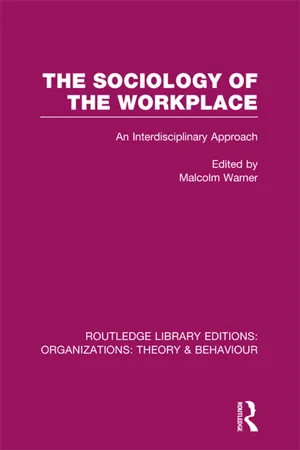
This volume adopts an interdisciplinary approach. The study of the workplace is approached from the standpoint of industrial sociology, industrial relations, industrial anthropology and other related disciplines. It includes contributions from economists and psychologists as well as from sociologists. The theoretical and practical issues raised, are, however, central to the sociological tradition of Marx and Weber in that they concern the meaning of human and social phenomena and their relevance to resolving questions of moment in industrial and industrializing societies.
- 292 pages
- English
- ePUB (mobile friendly)
- Available on iOS & Android
eBook - ePub
The Sociology of the Workplace (RLE: Organizations)
About this book
Trusted by 375,005 students
Access to over 1.5 million titles for a fair monthly price.
Study more efficiently using our study tools.
Information
1
Research into Workplace Industrial Relations: Progress and Prospects
In this chapter I propose to review the progress that has been made in researching into different aspects of industrial relations at workplace level. My review starts with an assessment of some of the main findings of the survey carried out for the Royal Commission on Trade Unions and Employers’ Associations (the ‘Donovan Commission’) and goes on to note some of the possible topics for further survey research. I then turn to the contribution of case studies in gaining a deeper understanding of a single situation or relatively few situations. Finally I propose two models to help guide future research into workplace industrial relations in a systematic way: a general model of the variables involved, and a ‘path’ model tracing the various paths that can be taken in handling a particular industrial relations episode.
THE DONOVAN SURVEY
In 1968 the report of the first large-scale national survey of workplace industrial relations was published.[1] This inquiry was carried out by the Government Social Survey (now part of the Office of Population Censuses and Surveys) for the Donovan Commission. Representative samples of all the main types of people involved in workplace industrial relations were interviewed: works managers, personnel officers, foremen, shop stewards, union full-time officers, union members, non-unionists, and employers’ association officials.[2] Altogether over 3,500 interviews were carried out during 1966.
The full report contains a large amount of factual information and the Royal Commission Research Paper 10 added some interpretation of these results. The survey was intended to give the Commission members background information likely to be useful to them in coming to some of their conclusions. It was largely a fact-finding rather than a hypothesis-testing exercise, because little prior information was available and the question had to cover a wide variety of topics on which information was desired. Some analytical work was done on the results of the survey (notably to suggest types of shop steward and their correlates[3]). The main value of the results, however, was to enable some broad descriptive conclusions to be drawn about workplace industrial relations, backed up by a mass of survey data and interpreted in the light of previous smaller-scale research and the experience of the industrial relations experts who were involved in the Commission's work.
Without attempting an exhaustive review of all the findings,[4] I should like to discuss briefly a few of what seem to me to be the more important topic areas :
1. The extent of workplace bargaining. This is probably the single most important and most often quoted topic covered by the survey. It relates to the significant role that shop stewards were shown to play in conducting negotiations with local managements on a wide variety of issues affecting the interests of their members. Besides enabling a more accurate estimate of the total number of shop stewards to be made, the survey revealed details of stewards’ bargaining activities with different levels of management. Five out of six stewards in the sample discussed and settled at least some issues with management. Three-quarters had settled some aspect of working conditions as standard practice and just over half had settled some wage issues. The widespread existence of pressure to increase the range of issues negotiated with management was clear: nearly half of the stewards said there were issues which they wanted to settle with management but which the latter regarded as their own right to decide.
2. The growth of informal practices alongside formal procedures. The role of shop stewards in formal grievance procedures is usually supposed to be that of taking complaints or claims raised by members to the first level of supervision (foreman). However, the survey showed that 80 per cent of stewards said their members brought problems to them without first approaching their foreman. Furthermore, nearly half of the stewards said they sometimes bypassed the foreman to approach the next stage of management above, and nearly three-quarters said they had ‘unofficial’ ways of approaching management. Yet these informal practices did not seem to be accompanied by any widespread lack of formal procedures. Four out of five stewards said there was a nationally agreed procedure for settling disputes that arose at local level. A third of managers in federated plants said that the use of procedure within their plant had increased in recent years (only 3 per cent said it had decreased). Informal practices would seem to have supplemented formal procedures rather than to have replaced them.
3. Favourable evaluation of stewards. The stereotype of a shop steward as a militant trouble-maker and a scourge of management was shown by the survey to be quite false. There was no question that most stewards represented the interests of their members conscientiously and on occasions forcefully, but their role in doing so was widely accepted by all parties to industrial relations. In the words of the report, they were seen as ‘more of a lubricant than an irritant’. Not only were stewards generally regarded as less militant than their members, but 70 per cent of managers preferred to deal with a steward if he and a full-time union officer were competent to settle an issue. Moreover, stewards generally saw themselves as playing a positive role in the production system: 68 per cent thought they were helping management ‘quite a lot’ to solve its problems and run the firm more efficiently (only 6 per cent thought they were not helping at all).
4. Favourable evaluation of ‘the system’. Rather than ask a very general question about the degree of satisfaction that the various parties to industrial relations felt about the operation of ‘the system’ at workplace level, the researchers built up indices of such satisfaction from the answers to specific questions. Since the indices included different items for stewards, managers, foremen, etc. it was not possible to make an exact comparison. However, the general picture was one of majority satisfaction with items such as the procedure for dealing with grievances and claims and the efficiency and reasonableness of ‘opposite numbers’. Perhaps it is significant that union officers were rather less satisfied with questions of procedure and ‘access’ than the other parties (the officers’ experience of a number of different workplaces may have led them to judge the worst by the standards of the best). The general picture of satisfaction should not, however, divert attention from the existence of minority dissatisfaction with specific aspects of the system in specific workplaces.
5. Dissatisfaction with management efficiency and manpower utilization. If one takes a narrow view of ‘industrial relations’ the question of management efficiency is relevant only in so far as it concerns efficiency in handling industrial relations and the question of manpower utilization is not relevant at all. But the survey findings indicate that a wider view is desirable. Large minorities of informants were dissatisfied with these two questions – generally much large minorities than were dissatisfied with points concerning the working of the industrial relations system itself. Nearly a third of the stewards and more than a third of the union officers thought that management was either ‘not very efficient’ or ‘inefficient’. One clue to the relationship between perceived management efficiency and industrial relations was the finding that 40 per cent of the stewards who were dissatisfied with facilities to deal with members’ grievances and claims thought their management was ‘inefficient’, but only 5 per cent of stewards who were very satisfied with facilities thought this. Four out of ten foremen and employees thought that the work they supervised or did could be better organized. Similar proportions of managers and personnel officers claimed that there were time-wasting and inefficient labour practices in their workplaces.
The above are only a few of the findings of the Donovan survey. I have said nothing about the findings of the survey on a very large number of other specific questions, because I want to leave space to consider what further research questions are posed by the results obtained. It is convenient to discuss the possibilities of further survey research in relation to the five points above:
1. Workplace bargaining. Although the Donovan survey obtained information about the range of bargaining between stewards and management, it did so by asking questions about the situation at the time of interview. It would be interesting to know the progress that stewards may be making in gaining the right to negotiate further issues with management, and what type of issues these may be. As associated concerns it would be instructive to examine the circumstances in which the range of bargaining may tend to be increased, as well as the reactions of the parties to any unsuccessful attempts by stewards to encroach on what management see as their decision-making prerogatives.
2. Informal practices. There is scope for finding out more about the reasons why workplace bargaining seems to be preferred by the parties involved in industrial relations, and what are seen to be the advantages and disadvantages of this type of bargaining as opposed to bargaining above workplace level. Is it the flexibility and informality of local bargaining which is the attraction, or would unions and/or management prefer to negotiate more workplace agreements? A different aspect of informality is the role of the informal work-group spokesman, to which Goodman and Whittingham[5] drew attention but which was not examined at all in the Donovan survey. In non-union workplaces attention could focus on the degree to which such spokesmen acted as substitute stewards, while in unionized workplaces the possible intervention of the spokesman in the worker-forman-steward relationship seems likely to repay study.
3. Evaluation of stewards. The crucial relationship is between the steward and the members he represents. Although this relationship can survive a certain amount of disagreement (which the survey showed was not infrequent), a deeper division of interests could alienate the steward from his members in a way similar to the gulf that sometimes appears between union members in a workplace and the national leadership. As a basis for understanding the possibilities and the limitations of the steward role in other directions, we need to know more about the variations in quality of the member-steward relationship and the circumstances which accompany these variations. Specifically, to what extent are stewards mere mouthpieces of their members and to what extent are they leaders?
4. Evaluation of ‘the system’. The Donovan survey asked about degrees of satisfaction with a number of particular features of workplace industrial relations, but it did not go very deeply into why there was dissatisfaction in some cases. Also, more positively, there is scope for finding out what are the main kinds of change thought to be needed to improve industrial relations at workplace level. It would not be surprising to discover that a fairly large proportion of all those involved think that better communication between employees and management would help. Other suggestions might not be so easy to predict. It would also be worthwhile to know the relative emphasis that the different parties place on different possible ways of improving industrial relations in their workplaces.
5. Efficiency. There were many indications from the Donovan survey that a more intensive study of the mutual influence of the industrial relations system and the production system would yield positive results. Efficiency or inefficiency – particularly of middle and top management, who have more scope for decision making than other groups – may well be a characteristic that pervades both industrial relations and production systems in a given workplace. The implications of such a finding for policies designed to secure improvement in either or both spheres would be far-reaching.
Again, the list of topics proposed for further research is not exhaustive, though I hope it includes some subjects that are generally agreed to be worth researching. One important methodological point should be mentioned in connection with any possible future survey of workplace industrial relations involving a number of different workplaces. It was pointed out in a section on the samples in the full report of the Donovan survey that ‘the ideal method of obtaining information about workplace relations would have been to interview all those involved in a number of randomly selected workplaces’. Unfortunately it was not possible to use this method, and several separate representative samples had to be drawn. While the method of interviewing people who deal with each other in the same workplaces is not without its own sampling problems, it would clearly allow more to be learned about the way in which the different parties perceive each other's roles and react to the same environment.
CASE STUDY RESEARCH
I have concentrated so far on discussing the Donovan survey and the possibilities of further workplace surveys along similar lines. But there is, of course, another kind of research – that confined to a single case or a very small number of cases. Except in so far as they may allow samples of particular types of people to be taken within one work unit, case studies do not permit statistical analysis to be made of their findings. But they do enable more to be understood ‘in depth’ about a particular situation. The two methods of sample surveys and case studies really complement each other, because each adds a dimension to the possibilities of data analysis afforded by the other.
A scrutiny of existing case studies carried out in the field of industrial relations (plus those case studies which have had industrial relations as a subsidiary rather than a main research aim) might enable us to formulate hypotheses testable either in further case studies or in surveys. To illustrate some of the possibilities I shall take two examples, one from officially sponsored and one from academic research.
Among the reports of the Commission on Industrial Relations on particular references made to them is one on British Home Stores Ltd.[6] The report is mainly concerned with the industrial relations institutions and procedures of BHS as a whole, but the reference arose out of events at one of the company's stores and in the course of the inquiry the Commission thought it appropriate to make some general assessment of the industrial relations situation in the multiple retail trade as a whole. Thus the findings of the report have implications for at least three levels of industrial relations – the workplace, the company, and the industry.
I shall not attempt to summarize either the findings or the recommendations of the report. Instead I want to draw attention to one feature of the report which seems to me to have important implications for both the design and interpretation of future research. This feature is the influence that an individual or small group of individuals can have on the ‘structure’ of a situation. With regard to trade union recognition and influence, the report notes that ‘The energy and keenness of collectors of individual branches is important; one divisional officer mentioned two stores in which a very high rate of membership had dwindled to almost nothing when the collector left the store.… The personality of the local manager appears to have been a factor in the decision of employees ...
Table of contents
- Cover
- Half Title
- Title Page
- Copyright Page
- Title Page
- Original Copyright page
- Dedication
- Table of Contents
- 1 Research into Workplace Industrial Relations: Progress and Prospects
- 2 A Behavioural Analysis of Bargaining
- 3 Cheap at Twice the Price? Shop Stewards and Workshop Relations in Engineering
- 4 Perceptions, the ‘Principle of Cumulation’, and the Supply of Labour
- 5 Technology and Other Variables : Some Current Approaches in Organization Theory
- 6 The Task Analysis Framework in Organizational Analysis
- 7 Computers and Supervisors
- 8 Chance, Punters, and the Fiddle: Institutionalized Pilferage in a Hotel Dining Room
- 9 Relative Deprivation, Occupational Status, and Occupational ‘Situs’: the Theoretical and Empirical Application of a Neglected Concept
- 10 Industrial Conflict Revisited
- 11 Sociological Imagination and Industrial Life
- Index
Frequently asked questions
Yes, you can cancel anytime from the Subscription tab in your account settings on the Perlego website. Your subscription will stay active until the end of your current billing period. Learn how to cancel your subscription
No, books cannot be downloaded as external files, such as PDFs, for use outside of Perlego. However, you can download books within the Perlego app for offline reading on mobile or tablet. Learn how to download books offline
Perlego offers two plans: Essential and Complete
- Essential is ideal for learners and professionals who enjoy exploring a wide range of subjects. Access the Essential Library with 800,000+ trusted titles and best-sellers across business, personal growth, and the humanities. Includes unlimited reading time and Standard Read Aloud voice.
- Complete: Perfect for advanced learners and researchers needing full, unrestricted access. Unlock 1.5M+ books across hundreds of subjects, including academic and specialized titles. The Complete Plan also includes advanced features like Premium Read Aloud and Research Assistant.
We are an online textbook subscription service, where you can get access to an entire online library for less than the price of a single book per month. With over 1.5 million books across 990+ topics, we’ve got you covered! Learn about our mission
Look out for the read-aloud symbol on your next book to see if you can listen to it. The read-aloud tool reads text aloud for you, highlighting the text as it is being read. You can pause it, speed it up and slow it down. Learn more about Read Aloud
Yes! You can use the Perlego app on both iOS and Android devices to read anytime, anywhere — even offline. Perfect for commutes or when you’re on the go.
Please note we cannot support devices running on iOS 13 and Android 7 or earlier. Learn more about using the app
Please note we cannot support devices running on iOS 13 and Android 7 or earlier. Learn more about using the app
Yes, you can access The Sociology of the Workplace (RLE: Organizations) by Malcolm Warner in PDF and/or ePUB format, as well as other popular books in Business & Business General. We have over 1.5 million books available in our catalogue for you to explore.