eBook - ePub
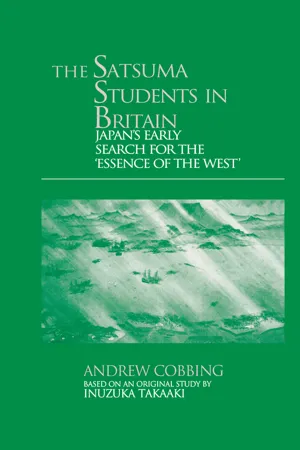
The Satsuma Students in Britain
Japan's Early Search for the essence of the West'
- 224 pages
- English
- ePUB (mobile friendly)
- Available on iOS & Android
eBook - ePub
About this book
In the spring of 1865, when Japan was in the grip of a major civil war, eighteen samurai and an interpreter risked their lives to embark secretly on a voyage to the unknown lands of the barbarian west. Their destination was Britain - at the hub of a vast empire. These were the Satsuma students, some of them still in their teens, all carrying orders from their domains to travel abroad. It was an extraordinary and daring expedition. Their experience of life in the west not only transformed their perception of the outside world, but through their diverse activities in later life, had a profound impact on commerce, education and culture in Meiji Japan. First published in 1974, Inuzuka Takaaki's study is still the classic work on the Satsuma students' revealing tale of discovery. In this translation by Andrew Cobbing, further details that have since emerged are also included to give a fresh portrayal, the first in English, of this singular episode in the opening of Japan.
Trusted by 375,005 students
Access to over 1.5 million titles for a fair monthly price.
Study more efficiently using our study tools.
Information
1
Fifteen Samurai to Study Abroad
Hashima
TWENTY-FIVE miles north of Kagoshima along the Izumi Road lies some rich coastal terrain. Here to the northwest of Hioki by the Satsuma district border is the land of Kushikino, one of more than a hundred areas that once made up the old province of Satsuma. It is a warm, scenic stretch of coast. A backdrop of mountains, the Yaeyama range, sweeps across the skyline from Mount Kanmuri to Mount Benzaiten in the north. Far below, the waters of the East China Sea wash along the shores of Atakai Bay.1
In times past, this area lay within the territories of the Shimazu family, the daimyo rulers of the Satsuma domain. The land was under the jurisdiction of an absentee lord who lived in Kagoshima, the seat of Shimazu power. In practice, affairs here were run by his agents from a makeshift office in the town of Kushikino.
At the northern extremity of Atakai Bay, five miles beyond this old outpost of administrative control, lies the little village of Hashima. From the fine natural harbour here, the Koshikijima Islands can be seen far out to sea in the distance. It is a secluded spot, sheltered from northwesterly gales in winter by the shoulder of Mount Benzaiten rising from the sea to the north. The climate feels quite tropical, unusually warm even in these southern parts.
In 1847, Saigō Takamori, then a youth of twenty called Saigō Kichinosuke, was ordered here to Hashima by the Satsuma domain. He came as a clerk serving under the district magistrate Komori Shinzō during the Manpuku Tameike flood prevention works. This was one of the most important river projects in the region at the time, involving the combined efforts of samurai from the castle-town and local rural samurai (gōshi). With county administrators, district clerks, village elders and inspectors all cooperating together under Komori's supervision, construction was completed the following year.2
During his stay in Hashima, Saigō was on intimate terms with a rural samurai called Haseba Tōzō. Taking advantage of breaks in the work he often called by at his house, and there the two friends would lay bare their thoughts as they talked over the affairs of the day. These visits made a deep impression on Haseba's eldest son Sumitaka, and although he was just a boy at the time, the contact he had with Saigō through his father did much to shape his outlook. In later years, he became a man of some influence himself in the world of Meiji politics as Speaker of the House of Representatives, minister of Education, and a leading figure in the Seiyūkai Party.
Early in 1865, some seventeen years after Saigö's stay, a group of young Satsuma samurai also spent nearly two months on the seafront here in Hashima. Apart from two or three older members, they were all youths of around twenty studying at the Kaiseijo College, Satsuma's new training centre in Western Studies. On 13 February that year, they had been summoned to the domain's council chambers in Kagoshima, where they received instructions for a special mission from the daimyo Shimazu Tadayoshi. Now they were in Hashima under confidential orders, their brief, 'a voyage of investigation to the island of Britain.'3
Godai’s Plans for an Overseas Expedition
In Satsuma, the idea of sending a student expedition to the technologically advanced countries of Europe and America had originally been conceived in 1857 by the daimyo of the time, Shimazu Nariakira. A man of enterprising spirit renowned for his progressive ideas, he held a bolder and wider perspective than any other lord of his day.4
This was Nariakira's plan. Overseas travel was still prohibited by Tokugawa law, and it was essential to make sure that no knowledge of the expedition should reach the ears of Bakufu officials. The Ryūkyū Islands were thus chosen as the base of operations as not only were they controlled by Satsuma, but they were the gateway for much smuggling to and from the continent. Some intelligent youths aged about seventeen or eighteen would be selected, five or six of them Satsuma samurai, together with three or four Ryūkyū natives. They were then to be sent abroad to three different countries, Britain, France and the United States. Arrangements for their safe passage would be entrusted to a Frenchman who was staying in the islands at the time.
The contingent from the Satsuma mainland was initially to be sent to the Ryūkyū Islands under the pretext of defending Ōshima. From there they would continue their journey to the West, disguised throughout their travels as Ryūkyū natives. In addition to learning European languages, their mission was to study science, industry and medicine with a special emphasis on military-related fields such as gunnery, shipbuilding and navigation. Satsuma would finance their research for up to five or six years, and they were then to report back on the conditions they found in Europe and America.
Plans were made for the party to embark in the spring of 1859. Before these were ready, however, Shimazu Nariakira died suddenly in August 1858, and his grand scheme fell by the wayside. But seven years later, a man called Godai Saisuke (Tomoatsu) would ultimately realize this dream of an overseas expedition of Satsuma students to the West.
Godai was born in Satsuma in 1835. He was a talented child and developed a great appetite for knowledge as he grew up, particularly for information about the world beyond Japan's shores. At the age of twenty-one in February 1857, he was sent to Nagasaki together with some other Satsuma officers, Kawamura Yōjūrō, Oki Naojirō, Isonaga Magoshirō and Saisho Shirozaemon. They were all under orders to attend the naval training college that had recently been established there by the Bakufu. This opportunity gave him a grounding in Dutch-style naval technology and enabled him to further expand his knowledge of world affairs.5
After the college closed down in 1859, Godai stayed in Nagasaki for some years as an agent for Satsuma. He was still there in July 1863 when he heard news of the growing threat of war between Satsuma and Britain. Hurrying back to Kagoshima, he was promptly appointed captain of the Tenyū Maru, a steamship in the Satsuma navy.
Godai wanted to avoid a conflict with the British. Together with a fellow officer called Matsuki Kōan, he looked for some way to undermine the xenophobic jōi beliefs that were then dominant in Satsuma politics, provoking this showdown with the Royal Navy. Matsuki was also a man of progressive views, and in later life he was to become widely known under the name of Terashima Munenori.
Soon after Godai's return, the Tenyū Maru was taken by the Royal Navy and the crew were put ashore. Godai and Matsuki, however, decided to give themselves up voluntarily to the British. Their capture, in fact, served as the pretext for the jōi forces manning the batteries on shore in Kagoshima to open fire. The bombardment of Kagoshima that followed was a decisive moment for Satsuma, as it brought home to the jōi faction the destructive power of the Royal Navy's new Armstrong guns.
For Godai, this experience of defeat and capture strengthened his conviction that Japan must seek wider contacts with the outside world. In his view, the only way to strengthen military defences was by developing foreign trade, and to achieve this, he became convinced of the need to send a party of students to the West.
Afterwards, the British sailed back to Yokohama, taking Godai and Matsuki with them as prisoners of war. Fortunately for them they happened to know the British consul in Yokohama, and they were released soon after their arrival. Some restless months followed, however, as they were forced to live as fugitives, scuttling under cover in the streets of Edo and in the Kumagaya area of nearby Musashi Province. Not only were their activities considered suspect in the eyes of the Bakufu, but they were also thought of as traitors in their native Satsuma for giving themselves up to the British. Godai became increasingly strated as he searched in vain for an opportunity to find some Satsuma compatriots and convince them that he was no deserter. In order to evade the persistent attention of Bakufu agents, he finally decided on flight to Nagasaki.
Matsuki thought it was still too soon for such a dangerous journey, so Godai set off alone, travelling incognito under the name of Kawaji Yōzō. He reached Nagasaki at last in February 1864, and took lodgings in the house of a merchant called Nakai Sanzō. Before long, he had renewed his old friendship with the Scottish merchant Thomas Blake Glover, and with his help, his dream of an overseas expedition finally began to take shape.
Glover was one of the so-called merchant-adventurers who took advantage of the political instability in Japan during the 1860s to reap substantial profits by trafficking in arms. As he sold weapons to agents from various domains, however, he also established close relations with his customers, and in particular with influential figures from the strong independent domains of southwestern Japan. He also had a hand in politics himself, as he tried to act in his country's interest by keeping the British minister informed of news that came his way during his business transactions. He could be seen as playing an instrumental role behind the scenes in paving the way for later British cooperation with the anti-Bakufu alliance of Satsuma and Chōshū, countering the pact struck between the French and the Tokugawa regime.
Glover was always ready to help samurai from the southwestern domains who showed a desire to study in Britain. A month after the Satsuma students embarked in 1865, he enabled three men from Chōshū, Minami Teisuke, Yamazaki Kosaburō and Takeda Yōjirō to escape as well. In November the same year, he also arranged for two men from Hizen (Saga), Ishimaru Toragorō and Mawatari Hachirō to steal away together with Nomura Fumio from Aki (Hiroshima) from Nagasaki on one of his ships, the Chanticleer.6
Glover seems to have treated Godai with particular favour, impressed with his resourcefulness and surprised to find a samurai with such progressive ideas. For his part, during his frequent visits to the Scottish merchant's house in Nagasaki, Godai heard a continuous stream of information on overseas affairs, which only reaffirmed his growing belief in the need for an overseas expedition. Seizing the moment, he explained his plans to Glover and enlisted his support for the project.
At some stage in July 1864, Godai drafted the conclusions he had drawn from all his ordeals on paper, and sent them to the Satsuma authorities in Kagoshima. In this, a document known as 'Godai Saisuke's Proposals', he gave full vent to his feelings and explained the strategy that he recommended for the Satsuma domain.
It is with a heavy heart that I even dare to offer my counsel as I have not only committed the gravest of sins but have compounded my error by escaping into hiding. In these critical times for all Japan, however, I care not what becomes of my own life, but it is for the sake of Satsuma alone that I humbly present the following proposals.7
First of all, Godai criticized jōi ideas and made a concise case for a programme of military expansion underpinned by open foreign trade. His plan of action consisted of three stages packed with cross-references. In these he outlined two broad proposals, the case for trade with Shanghai and his recommendation for a party of students to be sent abroad.
In the first stage of his plan, food products from Satsuma, particularly rice, were to be exported to Shanghai. The profits from their sale would be used to buy foreign refining machinery capable of processing large quantities of sugar, Satsuma's richest natural product. Secondly, a party of students was to be sent overseas, and thirdly, the profits from the export of refined sugar would be sent on to them in the West. As the students would be observing the state of affairs in European countries at first hand, they could then use this money to select and order a range of equipment for Satsuma. This would include not just agricultural, spinning and minting machinery, but also military hardware from small firearms and cannon to steam-powered warships.
The overseas expedition that Godai had in mind was to consist of sixteen men and an interpreter who were to be selected to study in Britain and France. These students would include four senior retainers, two military officials and three supporters of the jōi faction, whose task would be to observe military affairs together with the geography and social customs of both countries.
In addition, the party would include a district magistrate charged with the task of investigating agricultural machinery. Two men with a practical training were to study the principles of fortification, battery construction and the manufacture of cannon and small arms. One student from the Zōshikan, Satsuma's school for samurai, would make a survey of various social institutions from schools and hospitals to orphanages and poorhouses. Finally, three engineers with a training in draughtsman ship were to learn how to operate machinery in Britain and France and draw explanatory diagrams for future reference. Their work would be particularly indispensible to the growth of industry in Satsuma.
Godai proposed that these seventeen men should be sent abroad in the autumn of 1864 to study in Britain and France for a period of about five months. In addition to pursuing research in their respective disciplines, they would have instructions to examine any other fields they encountered during their travels which they thought might be worth investigating. If these received official recognition in Satsuma as potentially useful areas of research, they were to promptly follow up their initial findings with further reports.
Godai had a shrewd head for business, and showed a prodigious capacity for calculation in his proposals. The overall profit of the scheme was estimated with detailed figures for each stage of the plan. The framework for the overseas expedition also included all the expenses that would conceivably be incurred throughout the party's travels abroad, from the cost of the voyage itself to miscellaneous extras.
He even provided long-term guidelines for a second future mission assuming the successful execution of the first. For this he envisaged:
Fifty or sixty of the most talented students would be chosen from the Zōshikan together with twenty or so older officers and sent to countries in the West to carry out research into naval and military studies, gunnery, astronomy, geography, chemistry and physics. On their return to Japan, the most advanced among them would be employed as instructors with a view to establishing a range of educational facilities throughout Satsuma's territories.8
The first expedition wa...
Table of contents
- Cover
- Title
- Copyright
- Dedication
- Contents
- Preface
- Historical Introduction
- 1. Fifteen Samurai to Study Abroad
- 2. The Voyage
- 3. The House in Bayswater Road
- 4. College Days in London
- 5. Aftermath
- Epilogue
- Glossary
- Appendixes
- Notes
- Bibliography
- Index
Frequently asked questions
Yes, you can cancel anytime from the Subscription tab in your account settings on the Perlego website. Your subscription will stay active until the end of your current billing period. Learn how to cancel your subscription
No, books cannot be downloaded as external files, such as PDFs, for use outside of Perlego. However, you can download books within the Perlego app for offline reading on mobile or tablet. Learn how to download books offline
Perlego offers two plans: Essential and Complete
- Essential is ideal for learners and professionals who enjoy exploring a wide range of subjects. Access the Essential Library with 800,000+ trusted titles and best-sellers across business, personal growth, and the humanities. Includes unlimited reading time and Standard Read Aloud voice.
- Complete: Perfect for advanced learners and researchers needing full, unrestricted access. Unlock 1.5M+ books across hundreds of subjects, including academic and specialized titles. The Complete Plan also includes advanced features like Premium Read Aloud and Research Assistant.
We are an online textbook subscription service, where you can get access to an entire online library for less than the price of a single book per month. With over 1.5 million books across 990+ topics, we’ve got you covered! Learn about our mission
Look out for the read-aloud symbol on your next book to see if you can listen to it. The read-aloud tool reads text aloud for you, highlighting the text as it is being read. You can pause it, speed it up and slow it down. Learn more about Read Aloud
Yes! You can use the Perlego app on both iOS and Android devices to read anytime, anywhere — even offline. Perfect for commutes or when you’re on the go.
Please note we cannot support devices running on iOS 13 and Android 7 or earlier. Learn more about using the app
Please note we cannot support devices running on iOS 13 and Android 7 or earlier. Learn more about using the app
Yes, you can access The Satsuma Students in Britain by Andrew Cobbing in PDF and/or ePUB format, as well as other popular books in Social Sciences & Ethnic Studies. We have over 1.5 million books available in our catalogue for you to explore.