eBook - ePub
Chushingura and the Floating World
The Representation of Kanadehon Chushingura in Ukiyo-e Prints
- 178 pages
- English
- ePUB (mobile friendly)
- Available on iOS & Android
eBook - ePub
Chushingura and the Floating World
The Representation of Kanadehon Chushingura in Ukiyo-e Prints
About this book
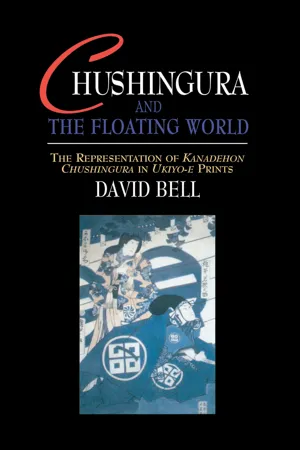
Kanadehon Chushingura has been one of the most popular bunraku and kabuki plays. This fascinating study explores the full spectrum of ukiyo-e (floating world) representations of the Chushingura story. Essential reading for all students of Japanese theatre, the history of Japanese art and the social history of Japan.
Trusted by 375,005 students
Access to over 1.5 million titles for a fair monthly price.
Study more efficiently using our study tools.
Information
Plates

Plate 1
KATSUSHIKA HOKUSAI (1760-1849)
The Servant Rin by a Well
c. 1800-05
monochrome two-sheet woodblock illustration for hanshibon
illustrated book of Chushingura
koban sheet size1
Biblioteque Nationale, Paris, Dd 487.
KATSUSHIKA HOKUSAI (1760-1849)
The Servant Rin by a Well
c. 1800-05
monochrome two-sheet woodblock illustration for hanshibon
illustrated book of Chushingura
koban sheet size1
Biblioteque Nationale, Paris, Dd 487.
Yomihon combinations of text and image drew on dual traditions. The uruski-e 'lacquer print' woodblock printing style of the earlier Torii and Kaigetsudo schools provided exemplars for working in a monochromatic fashion which were complementary to the sensitive, delicate drawing style typical of Hokusai throughout his career. The visual aesthetic of the much earlier Heian waka tradition, in which the elegance of both the gestural quality and the spatial disposition of script were of equal importance to the verse itself, underlay Hokusai's preoccupation with the visual interaction of script and image in this and other illustrations.
The poem to the left of Rin reads, approximately, as:
'Gradually the nightingale emerges through the gorge's entrance, steadily learning its song. Wind below mountains.'2
These words seem to allude to the gathering strength of the league, waiting patiently and out of sight for the moment of their own emergence, and the eventual implementation of their plan for revenge.
In the illustration a nightingale hovers in the air above the figure of the servant filling a bucket with ladles of water from the well. The metaphor here is to the unity of the many members of the league: the ronin will gain strength from that unity, as the bucket will be filled by many ladles of water. The feather motif on Rin's sash repeats that of the nightingale and, incidentally, alludes to the crossed feather mon of Enya Hangan.

Plate 2
KATSUSHIKA HOKUSAI
Oboshi Yuranosuke
c. 1800-05
monochrome two-sheet woodblock illustration for hanshibon
illustrated book of Chushingura
koban sheet size
Biblioteque Nationale, Paris, Dd487.
KATSUSHIKA HOKUSAI
Oboshi Yuranosuke
c. 1800-05
monochrome two-sheet woodblock illustration for hanshibon
illustrated book of Chushingura
koban sheet size
Biblioteque Nationale, Paris, Dd487.
In this, a further illustration from the same volume as Plate 1, there is no confusion as to the identity of the character portrayed. Although he appears in only three acts of Chushingura, Oboshi Yuranosuke is its hero. In his person, and through his leadership, are embodied every ideal of the samurai: resolution, self-sacrifice and unswerving, unconditional loyalty. These qualities are reflected in the verse accompanying the illustration, spreading across the upper left-hand area behind the figure of Yuranosuke:
'The emblem of the faithful Yuranosuke stands as a model for the conduct of samurai of future worlds.'3
In describing Yuranosuke as a 'model for the conduct of samurai' the poem alludes to the notion embodied in the 'Kanadehon' of the play's title of a 'copybook' of exemplary behaviour. The reference to the Oboshi mon is to the tomoe, or more properly hutatsu domoe emblem which identifies Yuranosuke, and also his son Rikiya, throughout the play. Here Yuranosuke is depicted dancing in an apparently carefree manner in the garden of Ichiriki ageya.
As in the illustration of Rin some of the marginal inscriptions are difficult to interpret. The upper group of characters translates as 'super super good' - here most obviously a reference to Yuranosuke's character, but possibly, given their repetition in the previous print, alluding to augury or good fortune in general. The middle group indicates the character's name - 'Yuranosuke Oboshi' - and the lower group seems to refer to a personal name, 'Sotomo'.

Plate 3
KATSUSHIKA HOKUSAI
Highwayman Robbing a Traveller
1795
monochrome two-sheet woodblock illustration from Sekai
Chushingura-Temaozuke ako no shiokara (Piquant Episodes
from the Life of the Heroes of the Chushingura)
koban sheet size
signed: Katsukawa Shunro, extreme right margin
Biblioteque Nationale, Paris, Dd 488.
KATSUSHIKA HOKUSAI
Highwayman Robbing a Traveller
1795
monochrome two-sheet woodblock illustration from Sekai
Chushingura-Temaozuke ako no shiokara (Piquant Episodes
from the Life of the Heroes of the Chushingura)
koban sheet size
signed: Katsukawa Shunro, extreme right margin
Biblioteque Nationale, Paris, Dd 488.
The extreme popularity of the Chushingura drama led to a public demand for further narratives, including variations on the 1748 version, or adventures of the individual ronin. In this instance the illustration is remarkably similar to depictions of the scene in Act V in which Sadakuro murders Yoichibei. Note, for example, the parallels between this work and Hokusai's later illustration of the Act V scene (Plate 9) in the interaction of the figures, their disposition in the landscape setting and the stela at left. The striped obi lying on the ground between the two figures alludes to the striped purse in which Yoichibei carried the fifty ryo paid from the Gion brothel keeper for his daughter.
As in the previous plates the visual relationship between pictorial content and areas of script is typical of kibyoshi convention. The cursive kana characters have been articulated with the same delicate gesture as the landscape details, particularly those of the foliage at left; in the lower right the script actually performs a pictorial function, standing as foreground detail. In this way Hokusai has included the necessary narrative content, while lending the pictorial content the primary emphasis.

Plate 4
KATSUSHIKA HOKUSAI
Tokaido michiyuki (The Journey Along the Tokaido)
1802
polychrome two-sheet woodblock illustration for Act VIII of
Chushingura in Volume 1 of hanshibon illustrated book Ehon
Chushingura ('Picture Book Chushingura'). Inner title
Chushingura yakuwari kyoka ('Humorous Poems on the
Chushingura Roles'); in two volumes, text by Jihinari
koban sheet size
signed: Hokusai Tokimasa, at margin
British Museum.
KATSUSHIKA HOKUSAI
Tokaido michiyuki (The Journey Along the Tokaido)
1802
polychrome two-sheet woodblock illustration for Act VIII of
Chushingura in Volume 1 of hanshibon illustrated book Ehon
Chushingura ('Picture Book Chushingura'). Inner title
Chushingura yakuwari kyoka ('Humorous Poems on the
Chushingura Roles'); in two volumes, text by Jihinari
koban sheet size
signed: Hokusai Tokimasa, at margin
British Museum.
This image illustrates the journey of Konami and her mother Tonase to Yamashina near Kyoto to pursue Konami's marriage to Oboshi Rikiya. Tonase is identified by the two swords of her husband Honzo which she carries thrust through her obi.
While the setting of the figures in a landscape is quite in keeping with the simple plot of Act VIII, the work also conforms to the broader preoccupation with genre/landscape subject combination that interested Hokusai throughout his entire career. The subtle interactions of the soft colours in both landscape and figures is equally consistent with Hokusai's single sheet prints in this pictorial category.

Plate 5
KATSUSHIKA HOKUSAI
Tsurugaoka shinzen (Before the Shrine at Tsurugaoka)
1806 (series date seals Tiger IV and Tiger VI; censor's seal,
kiwame)
polychrome woodblock print; Act I from the series Kanadehon
Chushingura (The Syllabary Chushingura); series title and Act
number, cartouche, upper right
oban
unsigned
publisher: Senichi. The 1806 edition of this series was
published by Tsuruya Kinsuke; the second and third editions
of this series, without the date seal of the earlier edition, were
published by Izumiya Ichibei or Senichi. The prints
reproduced here for Acts I to X are from the later edition
which employed the same key block as the earliest one, but
with differing colour combinations. Honolulu Academy of
Arts. Gift of James A. Michener, 1991.
KATSUSHIKA HOKUSAI
Tsurugaoka shinzen (Before the Shrine at Tsurugaoka)
1806 (series date seals Tiger IV and Tiger VI; censor's seal,
kiwame)
polychrome woodblock print; Act I from the series Kanadehon
Chushingura (The Syllabary Chushingura); series title and Act
number, cartouche, upper right
oban
unsigned
publisher: Senichi. The 1806 edition of this series was
published by Tsuruya Kinsuke; the second and third editions
of this series, without the date seal of the earlier edition, were
published by Izumiya Ichibei or Senichi. The prints
reproduced here for Acts I to X are from the later edition
which employed the same key block as the earliest one, but
with differing colour combinations. Honolulu Academy of
Arts. Gift of James A. Michener, 1991.
For this composition Hokusai has chosen to represent a point quite late in the first act. As Tadayoshi and his retinue leave the scene, Moronao, in the centre foreground, delivers his love poem to the Lady Kaoyo, observed by Wakasanosuke at left. While in the play Moronao's actions are quite furtive, here Hokusai has depicted him leering openly and grovelling before the elegantly curved figure of Kaoyo who looks down at him while turning her body away.
Hokusai's arrangement places the key figures on a raised foreground zone in front of the shrine at Tsurugaoka. The geographic location of the scene is confirmed by the sea beyond and the Kamakura coast at right; Fujiyama rises from the high horizon beyond.
The concentration of principal action in th...
Table of contents
- Cover
- Title
- Copyright
- Contents
- Introduction
- The Representation of Kanadehon Chushingura in Ukiyo-e
- Notes to 'Representation'
- Plates
- Notes to Plates
- Appendix I: List of the principal characters of Kanadehon Chushingura
- Appendix II: Synopsis of Kanadehon Chushingura: The Treasury of Loyal Retainers
- Notes to Appendix II
- Glossary
- Bibliography
Frequently asked questions
Yes, you can cancel anytime from the Subscription tab in your account settings on the Perlego website. Your subscription will stay active until the end of your current billing period. Learn how to cancel your subscription
No, books cannot be downloaded as external files, such as PDFs, for use outside of Perlego. However, you can download books within the Perlego app for offline reading on mobile or tablet. Learn how to download books offline
Perlego offers two plans: Essential and Complete
- Essential is ideal for learners and professionals who enjoy exploring a wide range of subjects. Access the Essential Library with 800,000+ trusted titles and best-sellers across business, personal growth, and the humanities. Includes unlimited reading time and Standard Read Aloud voice.
- Complete: Perfect for advanced learners and researchers needing full, unrestricted access. Unlock 1.5M+ books across hundreds of subjects, including academic and specialized titles. The Complete Plan also includes advanced features like Premium Read Aloud and Research Assistant.
We are an online textbook subscription service, where you can get access to an entire online library for less than the price of a single book per month. With over 1.5 million books across 990+ topics, we’ve got you covered! Learn about our mission
Look out for the read-aloud symbol on your next book to see if you can listen to it. The read-aloud tool reads text aloud for you, highlighting the text as it is being read. You can pause it, speed it up and slow it down. Learn more about Read Aloud
Yes! You can use the Perlego app on both iOS and Android devices to read anytime, anywhere — even offline. Perfect for commutes or when you’re on the go.
Please note we cannot support devices running on iOS 13 and Android 7 or earlier. Learn more about using the app
Please note we cannot support devices running on iOS 13 and Android 7 or earlier. Learn more about using the app
Yes, you can access Chushingura and the Floating World by David Bell in PDF and/or ePUB format, as well as other popular books in Social Sciences & Ethnic Studies. We have over 1.5 million books available in our catalogue for you to explore.